
REVIEW · GUIDED
Pompeii 360° – 4-hour tour with an expert Guide in archaeology
Pompeii can feel overwhelming fast. This 4-hour Pompeii 360° tour keeps you oriented with an expert archaeology guide, and it moves you through the big emotional highlights, the amphitheater, domus, baths, and temples, without you guessing what matters. One catch: the Pompeii Archaeological Park entrance fee (€20 per person) is not included, so budget that extra cost up front.
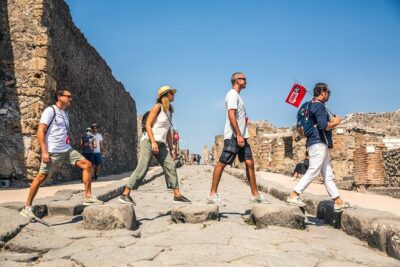
I like that it is a true private tour, so the pace and focus can work for your group, not a generic group shuffle. You’ll start and end at Piazza Esedra, and the day is designed as a tight, efficient loop across the World Heritage site, which means comfortable shoes and quick photo moments are part of the deal.
Key points you should know before you go
- Expert archaeology guide who explains what you’re seeing, site by site
- Private, small-in-practice experience for just your group
- Major Pompeii highlights in 4 hours, including the amphitheater and Stabian Baths
- Mount Vesuvius viewpoints built into the route (Jupiter and Apollo stops)
- Optional choice at the Lupanar, so you decide how far you want to go
- A clear add-on cost for the Pompeii park entrance ticket (€20 per person)
Pompeii’s “most important” areas, in one well-paced loop
Pompeii is not a single building or museum. It’s a whole city frozen in time, spread over 66 hectares, with about 50 hectares excavated. That scale is the reason most self-guided visits feel like blur: you see streets and buildings, but you miss the logic of how the city worked.
This tour solves that with a structured circuit. You start at the amphitheater area, then sweep through civic life (the Forum and temples), shift into domestic Pompeii (big houses and mosaics), and finish with public life and leisure (the Odeon, theaters, baths, and the lupanar area). You’re still walking, but the guide gives you a map in words, so your time feels like it has a point.
And because you are with an expert in archaeology, you can ask the annoying questions, the ones that actually make ruins come alive. Why is a building shaped this way? What does this mosaic tell us? How did these people live, and what changed right before the eruption?
Price, value, and the €20 park entrance ticket you must budget
The tour price is $203.70 per person, and it includes the licensed archaeology guide, taxes, and the private tour. Many stops also list admissions as included, which helps keep the experience organized.
But the key budgeting detail is the Pompeii Archaeological Park entrance fee: €20 per person, not included in the tour price. If you forget that, the final total can surprise you. If you’re booking for multiple people, add it up early and decide if you want to visit multiple sites in the same trip.
There are also youth-related savings on the park ticket:
- Under 18: free entry to the archaeological park
- EU ages 18 to 25 with a valid ID: €2 per person
So the value equation looks like this:
- If you want a guided route that hits the most meaningful stops efficiently, the pricing is reasonable for a private archaeology-focused tour.
- If you planned to wander on your own anyway, the added guide cost only makes sense if you like explanations and want your visit to feel more than photo ops.
Meeting at Piazza Esedra, and how the 4 hours tend to feel
You meet at Piazza Esedra and return there at the end, with an option for the tour to end at the exit of Piazza Esedra. That matters because Pompeii can be confusing when you’re trying to time transport after your visit.
The tour runs about 4 hours. Every stop is timed tightly, usually in the 5 to 15 minute range, with a couple longer moments at major houses. That means:
- You will see a lot.
- You will not linger the way you might on a slow, self-guided day.
- You should come with realistic expectations for photos, not a museum-style sit-and-read pace.
If your group includes kids, this kind of structure can actually help. Clear stops, short explanations, and a steady flow keep attention from collapsing. Guides who stay patient and positive make a noticeable difference here.
Stop-by-stop: amphitheater, Forum, domus, baths, temples, and the choice at the Lupanar
Below is the route logic, and what each stop is really good for.
1) Roman amphitheater (Anfiteatro Romano)
You begin at the amphitheater, described as the oldest in the Roman world and very well preserved. This is a smart opening because it sets the vibe: Pompeii was not a sleepy suburb. It was a city built for events, crowds, and public life.
Look for how the space is shaped for viewing. Even in a ruin, you can understand where people stood and why the building mattered. The stop is around 15 minutes.
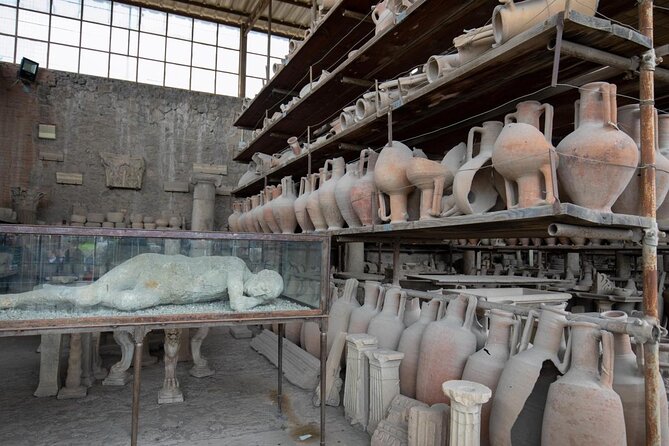
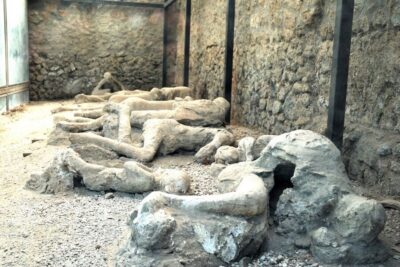
2) Orto dei Fuggiaschi and the plaster casts
Next is the Orto dei Fuggiaschi, linked to people who took refuge during the eruption. The big reason to stop here is the emotional impact of the plaster casts, which help you picture the crisis in a physical way.
This stop lasts about 15 minutes. It’s also one of those moments where a good guide keeps the tone respectful while still making the archaeology understandable.
3) Tempio di Giove Capitolino (Jupiter, Juno, Minerva) for the Vesuvius photo
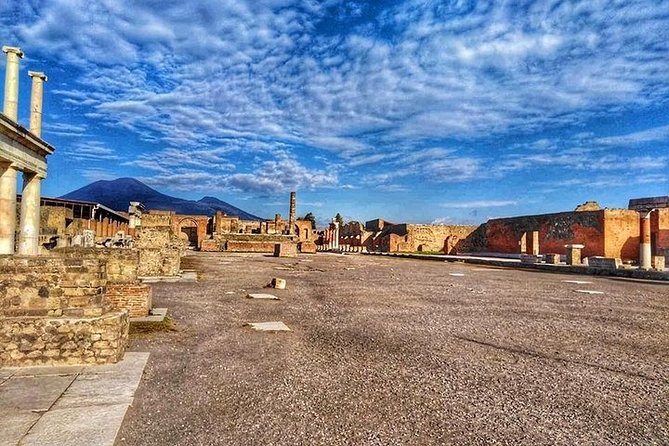
The Temple of Jupiter, Juno, and Minerva is famous partly for its architecture and partly for the view of Mount Vesuvius. You’ll get a short visit of about 5 minutes, plus a built-in photo moment with Vesuvius behind the temple.
In practical terms, this is the stop that helps you “land” the geography. When you see Vesuvius from inside the city ruins, Pompeii stops feeling abstract.
4) The Forum of Pompeii (Foro)
Then you move into the center of political, religious, civil, and economic life. This is where Pompeii behaves like a real city, not just a collection of homes.
Expect highlights like temples and public buildings, and yes, another photo stop with Vesuvius behind. The stop is about 10 minutes, so you’ll want to follow the guide’s pointers rather than wandering.
5) Casa del Fauno, including the Alexander mosaic
You’ll visit the Casa del Fauno, known as the largest house in ancient Pompeii (around 32,000 square feet, as described). This is the stop for mosaics and domestic grandeur.
You’ll see gardens and multicolor mosaics, including the mosaic tied to Alexander the Great. The stop is roughly 15 minutes.
This is also where you start to understand that Pompeii’s “art” is not only in temples. People decorated their daily spaces, and the decoration helped express status and identity.
6) Temple of Apollo, restored, with another strong Vesuvius view
The Temple of Apollo is among Pompeii’s most ancient temples, and it is described as restored not a long time ago. It’s also set up for a spectacular Vesuvius view.
This one also explains mythology in a practical way. Apollo is linked with the sun, and the tour notes the twin sister Diana, goddess of the moon. Visit time is about 10 minutes.
7) Casa del Cinghiale and a quick mosaic stop near the Forum
You get a smaller stop near the Forum at the Casa del Cinghiale, noted for a beautiful mosaic floor. It’s a brief visit of about 5 minutes, but it works as a palate cleanser after the larger civic structures.
8) Via dell’Abbondanza, the main commercial street
Now you walk the commercial spine: Via dell’Abbondanza. This is where you see shops, houses, and public fountains lined up along the main street.
Time here is about 15 minutes. The practical value is simple: you start picturing daily routes. Where would people walk? Where would they buy things? Where would they pause for water?
9) Odeon and Teatro Piccolo, including the marble floor detail
You’ll visit the small theater complex, with attention to details like a precious marble floor. This venue is described as used for music and poetry.
Expect about 10 minutes. A guide helps you notice tiny architectural clues that tell you how performances were staged.
10) Stabian Baths (Terme Stabiane)
Then comes Roman leisure and hygiene. The Stabian Baths stop includes references to a gym, a swimming pool, and rooms dedicated to sauna and massages.
This lasts about 15 minutes. It’s one of the most satisfying stops because the layout reads like a system. You can visualize the routine even if parts are broken. It also makes Roman life feel less distant.
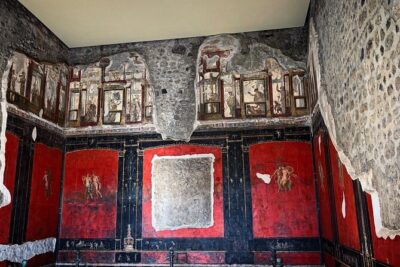
11) Casa dei Vettii, one of the best-preserved domus
Casa dei Vettii is highlighted as one of the best preserved examples of Roman domus. It’s the longer house visit, about 30 minutes, and it focuses on mythological frescoes and mosaics.
This is where you’ll likely slow down a bit, even though the stop is still timed. The guide’s job is to help you see what’s preserved and what the iconography is trying to communicate.
12) Basilica, the courtroom you might not expect
The Basilica sounds religious, but it’s described as an ancient Roman courthouse. That name trap is why this stop is worth a guided explanation.
You’ll get about 10 minutes, with an emphasis on beautiful details. Even if you don’t become a courthouse expert, you’ll come away understanding what public power looked like.
13) Tempio di Venere, panoramic spot for goddess symbolism
The Temple of Venus is described as dedicated to the main goddess of Pompeii and located in a panoramic spot. It’s about 10 minutes.
This stop balances the earlier civic structure and the more emotional domestic scenes. Venus here ties together religion and city identity.
14) Casa del Fauno again, for the statue and the mosaic
You return to the Casa del Fauno area for a second segment, about 15 minutes. This time the emphasis includes the famous statue of the faun and the mosaic of Alexander.
Why the repeat? In a route like this, it’s often about giving different angles and different explanation chunks time to land. You’re not meant to sprint past everything once.
15) Lupanar (house of pleasure), at your discretion
The Lupanar visit is explicitly described as optional, at the discretion of the customer. It lasts about 15 minutes.
If this kind of content makes your group uncomfortable, you can choose to skip it. If you do go, the guide can help keep it grounded in context rather than shock value.
16) House of Venus in the Shell, near the amphitheater
Finally you end at the House of Venus in the Shell, near the amphitheater. It’s described as known for its garden and for a fresco representing the birth of Venus.
This stop is about 10 minutes. It’s a gentle closing note: after streets, baths, courts, and temples, you get a domestic artistic focus tied to myth.
The real payoff: why an archaeology guide changes everything
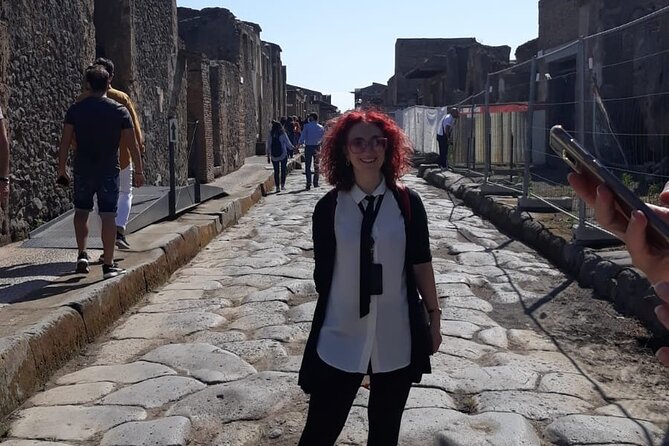
A self-guided walk through Pompeii can turn into “pretty walls, cool mosaics, lots of stairs.” A guide makes the city make sense.
Here’s what that typically looks like on this route:
- You learn how public buildings (amphitheater, Forum, Basilica) shaped daily life.
- You see how domus design, mosaics, and fresco themes communicated wealth and identity.
- You connect myth and religion to real spaces, not just stories in a textbook.
- You understand why certain viewpoints are built into the geography, especially with Mount Vesuvius framing multiple stops.
Guides in this program are often highlighted for being clear and interactive, including people like Luciano, Eugenia, Annalise, Martina, and Ernesto. If you get a guide with that style, you’ll likely feel like you’re not just walking through ruins, you’re walking through explanations.
What to do so your 4-hour tour stays enjoyable
With a route this packed, a little planning makes a big difference.
Wear comfortable shoes and expect uneven ground. Bring sunglasses and a hat, especially if the day is bright. You’re also told to keep backpacks to a maximum size of 30x30x15, so travel light.
Most importantly, treat each stop like a preview. This tour is built for you to leave with clarity and the urge to return. If you try to read every stone for four hours straight, you’ll burn out.
Who should book Pompeii 360°
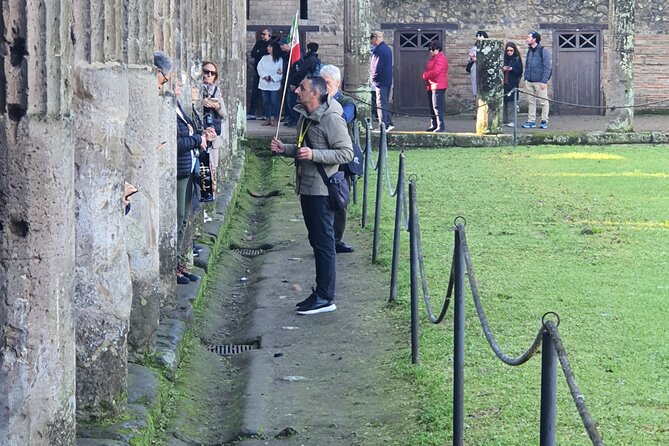
This is a strong fit if you:
- Want a structured, archaeology-focused tour of Pompeii in a half-day time window
- Prefer to understand what you’re seeing, not just take photos
- Like private experiences where your group can set the pace
- Are traveling with kids and want a guide who can keep things understandable and moving
It might not be the best fit if you:
- Want long, slow wandering with lots of free time in just one area
- Prefer a low-structure museum style visit over a city-route tour
Should you book Pompeii 360°?
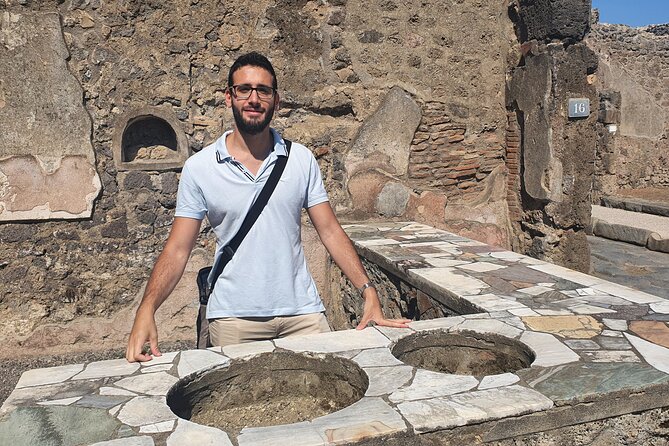
Yes, if you want Pompeii to feel organized and meaningful in about 4 hours. The pricing is mostly fair for a private, expert-led experience, as long as you remember the separate €20 per person Pompeii park entrance fee.
Book it if your priority is understanding the city layout, the purpose of major buildings, and the reasons behind standout art like mosaics and frescoes. Skip it only if you want hours of unstructured wandering, because this tour is intentionally timed and efficient.
FAQ
FAQ
What is included in the Pompeii 360° tour price?
The tour includes a licensed archaeology guide, taxes, and the private tour experience. It also lists admissions for each stop, but it does not include the main Archaeological Park of Pompeii entrance fee.
How much is the entrance ticket for Pompeii, and is it included?
The Archaeological Park of Pompeii entrance fee is €20 per person and it is not included in the tour price.
How long is the tour?
The tour lasts about 4 hours.
Where do we meet, and where does the tour end?
You start and end at Piazza Esedra, 80045 Pompei NA, Italy. The tour can also end at the exit of Piazza Esedra, depending on your preference.
Is this tour private?
Yes. It is a private tour/activity, and only your group participates.
What language is the tour offered in?
The tour is offered in English.
Do I need to buy the park ticket for all ages?
Under 18, the archaeological park ticket is free. For EU residents aged 18 to 25, the park ticket is €2 per person with a valid ID.
Can I cancel for a full refund?
Free cancellation is available up to 24 hours in advance of the experience start time for a full refund.
With a Local Guide
- Skip the Line Guided Tour of Pompeii led by an Archaeologist★ 5.0 · 703 reviews
- Pompeii private tour with an Official Guide★ 5.0 · 631 reviews
- Pompeii Skip-the-line Tour with Archaeologist Guide★ 5.0 · 559 reviews
- Pompeii Guided Tour & Horse Riding on Vesuvius with Lunch★ 5.0 · 419 reviews
- Complete Pompeii Skip the Line Tour with Archaeologist Guide★ 4.5 · 379 reviews
More Tours in Pompeii
- Pompeii Small Group Tour with an Archaeologist★ 5.0 · 6,593 reviews
- Pompeii and Herculaneum Small Group Tour with an Archaeologist★ 5.0 · 1,350 reviews
- Skip the Line Guided Tour of Pompeii led by an Archaeologist★ 5.0 · 703 reviews
- Pompeii Ticket + Tour with Optional Tasting Experience at Pompeii★ 5.0 · 663 reviews
- Pompeii private tour with an Official Guide★ 5.0 · 631 reviews
More Tour Reviews in Pompeii
- Pompeii Small Group Tour with an Archaeologist★ 5.0 · 6,593 reviews
- Discover the Ancient Ruins of Pompeii: Day Trip from Rome★ 3.5 · 2,247 reviews
- Pompeii and Herculaneum Small Group Tour with an Archaeologist★ 5.0 · 1,350 reviews
- Skip the Line Guided Tour of Pompeii led by an Archaeologist★ 5.0 · 703 reviews
- Pompeii Ticket + Tour with Optional Tasting Experience at Pompeii★ 5.0 · 663 reviews
More ways into Guided.
 ★ 4.8Pompeii: Entry Ticket and Guided Tour with an ArchaeologistFrom $3519,459 reviews
 ★ 4.2Pompeii: Entry Ticket with Optional Audio GuideFrom $2612,360 reviews
 ★ 4.0Pompeii: Skip-the-Line Entrance Ticket with Audio GuideFrom $392,509 reviews
 ★ 4.6Pompeii: Skip-the-line-Ticket and Guided TourFrom $641,152 reviews
 ★ 4.9Pompeii: Guided Tour with Skip-the-Line EntryFrom $58812 reviews
 ★ 4.1Pompeii: Skip-the-Line Entry Ticket with Digital Guide AppFrom $22770 reviews
 ★ 4.5Pompeii Express Guided Tour by Train from SorrentoFrom $65770 reviews
 ★ 4.5Skip-the-Line Pompeii Guided Tour from SorrentoFrom $90722 reviews