
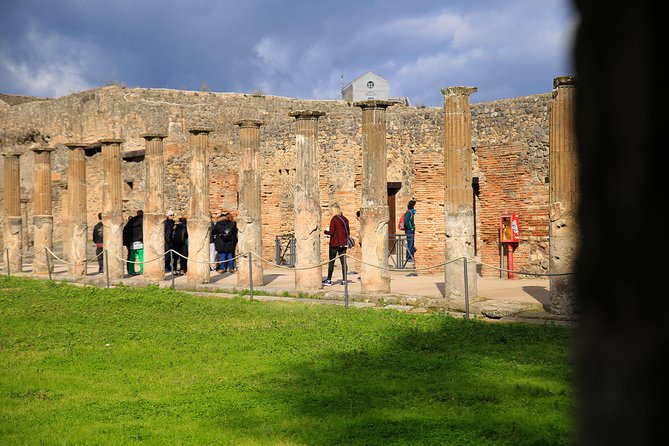
REVIEW · POMPEII TOURS FROM SORRENTO
Skip the Line Guided Tour of Pompeii led by an Archaeologist
Pompeii is easier with an archaeologist beside you. This skip-the-line guided tour is designed to get you into Pompeii fast and then walk the major highlights with an archaeologist leading the way, from Piazza Esedra and back again in about 2 hours. It runs in English, capped at a small group size, and uses a mobile ticket for convenience.
I love the small-group pace and the way you are not stuck in a loud crowd moving at someone else’s speed. I also love how guides such as Lello and Italo explain what you are looking at, turning streets and buildings into clear, lived-in Roman life, from Via dell’Abbondanza to the Forum and the Lupanar. You will come away with a “I see it now” feeling that is hard to get when you wander solo.
One consideration: Pompeii is huge, so 2 hours means you will cover big headlines, not every street and room. Add in sun, original uneven walking surfaces, and the fact that the tour is on a fixed schedule, and you’ll want to plan for a strong, comfortable walk.
Key things to know before you go
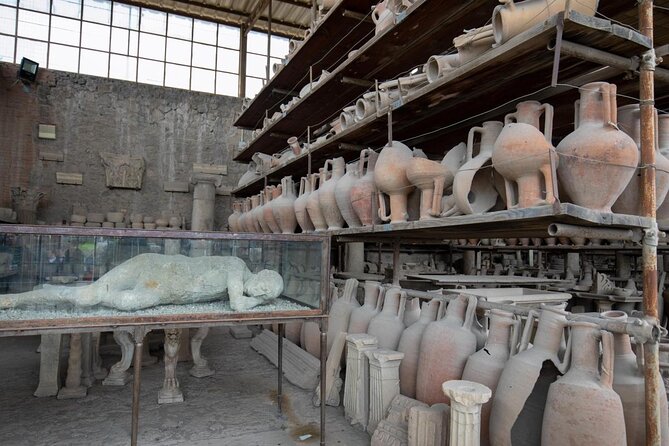
- Skip-the-line entry is the point, so your time goes into ruins, not waiting at the gates
- Max 15 people keeps the tour tight and allows you to ask questions without shouting
- Admission is built into the experience, so you do not have to juggle separate tickets for the stops
- Expect walking on original ancient streets, so comfortable shoes matter
- You get guided context, especially at the Forum, baths, and the Lupanar
Skip-the-line in Pompeii: why it matters more than you think
Pompeii rewards curiosity, but it punishes wasted time. This tour is structured around fast entry with skip-the-line tickets, so you start seeing things quickly instead of burning your best morning or afternoon waiting around. When you only have around two hours, that can be the difference between a tour that feels satisfying and one that feels rushed.
The other big win is that the guide controls the flow. In a site like Pompeii, crowds can bunch up at the same few photo spots. Here, the idea is a guided walk that keeps you moving and helps you keep your bearings as the ruins unfold.
Small group, strong guidance: the real reason people rave
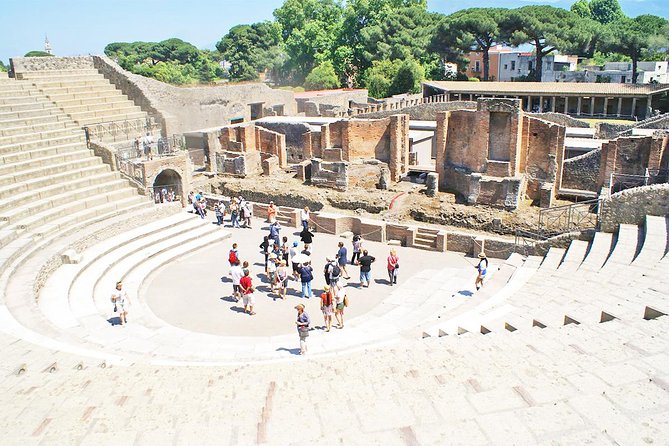
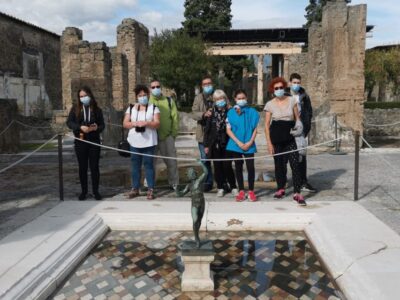
This is not a “walk and wave” tour. With a max of 15 travelers, you get a more human rhythm, like a tour with a professional storyteller who actually wants everyone to hear and understand. You’ll also see why the tour stands out when you watch the group size in action. Everyone gets a fair shot at listening up close, and the guide can pace explanations with what you are standing in front of.
In practice, the best guides on this route, like Lello or Italo, tend to focus on cause and effect. You learn not just what a building was, but what problem it solved in daily Roman life. The result is that your brain stops treating Pompeii like scattered ruins and starts organizing it into a real city.
One more detail that helps: the tour format supports clear listening. People have mentioned audio help like ear buds, which makes a big difference when you’re talking near crowds or in open areas where voices carry poorly.
The meet-up and timing: Piazza Esedra sets the tone
Your start point is Piazza Esedra, 80045 Pompei NA, Italy, and the tour ends back at that same meeting point. That matters because it makes your planning easier. You are not guessing where you will end up after the ruins.
What you should not ignore is timing. The tour has a fixed schedule, and if you are late or miss it, there are no refunds. One practical move is to give yourself extra buffer time getting to Pompeii, since local roads can be unpredictable once you’re close to the entrance areas. Plan for a little delay and you will enjoy the tour instead of stressing about the clock.
Stop 1, Archaeological Park: entering a UNESCO site with the right context
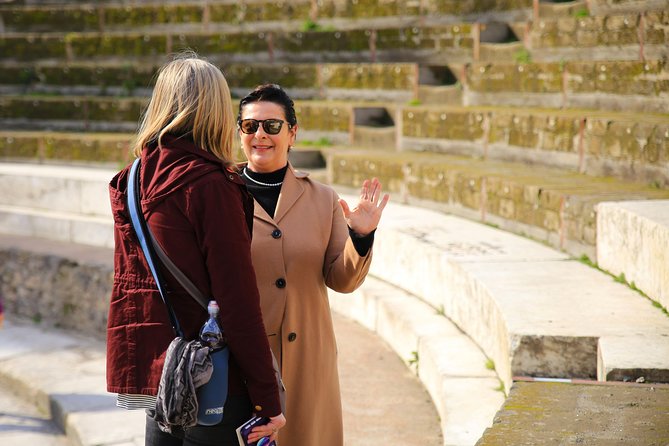
The first stop is the Archaeological Park of Pompeii. You get about 20 minutes here, and admission is included. This is where your guide usually frames the bigger story: Pompeii was an ancient Roman city buried after the eruption of Mount Vesuvius in 79 A.D., under ash and pumice.
That background changes how you read everything that follows. Without it, you might look at rooms and streets as “ruins.” With it, you start looking for clues: daily routines, public space, and how people lived before the eruption. This early orientation helps you see the city as a place, not just a set of monuments.
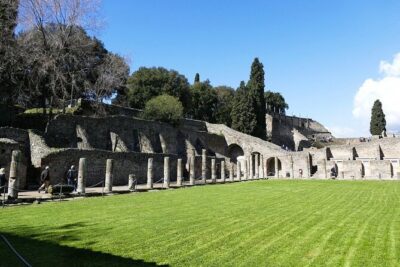
Stop 2, Via dell’Abbondanza: Pompeii’s main street, with purpose
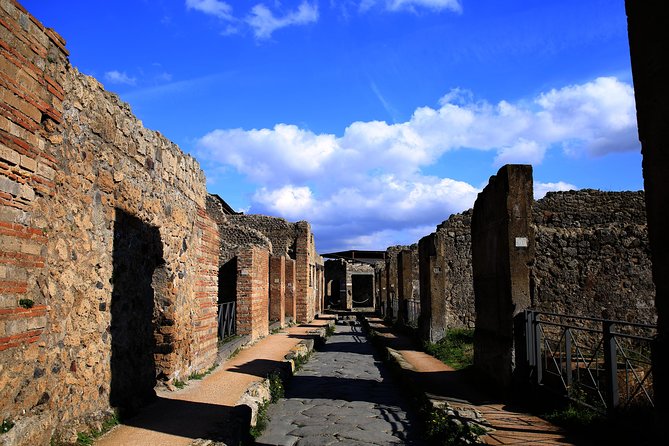
Next comes Via dell’Abbondanza, Pompeii’s main street. You’ll spend about 20 minutes here, and admission is included as part of the guided entry sequence.
This stretch works best when you have someone pointing out details while you walk. The “main street” label is simple, but the guide’s job is to show you why it mattered. You’ll get a sense of movement, commerce, and how the city’s layout guided where people went and what they saw every day.
One practical reason this stop is valuable: after you learn how the city’s core behaves, the later stops like the Forum feel less random. You start understanding the flow.
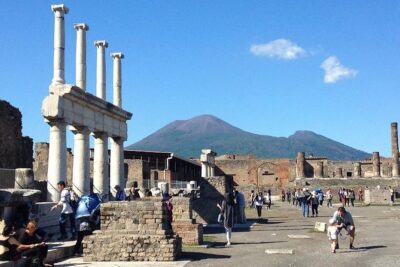
Stop 3, Foro de Pompeya: the Forum as the heart of daily Roman life
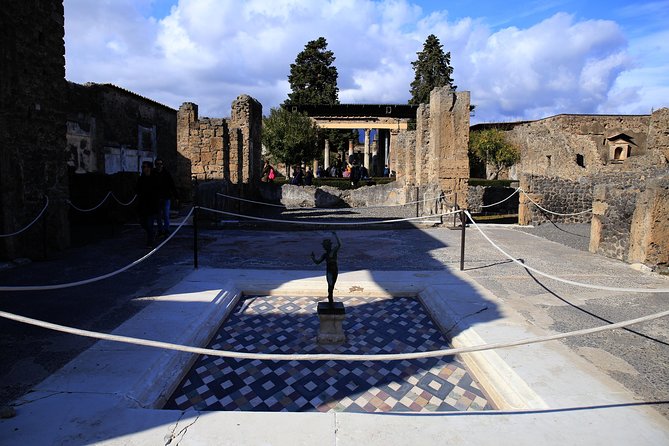
Then you walk to the Foro de Pompeya, with about 20 minutes here. This is the main square, and the guide explains how life worked in Roman times, ending with the Forum area where markets and civic life clustered.
This stop is often the emotional center of the tour. It is where you feel the “city mindset.” The guide’s explanations make the space easier to visualize. You can think of it as Pompeii’s conversation hub: people arriving, doing business, discussing what mattered.
If you like to orient yourself for the rest of your visit, the Forum also gives you a better sense of how Pompeii’s grid-like logic connects streets. Even if your guided route ends soon after, that mental map can help you decide where to wander next on your own time.
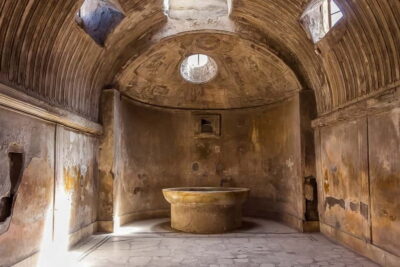
Stop 4, Stabian Baths (Terme Stabiane): how Romans handled public life and comfort
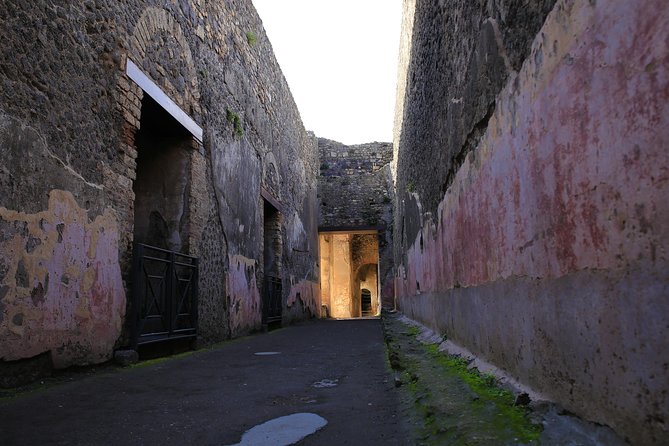
At about 20 minutes, the Stabian Baths (Terme Stabiane) stop is a shift from streets and markets to routines. Bathhouses in Roman cities were social spaces, not just places to wash. In this part of the tour, you’re able to see how bathing fit into the rhythms of a daily city.
The drawback here is also simple: bathhouses can take a bit of imagination, because much of what made them lively is gone. The upside is that a guide can connect what remains to the way the space likely functioned. You learn to look at layout and purpose, not just walls.
For many people, this stop is a refreshing break from the heat and the constant “look at another street” feeling. It gives your brain a new category to explore, Roman leisure and hygiene as public culture.
Stop 5, Lupanar: erotic frescoes and what they tell you
Next is the Lupanar, often known for its famous erotic frescoes. You’ll spend about 20 minutes here, and admission is included.
This is the kind of stop that can surprise you, mostly because it forces you to face the full range of life in Pompeii, including aspects that many visitors prefer to skip over mentally. A good guide does not just point at imagery, but puts it into context, so it does not feel like shock tourism.
If you are sensitive to sexual content, this is an important planning note. It is part of the tour route and it is clearly a highlight. If you are traveling with kids, remember that children must be accompanied by an adult, and you should consider whether this stop fits your family comfort level.
Stop 6, Archaeological Park wrap-up: turning walking into understanding
The final stop is another segment of the Archaeological Park of Pompeii, about 20 minutes with the guide. Think of this as the consolidation part of the tour. After you have seen the street, the Forum, the baths, and the Lupanar, the guide can help you connect themes.
This last stretch is where you usually get the “okay, I get it” moment. You start noticing patterns in layout and function. You also get a clearer sense of what you might want to explore next if you still have energy after the tour ends back at Piazza Esedra.
Price and value: is $95.53 worth it for 2 hours?
At $95.53 per person, the price is not cheap, but it is easier to justify when you look at what’s included. You are paying for:
- a professional guide with archaeological perspective
- skip-the-line tickets designed to prevent long waits
- admission connected to the key stops on the route
- a small group size, capped at 15
If you are the kind of person who wants meaning, not just photos, this format tends to pay off. Pompeii can be overwhelming without a structure. A guided tour gives you a curated storyline you can actually follow.
If you are mostly there for a quick wander and you already have a lot of Pompeii knowledge, you might feel the cost more. Still, even experienced visitors often find value in an archaeologist’s way of explaining what you are seeing, especially around the Forum and bathhouse layout.
Who this tour suits best
This tour fits best if you want a short, high-impact Pompeii experience with expert context. You’ll likely enjoy it if you:
- want to avoid entrance-line stress and start seeing ruins fast
- appreciate a guided explanation while you walk
- like small groups and a comfortable pace
- want Roman daily life explained through specific sites
The tour also requires moderate physical fitness because you will be walking on the original ancient streets. Bring that into your planning, especially in summer heat.
Quick practical notes so you do not lose time
Smart casual dress code is requested, but the bigger practical rule is simple: wear comfortable shoes. The walking is on original ancient surfaces, which can be uneven underfoot.
Also, do not treat this like a stand-alone entry ticket. This is a guided tour confirmation, and it is meant to be used with the guide. You will want your mobile ticket ready and your expectations aligned with the tour structure.
Finally, IDs are mandatory on the day of the tour to enter the site, and the names you give during reservation need to match what you bring. This is the kind of small detail that can derail your day if you ignore it.
Should you book this Pompeii archaeologist tour?
Yes, I think you should book it if you want your Pompeii visit to feel guided, understandable, and time-efficient. The combination of skip-the-line access, a small group, and an archaeologist-style storytelling approach is exactly what helps Pompeii click.
If you dislike walking, hate hot outdoor walking sessions, or only want to see everything at your own pace with no structured stops, you might be happier planning a longer independent visit. But for many people, this is the sweet spot: you get Pompeii’s major story beats without losing half your day in logistics.
FAQ
FAQ
What sights are included on this Pompeii guided route?
The tour route includes the Archaeological Park of Pompeii, Via dell’Abbondanza, the Foro de Pompeya (Forum), the Stabian Baths (Terme Stabiane), and the Lupanar, with the tour ending back at Piazza Esedra. Each stop is listed as about 20 minutes, and the full tour is about 2 hours.
Does the skip-the-line ticket mean I wait less to enter?
Yes. The tour includes skip-the-line tickets that are guaranteed to avoid long waits.
Is this a ticket to Pompeii I can use without a guide?
No. It is a guided tour confirmation, not a stand-alone entry ticket. You can use it only with the guide.
Where do we meet, and where does the tour end?
You start at Piazza Esedra, 80045 Pompei NA, Italy. The tour ends back at the same meeting point.
Do I need to bring an ID?
Yes. IDs are mandatory on the day of the tour to enter the site, and the names from your reservation have to match your IDs.
Can I cancel for a full refund?
Yes. You can cancel for free up to 24 hours in advance for a full refund. If you cancel less than 24 hours before the start time, you will not be refunded.
More Tours in Pompeii
- Pompeii Small Group Tour with an Archaeologist★ 5.0 · 6,593 reviews
- Pompeii and Herculaneum Small Group Tour with an Archaeologist★ 5.0 · 1,350 reviews
- Pompeii Ticket + Tour with Optional Tasting Experience at Pompeii★ 5.0 · 663 reviews
- Pompeii private tour with an Official Guide★ 5.0 · 631 reviews
- Pompeii Private Tour with an Archaeologist and Skip The Line – 3 hours★ 5.0 · 564 reviews
More Tour Reviews in Pompeii
- Pompeii Small Group Tour with an Archaeologist★ 5.0 · 6,593 reviews
- Discover the Ancient Ruins of Pompeii: Day Trip from Rome★ 3.5 · 2,247 reviews
- Pompeii and Herculaneum Small Group Tour with an Archaeologist★ 5.0 · 1,350 reviews
- Pompeii Ticket + Tour with Optional Tasting Experience at Pompeii★ 5.0 · 663 reviews
- Pompeii private tour with an Official Guide★ 5.0 · 631 reviews
Sorrento to Pompeii, More Ways
- Sharing Tour of Pompeii★ 5.0 · 487 reviews
- Pompeii Tour & Lunch with Wine Tasting Experience★ 5.0 · 383 reviews
- 2 hours Pompeii Tour with Local Historian – Ticket Included★ 5.0 · 335 reviews
- Private Day Tour of Pompeii, Sorrento and Positano with Pick Up★ 5.0 · 110 reviews
- Semi – Private Tour of Pompeii with an Archaeologist★ 5.0 · 99 reviews
More ways into Pompeii Tours from Sorrento.
 ★ 4.8Pompeii: Small-Group Tour of Pompeii and Herculaneum867 reviews
 ★ 4.9Pompeii Ruins Private Tour with Optional Skip-the-Line EntryFrom $254732 reviews
 ★ 4.0Pompeii Ruins Half-Day Tour from Sorrento with GuideFrom $97714 reviews
 ★ 4.3Day Tour to Pompeii Ruins and Mount VesuviusFrom $130489 reviews
 ★ 5.0Sharing Tour of PompeiiFrom $193487 reviews
 ★ 5.0Pompeii Tour & Lunch with Wine Tasting ExperienceFrom $120383 reviews
 ★ 5.02 hours Pompeii Tour with Local Historian – Ticket IncludedFrom $48335 reviews
 ★ 4.5Guided Day Tour of Pompeii and Herculaneum with Light LunchFrom $185311 reviews
Other useful routes from here