
REVIEW · POMPEII ARCHAEOLOGIST TOURS
Pompeii: Tour with Archaeologist Guide & Skip-the-Line Entry
Pompeii hits different with an archaeologist guiding the walk. I love the skip-the-line entry and the expert explanations that connect buildings to everyday Roman life. The only real drawback is the time crunch, 2 hours moves fast, so you will not have hours to roam without a plan.
This Pompeii Express tour is built for the excavations. You meet at the Welcome box, get priority access, and follow a set route through key stops like Porta Marina, the House of Menander, and the Foro Civile. You’ll likely use the audio setup for clear listening, especially when the group is larger.
Key things that make this Pompeii tour a smart choice
- Skip-the-line entry so you spend more time walking and less time queued up
- Archaeologist-led guiding with a real interpretation of what you see
- A fixed, high-value route through major sites without guesswork
- Audio support (radioguide for larger groups, audio support when groups are small)
- Practical guidance on what to look for, not just a list of ruins
Pompeii in 2 hours: what this tour actually covers
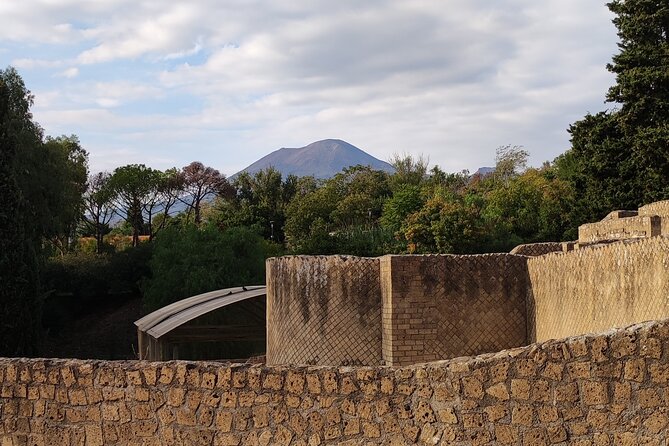
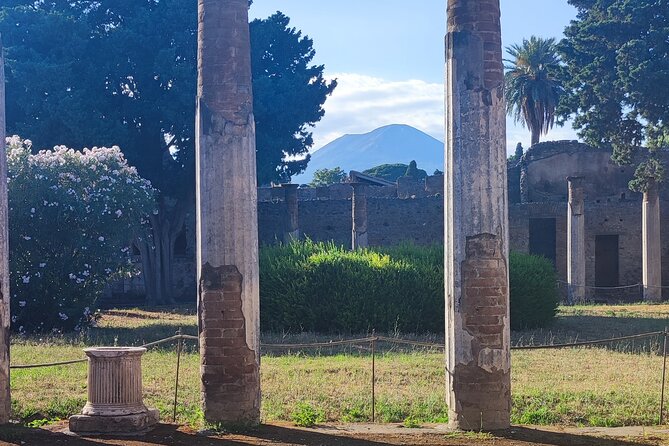
Pompeii is the rare ancient city that is still there, almost whole, after the eruption of Vesuvius in 79 AD buried it under ash and debris. That preservation is why the site matters so much. But it is also why Pompeii can feel confusing if you wander alone. A guided route helps you translate what you are seeing into daily life: where people walked in, what they ate, how they shopped, and how public space worked.
This tour runs about 2 hours inside the excavations. You follow a sequence of stops, with short guided time at each place and one brief block of free time at the end. That pacing is ideal for first-timers, or for anyone who feels anxious about “doing Pompeii wrong” with too much walking and too little context.
You should also know the limits up front. This is not an all-day deep wander. If you want to linger for a long time at every mosaic, mural, or threshold detail, you will likely wish the tour were longer.
Skip-the-line entry and why it saves more than time
At Pompeii, the site can be crowded and lines can eat your day. The biggest practical win here is the Pompeii Express entrance ticket, which gives you priority access. Instead of spending your energy watching people shuffle forward, you start the walk and get your bearings fast.
That matters because Pompeii is outdoor walking, uneven ground, and there is no “pause” once you’re inside. When the tour starts on schedule, you also get a more comfortable experience with the audio setup and group flow.
One small reality check: even with priority access, you still need to plan how you’ll get to the meeting point and find your group quickly. A handful of visitors have found the check-in meeting spot tricky, so give yourself a little buffer.
Meeting at the Welcome box: the start of a smoother Pompeii day

The tour begins at the Welcome box and ends back at the meeting point. That round-trip structure is helpful. You do not have to figure out how to exit the site or where your guide will be later.
Because your time inside is limited, I suggest you arrive early enough to handle the two things that usually cost minutes: getting through the gates with your ID, and locating the correct group. You will also want to come ready for the rules. Bikes are not allowed, alcohol and drugs are not allowed, and bags are not allowed.
What to bring is straightforward. Bring a passport or ID card. Copies are accepted, including for children. This is one of those “bring it and forget it” requirements that can still ruin a day if you overlook it.
The archaeologist guide and the audio setup you’ll use
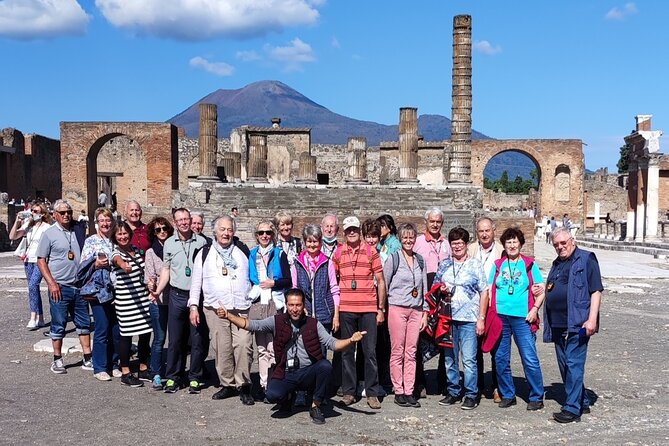
The guiding is done by an authorized expert in archaeology, and that is the heart of the value here. A good guide does more than explain what a building was used for. They help you see why it looks the way it does, what details mattered to the people living there, and how the city worked as a connected place rather than isolated ruins.
Listening support is built into the experience. The tour includes a radioguide when the group passes 8 participants. If your group is small, and there are not more than 4 people in the same language, the tour uses an audio guide plus a tour guide in English.
That audio system is a big deal at Pompeii because the site can be loud and crowded. In practice, the earpieces can be loud, but they are also necessary when you want every spoken detail without guessing.
Guide styles can also be the difference between a “cool place” and a memorable one. Different guides have brought humor and pacing, like Teresa’s professional, funny approach, or Lilian’s clear explanations with an audio setup that works well. Angelo has been noted for an engaging, organized flow. Paolo is often singled out for strong context and direction. Even when weather gets rough, the guide and team can adjust the experience so you still get meaningful stops.
Stop-by-stop: from Porta Marina to the Foro Civile
This route is designed to give you a balanced sample of Pompeii. You see entrances and streets, then daily life, then public and social spaces. The guided time at each stop is short, so each location needs to do a lot of explaining. Here is what you can expect.
Porta Marina (about 10 minutes)
You start at Porta Marina, one of the city’s main entries. Early on, this stop works as an orientation moment. You get a sense of movement into the city and how entrances shaped daily routines. It is not the most “wow” stop visually, but it sets up the logic of the rest of your walk.
A potential drawback of early stops like this: if you arrive tired, 10 minutes can feel like it passes quickly. Still, it is time well spent because it helps you read later buildings with less confusion.
Teatro Piccolo (about 10 minutes)
From the entrance you move to the Teatro Piccolo, a smaller theater. The guide’s job here is to show how entertainment fit into ordinary life. The goal is not just to point at stone seats. It is to explain what theater spaces meant in Roman society, and how crowds and performances shaped social identity.
This is one of those stops where good listening matters. With the audio support, you can follow the story even while you’re surrounded by other groups.
House of Menander (about 15 minutes)
The House of Menander is a favorite for good reason. Houses in Pompeii show you wealth and status, but also everyday patterns: where people gathered, how rooms were arranged, and how decoration reflected identity.
You’ll spend about 15 minutes here, which is long enough to grasp the big ideas but not long enough to study everything slowly. If you love details, keep your eyes open for the small visual cues your guide mentions, like how surfaces and spaces were organized.
Thermopolium (about 15 minutes)
Next is the Thermopolium, the classic Pompeian fast-food counter concept. It is one of the best stops for “human scale” understanding, because it connects to a daily habit: grab something hot or quick and move on with your day.
This is where plaster casts and artifacts (when described in context) really help you see the lived-in reality of the site. It is not just ancient architecture. It is a place where people ate, worked, and chatted.
Terme Stabiane (about 15 minutes)
Then you hit the Terme Stabiane, public baths. Baths were about hygiene, sure, but also socializing and routine. A guide can bring this space to life by walking you through how movement through different rooms likely worked and what the public environment suggests about community life.
One practical note: baths can feel busy and visually dense. You will benefit most when your guide tells you what to look for first, rather than trying to “see everything” at once.
Lupanare (about 20 minutes)
The Lupanare is typically the most eyebrow-raising stop. Even if you already know the general subject, a guide’s job is to connect it to how Pompeii’s society functioned and what this kind of venue suggests about urban life.
You’ll spend about 20 minutes here, which is relatively generous compared to some other stops. That extra time helps the story land, instead of feeling like a quick, awkward detour.
It is also worth saying: if you prefer a lighter tour, you may want to mentally prepare for this darker, more uncomfortable corner of Pompeii. Still, it is a real part of the city and the tour includes it for a reason.
Foro Civile di Pompei (about 15 minutes guided + 10 minutes free time)
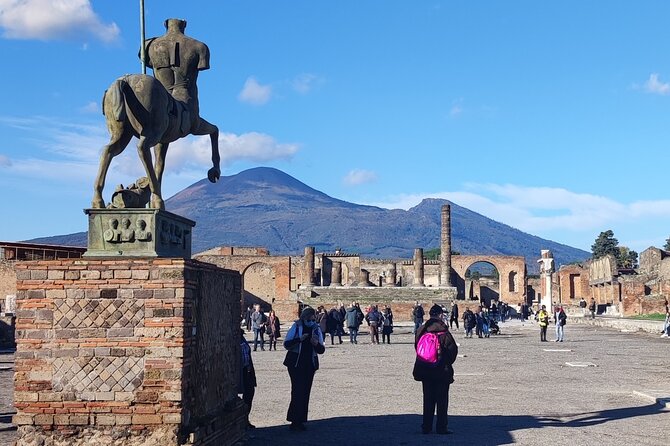
You finish at the Foro Civile di Pompei, the civic forum. This is where the city’s public life comes together. You’ll get guided time of about 15 minutes, then a short free time block of about 10 minutes to take photos, catch your breath, or linger at whatever struck you most.
That last free time is useful because the tour is otherwise tightly paced. It gives you a chance to reset and decide what you want to explore further after the formal guiding ends.
Price and value: is $57 reasonable for this Pompeii experience?
At about $57 per person for a roughly 2-hour Pompeii Express tour, the price makes sense because you are not paying for a long bus ride or an all-day package. You are paying for three things that are hard to replicate on your own.
First, you pay for priority access through the ticket line. If you hate queues, this matters a lot at Pompeii.
Second, you pay for an archaeologist expert guide who can interpret what you see quickly. In 2 hours, interpretation is the difference between walking past stones and understanding how the city worked.
Third, you pay for the audio support system that keeps you connected to the guide even in crowd conditions. That is one of the most practical “comfort for learning” upgrades you can get at an outdoor site.
What’s not included is also clear: transport, lunch, and tips. So if Pompeii is part of a day trip from elsewhere, budget for those separately.
If you already plan to spend most of the day at Pompeii and you’re an absolute “self-guided ruins person,” you might be tempted to go without a guide. But if this is your first time seeing Pompeii, or you want context so your photos mean something later, this price is fair value.
Tips to make your 2-hour tour feel longer
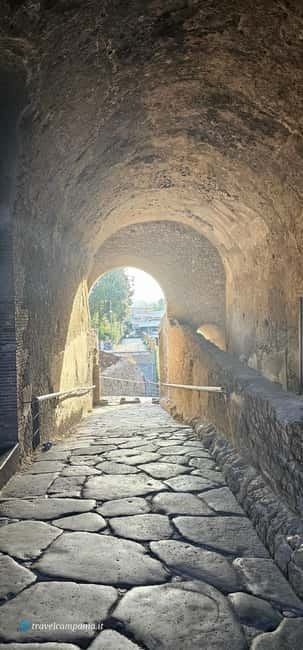
A short tour can feel rushed if you show up unprepared. Here’s how to stretch the experience in a practical way.
- Use the free lockers at the gates if you have a backpack. One common tip from visitors is that the lockers are available near the entrance. It makes walking easier when you are not balancing bags in crowded pathways.
- Plan for water. There are water fountains inside the site, though they may be unmarked. Bring your own bottle if you can, and treat fountains as a bonus.
- Wear shoes with grip. Pompeii is uneven and you will be walking a lot in a short span.
- Expect the audio system to be important. If it feels loud, that can be normal. The upside is you get the guide clearly without craning your neck.
- If you have a schedule hiccup, reach out. There are examples of the team helping when plans change, like train delays leading to shifting to a later slot.
Also, the tour is not built for everyone. It is not suitable for people with mobility impairments or wheelchair users, and it is not suitable for people over 95 years. If that applies to you, you’ll need to consider a different format.
Should you book this Pompeii Archaeologist Guide tour?

Book it if: you want skip-the-line entry, you like learning as you walk, and you want a route that covers the big Pompeii anchors without decision fatigue. It is a strong fit for first-timers and for day-trippers who need to maximize a limited time window.
Skip it or reconsider if: you want to spend half a day lingering at a few favorites, you have mobility limitations that the tour route cannot accommodate, or you dislike structured routes and prefer wandering at your own speed with no audio support.
For most people, this is a smart “best of Pompeii” plan. The guide and audio setup are the real reason it works, and the short free time at the Foro helps you decide what to chase after the tour ends.
More Tours in Pompei Campania
- Pompeii: Entry Ticket and Guided Tour with an Archaeologist★ 4.8 · 19,459 reviews
- Pompeii: Small Group Tour with an Archaeologist★ 4.8 · 12,264 reviews
- Pompeii: Skip-the-line-Ticket and Guided Tour★ 4.6 · 1,152 reviews
- Pompeii: Small-Group Tour of Pompeii and Herculaneum★ 4.8 · 867 reviews
- Pompeii: Guided Tour with Skip-the-Line Entry★ 4.9 · 812 reviews
More Tour Reviews in Pompei Campania
- Pompeii: Entry Ticket and Guided Tour with an Archaeologist★ 4.8 · 19,459 reviews
- Pompeii: Small Group Tour with an Archaeologist★ 4.8 · 12,264 reviews
- Pompeii: Skip-the-Line Entrance Ticket with Audio Guide★ 4.0 · 2,509 reviews
- Naples: Pompeii and Mt. Vesuvius with Lunch and Wine Tasting★ 4.5 · 2,454 reviews
- Pompeii: Skip-the-line-Ticket and Guided Tour★ 4.6 · 1,152 reviews
Pompeii with an Archaeologist
- Pompeii: Skip-the-Line Private Tour with Archaeologist Guide★ 5.0 · 5 reviews
More ways into Pompeii Archaeologist Tours.
 ★ 5.0Pompeii Skip-the-line Tour with Archaeologist GuideFrom $71559 reviews
 ★ 5.0Explore Pompeii with an ArchaeologistFrom $35511 reviews
 ★ 4.5Complete Pompeii Skip the Line Tour with Archaeologist GuideFrom $71379 reviews
 ★ 5.0Pompeii Private Tour with an Archaeologist GuideFrom $178184 reviews
 ★ 5.0Tour in the ruins of Pompeii with an archaeologistFrom $338150 reviews
 ★ 5.0Semi – Private Tour of Pompeii with an ArchaeologistFrom $3699 reviews
 ★ 5.02.5-Hour Guided Tour of Pompeii with an ArchaeologistFrom $7178 reviews
 ★ 4.9Positano: Old Town Walking Tour with Archaeologist GuideFrom $11233 reviews
Other useful routes from here