

REVIEW · TICKETS
Pompeii: Skip the line ticket (art) + audioguide + map
Skip the line, but keep your eyes open. This Pompeii package mixes pre-booked Artecard entry with a self-paced audioguide and map, so you can explore the ruins at your own speed without getting stuck in a long crowd shuffle. The catch is that the experience starts with a voucher and pickup step, so if you arrive at the wrong place or miss instructions, you can lose time before you even enter.
I like that this is built for independence, yet still has human backup at an office, with an English audioguide device plus a map. The entry is designed through Porta Marina Inferiore in Piazza Esedra, and you’ll need a valid ID as a deposit for the device. Plan for real Pompeii weather too, since shade is limited and you’ll be walking a lot in a short 2 to 4 hour window.
Quick take: what matters most
- Artecard express entry, aimed at faster access than day-of buying
- Porta Marina Inferiore access in Piazza Esedra, the key entrance to target
- Audioguide device with numbered explanations, plus a map to follow along
- ID deposit for the device, so bring your passport or ID document
- Expect some friction at the start, since vouchers and queues can still happen
What you really get here, Artecard entry plus an audioguide device
This is a self-guided format with one main goal: get you into Pompeii faster, then help you make sense of what you’re seeing. Your ticket component is an Artecadr (Artecard) entry package, paired with a handheld audioguide device and an included map.
On the access side, the included dedicated route is from the entrance of Porta Marina Inferiore in Piazza Esedra. That entrance detail matters more than you might think, because several people ran into trouble when they tried to enter from other points. If you want the time-saving effect, build your plan around Porta Marina Inferiore.
You also get multilingual assistance at the operator office. That’s not the same thing as a full guide walking with you the whole time, but it’s a real safety net if you’re confused about where to go next.
Price and value: when $44.31 makes sense, and when it doesn’t
$44.31 per person can be a good deal in Pompeii, but only if your day is queue-heavy. The “value” comes from two places: pre-booked entry designed to speed up access and an audioguide you don’t have to rent at the last minute.
That said, Pompeii is unpredictable at the ground level. Even with a skip-the-line style ticket, you may still face time spent swapping a voucher for an actual entry ticket, plus security screening and whatever queue exists at the entrance you’re routed to. Some days feel smooth, other days feel like extra steps piled on top of each other.
I think this package is worth it when you:
- have limited time and want to use your hours inside the park efficiently
- don’t want to deal with figuring out signage and picking your own highlights without context
- prefer your own pace over a group tour schedule
If you’re the type who enjoys improvising and buying tickets on the spot, you might decide you can save money. In one case, someone said advance booking ended up being more trouble than it was worth because of the extra pickup and exchange steps.
Getting into Pompeii: the Porta Marina Inferiore route and pickup steps
Here’s the practical reality of how this package tends to play out on-site. You’ll start with pickup and an exchange step, meaning your voucher usually needs to be turned into the actual entry ticket for the park. Multiple people described having to go to a nearby office to swap things before entering.
Once you have the right entry in hand, you’re directed to enter through Porta Marina Inferiore in Piazza Esedra. That’s the included access point, and it’s also the one connected to the priority idea of this ticket type. If staff at the gate tell you to go swap first, don’t argue, just follow the route.
Two things help a lot:
- Bring your ID document (valid ID is required as a deposit for the audioguide device)
- Give yourself buffer time before your planned entry, because lines can shift and some days the exchange step takes longer than you expect
Stop 1: Archaeological Park of Pompeii, what the audioguide helps you see
The visit is self-paced, but it’s not random. The audioguide is designed to take you through the areas that most visitors aim for: houses, temples, theatres, and streets. The big value is that you’re not just walking from one photo spot to the next, you’re getting context tied to what’s around you.
A neat detail is how the device works. You access the explanations using the numbers on the device. That’s meant to keep the information accurate and aligned with what you’re looking at right then, instead of relying on an unreliable phone map or memory.
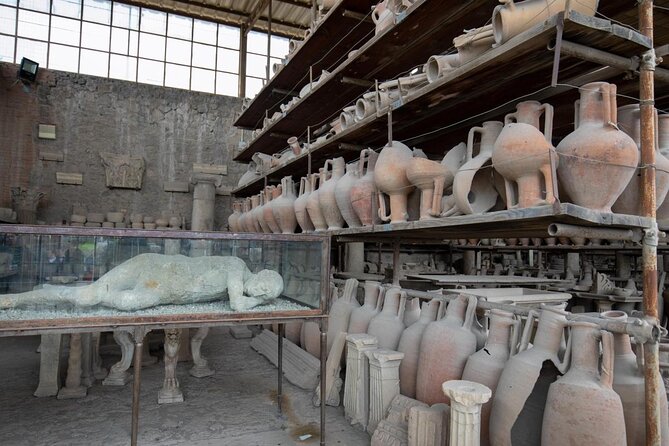
The guide also focuses on what makes Pompeii feel so specific: the way volcanic ash preserved the city for centuries. That kind of preservation matters, because it’s what lets you stand in a street and understand it as a real place with real routines, not just ruins that happened to survive.
How to pace your 2 to 4 hours inside the park
You’re looking at about 2 to 4 hours, and you’ll feel it. Pompeii is bigger than it looks from afar, and you’re walking between zones that can take longer than you think, especially if heat is high and you’re stopping for audio moments.
My advice is to plan your day as a series of short goals:
- Pick a first cluster you care about most
- Use the audio numbers to guide your stops rather than trying to read everything
- Stop often, because the audio rhythm is designed for breaks
If you’re traveling with limited time, the temptation is to treat it like a checklist. Instead, let the audioguide do the heavy lifting for priorities, then you decide where to slow down.
You do not have to match group timing here. The self-guided format is meant for flexibility, and that’s one of the strongest reasons people like it. In fact, one reviewer said it was faster and less exhausting than group walking, especially helpful for someone traveling with an older family member.
Using the audioguide device: comfort, headphones, and clarity
The device is essentially a phone-style audioguide, and your audio experience depends on your comfort with that setup. The package says you can use it hands-free, or with standard jack headphones, but headphones are not included. So if you want the cleanest sound without holding anything to your ear, bring wired earbuds with a standard jack.
Some people found the audio map and instructions confusing. That’s usually a setup issue, not a Pompeii problem. If you get stuck, reset your plan: stop walking, confirm you’re on the right numbered stop, then listen to that particular description before moving again.
One practical note: if your plan includes kids, handheld audio can become a logistics issue. One review complained that holding the phone was awkward and risky for dropping, and suggested straps and Bluetooth headsets would make it easier. So if you’re doing this with children, bring a practical way to manage the device.
Map, navigation, and avoiding the I’m-lost spiral
The included map is helpful, but don’t assume it will solve everything by itself. Some visitors said the map was hard to understand or that they felt turned around because instructions on where to go were vague.
What you can do to protect your time:
- Use the included map as a big-picture reference, not as a GPS replacement
- Keep your eyes on the main entrances and the Porta Marina Inferiore route
- If you feel confused, pause and re-orient rather than walking in circles
Also, pay attention to language. One person said the materials they received were in Italian rather than English, so if language is important to you, double-check everything during pickup.
If you’re easily stressed by logistics, you might still prefer a live guide. A few people felt the full self-guided process was too complicated and suggested getting a proper guided tour for clearer direction and less backtracking.
The real meaning of skip-the-line here
Let’s talk straight about the phrase skip the line. This experience is designed around faster entry via the priority Porta Marina Inferiore access, but it doesn’t eliminate every queue in the system. Multiple people described the same pattern: arrive, go to an office to swap a voucher, then queue again for entry.
In cases where lines were light, people said the skip effect was not as necessary as they expected. In other cases, the voucher exchange plus gate queue took over an hour, which dramatically reduced time inside the park.
So how do you maximize the “skip” portion?
- Arrive early so your queue experience is less intense
- Make sure you have your ID ready for the device deposit
- Follow the entrance instructions exactly, Porta Marina Inferiore in Piazza Esedra
- Keep buffer time, so a slow exchange step does not ruin your whole visit
If you arrive and try to enter immediately without swapping your voucher first, you can get turned back. Build your plan around the idea that there is a first phase before gate time.
Comfort and logistics on-site: heat, shade, and basic needs
Pompeii can be very hot and crowded, especially in peak season. Even though this doesn’t change the ticket value, it changes how much you enjoy the ruins. One review warned there’s not a lot of shade and suggested bringing a hat and water.
Facilities matter too. A couple of people described basic issues inside the park, like limited open food options and restrooms that weren’t pleasant. That’s not something you can solve with a ticket, but you can handle it by carrying water, planning your breaks earlier, and not waiting until you’re desperate.
And don’t forget: this is a walking-first experience. The audio is helpful, but your legs are the real transportation. If you’re trying to see Pompeii plus another thing nearby, protect your schedule with realistic walking time.
Who this Pompeii self-guided audioguide is best for
This tour shines if you want independence with context. You’ll probably enjoy it if:
- you like exploring at your own pace instead of matching a group’s schedule
- you’re comfortable figuring things out after a quick orientation at the office
- you want audio explanations keyed to what you’re physically seeing
It’s also a solid choice if you have mixed mobility in your group. One review mentioned the audio guide helped limit walking distance for a 94-year-old visitor, suggesting the guidance helped them focus on key areas without wandering as much.
Who might struggle:
- people who hate logistics, especially voucher exchanges
- travelers who need extremely clear, step-by-step meeting point instructions
- anyone expecting a totally friction-free skip-the-line experience
If you fall into those categories, consider whether a live guide would reduce stress and keep you focused inside the park longer.
Should you book this Pompeii skip-the-line audioguide?
Book it if your priorities are saving time versus day-of planning and having a self-paced audioguide that helps you understand what you’re looking at. At $44.31, it’s best when you can enter smoothly through the right entrance, swap your voucher quickly, and spend your hours in the ruins instead of figuring things out.
Skip the pre-booked package and consider other options if:
- you’re arriving when you know lines will be heavy and you can’t afford extra steps
- you want zero uncertainty at the gate
- you’d rather rely on a live guide to handle navigation and explanations without needing a device setup
If you do book, do it smart: bring your ID, plan to enter via Porta Marina Inferiore, and give yourself a little extra buffer time so the voucher exchange does not shrink your Pompeii time.
FAQ
What’s included with the ticket?
You get an Archaeological Park entry express ticket (Artecard), dedicated access from Porta Marina Inferiore in Piazza Esedra, an audioguide device, a map, and multilingual assistance at the office.
Where do I enter the Archaeological Park?
The included dedicated access is from the entrance of Porta Marina Inferiore, located in Piazza Esedra.
What language is the audioguide offered in?
The experience is offered in English.
Do I need headphones for the audioguide?
Headphones are not included. The device can be used hands-free or with standard jack headphones, but you must bring your own headphones if you want that option.
Do I need to bring an ID?
Yes. A valid ID is required as a deposit for the audioguide device, and it is returned when you return the device.
How long does the experience take?
It’s listed as about 2 to 4 hours.
Is this a private tour?
Yes. Only your group participates.
Are service animals allowed?
Yes, service animals are allowed.
Is there any parking information?
If available, there is free parking (not gated) from 01/04 at Osteria Nonna Cherubina, Via Andolfi 46.
What is not included?
Not included are headphones, the entrance ticket plus, food, and hotel pickup.
Can I cancel for free?
Yes, you can cancel up to 24 hours in advance for a full refund. If you cancel less than 24 hours before the start time, the amount paid will not be refunded.
More Skip the Line in Pompeii
- Skip the Line Guided Tour of Pompeii led by an Archaeologist★ 5.0 · 703 reviews
- Pompeii Private Tour with an Archaeologist and Skip The Line – 3 hours★ 5.0 · 564 reviews
- Pompeii Skip-the-line Tour with Archaeologist Guide★ 5.0 · 559 reviews
- Pompeii Private Tour with an Archaeologist and Skip The Line★ 5.0 · 391 reviews
- Complete Pompeii Skip the Line Tour with Archaeologist Guide★ 4.5 · 379 reviews
Choose the Right Entry
- Pompeii Ticket + Tour with Optional Tasting Experience at Pompeii★ 5.0 · 663 reviews
- 2 hours Pompeii Tour with Local Historian – Ticket Included★ 5.0 · 335 reviews
- Pompeii Guided Group Tour with Entry Ticket and Archaeologist★ 4.5 · 269 reviews
- Pompeii 2-hour Private Tour with an Archaeologist-Ticket included★ 5.0 · 181 reviews
- Pompeii Small Group Tour – Tickets Included★ 5.0 · 85 reviews
More Tour Reviews in Pompeii
- Pompeii Small Group Tour with an Archaeologist★ 5.0 · 6,593 reviews
- Discover the Ancient Ruins of Pompeii: Day Trip from Rome★ 3.5 · 2,247 reviews
- Pompeii and Herculaneum Small Group Tour with an Archaeologist★ 5.0 · 1,350 reviews
- Skip the Line Guided Tour of Pompeii led by an Archaeologist★ 5.0 · 703 reviews
- Pompeii Ticket + Tour with Optional Tasting Experience at Pompeii★ 5.0 · 663 reviews
More ways into Tickets.
 ★ 4.8Pompeii: Entry Ticket and Guided Tour with an ArchaeologistFrom $3519,459 reviews
 ★ 4.2Pompeii: Entry Ticket with Optional Audio GuideFrom $2612,360 reviews
 ★ 4.0Pompeii: Skip-the-Line Entrance Ticket with Audio GuideFrom $392,509 reviews
 ★ 4.5Pompeii: Archaeological Park Tour with Ticket on requestFrom $312,283 reviews
 ★ 4.6Pompeii: Skip-the-line-Ticket and Guided TourFrom $641,152 reviews
 ★ 4.1Pompeii: Skip-the-Line Entry Ticket with Digital Guide AppFrom $22770 reviews
 ★ 5.0Pompeii Ticket + Tour with Optional Tasting Experience at PompeiiFrom $35663 reviews
 ★ 4.9Pompeii: Exclusive Tour with Archaeologist and Entry TicketsFrom $50634 reviews
Other useful routes from here