
REVIEW · GUIDED
Fast Access Exclusive Private Ancient Pompeii Half Day Tour with Local Guide
Pompeii hits harder with someone to guide you. This private, skip-the-line half-day tour is built for speed with meaning, so you spend your limited time on what Pompeii does best: daily life frozen in stone, and the story of the eruption told on the ground.
Two things I especially like are the personal, interest-led focus (mosaics, details, even plaster-cast type perspectives) and the way the tour keeps you moving early to avoid the worst crush.
One thing to consider: at about 2 hours, you will see the main highlights, not every street and corner of the site. If you want a slow, all-day wandering marathon, plan for more time in Pompeii.
The guides you might meet, like Anna, Livio, or Lello, are the sort who can keep the visit lively while staying on track. And you get to choose a morning or afternoon slot, which helps you match Pompeii to your overall day in the Naples area.
Key Points That Matter Before You Go
- Skip-the-line access with a private guide, so you spend less time waiting and more time looking
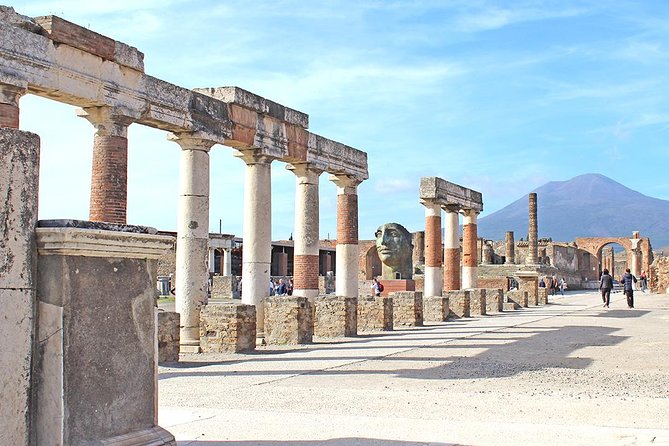
- Fixed 2-hour route with smart stops that cover theatres, streets, baths, and the Lupanar
- Tickets included for the listed sights, so you can focus on the ruins instead of paperwork
- Interest-led customization around what you want to notice most, from mosaics to casts
- Small-group feel for a private experience, only your group participates
- All-weather operation, so bring the right shoes and dress for conditions
The Real Advantage: Getting Into Pompeii Without Losing Your Time
Pompeii can feel like a test of patience if you hit it at peak hours. This tour is designed to beat that. With a private guide and guaranteed skip-the-line help, you are not stuck behind the biggest queues while the day slips away.
You also start with a structured plan, so the site stops feeling random. Pompeii is large, and without context, it is easy to walk for an hour and remember only a handful of views. Here, you get a sequence of stops that build a story: public life, daily life, and the eruption’s aftermath.
There is also a practical modern touch: you use a mobile ticket, which is convenient when you are juggling multiple places in one trip. And since the tour runs in the morning or afternoon, you can pick the time that best matches your energy and weather.
Where You Meet and How the Tour Keeps Moving
You meet at Piazza Esedra, 80045 Pompei NA, Italy. The end point brings you back to the same meeting spot, so you do not have to worry about a long detour at the end.
No hotel pickup is included, so plan to get yourself to the meeting area on your own. The good news is that it is near public transportation, so you have options if you are not driving.
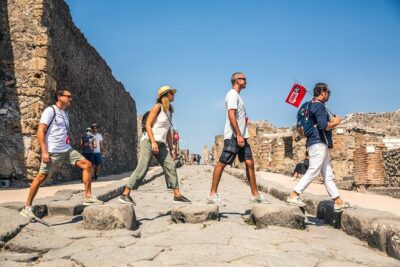
The route includes walking on uneven ground and through archaeological areas, so you will want moderate physical fitness. This is not a couch-to-the-museum style visit. You will cover distance between stops along Pompeii’s main zones, including a chunk on Via dell’Abbondanza.
Stop 1: The UNESCO Core With a Guide Who Sets the Scene
Your first stop is the Private Tours of Pompeii area, with one UNESCO World Heritage Site visit, plus an admission ticket included. This is the moment where the guide matters most.
Pompeii is not just ruins. It is a whole city layout, with neighborhoods, public spaces, and private homes all tied together. A good guide uses that to “aim your eyes.” You start learning how to read what you are seeing, whether it is street alignments, building types, or how people would have moved through the city.
This stop is about 20 minutes, which is long enough to get orientation and short enough to keep the momentum. If you are the kind of person who likes to know what things are before you look closely, this opening works.
Possible drawback: if you like spending lots of time at the first location you see, a timed start might feel a little fast. The payoff is that you keep the full highlight set within your half-day window.
Stop 2: Teatro Grande, the Big Open-Air Stage
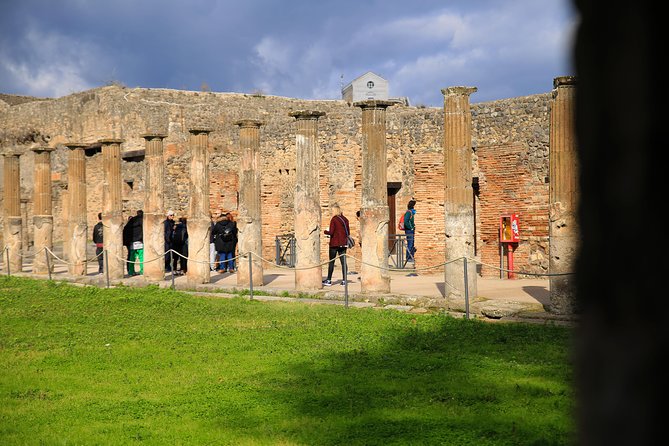
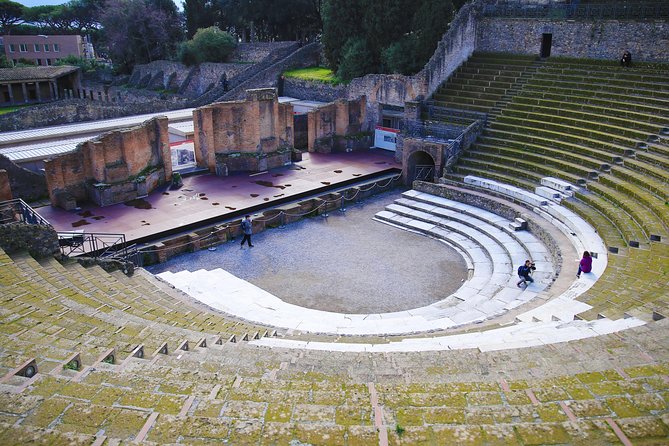
Next up is Teatro Grande, an open-air theatre with 5,000 seats. This is one of the most powerful “big scale” stops, because theatre architecture immediately tells you how Romans spent time together.
What I find useful here is the guide’s ability to connect structure to real behavior. An open-air theatre is not just a shell. It is where you watch, talk, listen, and turn the day into an event. With the eruption story woven in, you also get a sense of how quickly something public could be interrupted and left behind.
You get about 20 minutes here, including time to look around and take photos. If you want to focus on views and the feel of space, this stop gives you that. If you are more into ground-level details, you may want to ask your guide to point out the specific features that match your interests.
Stop 3: Odeon (Teatro Piccolo), a Smaller Theatre Moment
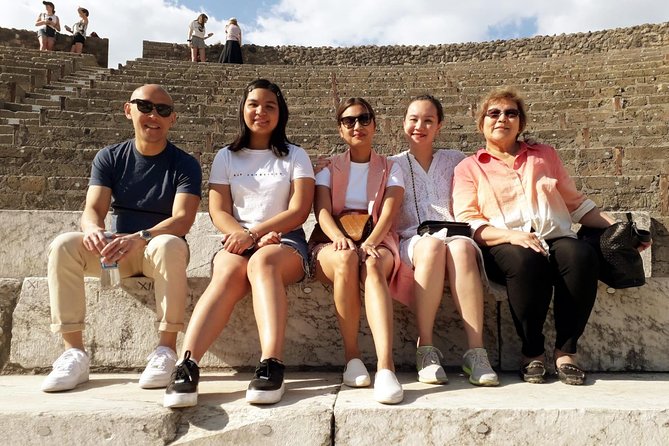
After the bigger stage, the tour goes to the Odeon, also known as Teatro Piccolo, with 800 seats. This is a great contrast stop. Pompeii’s public life wasn’t one-size-fits-all, and the smaller theatre suggests different kinds of performances or a different vibe.
Here, you get another 20-minute window. The pace matters. If you had been dropped into Pompeii on your own, you might bounce between locations without ever noticing how theatre size can shape the experience. With a guide in the middle, you can compare them.
I like that this stop often helps visitors “shift gears.” You stop thinking of Pompeii as one big museum and start seeing it as a series of designed spaces where people had routines and expectations.
Stop 4: Via dell’Abbondanza, Pompeii’s Main Street Walk
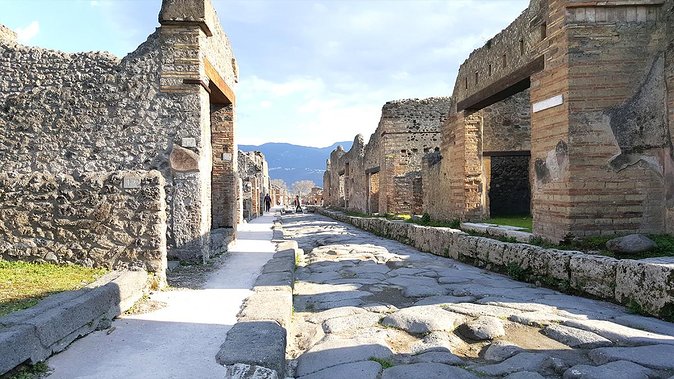
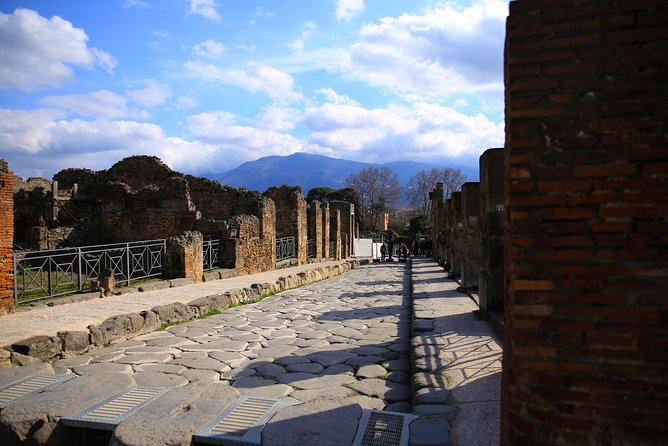
Then you hit Via dell’Abbondanza, Pompeii’s main street. This stretch matters because it is where major villas and Roman shops lined up along a key route.
This is a stop that rewards slow looking, even if the overall tour is time-limited. You are not just moving through a corridor of ruins. You are tracing a real street pattern and trying to imagine how a day might start at a shop, move toward home, and end back among community spaces.
You get about 20 minutes for this walking portion, with admission ticket included. Since it is a main thoroughfare, it is also one of the places where you can spot how the city layout connects everything you saw earlier, especially the public spaces.
Practical note: wear shoes with grip. Pompeii’s ground can be uneven, and you will want stable footing for photos and quick stops to read details your guide points out.
Stop 5: Terme del Foro, Roman Baths Buried by 79 AD
Next comes Terme del Foro, a Roman bath complex buried by the eruption of Vesuvius in 79 AD. Baths were social hubs, so this is not just architecture. It is daily routine.
A bath complex helps you understand what Romans did when they were not working, shopping, or watching shows. It is where you met people, talked, and handled the practical side of life through cleanliness and leisure.
This stop again is about 20 minutes, which is enough time to understand the layout and appreciate the scale. You will likely spend more time looking once you know what bath spaces were for, because your brain starts tagging features as you pass them.
One consideration: if you prefer very wide, scenic views, baths can feel more “technical” than a theatre. But if you want to understand everyday life, this one is a winner.
Stop 6: The Lupanar, an Ancient Roman Brothel With Frescoes
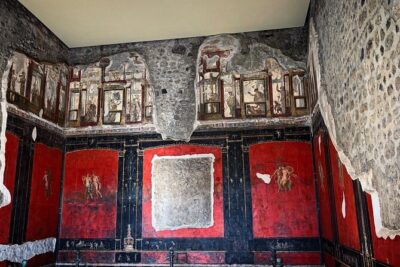
Finally, the tour heads to the Lupanar, an ancient Roman brothel. Some frescoes are still visible, and the artwork illustrates what each woman’s specialty might have been.
This stop can be the most surprising part of Pompeii for first-timers. Not because it is sensational, but because it shows you that private life, commerce, and adult services were part of the city’s reality. Pompeii does not sanitize its past.
Your time here is about 20 minutes. Depending on your comfort level, you may want to lean into the guide’s explanation to understand what you are looking at, or you might simply use it as a historical context stop. Either way, it is a meaningful final “human scale” viewpoint before you wrap up.
Practical note: if you are traveling with kids, make sure you are comfortable with the subject matter. The tour requires children be accompanied by an adult, but adult comfort is still a key factor.
How the Guide Customizes Your Pompeii Focus
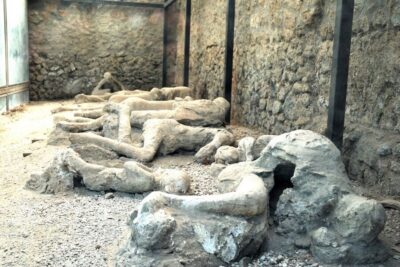
A highlight of this tour is the ability to customize your visit to fit what you care about. That means your guide can help you notice mosaics and fine details, and you can also get a plaster-cast type perspective on what preserved forms can tell you about a moment.
Even if the route is fixed, customization still makes a difference. You are not just getting a checklist of locations. You are learning where to look first, and what clues matter.
If you love art details, ask your guide to slow down for floor-level or decorative elements during the stops. If you prefer storytelling, ask them to connect architecture to everyday routines, like how people moved between bath spaces and street life. If you are the photo type, ask what angles best show the theatre’s shape or how to frame Via dell’Abbondanza so you catch the street perspective.
This is one of those situations where the guide is acting like a translator. Pompeii speaks in stone, patterns, and layout. Your guide helps you read it.
What the 2 Hours Actually Feel Like
With a half-day format, the tour is built for focus, not wandering. About 20 minutes per stop makes sense for Pompeii, because you can take in each location without burning an entire morning on one spot.
I like the flow because it covers different kinds of Pompeii experiences:
- Public entertainment (theatres)
- Everyday urban life (main street)
- Routine and social structure (bath complex)
- A darker, personal side of city life (Lupanar)
By the time you reach the last stop, you should feel like you understand more than just what is where. You should understand what kind of life happened there, and how quickly it was interrupted.
If you are a first-time visitor, this structure is a big win. If you have already visited before, you may still appreciate the guided pacing, especially for interpretation.
Price and Value: Is $203.95 Worth It?
At $203.95 per person, this is not a budget option. The question is what you are buying.
Here’s what you are getting that supports the price:
- A private guide for your group, not a big free-for-all
- Guaranteed skip-the-line help, which protects your time
- Admission tickets included for the listed sights
- A guide team described as local plus art-historian style expertise and professional guiding
Pompeii’s biggest cost, in my mind, is time. If you lose an hour waiting, you do not just lose walking time, you lose context building time. This tour protects that by getting you into key areas efficiently.
You are also buying clarity. With an experienced guide, your eyes catch details faster. That makes the ruins feel less like random walls and more like information.
For couples, this can be especially good because it gives you a shared, guided experience without needing to coordinate a group of strangers. For families, it can work if you keep expectations realistic about the route length and the subject matter at the Lupanar.
Who Should Book This Pompeii Private Tour
I think this is a strong fit if you:
- Want the best-known Pompeii sights in a short time
- Get impatient in lines and want to protect your schedule
- Prefer a guide who can explain what you are seeing, rather than reading every sign yourself
- Like art details, including mosaics and the idea of preserved forms (plaster-cast style viewpoints)
- Are visiting with a group that wants a private experience and control of pace
It is less ideal if you:
- Want a slow, independent stroll across Pompeii without a timed plan
- Need long breaks at every stop
- Are traveling with someone who strongly dislikes guided explanations
Should You Book It?
If you want a high-efficiency Pompeii visit where you actually understand what you are looking at, I would book this. The skip-the-line advantage is the headline benefit, and the route covers a smart mix of public spaces, street life, baths, and the Lupanar.
Choose it especially if you only have a half-day and you want your time to feel intentional. If you have more time in Pompeii, you can still use this as a “foundation tour,” then return later for whatever details caught your eye.
FAQ
How long is the Pompeii half-day tour?
The tour lasts about 2 hours.
Is this tour private, or do I join a group?
This is a private tour. Only your group will participate.
What is included in the ticket price?
A local guide, a professional art historian guide, and a professional guide are included. You also get guaranteed skip-the-line access, and admission tickets are included for the listed stops.
Do I need to bring a passport?
Yes. A current valid passport is required on the day of travel.
Where do I meet the guide?
You meet at Piazza Esedra, 80045 Pompei NA, Italy, and the tour ends back at the same meeting point.
Is hotel pickup provided?
No. Hotel pickup and drop-off are not included.
What languages is the tour offered in?
The tour is offered in English.
With a Local Guide
- Skip the Line Guided Tour of Pompeii led by an Archaeologist★ 5.0 · 703 reviews
- Pompeii private tour with an Official Guide★ 5.0 · 631 reviews
- Pompeii Skip-the-line Tour with Archaeologist Guide★ 5.0 · 559 reviews
- Pompeii Guided Tour & Horse Riding on Vesuvius with Lunch★ 5.0 · 419 reviews
- Complete Pompeii Skip the Line Tour with Archaeologist Guide★ 4.5 · 379 reviews
More Tours in Pompeii
- Pompeii Small Group Tour with an Archaeologist★ 5.0 · 6,593 reviews
- Pompeii and Herculaneum Small Group Tour with an Archaeologist★ 5.0 · 1,350 reviews
- Skip the Line Guided Tour of Pompeii led by an Archaeologist★ 5.0 · 703 reviews
- Pompeii Ticket + Tour with Optional Tasting Experience at Pompeii★ 5.0 · 663 reviews
- Pompeii private tour with an Official Guide★ 5.0 · 631 reviews
More Tour Reviews in Pompeii
- Pompeii Small Group Tour with an Archaeologist★ 5.0 · 6,593 reviews
- Discover the Ancient Ruins of Pompeii: Day Trip from Rome★ 3.5 · 2,247 reviews
- Pompeii and Herculaneum Small Group Tour with an Archaeologist★ 5.0 · 1,350 reviews
- Skip the Line Guided Tour of Pompeii led by an Archaeologist★ 5.0 · 703 reviews
- Pompeii Ticket + Tour with Optional Tasting Experience at Pompeii★ 5.0 · 663 reviews
More ways into Guided.
 ★ 4.8Pompeii: Entry Ticket and Guided Tour with an ArchaeologistFrom $3519,459 reviews
 ★ 4.2Pompeii: Entry Ticket with Optional Audio GuideFrom $2612,360 reviews
 ★ 4.0Pompeii: Skip-the-Line Entrance Ticket with Audio GuideFrom $392,509 reviews
 ★ 4.6Pompeii: Skip-the-line-Ticket and Guided TourFrom $641,152 reviews
 ★ 4.9Pompeii: Guided Tour with Skip-the-Line EntryFrom $58812 reviews
 ★ 4.1Pompeii: Skip-the-Line Entry Ticket with Digital Guide AppFrom $22770 reviews
 ★ 4.5Pompeii Express Guided Tour by Train from SorrentoFrom $65770 reviews
 ★ 4.5Skip-the-Line Pompeii Guided Tour from SorrentoFrom $90722 reviews