
REVIEW · TICKETS
Small-Group Tour in Pompeii with a Real Archeologist, ticket included
Pompeii feels personal, even in a crowd. This small-group tour takes you through key Roman homes and public spaces with a real archaeologist, and a priority ticket helps you skip some hassle.
I love the archaeologist-led focus on how people lived, not just what things are called. I also like the practical side, like headsets that make it easy to hear explanations as you move.
One possible drawback is the pace. You hit nine big highlights in about 2.5 hours, so you will want to decide what you want to revisit on your own after the guided portion.
Key things I’d watch for
- Max 15 travelers keeps questions on the table and the group easier to manage.
- Priority entry to the archaeological park helps your time feel efficient.
- Headsets make a big difference in an outdoor, noisy setting.
- Roman daily life theme means you learn why each house, street, and building mattered.
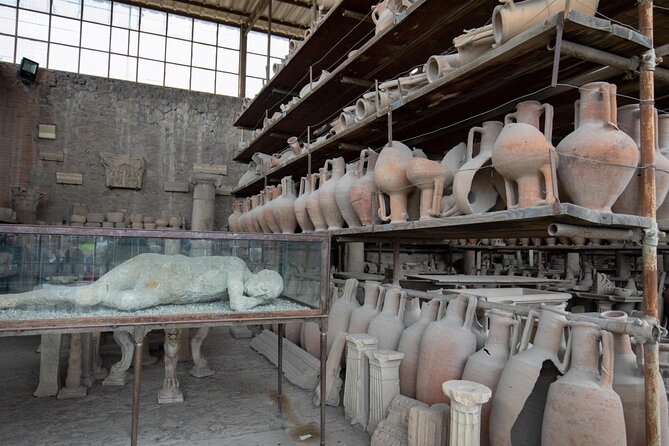
- Short stop format makes this great for a first pass, then best followed by extra time inside.
Why This Pompeii Tour Works in 2.5 Hours
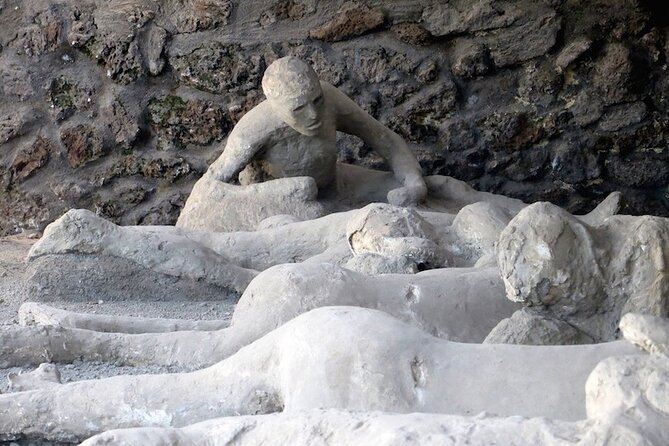
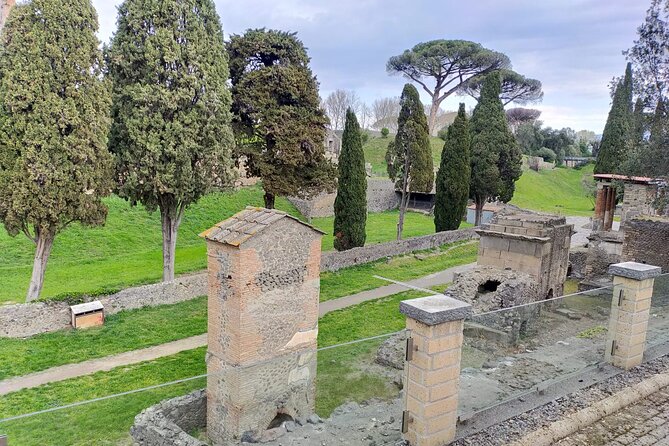
Pompeii is huge, and trying to “see it all” alone can turn into a lot of walking and guessing. This tour gives you a guided route that hits major areas quickly, so you leave with a mental map, not just random photos.
The small-group size, capped at 15, matters more than you might think. When you can actually ask a question, the stones start making sense faster, especially if it’s your first time in Pompeii.
I also like that it is led by a real archaeologist. In practice, that tends to mean you get context you can reuse, like how to interpret rooms, art, and wear patterns in a way that connects to real Roman life.
Starting at Hotel Vittoria near Piazza Esedra
The meeting point is Hotel Vittoria at Piazza Esedra in Pompeii, and the tour ends back there. That simple loop helps because you do not lose time figuring out a second pick-up spot.
The tour runs in English, and it includes a headset. So even if you are standing at the edge of a group, you can still hear what the guide is pointing out.
Do yourself a favor and come ready for walking. Pompeii is uneven in places, and one practical review-style tip is to wear good walking shoes and bring water, because the heat can be intense in summer.
Casa del Poeta Tragico and the Cave Canem mosaic
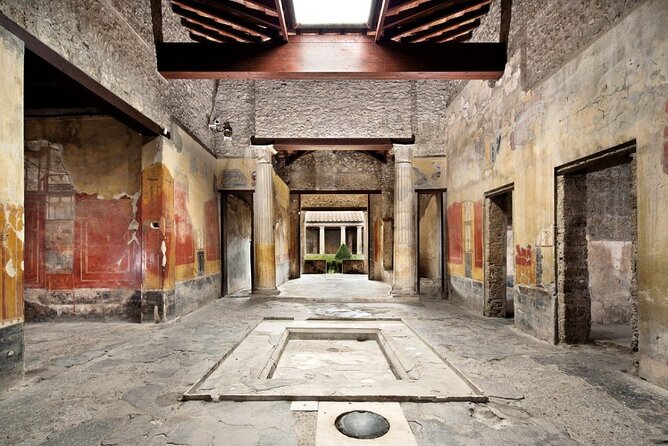
Your first stop is Casa del Poeta Tragico, an elegant imperial-age house. Inside, you will see the famous floor mosaic Cave Canem, the one that warns you about a dog.
This is a smart early stop because it teaches you how Pompeii homes were organized. You get a direct look at decorative choices right away, and then you can carry that mindset through the rest of the route.
A small time note: the visit is only about 15 minutes here. Use that time to look down as much as you look around, because the mosaic is the kind of detail you will want to actually study, not just pass.
Casa dei Vettii: luxury in vicolo dei Vettii
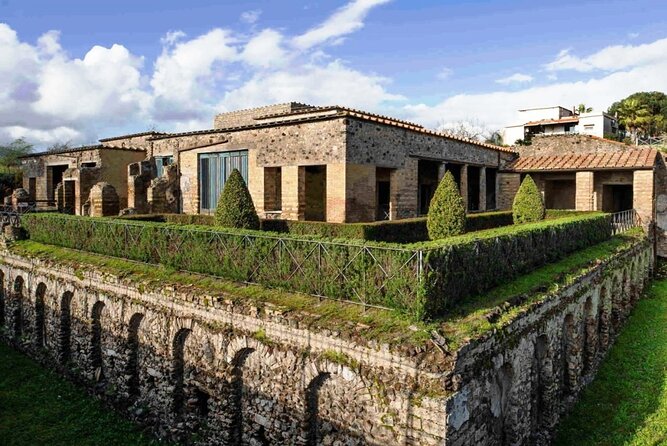
Next comes Casa dei Vettii, reached in vicolo dei Vettii. The house takes its name from its owners, Aulo Vettio Restituto and Aulo Vettio Conviva, which is a nice reminder that these were real people with names tied to their property.
This stop is valuable because it shows wealth as something you can read in space. Painted surfaces, layout choices, and the sheer sense of ownership help you understand how class and lifestyle shaped everyday routines.
Again, you are there for a short window. If you want to focus on wall art or spatial layout, you might enjoy stepping back for a minute to re-orient yourself before you move on.
Lupanar: what the rooms reveal about daily life
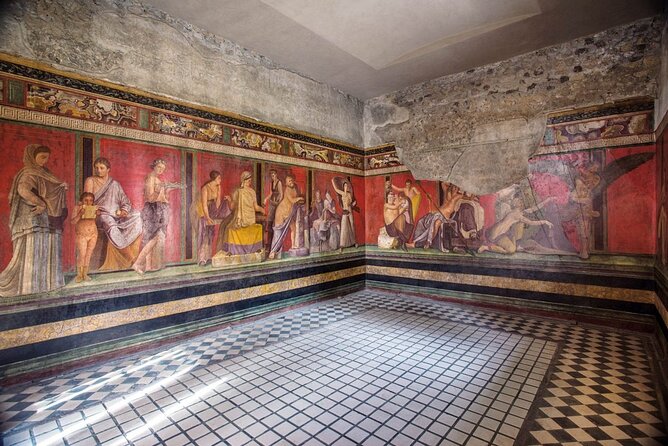
Then you get a stop most people recognize: the Lupanar, Pompeii’s two-story brothel. It is laid out with five rooms on the ground floor and five on the upper one, and the guide typically explains it as a business model, not just a scandal site.
The details here matter. Each room had a stone, concrete-like bed, and the expectation was that visitors would use whatever bedding was available, which makes the place feel more starkly practical than romanticized.
It is also a reminder that Pompeii includes everything, not only the “pretty” parts. In a guided format, you can get safer context for how to interpret what you see without turning it into shock value.
The Pompeii Forum: a public space built for people on foot
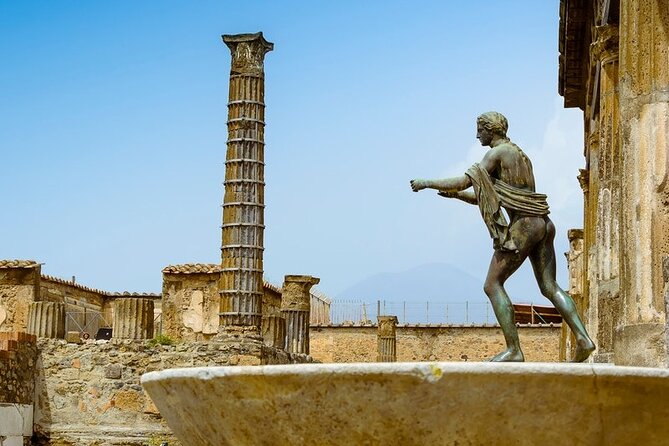
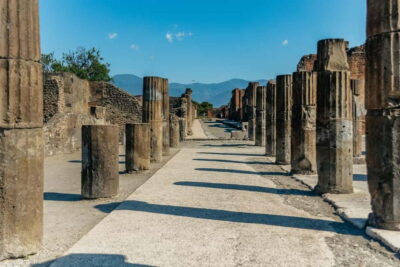
The route moves to the Foro de Pompeya, about 142 metres long and 38 metres wide. This was an area reserved to pedestrians and carts were not allowed, which means it functioned like a walkway of civic life, not a mixed-traffic marketplace plaza.
What you see today is more bare than you might expect, with statues and ornate flooring work largely absent. The interesting twist is that after the eruption, portions of the area were dug up and those materials were reused in later works elsewhere.
This is one of the better places to slow down for a moment, even if the guided time is short. Stand still for a few seconds and imagine the crowd flow: where people moved, where they gathered, and which public buildings were meant to “front” the forum.
Suburban Baths: travelers, water, and life beyond the walls
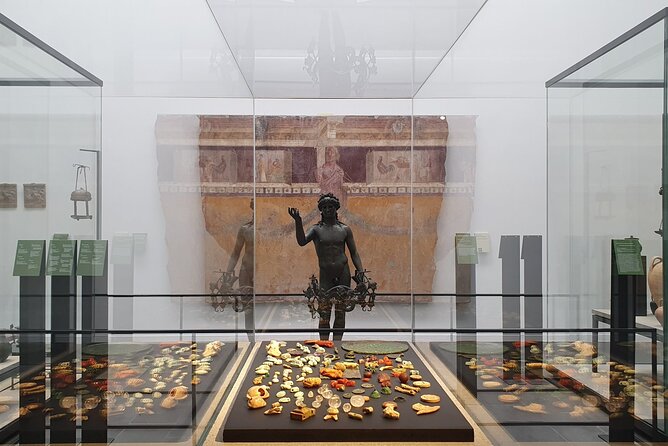
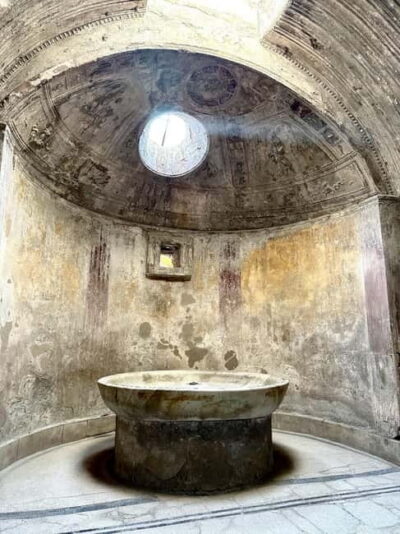
Next are the Suburban Baths, located outside the city walls. That location alone changes the story, because it suggests a different audience, and the nearby port area likely supported visitors arriving by boat.
The tour explanation often frames this with travelers in mind. The nearby port was connected to several large rocks where boats could be moored, and the baths would have been convenient after a day of travel.
This stop helps you understand Pompeii as a system, not an isolated city stuck in time. City walls tell you what was protected, while buildings outside them point to where commerce and movement happened.
Casa del Fauno: a house known by one bronze statue
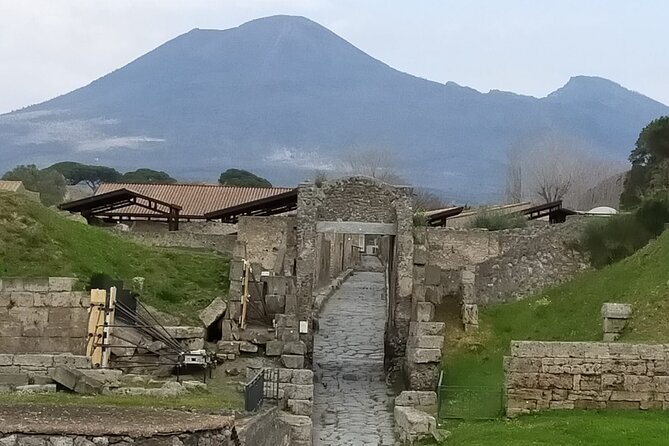
Casa del Fauno is another major highlight, and it gets its name from a bronze statue of a faun found in the impluvium. If you only remember one object from this house, this is the one.
This is a good stop for first-timers because it teaches how to “read” Pompeii houses by key features. The impluvium is central to how water was collected, and the bronze statue gives you a visual anchor, so the house stops feel less abstract.
Your guided time here is brief, around 15 minutes. Focus on finding the impluvium area and relating the statue to the room layout, then let the guide’s historical framing finish the connection.
Casa del Menandro: silver tableware and Trojan War scenes
Casa del Menandro is the large one, with about 2,000 square metres of space. It is named for an affresco of the poet Menandro, and the standout detail is what was found inside, including 118 objects in silver, tied to tableware.
The art adds another layer. You will also see wall depictions related to the Trojan War, including the death of Laocoonte, plus scenes involving Cassandra and Ulysses.
This stop is where Pompeii starts to feel like a snapshot of taste and education, not only survival. Even in a short visit, the combination of scale, silver finds, and narrative fresco themes helps you understand why elite homes mattered in Roman culture.
Inside the Archaeological Park: amphitheatre, gymnasium, and Apollo
The tour then enters the Archaeological Park of Pompeii, where you see two big religious and entertainment anchors. The stop list includes the amphitheatre area and then the Temple of Apollo.
In the amphitheatre, Romans loved games and fights, and Pompeii had a venue built for that. The amphitheatre could hold up to 20,000 people on three levels, and during hot summer months, spectators were protected by a type of dark linen covering, according to the guide’s explanation. Adjacent to the arena, you can also see the gymnasium, where young people would work out.
One practical note: the stop description for this segment says the admission ticket is not included. At the same time, the tour includes a priority ticket entrance for the archaeological park itself. That means you should double-check what your park entry covers when you arrive, so there are no surprises at the gate.
Finally, you reach the Temple of Apollo. The worship of Apollo came before the eruption of 79 A.C., and the guide explains that Apollo’s cult lost followers as Jupiter became stronger. You will see bronze representations of Apollo with bow and arrow, plus a statue of Diana.
This combination works well because it shows two sides of Roman life in one sweep. Entertainment draws the crowd, and temples explain what the city valued spiritually, even when that belief system shifted over time.
What makes the guided stories stick
I like tours that teach you how to interpret what you are seeing, not just recite facts. This one tends to do that by linking objects and rooms to context: who used them, why they looked that way, and what the city was like before the eruption.
The pace also helps. With about 15 minutes per main stop, you get quick context at each location, so you do not waste time trying to figure out what you should be noticing first.
If you are the type who asks questions, the small size makes it easier. In several experiences with this tour style, guides focused on questions and even kept talking after the main route ended, which is a nice bonus when you are trying to process everything you just saw.
Price and Logistics: is $66.23 good value?
At $66.23 per person, the value depends on what you want from your Pompeii visit. What you are paying for is not just access, it is time saved and meaning added.
Included in the tour package are the guide service in your language, priority ticket entrance for the archaeological park, and headsets. The stop tickets are also listed as included for most of the route, which reduces the headache of figuring out separate entries while you are already standing in the heat.
What is not included is private transportation. That is typical for walking-focused Pompeii tours, but it matters if you are coming in by car or taxi. You will want to plan public transit or local walking since the meeting point is near public transportation.
Overall, I would treat this as a solid buy if you want a guided orientation plus priority entry. If you already have a personal guide or you prefer slow independent exploring without a set route, you might spend less by going fully self-guided. But for many first-timers, this hits a sweet spot.
Extending your visit after the tour
One reason I like this format is that you do not have to stop learning when the guide route ends. Your tickets are for the day, so after the guided walk, you can keep exploring independently.
That matters because Pompeii rewards repeat attention. The first pass helps you recognize key spaces, and then later you can return to the house, street, or viewpoint you liked most, without feeling rushed.
If you are visiting during a hot season, think strategically. Use your tour time for shade and orientation, then plan later visits for indoor or semi-covered areas where you can slow down.
Who this tour is best for
This tour is a good fit if you want a guided overview that still covers major sites. The combination of houses, public space, baths, the amphitheatre area, and Apollo gives you a well-rounded sense of Pompeii as a functioning city.
You will also appreciate it if you like being able to ask questions and get interpretation. A real archaeologist guide tends to explain how dates, design, and artifacts connect, which is what turns a list of rooms into a story you can remember.
If you hate crowds and long lines, the small-group size and priority entry help. And if you are traveling with limited time, the 2 hours 30 minutes duration makes it easier to build Pompeii into a broader itinerary.
Should you book this Pompeii Ruins tour?
Book it if you want Pompeii with structure, context, and priority entry, without spending your whole day figuring out what matters. This is especially good for first-timers who want to leave with a clear map of what you just saw.
Skip it, or pair it with extra time, if you prefer spending 45 to 60 minutes in one site. With nine stops and short visits, you will likely want to return on your own to get the full effect from the houses that catch your eye most.
FAQ
How long is the Pompeii small-group tour with a real archaeologist?
The tour lasts approximately 2 hours 30 minutes.
Is there priority entry included for Pompeii?
Yes. The tour includes a priority ticket entrance for the Archaeological Park of Pompeii.
What group size should I expect?
The tour has a maximum of 15 travelers.
Is transportation included in the price?
No. Private transportation is not included.
Are service animals allowed on this tour?
Yes, service animals are allowed.
What happens if I cancel, or if the tour is canceled due to weather?
Cancellation is free up to 24 hours in advance for a full refund. If the experience is canceled because of poor weather, you will be offered a different date or a full refund.
Choose the Right Entry
- Pompeii Ticket + Tour with Optional Tasting Experience at Pompeii★ 5.0 · 663 reviews
- 2 hours Pompeii Tour with Local Historian – Ticket Included★ 5.0 · 335 reviews
- Pompeii Guided Group Tour with Entry Ticket and Archaeologist★ 4.5 · 269 reviews
- Pompeii 2-hour Private Tour with an Archaeologist-Ticket included★ 5.0 · 181 reviews
- Pompeii: Skip the line ticket (art) + audioguide + map★ 3.5 · 155 reviews
More Tours in Pompeii
- Pompeii Small Group Tour with an Archaeologist★ 5.0 · 6,593 reviews
- Pompeii and Herculaneum Small Group Tour with an Archaeologist★ 5.0 · 1,350 reviews
- Skip the Line Guided Tour of Pompeii led by an Archaeologist★ 5.0 · 703 reviews
- Pompeii Ticket + Tour with Optional Tasting Experience at Pompeii★ 5.0 · 663 reviews
- Pompeii private tour with an Official Guide★ 5.0 · 631 reviews
More Tour Reviews in Pompeii
- Pompeii Small Group Tour with an Archaeologist★ 5.0 · 6,593 reviews
- Discover the Ancient Ruins of Pompeii: Day Trip from Rome★ 3.5 · 2,247 reviews
- Pompeii and Herculaneum Small Group Tour with an Archaeologist★ 5.0 · 1,350 reviews
- Skip the Line Guided Tour of Pompeii led by an Archaeologist★ 5.0 · 703 reviews
- Pompeii Ticket + Tour with Optional Tasting Experience at Pompeii★ 5.0 · 663 reviews
More ways into Tickets.
 ★ 4.8Pompeii: Entry Ticket and Guided Tour with an ArchaeologistFrom $3519,459 reviews
 ★ 4.2Pompeii: Entry Ticket with Optional Audio GuideFrom $2612,360 reviews
 ★ 4.0Pompeii: Skip-the-Line Entrance Ticket with Audio GuideFrom $392,509 reviews
 ★ 4.5Pompeii: Archaeological Park Tour with Ticket on requestFrom $312,283 reviews
 ★ 4.6Pompeii: Skip-the-line-Ticket and Guided TourFrom $641,152 reviews
 ★ 4.1Pompeii: Skip-the-Line Entry Ticket with Digital Guide AppFrom $22770 reviews
 ★ 5.0Pompeii Ticket + Tour with Optional Tasting Experience at PompeiiFrom $35663 reviews
 ★ 4.9Pompeii: Exclusive Tour with Archaeologist and Entry TicketsFrom $50634 reviews