
REVIEW · SKIP THE LINE
Pompeii Small Group Guided Tour with Skip-the-line Admission
Pompeii hits different with a guide’s pace. This 2-hour small-group visit is built for efficiency, with skip-the-line admission and an English-speaking guide to get you into the action fast. You also get a mobile ticket, which helps on a day when even simple logistics can steal time.
What I like most is the mix of big public landmarks and everyday Roman life, not just the famous ruins. You’ll pass through major spaces like theatres, temples, and thermal baths, then get pointed to places tied to daily eating and shopping, including thermopolia and pistrinum. I also really appreciate how the tour pushes you through the well-known houses, like the House of Menander, House of the Faun, House of the Vettii, and Caecilius Iucundus.
One possible drawback to think about is cost surprises if your group size changes close to departure. In one scenario, the provider’s message mentioned switching options that could raise the total, especially if admission ticket terms end up different than expected. So, check your booking details carefully before you show up.
Key things you’ll notice on this Pompeii tour
- Skip-the-line entry with a mobile ticket to cut down waiting time
- A tight 2-hour route that focuses on major sights without dragging
- Everyday Roman stops, like thermopolia and pistrinum (food and shops)
- Walk-through access to famous houses, including the House of Menander and House of the Faun
- A strong street-and-square route, via Via dell’Abbondanza and the Forum
- Crowd-smart guiding, with comments from one past guide experience that specifically mention avoiding congestion
Why skip-the-line matters at Pompeii Archaeological Park
Pompeii is popular, so time can evaporate before you even start seeing things. A skip-the-line admission approach is one of the smartest reasons to book a guided option, because it protects your main resource: your limited sightseeing window. With only about 2 hours, you do not want to spend half that time shuffling forward in a line.
The mobile ticket piece also helps. On a busy day, anything that speeds up check-in reduces stress. You can focus on where you’re going instead of trying to figure out ticket paperwork in the moment.
There’s another practical bonus. A guide route usually means you’re not zig-zagging across the site like you’re solving a map puzzle. Even if you’re a confident navigator, Pompeii is spread out, and a plan helps you see more in less walking.
The 2-hour game plan: public buildings, shops, and streets
This tour is essentially a guided highlights route that tries to balance three kinds of Pompeii. You get public life, private life, and street life. The order matters, because it keeps the story moving: city functions first, then daily habits, then the neighborhoods and homes that defined status and comfort.
Expect the guide to highlight what you’re actually looking at, not just point and move on. You’ll cover theatres, temples, thermal baths, and traditional shops. Then you’ll shift to domestic spaces in well-known residences, before walking along main corridors like Via dell’Abbondanza and arriving at the Forum.
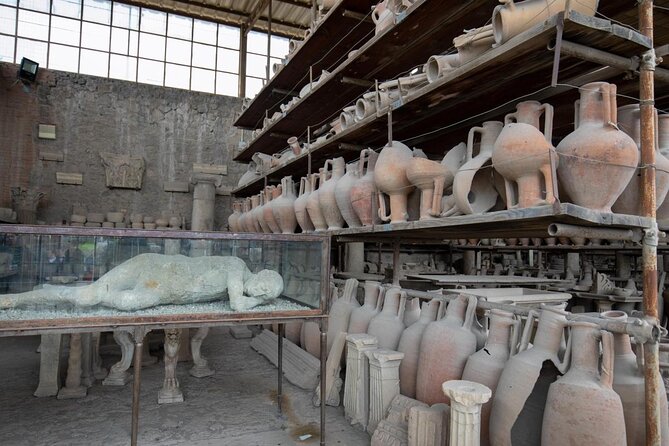
Finally, the tour ends by facing one of the heaviest parts of the Pompeii story. You’ll have special focus on the victims of the eruption, shown through petrified bodies. That moment changes the tone of the whole experience, so it’s good to know you’ll get more than just postcard ruins.
Pompeii’s public spaces: theatres, temples, and thermal baths
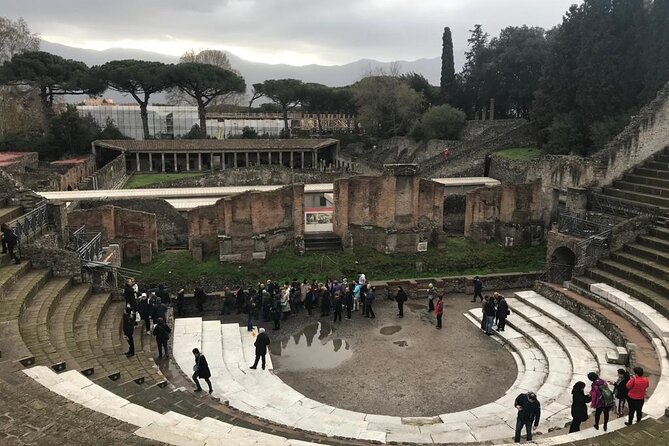
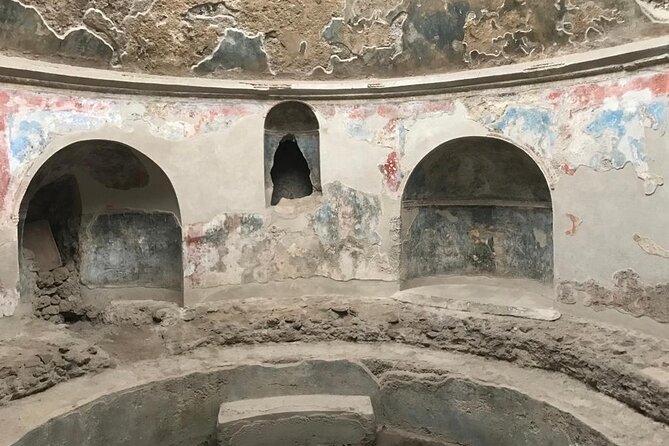
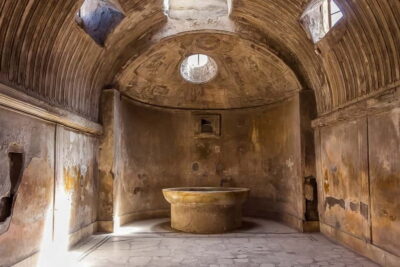
The heart of ancient Pompeii was built for community life, and that’s where you start. Theatres show how Romans staged entertainment and public gatherings. Temples matter because they connect architecture to belief and civic identity. Thermal baths show the everyday routine side of Roman culture, where bathing was social and practical.
What helps you most on a small-group format is that your guide can point out details you might miss on your own. Even in a short time, someone watching you can steer you toward the right spots: where you can see the layout, where you can understand the function, and where the ruins still communicate how people moved through the space.
A drawback of a fast route, of course, is that you won’t stop forever in any one location. If you love ultra-slow museum pacing, you might feel the timeline tugging you along. But if you want an efficient, guided orientation, this format does the job.
Everyday Roman food and shopping: thermopolia and pistrinum
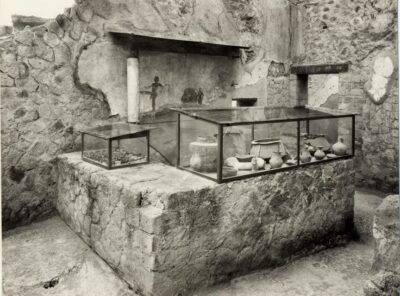
One of the most fun shifts on this tour is the attention to everyday businesses. You’ll learn about thermopolia, which were essentially fast-food counters for hot, ready-to-eat meals. You’ll also hear about pistrinum, the Roman equivalent of a bakery.
These stops are valuable because they make Pompeii feel less like a preserved theme park and more like a real city. You start to picture what people did between home, work, and leisure. And because these places were designed around food and quick service, they connect with modern instincts fast.
This is also where good guiding makes a difference. The ruins can look like “walls and columns” until someone frames what the space was for. When you know a room or counter type, you read the site differently, and the time invested feels more rewarding.
Famous houses you can actually walk through
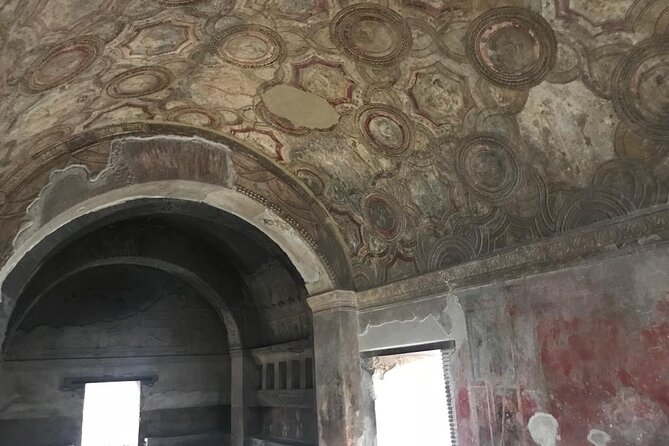
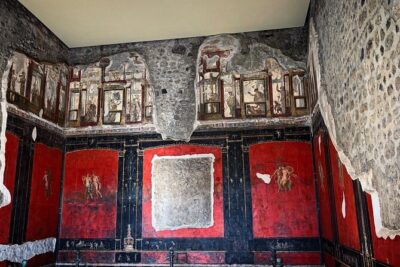
Pompeii’s residences are part of what makes the site so famous, because they show how wealth, taste, and daily routine intersected. This tour includes several of the most referenced names: the House of Menander, the House of the Faun, the House of the Vettii, and the home associated with Caecilius Iucundus.
Why this matters for you is simple. Houses let you understand social ranking and private life. You’re not just seeing where people prayed or ate in public. You’re stepping into spaces that reflect status and family identity, and you’re seeing how Romans used art and room layouts to express themselves.
You’ll also walk through areas connected to key street life, like the main street Via dell’Abbondanza. That matters because it gives you context. Homes make more sense when you understand how close they were to daily movement and commerce.
Time trade-off to keep in mind: you’ll see a lot of highlights, not a full deep dive into every house. So if your ideal Pompeii day is mainly about one or two residences, you might consider pairing this with extra independent time after. But as an overview and guide-led orientation, it’s strong.
Via dell’Abbondanza, the Forum, and the red-light district wall paintings
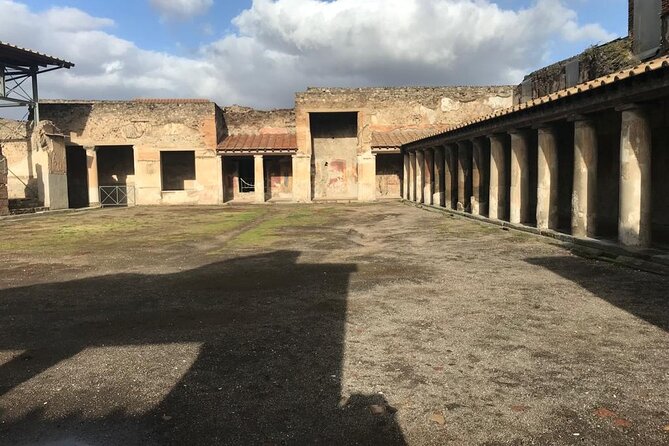
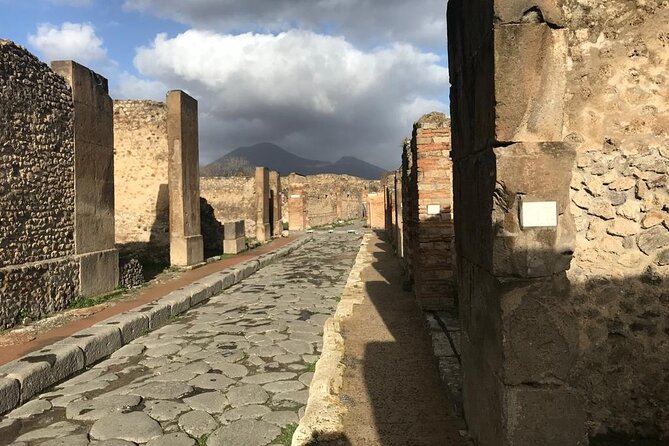
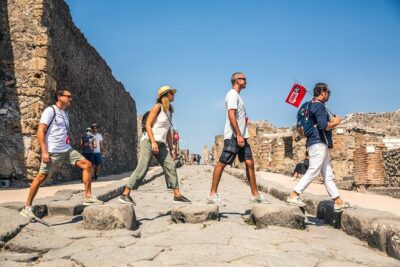
Street scenes are where Pompeii stops being a sequence of buildings and becomes a living urban story. You’ll walk down Via dell’Abbondanza, the main street. This gives you a sense of how traffic, shoppers, and locals moved through the city.
Then you’ll reach the Forum, the civic center. A Forum visit is about understanding the city’s “main stage” role: public gatherings, civic identity, and the spaces where everyday life intersected with politics and religion.
The tour also includes what’s often called the red-light district, including the suggestive wall paintings. This part can surprise people, which is part of why it works. It reminds you Pompeii was inhabited by real humans with real desires, jokes, and instincts, not just solemn stone monuments.
If you’re sensitive to that tone, you can mentally brace for it. A good guide keeps it respectful and contextual, because the point is historical and social, not shock value.
The moment that changes everything: victims of the eruption
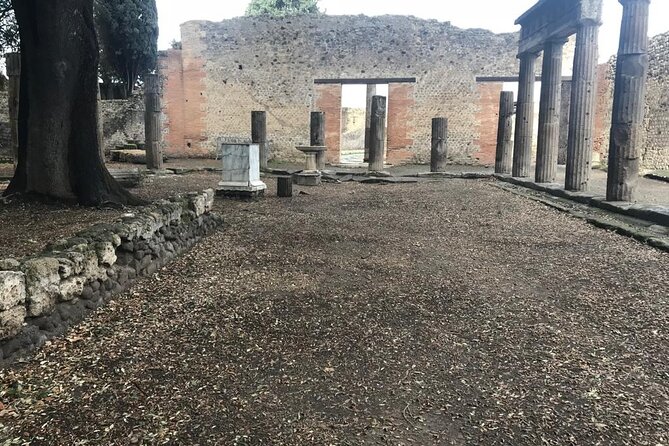
No matter how energetic the first half feels, Pompeii is impossible to experience without confronting tragedy. This tour gives special focus to the poor victims of the eruption, shown as petrified bodies.
I appreciate that the tour doesn’t treat this like a quick photo stop. When a guide sets the tone and stays focused, you’re more likely to actually process what you’re seeing instead of just moving through it like a checklist.
This part is also where you get the biggest emotional shift in a short day. Expect your perspective to change in a way that makes the earlier buildings and streets feel more human. It’s heavy, but it’s also essential.
Small group size and guide style: what helps you get more from 2 hours
A max group size of 15 travelers is big enough to meet people and still small enough for the guide to adjust pacing. In practice, that usually means you’re not stuck behind a long line of slow movers or blocked at every turn.
One guide experience that really lands here is Roberta. The notes from her past tour described her as able to make the history interesting, help avoid crowds, and show favorite places. That combination is exactly what you want in Pompeii: storytelling plus smart movement.
Here’s how I’d use a small group to your advantage. Ask questions early, when energy is high and before you’re tired. If you see something you’re curious about, point it out right away, so the guide can connect it to the broader city story. And if the group pace starts to feel intense, it’s okay to take a second to catch your breath, because Pompeii walking adds up fast.
What to bring is basic but important: comfortable shoes for uneven ground, water if you’re heat sensitive, and a light plan for photos. If you’re trying to photograph everything, you’ll lose the plot. You’re better off taking fewer shots and remembering where you stood, because the guide framing does most of the work.
Price and value: is $82.91 worth it?
At $82.91 per person, you’re paying for two things: guided interpretation and time savings. Pompeii is huge, so a guided highlights route is partly about reducing decision fatigue. You don’t have to figure out what to prioritize, and you don’t have to wait in lines if you arrive at a busy time.
The other value lever is the time limit. With about 2 hours, you can fit this into a day without needing a whole afternoon. If you have limited time in Naples or the surrounding area, that efficiency can make the price feel reasonable.
Still, I recommend you do one quick sanity check before you book or right after you book. One piece of feedback described a scenario where a switch to a private option came with additional payment and admission ticket requirements. That doesn’t mean it will happen to you. But it does mean you should verify what your specific booking includes, especially around admission ticket coverage and any changes if the minimum participant count affects the schedule.
If your plan is straightforward and your booking terms match the basics you expect, then this price looks like a fair trade for a guided Pompeii orientation.
Who this Pompeii tour suits best
This tour fits best if you want an organized Pompeii visit that hits the major categories quickly. You’ll like it if:
- You want public buildings plus houses, not just one type of ruin
- You prefer a guided route over a solo scramble
- You have about 2 hours and want maximum clarity on what you’re seeing
- You appreciate stories that include daily life, like food and shops, not just big architecture
It might not be ideal if you’re the type of traveler who wants to linger and read every surface. Also, if you’re very budget-focused, pay close attention to ticket inclusion details in your confirmation, since that’s where the total can shift in edge cases.
Should you book this skip-the-line small group Pompeii tour?
My take: this is a strong booking if you want a guided Pompeii “best-of” that respects your time. The combination of skip-the-line admission, a small group of up to 15, and a route that covers public spaces, daily-life shops, famous houses, the main street and Forum, plus the victims makes it feel complete for a 2-hour experience.
The standout reason to book is the way you get guided meaning, not just walking. When the guide helps you avoid crowds and points out what you’re looking at, the site becomes easier to understand fast. With a 4.9 rating and a 94% recommendation signal, this is clearly landing well for many visitors.
Before you go, do that one quick practical check: confirm what’s included in your specific purchase, especially around admission ticket coverage. If that’s clear, you’ll get an efficient, emotionally grounded Pompeii overview without losing precious time to lines or guesswork.
FAQ
How long is the Pompeii Small Group Guided Tour?
It runs for about 2 hours.
Is admission included?
The tour summary states that an admission ticket is included.
What language is the tour offered in?
The tour is offered in English.
How big is the group?
The tour has a maximum of 15 travelers.
Do I get a mobile ticket?
Yes, the tour includes a mobile ticket.
What is the cancellation policy?
You can cancel up to 24 hours in advance for a full refund. If you cancel less than 24 hours before the start time, you do not receive a refund.
With a Local Guide
- Skip the Line Guided Tour of Pompeii led by an Archaeologist★ 5.0 · 703 reviews
- Pompeii private tour with an Official Guide★ 5.0 · 631 reviews
- Pompeii Skip-the-line Tour with Archaeologist Guide★ 5.0 · 559 reviews
- Pompeii Guided Tour & Horse Riding on Vesuvius with Lunch★ 5.0 · 419 reviews
- Complete Pompeii Skip the Line Tour with Archaeologist Guide★ 4.5 · 379 reviews
More Tours in Pompeii
- Pompeii Small Group Tour with an Archaeologist★ 5.0 · 6,593 reviews
- Pompeii and Herculaneum Small Group Tour with an Archaeologist★ 5.0 · 1,350 reviews
- Skip the Line Guided Tour of Pompeii led by an Archaeologist★ 5.0 · 703 reviews
- Pompeii Ticket + Tour with Optional Tasting Experience at Pompeii★ 5.0 · 663 reviews
- Pompeii private tour with an Official Guide★ 5.0 · 631 reviews
More Tour Reviews in Pompeii
- Pompeii Small Group Tour with an Archaeologist★ 5.0 · 6,593 reviews
- Discover the Ancient Ruins of Pompeii: Day Trip from Rome★ 3.5 · 2,247 reviews
- Pompeii and Herculaneum Small Group Tour with an Archaeologist★ 5.0 · 1,350 reviews
- Skip the Line Guided Tour of Pompeii led by an Archaeologist★ 5.0 · 703 reviews
- Pompeii Ticket + Tour with Optional Tasting Experience at Pompeii★ 5.0 · 663 reviews
More ways into Skip the Line.
 ★ 4.0Pompeii: Skip-the-Line Entrance Ticket with Audio GuideFrom $392,509 reviews
 ★ 4.8Skip-the-Line Pompeii Express Tour by TrainFrom $632,038 reviews
 ★ 4.6Pompeii: Skip-the-line-Ticket and Guided TourFrom $641,152 reviews
 ★ 4.9Pompeii: Guided Tour with Skip-the-Line EntryFrom $58812 reviews
 ★ 4.1Pompeii: Skip-the-Line Entry Ticket with Digital Guide AppFrom $22770 reviews
 ★ 4.9Pompeii Ruins Private Tour with Optional Skip-the-Line EntryFrom $254732 reviews
 ★ 4.5Skip-the-Line Pompeii Guided Tour from SorrentoFrom $90722 reviews
 ★ 5.0Skip the Line Guided Tour of Pompeii led by an ArchaeologistFrom $95703 reviews
Other useful routes from here