
REVIEW · SKIP THE LINE
Pompeii Skip-the-Line Entry & Guided Tour with a certified guide
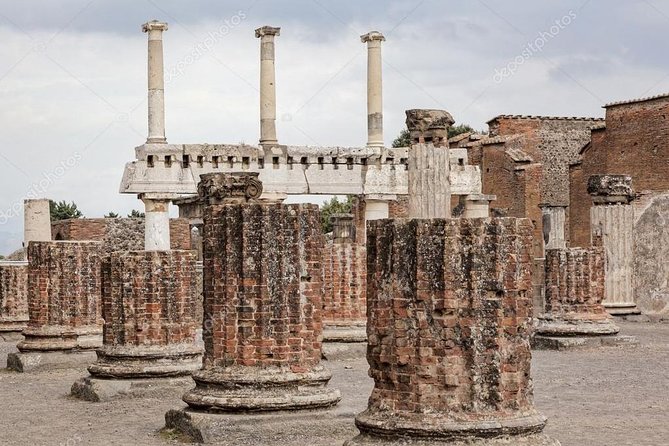
Pompeii hits harder with context. This 2-hour, English-guided tour is a practical way to see Pompeii’s big sights without wasting time in entrance lines, and it includes both the express admission and a guide who explains what you’re looking at. I like the tight focus on daily life, from the Foro to the baths and street food, and I also love that you get a guide so the ruins make sense even when details are hard to spot. The main drawback is pacing, so if you want lots of lingering for photos, you may feel a bit rushed on the way between highlights.
You’ll meet in the Circumvesuviana station area, right by Porta Marina Superiore, then walk in a group with headsets (when the group is larger). The route is short enough to fit into a busy day, but it still covers a surprisingly broad slice of Pompeii, including elite homes and the kind of places people actually used. If it’s hot, plan your energy for standing, stairs, and some uphill walking, because Pompeii is not gentle terrain.
I also appreciate how the stops connect. You’re not just checking boxes, you’re moving along the city’s main story, from public life in the Foro to private rooms in the luxury houses, and finally to everyday bites at a thermopolium. And if you get a guide like Alfonso, Annaliza, or Eraldo (names I’ve seen attached to this tour style), you’ll get clear, lively narration that keeps things moving.
Quick Reasons To Book This Pompeii Skip-the-Line Tour
- Express entry included so you spend less time queuing and more time looking at the ruins
- A certified guide with headsets helps you follow along, especially when signs are limited
- Forum-focused route that shows how politics, religion, business, and food blended together
- Real Pompeian details at each stop, like frescoes of Roman-era foods and the Forum baths layout
- Elite homes plus everyday street food, so you get variety without a long day
- Maximum 35 travelers, which usually keeps the pace manageable on uneven ground
Skip-the-Line Entry That Actually Gets You Inside Faster
Pompeii is one of those places where the line can eat your day. This tour includes express entrance tickets for the archaeological site, which means you line up less and start seeing sooner. In a spot like this, “time saved” is not small, because the ruins are huge and the walking is real.
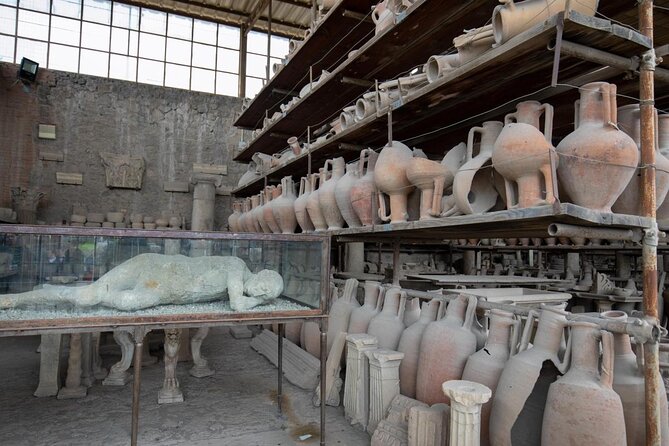
The other value of guided entry is simple: Pompeii is full of stone outlines. Without explanation, you might walk past something important and miss why it matters. With a guide, you’re not hunting for the story, you’re given it while you’re standing there.
The duration is about 2 hours, so this is best seen as an efficient highlights loop rather than a slow museum-style wander. If your goal is to study every inscription or linger in gardens, you’ll likely want a longer self-guided visit later. But if your goal is to get oriented and see key buildings properly, this tour does that job well.
Finding the Meeting Point at Via Villa dei Misteri, 1
Logistics can make or break a short tour, and this one has a very specific starting point. You meet at Via Villa dei Misteri 1, in the Circumvesuviana station building for Pompei Scavi Villa dei Misteri. The instruction is to arrive 15 minutes before the time on your voucher.
Look for the office called Tempio Travel / Pompeii Tickets. It’s on the first floor, inside a red station building, and it’s about 100 meters from Porta Marina Superiore. If you rely only on Google Maps coordinates, you might get sent to the wrong side, so use the station and the office name as your anchor.
A few practical tips make this easier. Wear shoes you trust for uneven ground, and if you’re visiting in summer, bring an umbrella for harsh sun. One review called out the sun as unrelenting, and Pompeii days can turn from “fine” to “brutal” quickly.
Also, expect a bit of a climb on arrival. One reviewer specifically noted a steep hill to get into Pompeii, and it’s the kind of thing that matters when the tour is only about two hours long. Plan for that effort, not just for the time underground.
Stop 1: Foro di Pompei and the City’s Public Pulse
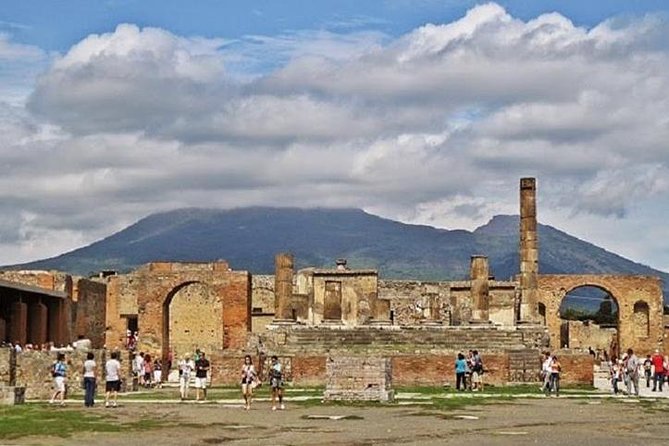
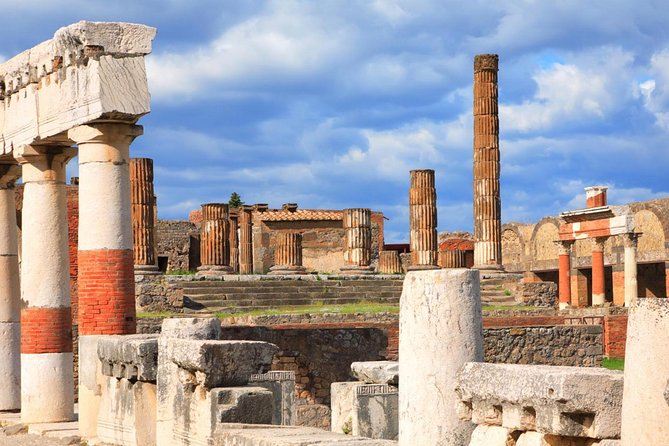
Your first major stop is the Foro di Pompei, the city’s main square. This wasn’t just a big open space. It was the center of politics, economics, and religion, all tied together in one place.
This is the perfect starting point because it gives your brain a map. Once you understand the Foro as Pompeii’s public core, the rest of the route becomes easier to follow. You’ll feel less like you’re wandering and more like you’re walking through how the city worked.
You’ll spend around 30 minutes here with your admission included. That’s enough time to take in scale, spot the different functions of the space, and get the basic timeline framing that helps everything else click.
If you’re the type who likes to take photos, the Foro can be a good place to practice. You’re seeing broad spaces, so compositions are easier than when you’re packed into doorways and corridors in smaller rooms.
Stop 2: Macellum Frescoes and Pompeii’s Market Culture
Next is the Macellum, set on the Foro. The Macellum was a market for meat and fish, and it was one of the focal points of daily commerce.
Here’s what makes this stop memorable: you can see frescoes showing the foods Romans ate in the 1st century AD. That turns a market building into a snapshot of ordinary life. You stop thinking about Pompeii as a single dramatic disaster and start seeing it as a real place with real habits.
The time here is about 10 minutes, so you won’t have long to stare at every detail. Instead, use the guide’s framing to decide what to focus on. If the frescoes are your interest, get your photos quickly, then return visually while your guide explains what you’re looking at.
The market theme also connects well to the later food stop. Once you’ve seen what people bought, the thermopolium later in the walk feels more grounded, not random.
Stop 3: Terme del Foro and How Pompeii Scheduled Comfort
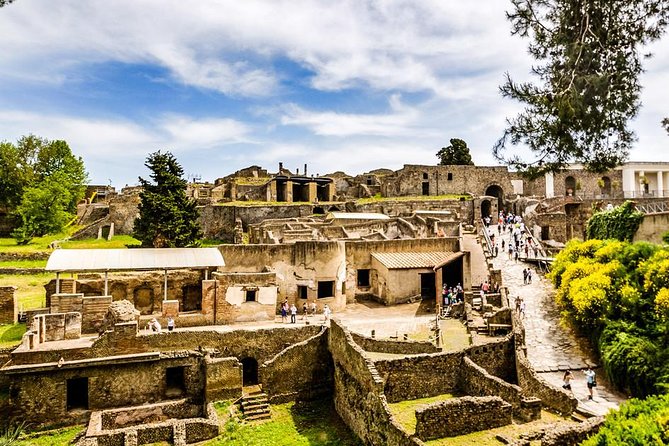
The tour then moves behind the Temple of Jupiter to the Terme del Foro (Forum Baths). This isn’t just about bathing. It’s a window into how people organized space by gender, routines, and even water supply.
You’ll learn that the baths covered around 410 square meters and had both male and female sections, each with independent entrances. That detail matters, because it shows how daily life had structure, even in something as routine as hygiene.
A helpful bit of specificity is the water system. The baths were supplied by the Acquedotto del Serino, but there was also a well as backup if water was scarce. That kind of planning makes Pompeii feel practical, not purely symbolic.
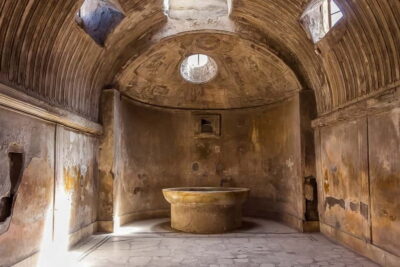
Your time here is about 15 minutes, and it’s visually rewarding. The description includes an original-style ceiling with stucco from the period, a marble basin in the caldarium, and a mosaic floor. Even in a short visit, those are elements you can actually spot rather than just hear about.
If you get hot easily, baths are a good mental reset. They’re also great for learning what different rooms meant, because the guide can connect temperature zones to the building layout.
Stop 4: Casa del Fauno and the Mosaics of Status
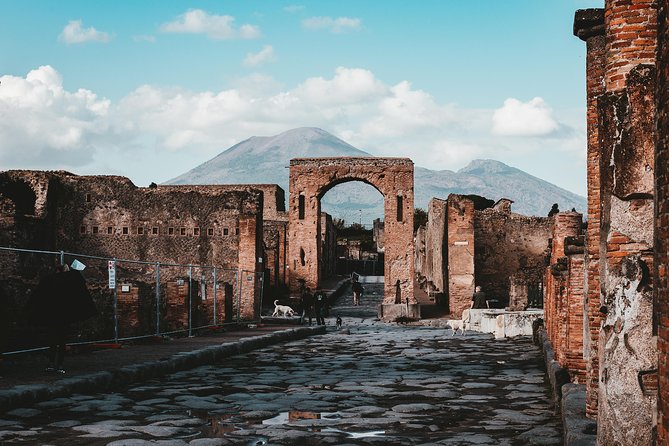
After the baths, you’ll step into luxury through the Casa del Fauno. This house is described as one of the most luxurious and large aristocratic homes of the Roman republic era. That matters because it shapes what you expect to see: more than a home, it was status made visible.
The standout art detail is the Mosaic of Alexander. You’ll see a copy here, while the original is conserved at the MANN. That kind of clarification is important on Pompeii tours, because it prevents that awkward moment of thinking you missed the “real” masterpiece.
Time at this stop is around 10 minutes, so again, you’re getting highlights rather than deep study. Focus on what the mosaic location and scale suggest about the household’s identity. A guide’s explanation is what turns a pretty floor into a social signal.
If you’ve visited other Roman sites before, you’ll notice a familiar pattern. Pompeian elite spaces often tell you who had power and what culture they wanted to display. This stop fits that pattern and gives you vocabulary to recognize it elsewhere.
Stop 5: Casa dei Vettii and Roman Art in Private Rooms
The next home is the Casa dei Vettii, a Roman domus that was buried in the eruption of 79 AD and uncovered through later archeological digs. It’s tied to Roman-era art and named after Aulo Vettio Restituto and Aulo Vettio Conviva, the owners found through the property’s evidence.
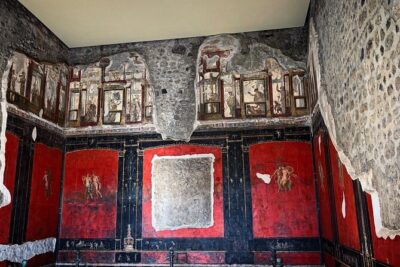
This is one of those stops where the guide makes the difference. You’ll see that the house preserves paintings, including a room associated with erotic paintings. The description includes that this room was used by a prostitute who lived with the owner. That detail is direct, and it helps show that Pompeii’s private life was not sanitized.
Time here is about 10 minutes, so don’t expect long reflection. Instead, use the guide’s context to understand the difference between decor, function, and what it tells you about social life.
This stop also brings moral and emotional variety to the walk. Pompeii is often treated as a site of tragedy. Casa dei Vettii adds the other truth, people lived, worked, arranged homes, and expressed tastes that were sometimes shocking by modern standards.
The Walk Along Via dell’Abbondanza and the City in Between
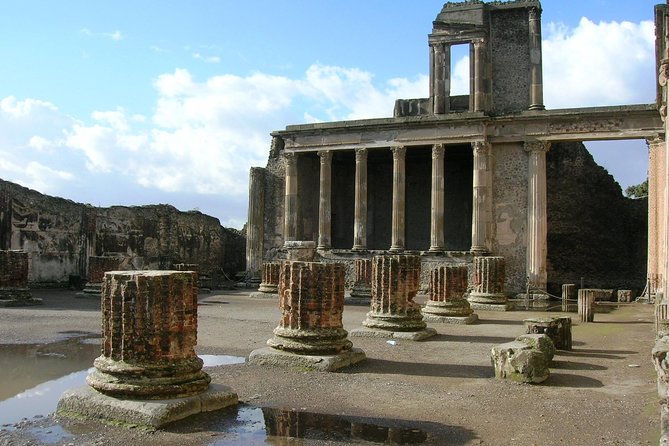
Between the homes and the final food stop, you’ll walk along Via dell’Abbondanza. This street connects major parts of the city between the Foro and Porta Sarno, and it passes notable areas like the Stabian Baths, Theatres, the Temple of Isis, and the Anfiteatro.
Even if you are not going inside every one of those sites, the route matters. It gives you the big-city feel and helps you visualize how Pompeii was laid out. You’ll understand that the Foro was not isolated. It was part of a connected system of entertainment, worship, bathing, and trade.
There’s no fixed “stop time” listed for this segment in the details, but the effect is that it keeps the tour from feeling like random jumps. It’s your thread that stitches the highlights together.
If you’re prone to taking too many detours for photos, this is where a guide helps. A group walk keeps you from spiraling into the maze of ruins and losing time near the end.
Stop 6: Thermopolium Regio VI, Insula VIII, 8
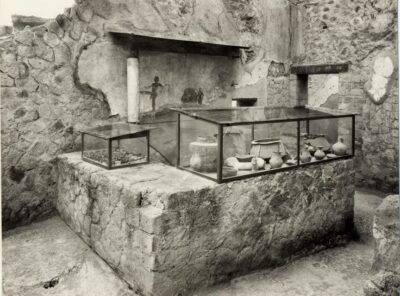
You end with the thermopolium at Regio VI, Insula VIII, number 8. A thermopolium was a place where you bought hot food to take away, kind of like an ancient fast food counter.
The reason this final stop lands well is that it shifts you from elite and public spaces into everyday routines. Earlier you saw the market culture at the Macellum. Here you see how food likely got served quickly, right at street level.
Time is about 10 minutes, and your guide should point out what makes the space distinctive: the layout for serving, and what you can infer about ordering and eating. You’ll probably leave thinking differently about Pompeii’s street life, because food is such a universal human constant.
If you’re trying to remember one stop, make it this one. It gives you an immediate mental image that’s easy to carry after you leave.
Pace, Group Size, and How to Enjoy the Two-Hour Window
A lot of Pompeii tours feel longer than they are, mainly because the site is physically challenging. This one is designed to be about two hours, with a maximum group size of 35 travelers. That helps keep things moving without feeling like a stampede.
You should still expect some waiting at entrances and transitions between stops. A short tour has to make tradeoffs, and some guides may stop more frequently than others. If your priority is slow looking, plan a separate time to return later on your own.
Also, heat can push you faster than the clock. Reviews specifically flagged the sun in August and recommended an umbrella, and that’s good advice. Bring sunscreen and water, because you’ll be standing outdoors at multiple points.
For the listening experience, you’ll get headsets if the group is more than 15 people. That means you can keep your eyes on the ruins while still catching the guide’s explanation. In a place with wind and echoes, that small convenience matters.
Finally, wear your “Pompeii shoes.” Uneven paving and frequent steps are part of the deal. One of the best ways to make the tour feel worth it is to remove discomfort from the equation.
Value for Money: Why $58.87 Can Be a Smart Spend
At $58.87 per person for about two hours, this is not the cheapest way to see Pompeii. But the price is doing real work for you.
First, the admission is included as express tickets. That means you’re paying for convenience and saved time, not just for a guide’s narration. Second, you’re buying a structured route that hits multiple types of buildings in a tight loop. For a short stay, it’s hard to beat that efficiency.
If you were to do this on your own, you’d likely spend more time figuring out what each place is and where to go next. In Pompeii, being “right there” matters, because many details are not obvious. A guide pays off when it turns stone shapes into meaning.
Where value can fail is if you expect a slow, freeform visit. The two-hour window is tight, and the tour is built to cover key highlights rather than provide deep immersion at every stop. If your style is fast and organized, you’ll feel the value. If your style is slow and photographic, you may wish you had chosen a longer visit.
Who This Tour Is Best For (and Who Might Want Something Else)
This tour is a great fit if you want a guided introduction to Pompeii without getting overwhelmed. It’s ideal for first-timers, people with limited time, or anyone who likes understanding daily life, not just dramatic set pieces.
It also suits families, with one practical note: children must be accompanied by an adult. And because the pace is designed to keep moving, it can work well as long as you bring water and plan for the heat.
On the other hand, you might want a different option if you strongly prefer self-paced wandering. Pompeii deserves repeat visits, and a two-hour tour will only scratch the surface. If you want to study mosaics, graffiti, and room-by-room layouts with zero pressure, you will probably feel boxed in.
This is also a good choice if you like a narrative arc. The Foro sets the stage, the baths show routine comfort, the houses show status and private life, and the thermopolium ends with street-level food.
Should You Book This Pompeii Skip-the-Line Guided Tour?
Book it if you want to get your bearings fast, avoid the entrance hassle, and leave with a clearer idea of what Pompeii looked like day to day. I think the best reason to choose it is the combination of express entry plus a guide-led route that connects public life, bathing, elite homes, and everyday food.
Skip it or consider a different format if you know you want long viewing time at a handful of sites. The tour is built to move, and even though the guides vary, the structure is designed around a short highlights circuit.
If you do book, do two things to get the most out of it: show up early at the station office so you don’t lose time, and come prepared for outdoor walking in the heat. With that, this is one of the most sensible ways to see Pompeii’s key corners in a single pass.
FAQ
What is included in the Pompeii entrance for this tour?
The tour includes the archaeological site entrance tickets as express admission, plus a professional guide. If the group is larger than 15, you also get headsets for listening.
How long is the guided tour?
It runs for about 2 hours.
Where do I meet the tour group?
Meet at Via Villa dei Misteri, 1, Pompei. The meeting point is at the agency office called Tempio Travel / Pompeii Tickets inside the Circumvesuviana station building, 15 minutes before the time on your voucher.
Is the tour conducted in English?
Yes. This tour is offered in English.
What should I do if I am bringing children?
Children must be accompanied by an adult.
Can I cancel and get a refund?
Yes. You can cancel for a full refund if you cancel at least 24 hours before the experience starts.
With a Local Guide
- Skip the Line Guided Tour of Pompeii led by an Archaeologist★ 5.0 · 703 reviews
- Pompeii private tour with an Official Guide★ 5.0 · 631 reviews
- Pompeii Skip-the-line Tour with Archaeologist Guide★ 5.0 · 559 reviews
- Pompeii Guided Tour & Horse Riding on Vesuvius with Lunch★ 5.0 · 419 reviews
- Complete Pompeii Skip the Line Tour with Archaeologist Guide★ 4.5 · 379 reviews
More Tours in Pompeii
- Pompeii Small Group Tour with an Archaeologist★ 5.0 · 6,593 reviews
- Pompeii and Herculaneum Small Group Tour with an Archaeologist★ 5.0 · 1,350 reviews
- Skip the Line Guided Tour of Pompeii led by an Archaeologist★ 5.0 · 703 reviews
- Pompeii Ticket + Tour with Optional Tasting Experience at Pompeii★ 5.0 · 663 reviews
- Pompeii private tour with an Official Guide★ 5.0 · 631 reviews
More Tour Reviews in Pompeii
- Pompeii Small Group Tour with an Archaeologist★ 5.0 · 6,593 reviews
- Discover the Ancient Ruins of Pompeii: Day Trip from Rome★ 3.5 · 2,247 reviews
- Pompeii and Herculaneum Small Group Tour with an Archaeologist★ 5.0 · 1,350 reviews
- Skip the Line Guided Tour of Pompeii led by an Archaeologist★ 5.0 · 703 reviews
- Pompeii Ticket + Tour with Optional Tasting Experience at Pompeii★ 5.0 · 663 reviews
More ways into Skip the Line.
 ★ 4.0Pompeii: Skip-the-Line Entrance Ticket with Audio GuideFrom $392,509 reviews
 ★ 4.8Skip-the-Line Pompeii Express Tour by TrainFrom $632,038 reviews
 ★ 4.6Pompeii: Skip-the-line-Ticket and Guided TourFrom $641,152 reviews
 ★ 4.9Pompeii: Guided Tour with Skip-the-Line EntryFrom $58812 reviews
 ★ 4.1Pompeii: Skip-the-Line Entry Ticket with Digital Guide AppFrom $22770 reviews
 ★ 4.9Pompeii Ruins Private Tour with Optional Skip-the-Line EntryFrom $254732 reviews
 ★ 4.5Skip-the-Line Pompeii Guided Tour from SorrentoFrom $90722 reviews
 ★ 5.0Skip the Line Guided Tour of Pompeii led by an ArchaeologistFrom $95703 reviews
Other useful routes from here