
REVIEW · SKIP THE LINE
Pompeii: Skip-the-Line Entry & Audioguide
Pompeii moves fast, even at walking pace. This skip-the-line ticket gets you inside the Pompeii Archaeological Park without the typical start-up delays, with an audioguide so you can go at your own speed.
I like that you can focus on what grabs you, whether that is the central forum or the quieter neighborhoods with homes, fountains, and aqueduct remains. The main drawback to consider is that you still need good timing and planning, since you are self-guided once you’re in, and you may be asked for your ID at check-in.
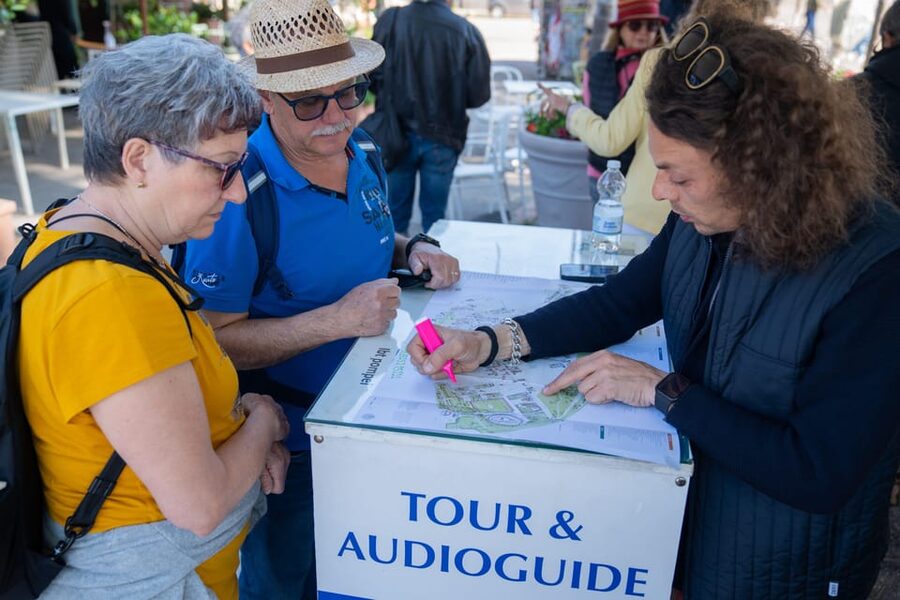
You’ll get a paper city map, the audioguide (in several languages), and time to wander the streets, forum, and big public spaces. On the value side, it is often a smoother first hour than trying to figure out lines and ticket desks on your own. Still, it is worth double-checking what is included in your exact booking, because some people run into confusion about extra audio costs or comparing prices with what they saw on-site.
Key takeaways before you go
- Skip-the-line entry helps you start exploring sooner, not later.
- Audioguide in many languages lets you understand what you are seeing without a live group pace.
- Forum first, then streets and neighborhoods keeps the visit logical and easy to follow.
- Roman daily life is everywhere (homes, businesses, baths, aqueducts, fountains, statues).
- Big set pieces like the amphitheater and theater show how crowds once gathered.
- Villa dei Misteri is not included, so plan your expectations if that is on your list.
Getting Past the Lines at Pompeii Archaeological Park
Pompeii is famous, which means it also attracts crowds. The payoff of this ticket is simple: skip-the-line entry so you can get into the park and start walking while the day is still calm.
That matters more than you might think. Pompeii is large, and your time fills up fast once you are inside. If you lose your first hour waiting outside, you end up sprinting between highlights. With this option, you usually spend more of the day actually seeing ruins, not managing queues.
The Meeting Point: IBT Center Next to Chalet Donna Lucia
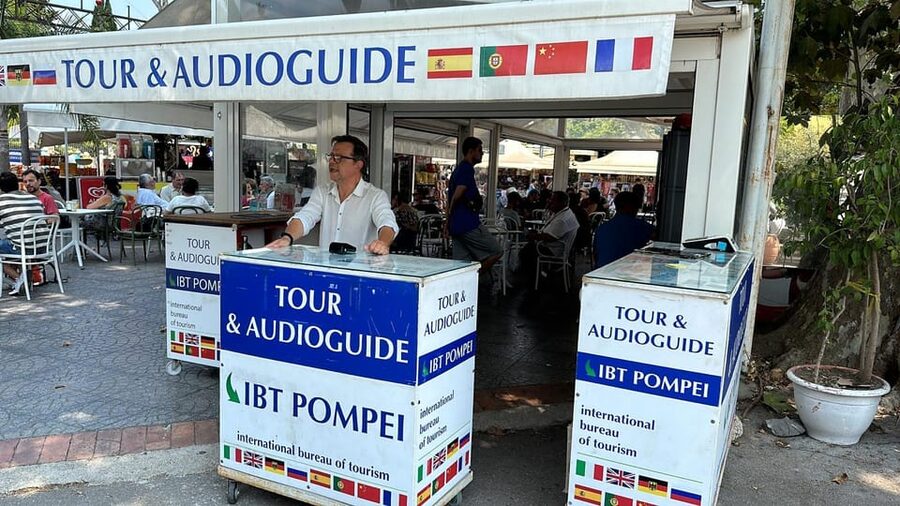
You meet at the IBT Center/Touristation next to Chalet Donna Lucia. This is the sort of detail that can save stress. When you are in a new town, “near” can mean multiple possibilities, so give yourself a little buffer to locate the exact spot before your entry window.
Also plan to bring your passport or ID card. The info for this activity is clear that ID is required for all participants, and that is one less thing to figure out after you arrive.
How Long You Actually Need: 2 Hours to a Full Day of Walking
The duration is listed as 2 hours to 1 day, depending on starting times and how long you choose to stay. In plain terms, Pompeii rewards slower walking, but you can absolutely do a strong visit in a shorter slot if you prioritize.
If you have about 2 hours, I would focus on a route that hits:
- the central forum
- a quick sweep through surrounding streets
- one of the larger public spaces like the amphitheater or theater
If you have more time, you will enjoy lingering over details like building layouts, remnants of fountains, and the mix of private houses and shops.
Start at the Forum: Rome’s Public Heart in Your Hands
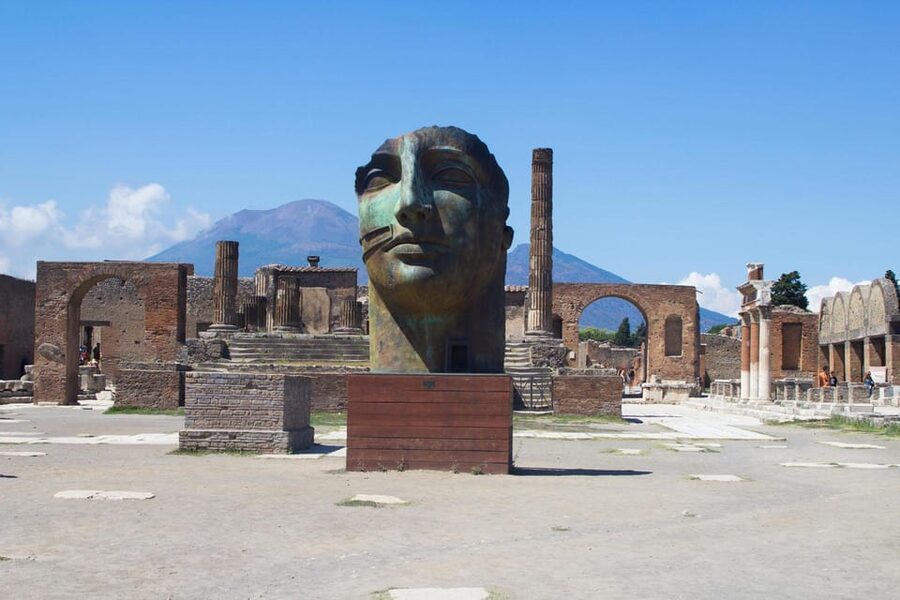
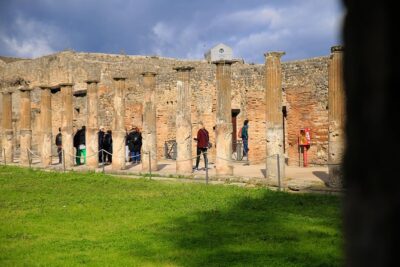
Most Pompeii visits feel like wandering until you reach the forum, then everything clicks. This experience starts with you walking around the central forum area, where you can look at columns, doorways, and stone structure placements that still suggest the scale of public life.
I like the forum as a starting point because it gives you a reference map in your head. Once you understand where people gathered for civic and commercial life, the later streets and buildings make more sense. You are no longer just looking at ruins, you are tracking how the city functioned.
And then there’s the view. You get the sense that Pompeii is still anchored to its landscape, with Mount Vesuvius looming in the background. Even if you know the story already, seeing the geography while you walk helps the place feel real.
Street-Grid Wandering: Pompeii Feels Like a Real Neighborhood
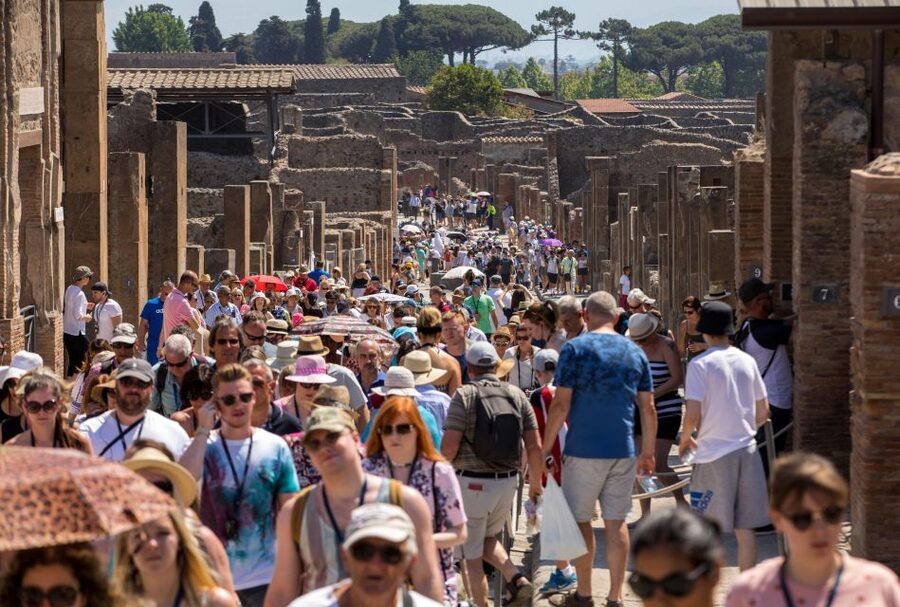
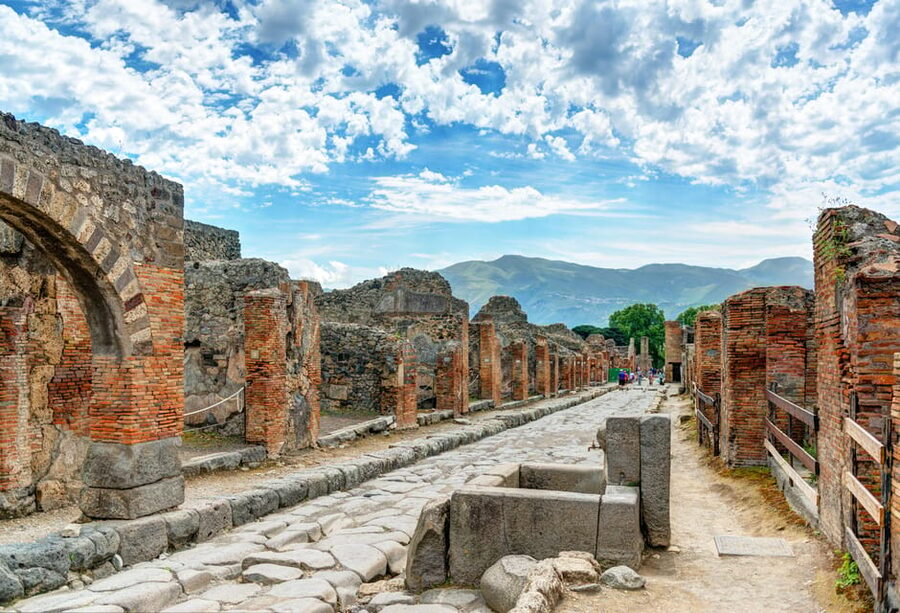
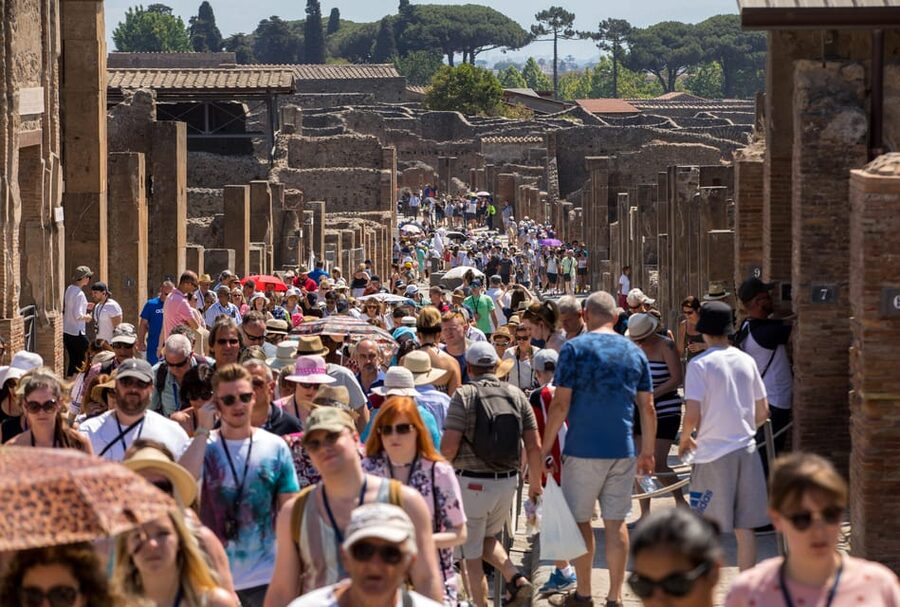
After the forum, you shift into the streets. This is where Pompeii can surprise you. It is not just grand monuments. It is doorways, street corners, business remains, and the rhythm of everyday travel.
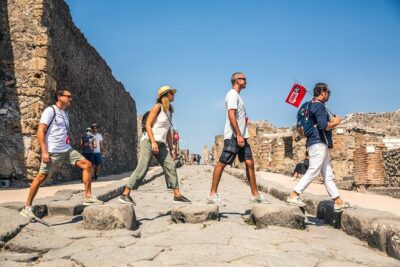
You will stroll the routes where people once moved between the forum, public baths, shops, and private homes. The city layout still guides you, and the audioguide helps you connect what you see with what each space likely was used for.
One practical upside of going at your own pace: you can slow down when something catches your eye, like a doorway layout or a section of stonework that hints at how a building was organized.
Roman Homes and Businesses: Where Life Happened Indoors
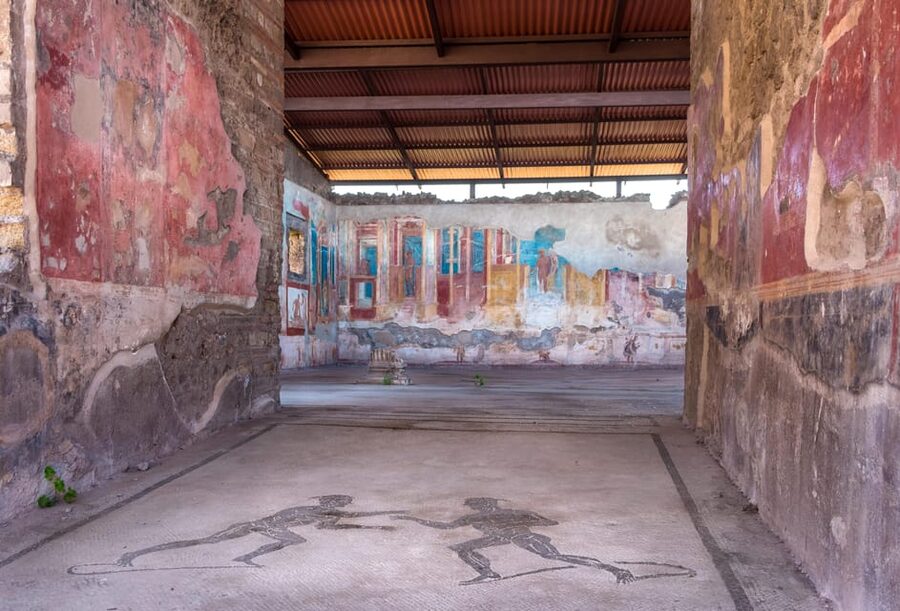
Pompeii is famous for its preservation, and a big reason is how much of daily life shows up in stone and plaster. This visit includes time to see Roman homes and businesses, including remains that point to how people lived, worked, and hosted visitors.
Look for:
- the basic layout of rooms and openings
- the way spaces connect to the street
- marks of everyday features, not just big landmarks
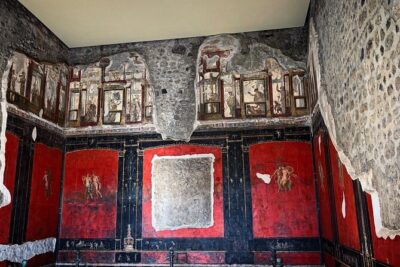
The homes and business sites are also where frescoes may appear. Some walls and sections still show traces of colorful frescoes, and seeing those fragments makes the ruins feel less like an empty stage and more like a lived-in city.
Aqueducts, Fountains, and Public Baths: Water as the Real Backbone
One of Pompeii’s most convincing details is water. You will see remains connected to the aqueduct and fountains, plus areas linked to public baths. It’s easy to think of ancient cities as dusty and dry. Pompeii reminds you that people built systems to bring water to where it was needed.
Even when remnants are incomplete, you can still get the idea. The ruins show you where water traveled and where it would have mattered most: near public gathering spaces and in the flow of daily routines.
For me, these are the spots that make the audioguide worth listening to. The notes can turn scattered stone into a system.
The Amphitheater and the Dramatic Theater: How Crowds Were Built
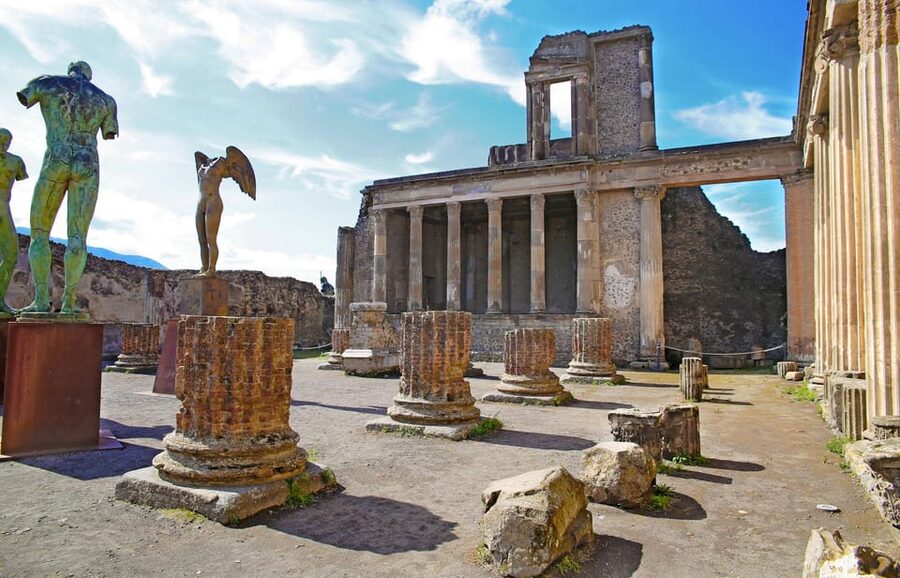
Pompeii’s entertainment venues are not gentle. The amphitheater and the dramatic theater once packed spectators eager for shows. Standing where crowds gathered makes the city feel theatrical even now.
This part of the visit is especially satisfying if you like large spaces with clear sightlines. Even if you cannot picture every moment perfectly, the form of the buildings helps you understand how performances and events were organized.
If you’re short on time, aim for one of these larger venues plus the forum area. They tend to give the biggest “wow, this is how it worked” payoff.
Colorful Frescoes and the Audioguide: How to Get More Out of Every Stop
You’ll have an audioguide plus a paper city map. That combination matters. A map helps you orient yourself, and the audio gives meaning to the buildings that can otherwise feel like random fragments.
The audioguide is available in multiple languages: Italian, English, French, Spanish, German, Portuguese, Chinese, and Japanese. If you do not speak Italian, English support is specifically noted as helpful in practice, which is great if you want your first Pompeii experience to be understandable.
Practical listening tip: don’t try to listen like you are studying. Instead, use the audio like a guide for your eyes. When you move to a new cluster of buildings, hit play again and let it set the scene.
Price and Value: Is $53 a Good Deal?
At $53 per person, this sounds like a fair offer on paper because it includes skip-the-line entry, an audioguide, and a paper map.
That said, I would treat Pompeii pricing as something you should verify carefully. Some people have been surprised by comparisons they made with on-site prices and by adding costs for an audiophone, even though the listing for this experience says the audioguide is included. So do the simple check when you book: confirm that an audioguide is included in your selected option and that there are no hidden add-ons in your final price.
Still, even with that caution, the value logic is strong. Paying extra makes sense if it saves meaningful waiting and helps you start exploring right away. In a place where the park is large and time gets swallowed quickly, “getting in faster” is not a luxury. It’s part of the value.
What’s Not Included: Villa dei Misteri and Meals
Two notable gaps to know up front:
- Villa dei Misteri is not included
- Food and drink are not included
If Villa dei Misteri is a must for you, you’ll need to add it separately. I would plan that decision before you arrive, because once you’re in and walking, it’s easy to assume everything important is included.
As for meals, plan on stopping for a snack or drink on your own. Pompeii is outdoors for the long stretches, so you will appreciate having water or a plan to buy it nearby.
Small Rules That Change Your Day (So You Don’t Lose Time)
This experience has clear rules that can affect how smoothly you move through the park.
What you should know:
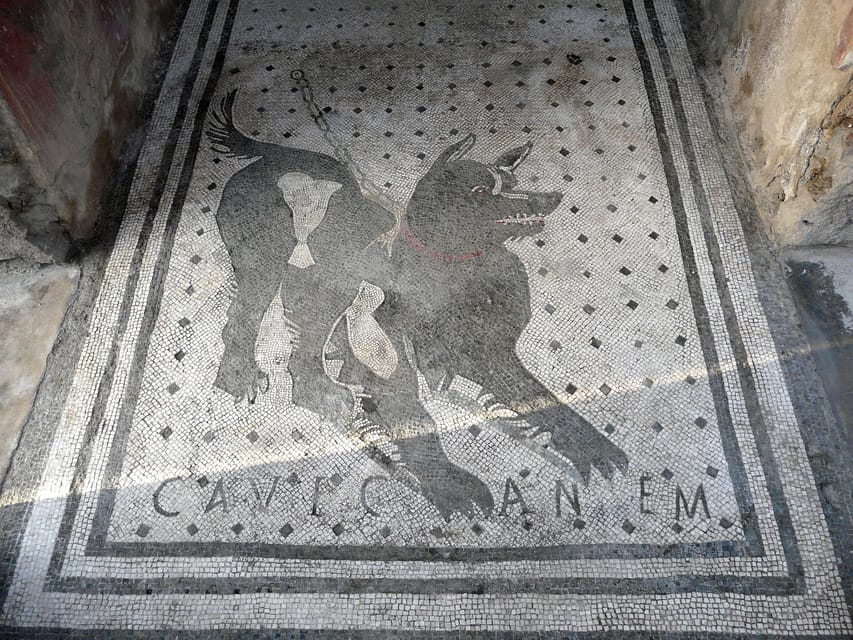
- Pets are not allowed inside the archaeological area, but small dogs are permitted if kept on a leash and carried when inside buildings.
- Smoking is not allowed.
- No luggage or large bags are allowed.
- Alcohol and drugs are not allowed.
- You should bring passport or ID, and ID is required for all participants.
One more practical consideration: some people feel uneasy about check-in processes that can require holding onto a passport as a deposit. If that is the sort of policy you do not like, it may help to mentally prepare for an ID handoff at the start so you can stay calm and proceed.
Who This Skip-the-Line + Audioguide Option Fits Best
This is a strong fit if you want Pompeii at your pace. The audioguide helps you move through a large site without needing to follow a tight group schedule.
You’ll probably like this most if:
- you prefer self-guided wandering over constant stop-and-go
- you want the big highlights (forum, streets, amphitheater, theater) plus day-to-day details (homes, businesses, fountains, aqueduct remnants)
- you want explanation while you walk, not after
If you only want one or two monuments and you hate maps and listening devices, you might prefer a simpler ticket with fewer extras. But for most first-timers, the combo of skip-the-line entry plus audio and a map is a sensible way to get traction fast.
Should You Book This Pompeii Experience?
I think this booking is a good choice if your goal is to get inside smoothly and spend your time looking at Pompeii instead of figuring out logistics. The biggest strengths are clear: skip-the-line access, an audioguide in many languages, and the freedom to walk through the forum, streets, homes, and major public spaces.
I would book with a little caution if:
- Villa dei Misteri is essential for your list
- you strongly dislike any ID-deposit-style check-in
- you tend to double-take at added costs and want to compare on-site pricing first
If you’re flexible, the odds are good you’ll leave with a much better understanding of how the city worked, not just a pile of ruins. Pompeii is already powerful. This plan helps you turn that power into a visit you can actually follow.
FAQ
Is Villa dei Misteri included in this Pompeii ticket?
No. Entrance to Villa dei Misteri is not included.
What does the skip-the-line ticket include?
It includes skip-the-line entry to Pompeii Archaeological Park, plus an audioguide and a paper city map.
What languages are available on the audioguide?
The audioguide is available in Italian, English, French, Spanish, German, Portuguese, Chinese, and Japanese.
Where do I meet for this experience?
You meet at the IBT Center/Touristation next to Chalet Donna Lucia.
What ID do I need to bring?
Bring your passport or ID card. ID is required for all participants.
Are pets allowed in Pompeii?
Pets are not allowed. Small dogs are permitted inside the archaeological area, but they must be kept on a leash and carried when inside buildings.
Is hotel pickup or drop-off included?
No. Hotel pickup and drop-off are not included.
Are food and drinks included?
No. Drink and food are not included.
Are bags allowed?
No. Luggage or large bags are not allowed.
How long is the visit?
The duration is listed as 2 hours to 1 day, depending on availability and starting times.
More Skip the Line in Pompei Campania
- Pompeii: Skip-the-Line Entrance Ticket with Audio Guide★ 4.0 · 2,509 reviews
- Pompeii: Skip-the-line-Ticket and Guided Tour★ 4.6 · 1,152 reviews
- Pompeii: Guided Tour with Skip-the-Line Entry★ 4.9 · 812 reviews
- Pompeii: Skip-the-Line Entry Ticket with Digital Guide App★ 4.1 · 770 reviews
- Pompeii: Tour with Archaeologist Guide & Skip-the-Line Entry★ 4.5 · 478 reviews
More Tour Reviews in Pompei Campania
- Pompeii: Entry Ticket and Guided Tour with an Archaeologist★ 4.8 · 19,459 reviews
- Pompeii: Small Group Tour with an Archaeologist★ 4.8 · 12,264 reviews
- Pompeii: Skip-the-Line Entrance Ticket with Audio Guide★ 4.0 · 2,509 reviews
- Naples: Pompeii and Mt. Vesuvius with Lunch and Wine Tasting★ 4.5 · 2,454 reviews
- Pompeii: Skip-the-line-Ticket and Guided Tour★ 4.6 · 1,152 reviews
More ways into Skip the Line.
 ★ 4.0Pompeii: Skip-the-Line Entrance Ticket with Audio GuideFrom $392,509 reviews
 ★ 4.8Skip-the-Line Pompeii Express Tour by TrainFrom $632,038 reviews
 ★ 4.6Pompeii: Skip-the-line-Ticket and Guided TourFrom $641,152 reviews
 ★ 4.9Pompeii: Guided Tour with Skip-the-Line EntryFrom $58812 reviews
 ★ 4.1Pompeii: Skip-the-Line Entry Ticket with Digital Guide AppFrom $22770 reviews
 ★ 4.9Pompeii Ruins Private Tour with Optional Skip-the-Line EntryFrom $254732 reviews
 ★ 4.5Skip-the-Line Pompeii Guided Tour from SorrentoFrom $90722 reviews
 ★ 5.0Skip the Line Guided Tour of Pompeii led by an ArchaeologistFrom $95703 reviews
Other useful routes from here