
REVIEW · 3-HOUR EXPERIENCES
Pompeii Private Tour with an Archaeologist and Skip The Line – 3 hours
Pompeii is great, but it needs a plan. This 3-hour private tour threads the big highlights from Porta Marina Superiore to Porta Marina Inferiore. It’s led by an archaeologist guide in English, with skip-the-line help when you request it in advance.
I like how the route is built like a story, not a random loop. You’ll hit theaters, baths, the Forum, markets, and even the red-light district areas, all explained in plain language. One thing to consider: the tour price is not the same as the Pompeii site admission, so you’ll want to sort out tickets up front.
Key Takeaways Before You Go
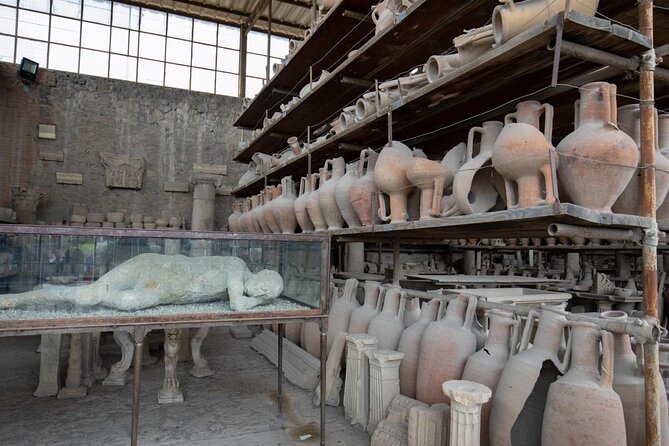
- Private, archaeologist-led focus: you get tailored explanations rather than loud group herding.
- A smart 3-hour route: major sights in a walk you can actually finish.
- Skip-the-line is request-based: it depends on you having your entrance setup correct in advance.
- Pompeii’s everyday life shows up often: markets, baths, laundries, and homes, not just monuments.
- Expect walking and uneven ground: some spots have steps and slippery surfaces.
- Meet and end in the same place: the tour starts and finishes back at Hortus Pompei, so you are not left guessing.
A 3-Hour Route Through Pompeii That Makes Sense
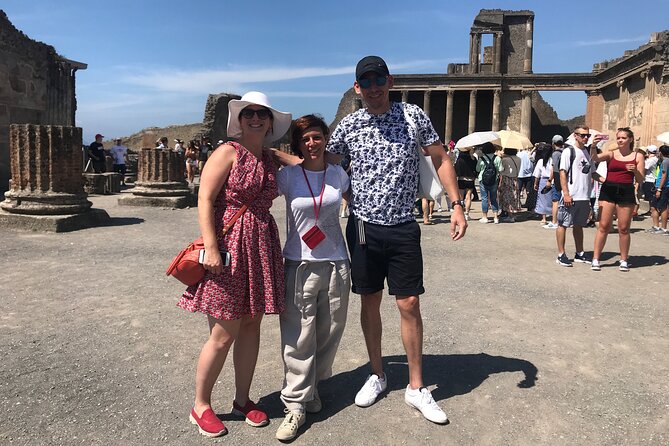
If you show up at Pompeii and wander, you can burn hours and still miss the thread. This tour does the hard part for you. It starts at Porta Marina Superiore and ends at Porta Marina Inferiore, which helps you avoid that backtracking feeling that can happen on a self-guided visit.
The pacing is built for a half-morning or early afternoon hit. You’ll spend short, focused time at each stop, which is perfect if you want to see a lot without turning it into a slog. It’s also private, so the guide can slow down when questions pop up, or speed up if you want the highlights and photos.
Why a Real Archaeologist Changes Everything
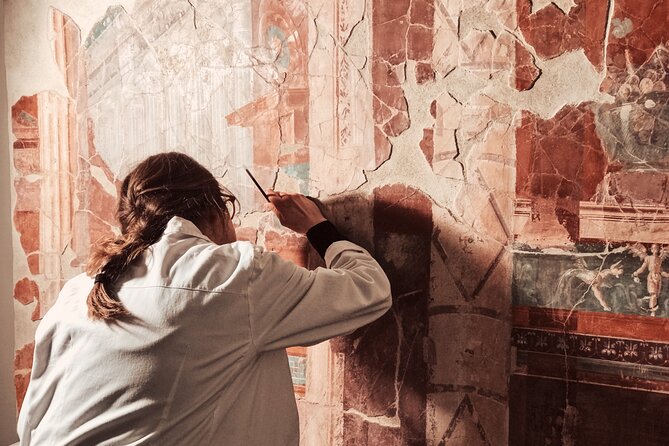
Pompeii can feel like a museum spread over a giant outdoor map. An archaeologist guide helps you connect the dots quickly.
Here’s what you’ll feel on the ground:
- You get context for what you’re looking at, like what a building was for and what daily life looked like in 79 AD.
- You understand why some areas are emphasized by the excavation work, not just because they’re pretty ruins.
- You get better wayfinding, so you spend less time staring at stones and more time reading the site.
The guide names that show up often in standout experiences include Luisa, Eliana, Amadeo, Maria, Roberto, and Mariagrazia. The common theme is clear: these guides are friendly, bring humor, and answer questions without making you feel rushed. If your idea of a good tour is explanation plus room to ask, this fits.
Skip the Line vs. Entrance Tickets: The One Spot to Double-Check
This is the part that can trip people up, so treat it like a checklist.
- The tour includes a skip-the-line ticket office option just on request in advance.
- The tour description lists a link to buy the Pompeii entrance ticket in advance.
- The tour does not include the Pompeii site admission fee. Adult entry is listed as 19 euros per person (and free entrance only for under 18, per the tour info you have).
So what should you do?
- Book your tour.
- Arrange your entrance ticket in advance using the provided purchase link.
- Make sure the skip-the-line request is in your booking notes or handled through the operator when the request is supported.
That small admin step matters. If you arrive without your entrance ticket set, you may end up dealing with ticket procedures on-site, and that burns time.
The Stops on Your Pompeii Walk, From Theaters to Baths
This route is designed to balance “big famous monuments” with the places that show how people actually lived. Each stop is short, but the guide uses that time well.
Porta Marina and the Main Street Setup
You’ll begin at Porta Marina Superiore and then get oriented as you move toward the main street of Pompeii. This is where you’ll start noticing how the city was laid out, and why some ruins feel more meaningful when you understand the flow of streets and movement.
A good guide here helps you shift your brain from, I am looking at ruins, to I am walking through a functioning city.
Odeon and Teatro Piccolo: Small Theater, Big Clues
Next up is the Odeon, also described as the small theater area (Odeon Teatro Piccolo). Even though it’s not the largest entertainment space, it’s perfect for learning how Romans used theater and performance in everyday life.
You get quick orientation: where the audience sat, how the space worked, and why theaters mattered beyond entertainment. The time at this stop is brief, so listen closely and ask if you want a specific angle for photos.
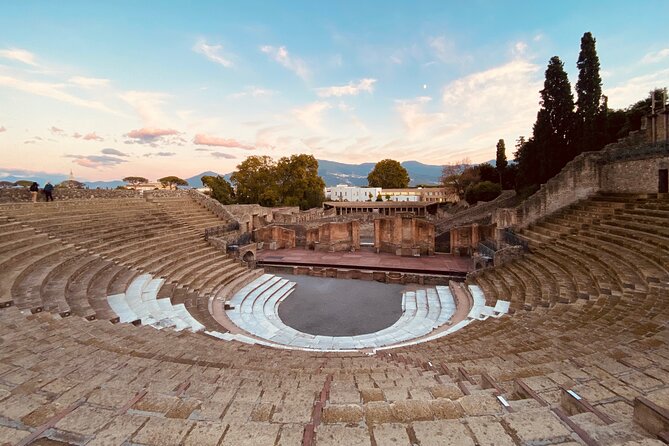
Teatro Grande: The Big Stage
Then comes Teatro Grande, the large theater. This is one of Pompeii’s headline sights for a reason. You’ll see the scale, the shape of the seating, and the way sound and viewing would have worked.
The time here is longer than at the Odeon, so it’s a great moment to slow down, look around, and let the guide connect it back to what Pompeii was like as a city, not just a site.
Granai del Foro: Storage That Kept the City Running
The Granai del Foro are the granaries, an archaeological deposit area tied to food supply. This is not the kind of stop most people pick instinctively, which is exactly why it’s worth including.
When you understand storage, markets, and food supply, Pompeii stops being only about shocks and tragedies. It becomes about logistics: how a city fed itself and kept daily routines going.
Stabian Baths: Pompeii’s Spa Life
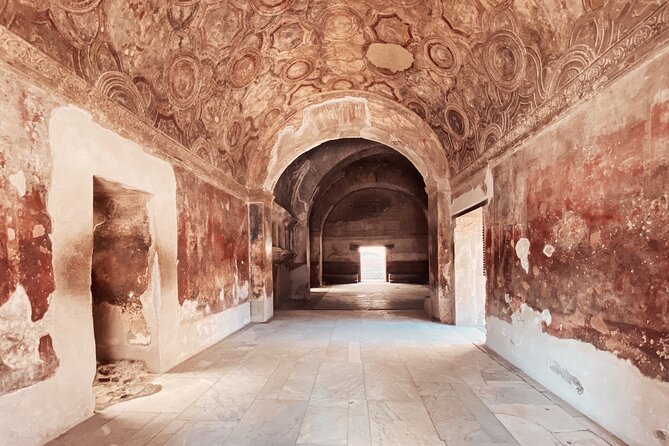
The Stabian Baths (Terme Stabiane) are the first baths stop on the route. These are a highlight if you like the human stuff: bathing, cleaning, social time, and the routines that were part of everyday Roman life.
Expect to see how different bathing and circulation spaces fit together. It’s also a good break from the sun, depending on the day and where you’re standing.
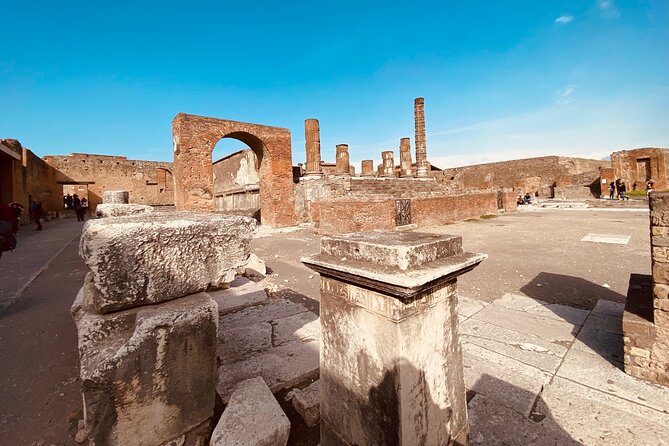
Forum and Court of Justice: Power at Street Level
Next you’ll hit the Forum (1 Foro di Pompei) and then Pompei La Basilica, described as the court of justice.
This combo is where Pompeii feels most like a city of politics and decisions. A good guide keeps it grounded: who would gather here, what kinds of civic actions happened in spaces like these, and how architecture supported public life.
If you care about how societies worked, don’t rush the Forum time. Ask for a simple explanation of how the space functioned, then look for it as the guide walks you through.
Temple of Jupiter and the Temple Zones
There’s a Temple: Jupiter stop, plus later stops tied to a Temple of Venus area and a final temple zone near the end of the walk.
Temples are important, but the best way to enjoy them is through use, not just looks. Ask your guide what the temple likely meant to the people who lived nearby, and how it related to nearby civic or social spaces.
Quadriporticus and the Gladiators Barracks Area
The Quadriporticus of the theatres is described here as the gladiators’ barracks area. This is a great Pompeii stop if you like the contrast between public spectacles and the people who trained for them.
You’ll get a clearer picture of how entertainment wasn’t just for show. It had a workforce, schedules, and daily routines.
Lupanar: The Brothel Area
The Lupanar, the brothel and prostitution area, is one of the most talked-about stops on the route. It’s also one of those places where interpretation matters.
You’ll want a guide who can explain what the space was for and how it fits into city life without turning it into sensationalism. A private archaeologist approach helps, because you can ask for context and keep your visit respectful and grounded.
Casa del Poeta Tragico: Cave Canem Mosaic Moment
One of the most famous photo stops on Pompeii is the Casa del Poeta Tragico, especially the Cave Canem mosaic. You’ll get a quick but meaningful look at the floor detail and the story it hints at.
Even if mosaics aren’t usually your thing, this one sticks because it’s recognizable and it shows how homes communicated personality and everyday humor.
Macellum and Edificio di Eumachia: Food and Wool
Then you’ll visit Macellum, the meat and fish market, followed by Edificio di Eumachia, the wool market area.
This pair is gold for understanding the economy of Pompeii:
- The market stop shows what people ate and how goods moved.
- The wool market stop shows work, trade, and the supplies behind clothing.
Together they make Pompeii feel like a real working town, not a postcard.
Casa del Menandro: Frescoes and Mosaics
At Casa del Menandro, you get a longer look at homes known for frescoes and mosaics. This is where you’ll see the wealth side of Pompeii, plus how art and decoration were part of daily life.
This is also a good place to focus on small details. When you can see the art choices clearly, you understand what mattered to the people living there.
Termopolio di Vetuzio Placido and Fullonica di Stephanus: Fast Food and Laundry
You’ll then head to:
- Termopolio di Vetuzio Placido, the take-away shop and fast food area
- Fullonica di Stephanus, the laundry area
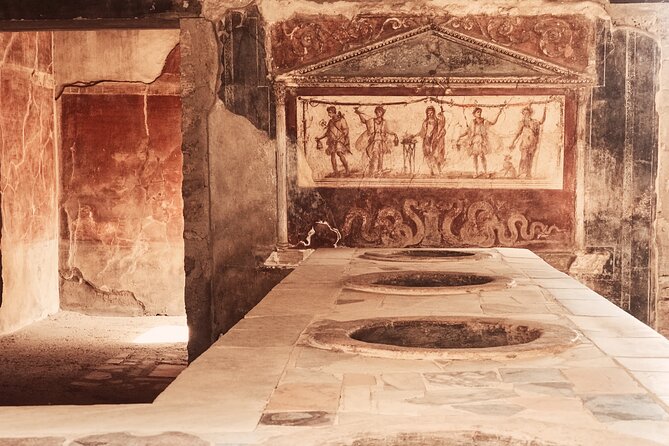
These two stops are some of the most practical. They show work and consumption patterns that are recognizable even today. Termopolio meant quick meals. Fullonica meant cleaning and processing clothing.
It’s a reminder that Pompeii had working neighborhoods, not just temples and theaters.
Final Temple Stop and the Walk Back
The last part includes a temple stop before the tour ends back near your meeting point. By the time you reach this final stretch, your brain usually clicks into place. The city starts to feel connected, and the walk back feels less like leaving and more like finishing a route that had a point.
What You Should Expect Physically (Steps, Uneven Ground, and Timing)
Pompeii is outdoors, and ruins are not smooth museum floors. In particular, plan for:
- walking over uneven ground
- steps in several places
- spots that can be slippery, especially if the surface is wet
Some people in past experiences also noted the need for moderate balance and patience at steeper sections. If you have mobility limitations, the private format is still helpful because your guide can set a pace and help you focus on accessible sight lines, but you should still expect the terrain to be challenging in places.
Also, this experience requires good weather. If conditions are poor, it may be rescheduled or refunded, depending on what happens.
Price and Value: Is This Worth $302 for a Private 3-Hour Tour?
The price listed is $302.32 per group (up to 1) for about 3 hours. On paper, that sounds steep until you translate it into what you are buying.
You are paying for:
- a private guide who can keep your attention and adjust your pace
- an archaeologist-led approach that turns stops into explanations, not just photos
- skip-the-line ticket help when requested in advance
And you still need to budget for Pompeii admission itself. Adult entry is listed as 19 euros per person (free for under 18). Meals and transport are not included.
So when does it feel like real value?
- If you care about Pompeii beyond the basics and want real context fast
- If you’re traveling with someone who asks questions, or you want your pace respected
- If you’d otherwise pay for multiple people in a group tour just to get decent explanations
If you mainly want to check boxes and take photos, you might do fine on your own. But if you want the place to make sense while you walk through it, the private archaeologist approach is hard to beat.
Who This Pompeii Tour Is Best For
This tour is a strong match if you:
- want English guidance and clear explanations
- like city life details, not just big monuments
- prefer a structured route rather than wandering
- want time to ask questions and get answers while you’re standing in front of the ruins
It may feel like a lot if you dislike walking for 3 hours in a major archaeological park. Also, because it’s Pompeii, expect the sites to be weather-dependent, and bring sun protection even in mild conditions.
Should You Book It? My Practical Take
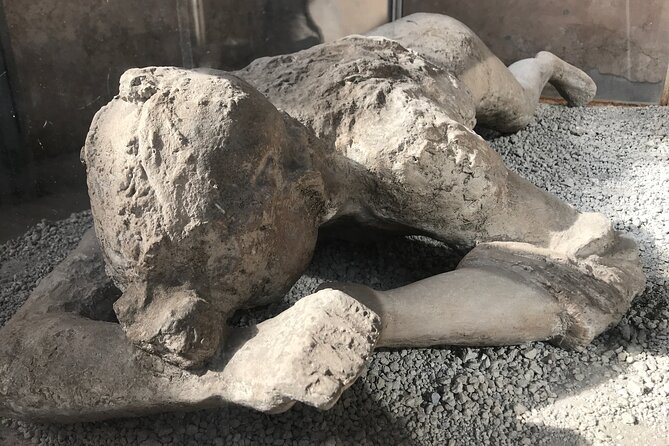
I’d book this Pompeii private archaeologist tour if your goal is to leave with more than memories of impressive stone. The route covers the big stages, the social spaces, and the everyday systems that made Pompeii run, from baths to markets to work sites.
Before you confirm, do two things:
- Plan for Pompeii admission as a separate cost (adult entry is listed as 19 euros).
- Make sure your skip-the-line request is set correctly and linked to your entrance ticket setup.
If you do that, you’ll spend your time inside Pompeii, not stuck figuring out ticket screens.
FAQ
How long is the Pompeii private tour with an archaeologist?
It lasts about 3 hours.
Is this a private tour?
Yes. It’s a private tour/activity, meaning only your group will participate.
What language is the tour offered in?
The tour is offered in English.
Is skip the line included?
Skip-the-line at the ticket office is included on request in advance. The tour info also includes a link to buy entrance tickets in advance.
Are Pompeii entrance fees included?
No. The tour lists admission tickets as included for the stops, but it also states the entrance fee is not included, with adult entry listed at 19 euros per person (and free for under 18). You’ll want to confirm your entrance ticket purchase is handled correctly for your booking.
Where does the tour start and end?
It starts at Hortus Pompei, Restaurant & Garden Bar, near Piazza Porta Marina Superiore 1, and it ends back at the meeting point.
What’s included in the tour price?
Included items are assistance before and during the tour, a private tour format, main attractions of Pompeii, a specialized archaeological tour guide, skip-the-line (on request), and a 3-hour private tour with a link to buy tickets entrance in advance.
What isn’t included?
Meals and food and drinks are not included. Entrance fee/tickets entrance to Pompeii are not included (except the free-under-18 note). Private transportation is also not included.
What if the weather is bad?
The experience requires good weather. If it’s canceled due to poor weather, you’ll be offered a different date or a full refund.
Is free cancellation available?
Yes. You can cancel up to 24 hours in advance for a full refund.
Just Your Group
- Pompeii private tour with an Official Guide★ 5.0 · 631 reviews
- Visit in Pompeii – Pompeii Private Tour with Ada★ 5.0 · 436 reviews
- Pompeii Private Tour with an Archaeologist and Skip The Line★ 5.0 · 391 reviews
- Pompeii Vineyard Escape: Private Wine Tasting & Lunch★ 5.0 · 329 reviews
- Private Day Tour to Vesuvius, Herculaneum & Pompeii with Pick Up★ 5.0 · 279 reviews
More Tours in Pompeii
- Pompeii Small Group Tour with an Archaeologist★ 5.0 · 6,593 reviews
- Pompeii and Herculaneum Small Group Tour with an Archaeologist★ 5.0 · 1,350 reviews
- Skip the Line Guided Tour of Pompeii led by an Archaeologist★ 5.0 · 703 reviews
- Pompeii Ticket + Tour with Optional Tasting Experience at Pompeii★ 5.0 · 663 reviews
- Pompeii private tour with an Official Guide★ 5.0 · 631 reviews
More Tour Reviews in Pompeii
- Pompeii Small Group Tour with an Archaeologist★ 5.0 · 6,593 reviews
- Discover the Ancient Ruins of Pompeii: Day Trip from Rome★ 3.5 · 2,247 reviews
- Pompeii and Herculaneum Small Group Tour with an Archaeologist★ 5.0 · 1,350 reviews
- Skip the Line Guided Tour of Pompeii led by an Archaeologist★ 5.0 · 703 reviews
- Pompeii Ticket + Tour with Optional Tasting Experience at Pompeii★ 5.0 · 663 reviews
More ways into 3-Hour Experiences.
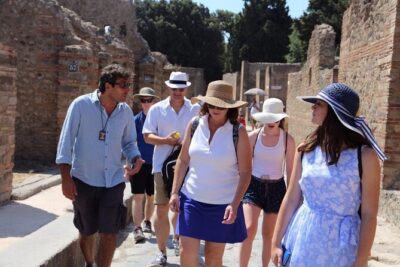 ★ 5.0Pompeii 3 Hours Walking Tour Led by an ArchaeologistFrom $256126 reviews
 ★ 5.0Pompei three hours with an expert guideFrom $41682 reviews
 ★ 5.0Complete Private Guided Three-Hour Tour on the Capri CoastFrom $42878 reviews
 ★ 5.0Private boat tour of Capri (relaxation tour three hours)From $58054 reviews
 ★ 5.03 Hours Private Tour of Capri IslandFrom $52254 reviews
 ★ 4.6Capri: 3-Hour Private Boat Tour with Blue Grotto VisitFrom $45054 reviews
 ★ 5.03-hour private boat tour of the island of CapriFrom $44352 reviews
 ★ 4.5Capri Private Boat Tour from Capri (3 Hours) with Blue GrottoFrom $49242 reviews
Other useful routes from here