
REVIEW · POMPEII ARCHAEOLOGIST TOURS
Explore Pompeii with an Archaeologist
Two hours in Pompeii feels like speed-walking through history. You get skip-the-line admission and an expert guide who turns streets and buildings into real stories fast. It is a practical way to beat the worst delays and still cover the big stops.
What I liked most is how the tour stays focused on what you are actually looking at, not a random history lecture. With an archaeologist leading you, the explanations land as you pass each doorway, court, and street corner. It also helps that the group is kept to a small size, so questions do not get lost in the crowd.
One thing to plan around, though: Pompeii can be crowded, and even with headsets it may be harder to hear when the site gets packed. If you want a slow, room-by-room experience or you are chasing specific ongoing digs, this quick-hit format may feel limiting.
Quick reasons this Pompeii tour works
- Skip-the-line admission that helps you start seeing things sooner
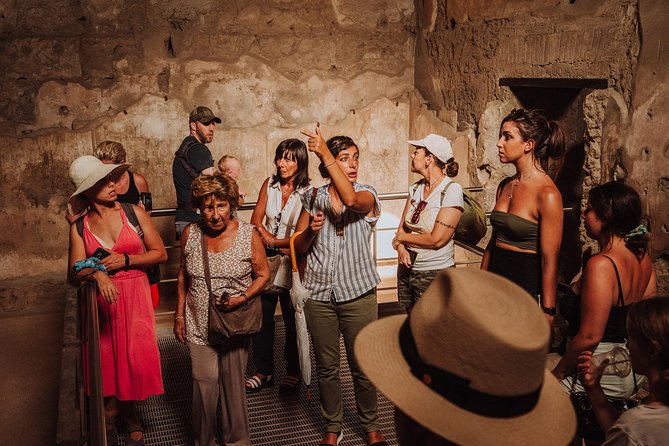
- Archaeologist-led explanations that match each stop you walk past
- Small group (max 20) for more chances to ask questions
- Headsets for groups of 16+, so you can follow along without crowding your guide
- A tight highlight route that covers major Pompeii areas in about 2 hours
- A real-world walking plan, with tips you can use immediately (bring water and shade in summer)
Price and time: what you are really paying for
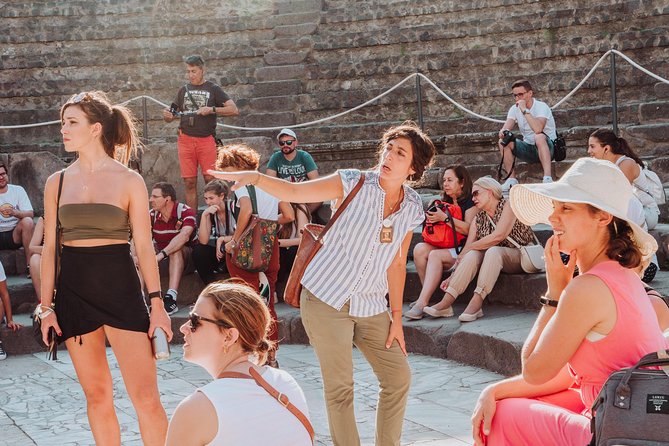
At $35.67 per person for an about-2-hour tour, this is not just a guided walk. You are paying for three things that matter in Pompeii: admission included, skip-the-line entry, and a guide who can interpret what you see while you are there.
If you have ever wandered Pompeii on your own, you know the problem. The ruins are amazing, but the connections are not always obvious. This tour saves you the work of figuring out what is important and why, so your time inside feels more productive.
There is also a value point that is easy to miss until you are standing in a queue. When you pre-book and use skip-the-line entry, you buy back energy for the walking and the sights. In a place as spread out as Pompeii, that time advantage matters.
Meeting at Porta Marina Superiore, then moving with a small group
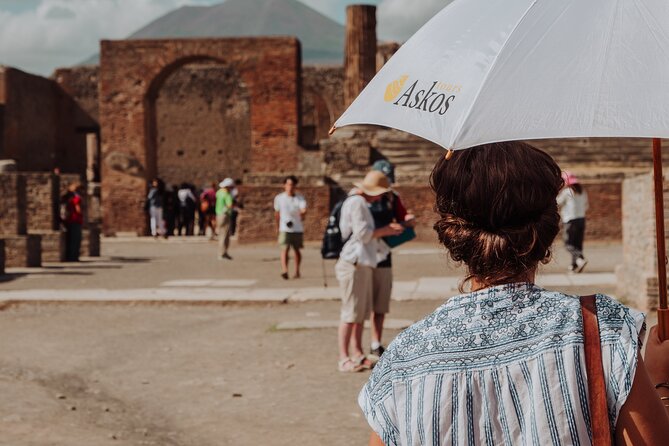
You meet the guide at the main entrance of the archaeological site called Porta Marina Superiore. The guide will be holding a sign for Askos Tours at that point. The tour ends at Piazza Esedra, so you are not stuck returning the same way you came in.
The group is capped at 20 people per guide. That is big enough to meet other visitors, but small enough that your guide can actually track questions and pace. If your brain likes to ask why this building was here or how daily life worked, this matters.
Headsets are included for groups of 16 or more. You will often hear people say the earphones help a lot, especially when you are in busy areas. It is still smart to stand where you can hear best, rather than getting pulled to the side for photos.
Stop-by-stop: from the entrance to the Forum main square
Stop 1: Archaeological Park of Pompeii (Porta Marina Superiore)
This is the orientation moment. Your guide sets the tone and helps you recognize what you are about to see. Since Pompeii is huge, this first introduction is what makes the rest of the walk feel organized rather than chaotic.
Stop 2: Foro de Pompeya (the main square)
The Forum is the civic heart. On your tour, you will treat it less like a single sight and more like a hub connecting other places. You will usually get explanations that help you understand why public squares and major buildings mattered to everyday Pompeians.
If you are short on time, this is a smart choice. Hitting the main square early helps your brain build a map of the city while you still have momentum.
Basilica, Lupanar, and granaries: power, commerce, and uncomfortable realities
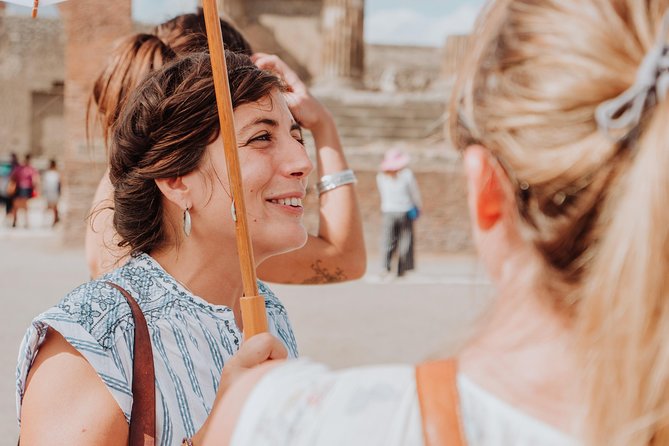
Stop 3: Basilica
Even without going deep into paperwork details, the Basilica gives you a feel for how Pompeii handled public business. This is where you start to see the city as a system, with spaces designed for meeting and decision-making.
Stop 4: Lupanar
This one is famously sensitive. Your guide will explain the site’s function as a brothel, and you will get context for how sex work shows up in ancient cities. If you are traveling with kids, you will want to judge how your family handles mature topics, since this stop is part of the standard route.
Stop 5: Granaries of the Forum
Food storage tells a different kind of story than temples and theaters. When you look at granaries, you are thinking supply chains, stability, and what a city needs to survive. This stop also helps you connect public life with basic needs, which makes Pompeii feel less like a set of random ruins.
The trade-off here is time. Each stop is only about 10 minutes. You will get clear context, but you will not get the luxury of lingering in one spot for half an hour.
Houses of Menander and Faun: private life after the public square
Stop 6: House of Menander
This house gives you a look at elite domestic space. Your archaeologist guide will help you interpret how these homes were used and what kinds of design choices signaled status. You might find the explanation makes the ruins feel less like fragments and more like a lived-in setting.
Stop 7: House of the Faun
The House of the Faun is another major household stop. Even when you are not obsessed with architecture, the guide’s commentary helps you notice the shift from civic buildings to private rooms and courtyards. It’s one of the points in the tour where you start understanding Pompeii as a whole city of different social layers.
If you love houses because you like how people actually lived, this is where the tour starts to feel extra satisfying.
Stabian Baths (Terme Stabiane): heat, routine, and community
Stop 8: Stabian Baths (Terme Stabiane)
Baths are one of the most human parts of Pompeii. You see a complex built around routine, hygiene, and social time. Your guide will talk through how these spaces worked, which helps you picture daily habits rather than just staring at walls.
This is also a good moment to remember that you are doing a lot of walking. In summer, the area can feel hot fast. People recommend bringing a fan and a refillable water bottle, and you can often refill from fountains.
Via dell’Abbondanza and Thermopolium VI: streets you can almost hear
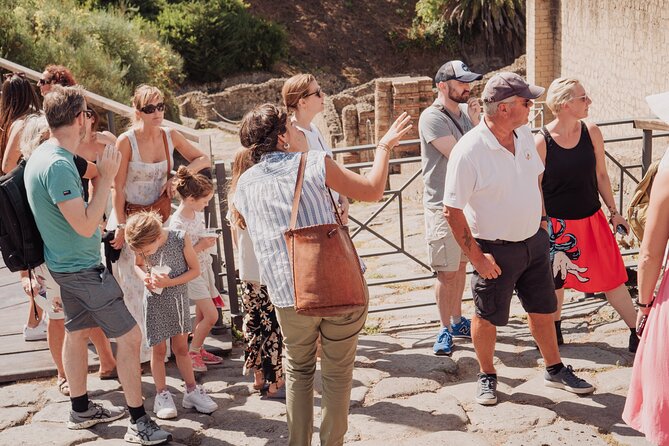
Stop 9: Via dell’Abbondanza (the main street)
This street is where Pompeii starts to feel like a place with motion. The guide’s explanations help you understand how streets shaped daily life, from where people traveled to how buildings related to the road.
Stop 10: Thermopolium VI
A thermopolium is basically an ancient fast-food and drink stop. Seeing it in context is useful, because it connects the city’s commercial side with real consumer behavior. Your archaeologist guide will frame what you see so it feels like everyday life, not just another labeled ruin.
If you like “stop-and-reset” moments where the tour feels practical, these two stops do the job. They slow your brain down just enough to process the city as a system.
Teatro Grande and Casa dei Vettii: public performance, then private wealth
Stop 11: Teatro Grande (the theatre)
Theatre shows you public culture and shared experience. In a short tour window, the theatre stop is your chance to understand what people gathered for and how public spaces created community. Expect a clear explanation that points out the theatre’s role, not just its size.
Stop 12: Casa dei Vettii (House of Vettii)
This final house stop brings you back into private space and social status. The guide typically uses it to connect earlier household examples to what makes this style of home meaningful in Pompeii’s story.
Finishing with a house is a strong closer. It gives you a last mental picture that stays with you when you leave, instead of ending on a single type of space only.
The archaeologist advantage: what you gain in real terms
You might think a good guide just adds fun facts. Here, the biggest benefit is timing and structure. The route hits a range of spaces, civic, commercial, domestic, and entertainment, and the archaeologist keeps explaining as you go.
That is why you will hear people rave about guides like Mario Celentano, Alexandra, Julia, Ilaria, Diego, Rosanna, Teresa, and Antonio. The common thread in those comments is clarity, patience for questions, and a sense of pacing that keeps the tour from becoming either a rush or a lecture.
There are two practical takeaways for you:
- If you have questions, ask them. The small group format is built for that.
- If you are easily overwhelmed, rely on the headset audio and let your guide provide the structure. Pompeii is visually loud.
One caution from the same type of feedback you want to take seriously: if crowds rise and audio gets harder, you may feel you miss parts. Stand close enough to hear, and do not plan to multitask with loud street-side photos.
Walking reality check: uneven ground, heat, and how to prep
Pompeii rewards preparation. The walking can be more intense than you expect, with uneven surfaces throughout the site. Wear shoes with good grip and plan for lots of steps even though the tour is only about 2 hours.
For summer visits, bring a fan and a refillable water bottle. People also recommend an umbrella or hat for shade. If you forget, you can still find fountains for water, but you will enjoy the tour more if you start hydrated.
Also note that transportation is not included. This tour is meant to be part of your Pompeii day, so make sure your schedule includes time to get to the meeting point and time to regroup after you finish at Piazza Esedra.
Who this Pompeii tour is best for
This works especially well if you want:
- A fast orientation to Pompeii’s major highlights without spending hours studying maps
- A guided explanation that helps you connect buildings to daily life
- A group experience with enough breathing room to ask questions, since the max group size is 20
- An English tour format (and headsets if your group is 16 or more)
It also tends to be family-friendly in practice. Guides have been praised for how well they explained things to kids and kept the mood positive. Still, remember the route includes mature themes at the Lupanar, so you will want to decide what works for your family.
If you are hoping for a slow, museum-style experience, or you specifically want to focus on areas under active excavation, you may prefer a private option or a longer tour format. This one is built for breadth in a short window.
Should you book this Pompeii tour?
Yes, I think you should book it if your goal is to see a lot of Pompeii highlights with context, without spending the day figuring everything out alone. The combination of skip-the-line admission, a small-group archaeologist-led approach, and a route that hits civic, domestic, and public life is strong value for the time.
Book it with one expectation set: you are touring a major site in about 2 hours, so you will not linger. If your ideal day includes slow wandering, deep room study, or specialized focus beyond the standard highlights, you may want a longer or private format instead.
FAQ
What is included in the Pompeii admission for this tour?
Pompeii admission is included in the price, and the tour also includes a dedicated guide.
Is this tour offered in English?
Yes, the tour is offered in English.
How long is the tour?
The tour is about 2 hours.
Do I get a ticket on my phone?
Yes, you receive a mobile ticket.
Are headsets provided?
Headsets are provided for groups of 16 or more.
Are service animals and dogs allowed?
Service animals are allowed. Dogs are permitted only if they do not exceed 10 kg in weight and a maximum height of 40 cm, and they must be on a leash. Inside buildings, dogs must be held in the arms, and it is mandatory to collect their excrement.
More Tour Reviews in Pompeii
- Pompeii Small Group Tour with an Archaeologist★ 5.0 · 6,593 reviews
- Discover the Ancient Ruins of Pompeii: Day Trip from Rome★ 3.5 · 2,247 reviews
- Pompeii and Herculaneum Small Group Tour with an Archaeologist★ 5.0 · 1,350 reviews
- Skip the Line Guided Tour of Pompeii led by an Archaeologist★ 5.0 · 703 reviews
- Pompeii Ticket + Tour with Optional Tasting Experience at Pompeii★ 5.0 · 663 reviews
Pompeii with an Archaeologist
- Pompeii Skip-the-line Tour with Archaeologist Guide★ 5.0 · 559 reviews
- Complete Pompeii Skip the Line Tour with Archaeologist Guide★ 4.5 · 379 reviews
- Pompeii Private Tour with an Archaeologist Guide★ 5.0 · 184 reviews
- Tour in the ruins of Pompeii with an archaeologist★ 5.0 · 150 reviews
- Semi – Private Tour of Pompeii with an Archaeologist★ 5.0 · 99 reviews
More ways into Pompeii Archaeologist Tours.
 ★ 5.0Pompeii Skip-the-line Tour with Archaeologist GuideFrom $71559 reviews
 ★ 4.5Pompeii: Tour with Archaeologist Guide & Skip-the-Line EntryFrom $57478 reviews
 ★ 4.5Complete Pompeii Skip the Line Tour with Archaeologist GuideFrom $71379 reviews
 ★ 5.0Pompeii Private Tour with an Archaeologist GuideFrom $178184 reviews
 ★ 5.0Tour in the ruins of Pompeii with an archaeologistFrom $338150 reviews
 ★ 5.0Semi – Private Tour of Pompeii with an ArchaeologistFrom $3699 reviews
 ★ 5.02.5-Hour Guided Tour of Pompeii with an ArchaeologistFrom $7178 reviews
 ★ 4.9Positano: Old Town Walking Tour with Archaeologist GuideFrom $11233 reviews
Other useful routes from here