
REVIEW · POMPEII ARCHAEOLOGIST TOURS
2 Hours Pompeii Group Tour with Archaeologist Guide and Skip the Line
Pompeii can feel overwhelming at first. This tight 2-hour tour gives you a focused route through the big, unforgettable sights, with an archaeologist guide and skip-the-line help at the ticket office. I especially like the way the route is arranged so you see major landmarks without spending your whole day stuck in queues, and I also like the small group feel, up to 15 people. The only drawback to think about is that it is a whistle-stop overview, so you will not have time to linger everywhere.
The meeting point is easy to find, at Ristorante Suisse in Piazza Esedra, and the tour ends back there. In the walk from stop to stop, guides like Mariagrazia, Eliana Sandretti, Luciana, and Luisa are repeatedly praised for making Pompeii readable, from everyday jobs to grand public spaces.
If you expect a slow, museum-style pace, this may feel too fast. But if you want the highlights, with interpretation that turns ruins into scenes, it is a smart use of limited time.
Key things I think are worth knowing first
- Skip-the-line ticket help at the ticket office, so you start seeing Pompeii sooner.
- Small groups (max 15), which usually means fewer stops while everyone catches up.
- A route built around Pompeii’s daily life, not just temples and big monuments.
- Stops include a mix of theaters, baths, houses, and the Lupanar for the full social picture.
- You get a quick look at Pompei 3D, which can help you visualize the city.
- Timing is tight, with several stops around 5 to 15 minutes each.
Entering Pompeii: why the skip-the-line piece matters
Pompeii is famous, which means it is also famous for long lines. This tour does not just hand you a ticket. It specifically includes skip the line to purchase tickets on site, so you avoid the slow start that can drain your energy before you even enter the ruins.
You still need to pay the entrance ticket separately: 18 euros for adults, free for minors (minors must bring an identity card). Once you clear that, your guide keeps you moving and oriented. With a 2-hour total duration, saving time at the start is not a luxury. It is the difference between a good overview and a stressed overview.
One practical detail: the tour uses a mobile ticket, and confirmation is sent at booking. It is the kind of setup that works well when you are juggling other parts of your trip.
The meeting point at Ristorante Suisse in Piazza Esedra
The tour starts at Ristorante Suisse, Piazza Esedra 10/13, 80045 Pompeii. The good news is that this is a clear landmark, and the tour ends back at the same point.
If you are using public transport, this area is marked as near public transportation, so you are not forced into an all-taxi day. In a place like Pompeii, that matters. You do not want your logistics to eat into your tour time.
Also note the tour format: it is for groups up to 15 travelers, and it is offered in English. That mix tends to create a calmer pace than the big bus crowds.
Vicolo di Gladiatori: where the legends trained
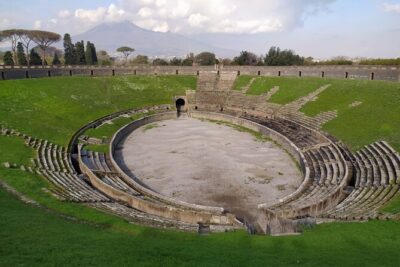
Your first stop is Vicolo di Gladiatori, the Gladiators’ Barracks area. This is one of the most evocative parts of Pompeii for many people because it feels like it should smell of sweat and metal. In practical terms, it is also a good early stop, because it sets a theme for the tour.
You spend about 10 minutes here. That is enough time to understand what the space was used for and to notice the layout the guide points out, even if you cannot read every inscription yourself.
What I like about starting here is the contrast. Pompeii is not only shattered buildings and romance. It also has real training spaces and real entertainment culture. A good guide helps you connect gladiators to the city around them, not just to the headline.
Fullonica di Stephanus: Roman laundry is weirder than you think
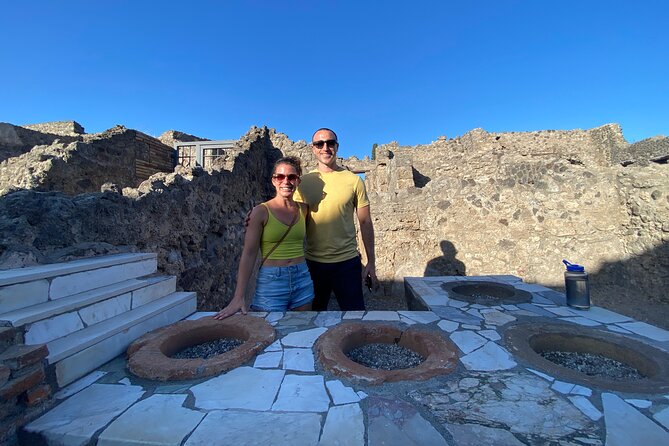
Next up is Fullonica di Stephanus, often called the most famous laundry in Pompeii. This is a short stop, around 10 minutes, but it is one of the most memorable because it is so specific.
You get a clear explanation of how Romans washed clothes and what materials were used for the process. Even if you are not the type to get excited about laundry, this stop is valuable because it anchors Pompeii’s scale in everyday work.
One downside to this kind of stop: if the group moves quickly, you may want to take photos fast and then rely on the guide’s storytelling to fill in details. Still, it beats passively walking past a site with no context.
Tempio di Giove Capitolino and the Forum rhythm
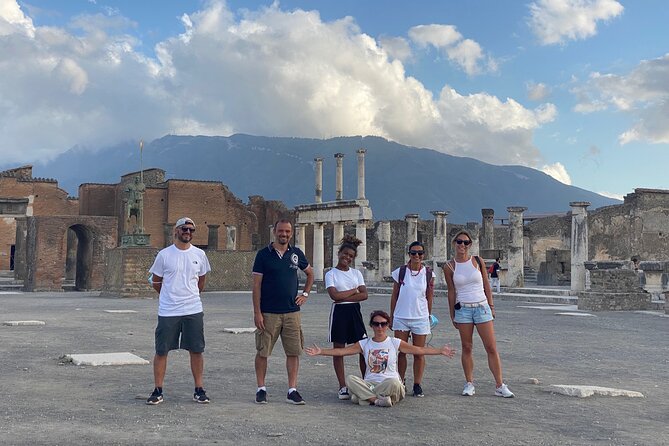
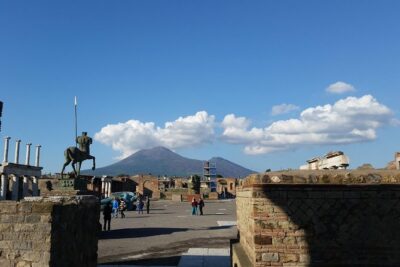
Then comes Tempio di Giove Capitolino, the temple tied to the cult practices held in the large forum. You get about 5 minutes at this stop.
This is one of those places where time is tight but direction helps. A quick visit is enough to appreciate why it is a symbol of Pompeii and why the forum mattered in the morning when Romans did both mercantile and religious activities.
For me, this is an important pivot point. The tour is not only about spectacle like theaters. It also shows you civic life, including where people gathered for commerce and worship.
Odeon and Teatro Piccolo: musical events in an intimate setting
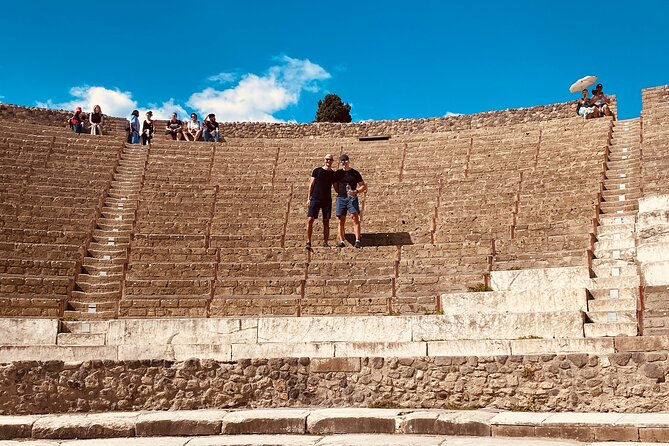
Your itinerary includes Odeon – Teatro Piccolo. You have about 15 minutes here, which is a healthy chunk for a theater stop.
This theater is described as a venue for musical events, and musical instruments were found inside. Some of those instruments are currently in the Antiquarium, but the stop still works because it tells you what kind of performances the space likely supported.
A practical note: theaters can be confusing if you just stare at stone seating. A guide can help you picture sound and crowd position. If you get that kind of explanation, a 15-minute stop becomes the most “alive” feeling part of the route.
Teatro Grande: the biggest stage in Pompeii
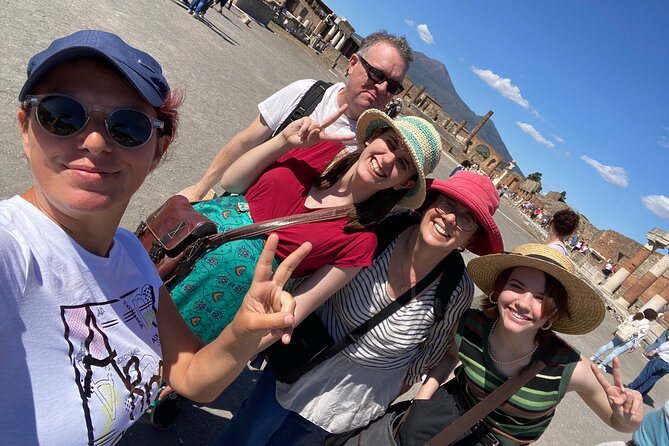
Next is Teatro Grande, the largest theater in Pompeii. You get about 10 minutes here, and the site is noted as being totally renovated thanks to grants from the Gens Holconia, one of the important families of Pompeii.
Even in a brief stop, the size gives you instant context. It is the show-off theater, the place where major dramas and theatrical comedies would have played.
The value here is understanding why Roman entertainment is also political and social. The stage is not separated from the city. It is part of how people lived together.
Casa del Menandro: frescoes and the luxury side of town
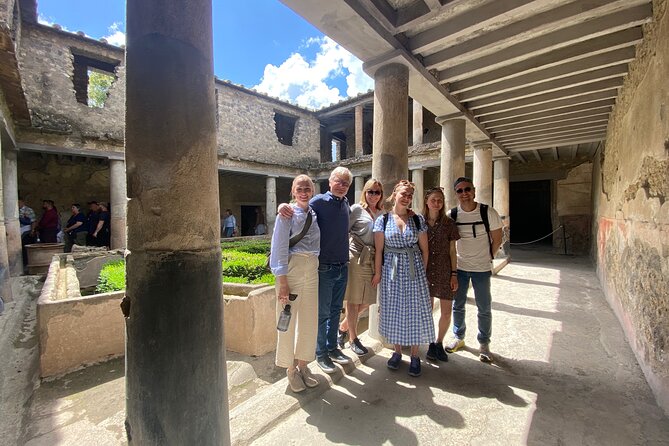
Then you step into Casa del Menandro, a luxury Roman house known for frescoes, decorations, and sculptures. You get about 15 minutes here.
This is a big mood shift from theaters. It answers the question that many people have early on: who lived in places like this? The guide’s job is to connect the house features to daily life, so you are not just looking at art fragments behind rope lines.
The trade-off is time. Houses in Pompeii reward slow looking. With 15 minutes, you will see the key rooms and the highlights, not every corner. If you want more depth, this tour is best as your starter course, then you can return later on your own with the sights you care about most.
Lupanar: reading Pompeii’s franker side
No Pompeii highlights route would be complete without the Lupanar, one of the most famous brothels in the world, with original frescoes showing scenes from the Kamasutra.
You spend about 15 minutes at this stop. It is not a comfortable topic for everyone, but it is historically important because it shows that Pompeii’s society included sex work, desire, and commerce in a very direct way.
A good guide helps you stay respectful while still making sense of what you are seeing. If your goal is a complete picture of Roman urban life, this stop matters.
The Temple of Venus, plus more religion corners
The itinerary includes the Temple of Venus, noted as partly destroyed during the Second World War. The time here is not specified in the itinerary details you provided, but expect a shorter, structured pause rather than a long exploration.
This kind of stop is useful because it adds another layer to the city’s religious map. Pompeii has multiple worship centers, and Venus is one of the names people recognize, which helps you connect the ruins to the stories your guide is telling.
Pompei La Basilica: justice in the public square
Next is Pompei La Basilica, described as the place where justice was administered near the main square. You get about 15 minutes.
This is a strong stop for the “how a city worked” goal. A theater entertains. A temple worships. The basilica governs. A guide can make this click quickly by pointing out how public buildings shape daily behavior.
If you only ever think of Pompeii as a tragic archaeological site, the basilica forces you to see it as a functioning city with rules, systems, and public space.
The streets of Pompeii: shops, markets, and walking context
Your route also includes time along the street full of shops, described as the main street of the archaeological site, plus “one of the streets of Pompeii.” You also visit the city market, located near the large forum, where goods were purchased to be resold in shops.
These are not long stops, but they are crucial. They give you the sense of movement, density, and business. Without these, Pompeii can feel like a set of isolated monuments.
In a practical sense, these streets also help you understand why stopping at theaters and houses makes sense. People did not live at the monuments. They lived along the routes between them.
Stabian Baths and Pompei 3D: washing, relaxing, and visualizing
Then you move to the Stabian Baths (Terme Stabiane). You get about 15 minutes here, and the note is that these are the first baths built in Pompeii, still showing casts and frescoes.
Baths are one of those topics where everyone understands the idea, but few people know the details. This stop gives you a glimpse of how Romans relaxed, cleaned up, and used communal spaces.
After that, you have a 5-minute stop at Pompei 3D, described as Bodies of Pompeii. Even though it is short, a 3D component can help your brain hold onto what you are seeing on the ground. Ruins look different when you can add reconstruction and scale in your head.
Temple of Apollo: a familiar name, a different stop rhythm
The tour finishes (within the route) at the Temple of the Apollo deities, described as one of the most popular in Pompeii. Again, the exact time is not specified, but this is part of the structured loop of major anchors.
If you are learning Pompeii for the first time, Apollo helps you build a simple mental map: temples are spread through the city, and each one signals a different piece of cultural life.
Then you head back to the meeting point at Ristorante Suisse.
How much time you really get at each stop
Because the overall duration is about 2 hours, the tour is designed as a set of quick, high-impact visits. Several stops are around 10 to 15 minutes, including the theaters, house, Lupanar, basilica, baths, and Odeon/Teatro Piccolo.
Other stops like Tempio di Giove Capitolino are shorter at about 5 minutes. That is not a problem if you expect an overview. It becomes a problem if you want to slow-roll photo by photo.
If you like to take lots of pictures and read inscriptions, keep expectations realistic. This tour helps you choose what to zoom in on later.
Price and value: what you are paying for
The tour price is listed at $132.03 per person and the entrance ticket is 18 euros per adult (free for minors with identity card). On paper, that looks like two separate payments.
In value terms, the tour fee is paying for three things you would struggle to replicate easily on your own in a short window:
- an archaeologist guide who interprets what you see,
- skip-the-line ticket purchase help, which saves time,
- and a small group route that moves you through the key sights.
So yes, you will likely spend more than the headline price once you add the entrance ticket. But you are also buying time and context. For many first-timers, that combo is exactly what makes the money feel justified.
Who this Pompeii tour is best for
This is a great fit if:
- you have limited time and want a strong first pass through Pompeii,
- you want interpretation instead of just wandering,
- you like a tight route that gets you to multiple major areas without long waits.
It can be a good family option too, with guides praised for patience with four young kids and for accommodating when kids got too hot. Since the tour notes that most travelers can participate and that service animals are allowed, it is also broadly inclusive in basic terms.
If you already know Pompeii well and you want deep room-by-room detail, you might find 2 hours too short. In that case, you might prefer a longer guided visit or a self-paced day.
Should you book the 2-Hour Pompeii tour with archaeologist guide?
I would book this if you are aiming for a smart overview. The skip-the-line component plus the tight route through gladiators, baths, theaters, homes, and daily-life spaces is the right package for a short stay.
I would hesitate if you know you need slow time to read and photograph. The good news is that this style of tour gives you a shortlist of what to return for later.
If you want Pompeii to feel like a city you can picture, not just stones you walk past, this is a strong choice.
FAQ
Is the Pompeii entrance ticket included?
No. The entrance ticket costs 18 euros per adult and is free for minors. Minors must bring an identity card.
What does the skip-the-line feature cover?
It covers skipping the long queue at the ticket office to purchase tickets on site. Your entrance ticket payment is still separate.
Where do we meet for the tour?
The meeting point is Ristorante Suisse, Piazza Esedra 10/13, 80045 Pompei. The tour ends back at the same location.
How long is the tour, and is it in English?
The tour lasts about 2 hours and it is offered in English.
How big is the group?
This is a group tour with a maximum of 15 travelers.
What if I need to cancel or the weather is bad?
You can cancel for a full refund if you cancel up to 24 hours in advance. The experience requires good weather, and if it is canceled due to poor weather, you are offered a different date or a full refund.
More Tours in Pompeii
- Pompeii Small Group Tour with an Archaeologist★ 5.0 · 6,593 reviews
- Pompeii and Herculaneum Small Group Tour with an Archaeologist★ 5.0 · 1,350 reviews
- Skip the Line Guided Tour of Pompeii led by an Archaeologist★ 5.0 · 703 reviews
- Pompeii Ticket + Tour with Optional Tasting Experience at Pompeii★ 5.0 · 663 reviews
- Pompeii private tour with an Official Guide★ 5.0 · 631 reviews
More Tour Reviews in Pompeii
- Pompeii Small Group Tour with an Archaeologist★ 5.0 · 6,593 reviews
- Discover the Ancient Ruins of Pompeii: Day Trip from Rome★ 3.5 · 2,247 reviews
- Pompeii and Herculaneum Small Group Tour with an Archaeologist★ 5.0 · 1,350 reviews
- Skip the Line Guided Tour of Pompeii led by an Archaeologist★ 5.0 · 703 reviews
- Pompeii Ticket + Tour with Optional Tasting Experience at Pompeii★ 5.0 · 663 reviews
Pompeii with an Archaeologist
- Pompeii Skip-the-line Tour with Archaeologist Guide★ 5.0 · 559 reviews
- Explore Pompeii with an Archaeologist★ 5.0 · 511 reviews
- Complete Pompeii Skip the Line Tour with Archaeologist Guide★ 4.5 · 379 reviews
- Pompeii Private Tour with an Archaeologist Guide★ 5.0 · 184 reviews
- Tour in the ruins of Pompeii with an archaeologist★ 5.0 · 150 reviews
More ways into Pompeii Archaeologist Tours.
 ★ 5.0Pompeii Skip-the-line Tour with Archaeologist GuideFrom $71559 reviews
 ★ 5.0Explore Pompeii with an ArchaeologistFrom $35511 reviews
 ★ 4.5Pompeii: Tour with Archaeologist Guide & Skip-the-Line EntryFrom $57478 reviews
 ★ 4.5Complete Pompeii Skip the Line Tour with Archaeologist GuideFrom $71379 reviews
 ★ 5.0Pompeii Private Tour with an Archaeologist GuideFrom $178184 reviews
 ★ 5.0Tour in the ruins of Pompeii with an archaeologistFrom $338150 reviews
 ★ 5.0Semi – Private Tour of Pompeii with an ArchaeologistFrom $3699 reviews
 ★ 5.02.5-Hour Guided Tour of Pompeii with an ArchaeologistFrom $7178 reviews
Other useful routes from here