
REVIEW · HISTORICAL TOURS
Pompeii Walking Tour: The Real History of the Ruins
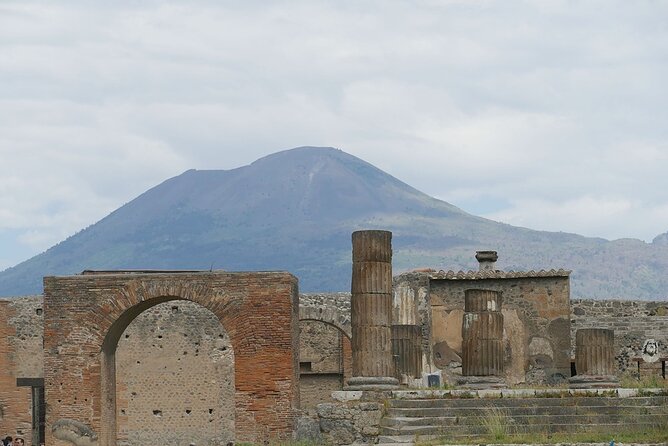
Pompeii hits fast, before you even buy water. This 2-hour Pompeii walking tour takes you into the city buried by Vesuvius in AD 79, with a guide who helps you read the ruins like a living neighborhood. You move from major public spaces to private homes, and you do it on a route that stays realistic for a morning visit, with admission tickets included.
I love the small group pace and the way the tour ties buildings to daily Roman life. Two stops that really land are the Teatro Grande, where you can picture comedy and other stage forms, and the Stabian Baths, where the male and female areas are still distinguishable.
One thing to plan for is timing. The experience is scheduled around a set departure and a meeting point, and it can run later than you expect, so arrive early and keep your schedule flexible for that 10.30 am start window.
Key things to know before you go
- A 2-hour route that actually fits Pompeii: you get a tight tour without trying to cover everything
- Tickets are included: you do not have to manage separate admissions
- Teatro Grande plus Odeon included: you get both big theater structures in the same circuit
- House-to-forum variety: domus, baths, brothel, and public buildings in one walk
- Errotic art is part of the story: the Lupanar murals are famous, so expect a sensitive stop
Price and logistics: what $42.05 buys you in Pompeii
At $42.05 per person for about 2 hours, this tour is aimed at good value through simplicity. You get an entrance ticket plus a guided visit, and that matters in Pompeii because the park can eat your time if you are figuring out access on your own.
It runs in English and is designed for a moderate group size, with a maximum of 35 people. That is not small enough to feel like a private tour, but it is small enough that a guide can keep the group together at walking speed, while still pointing out specific details inside each site.
It starts daily at 10.30 am from the InStazione help desk area. Your tour ends at Scavi di Pompei, Viale delle Ginestre. Planning tip: if you are also visiting Naples or the train station that morning, give yourself a cushion. Even when tours list a clear time, the reality in Pompeii is that crowds, check-in flow, and site movement can shift when you are actually inside.
From InStazione to Porta Anfiteatro: getting your bearings fast
The tour begins with check-in at InStazione, and then you walk as a group to the entrance at Porta Anfiteatro. That first transfer is useful because Pompeii is not just ruins, it is a whole urban grid. When you arrive as a group, you spend more time seeing what matters and less time wandering.
Once you are through the entrance and moving with the guide, the context clicks into place. Pompeii is often described as a city frozen in time, but the stronger idea is this: in AD 79, volcanic ash and debris buried a living Roman town. Your guide’s job is to turn what looks like scattered stone into a sense of layout and routine.
A nice touch is that the tour does not treat the stops as separate islands. You move from theaters to streets to homes, then into baths and public life. That order helps your brain build a map instead of just collecting photos.
Teatro Grande and the Odeon: picture performances under Vesuvius ash
One of the most satisfying parts of this tour is that it does not rush through the entertainment zone. You visit the Teatro Grande and also the Odeon, and you learn how they relate to the culture of Pompeii.
The Teatro Grande was a Roman theater buried by the eruption of Vesuvius in 79 and later discovered during archaeological excavations. In the theater, comedies, mimes, pantomimes, and other stage forms were performed. When you stand where those performances happened, it is easier to imagine that ancient Pompeii was not quiet. People gathered, watched, laughed, and socialized in scheduled public time.
Then you move to the Odeon. The tour information connects it to the time of the Samnite city’s deduction and the Roman colony period, which is a reminder that Pompeii changed under Roman control. So these theaters are not only about art, they also track political and cultural shifts.
How to get more out of it: pause when the guide points out how the theater space is organized. Even if you cannot reconstruct every detail perfectly, understanding the shape of seating and the idea of staging makes the ruins feel purposeful instead of random.
Via Stabiana and the cobblestone street: walk where feet once went
After the theaters, you head toward Via Stabiana, a preserved cobbled street with sidewalks and pedestrian walkways. This is one of those moments where Pompeii stops being abstract and becomes physical.
The guide points out how shops and houses line the route. When you see a real stone street surface, you understand the scale of daily movement. This was not a scenic ruin. It was a working city street, complete with foot traffic, storefront activity, and neighborhood life.
What makes this section especially valuable on a walking tour is the pacing. You do not just stand and look. You move along the street corridor long enough to understand direction and rhythm. You start to recognize how the city’s layout connected commercial areas and residences.
If you like street-level history, this is a highlight. If you are mostly into the big landmark sites, this part still helps because it grounds everything else you will see.
Casa del Menandro: a wealthy domus and its name from Greek art
The tour then brings you to Casa del Menandro, a large urban domus of ancient Pompeii, nearly 1,800 m². That size alone signals wealth and status. This house was excavated in the years 1926 to 1932, and it gives you a clear example of what a prosperous Pompeian home looked like.
The name comes from a depiction of the Greek poet Menander that was found there. That detail matters because it is easy to treat Roman homes like generic rooms, but this house tells you something about cultural taste and imported ideas. You are looking at a wealthy family home where Greek influence could appear in art and decoration.
You typically have about 15 minutes here. That is enough time to get the overall sense of layout and key decorative elements without feeling trapped in one room. If you want to take photos, this is also a good stop to do it quickly and keep moving, because the tour keeps a steady flow and you will want that attention later in the Forum area.
Stabian Baths: Roman hygiene, sex-segregated spaces, and old age
Next comes one of the most memorable learning moments on the route: the Stabian Baths (Terme Stabiane). This bath complex was buried by Vesuvius and is considered the oldest building of its kind in Pompeii.
The tour emphasizes that the male and female sectors are perfectly preserved. That detail is powerful because it turns baths into more than architecture. You start to see daily routines and social structure. Bathhouses were public, but not identical for everyone, and you can often read those cultural choices directly in the layout and preserved areas.
You get about 15 minutes at this stop, which is a practical amount for a site that can feel technical if you go too slow. The guide’s perspective helps you notice what to look for: how sections relate, what the building implies about routine, and why bathhouses were central to Roman city life.
Tip for your visit: watch your footing. Ancient surfaces can be uneven, and you will be on your feet for the full route.
The Lupanar: when Pompeii gets uncomfortable, and why it matters
Then the tour moves to the Lupanar, one of Pompeii’s most talked-about structures. In Roman times, lupanari were places dedicated to mercenary sexual pleasure, essentially houses of tolerance. Some of these spaces are still visible in the ruins, and the walls include famous erotic scenes.
This stop lasts about 10 minutes and it is fast, which is good. It also means you will not overstay it. Still, be ready for the fact that Pompeii includes material that is not comfortable for everyone. The value of seeing it on a guided tour is that you can understand it in context instead of treating it like shock value.
If you are visiting with kids or you have strict boundaries about adult themes, you can use that knowledge to decide whether you want to join this part fully. The tour includes it as a scheduled stop, so it is not something you can count on skipping without impacting your flow.
Forum of Pompeii, Temple of Jupiter, and the Basilica courtroom feel
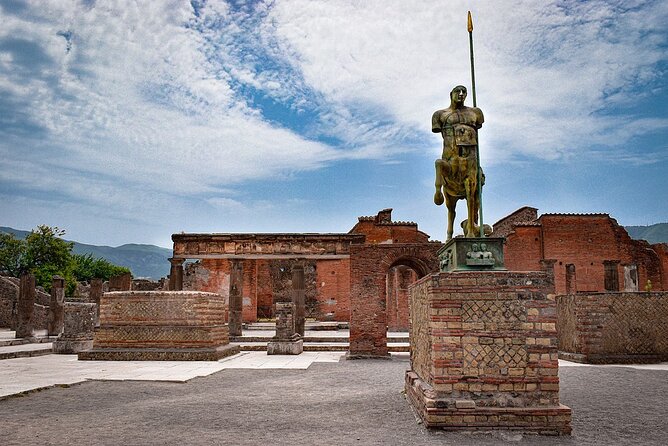
After the more personal spaces, the tour shifts to the city’s public center: the Forum of Pompeii. It was built around the 4th century BC during the Samnite era near key road junctions, with roads leading toward Neapolis, Nola, and Stabiae.
You then learn how Roman conquest changed the space. The Forum was rebuilt and enlarged, especially around the 2nd century BC. Shops and parts of the previous layout were demolished, and new political and religious buildings took their place around the square.
The stop includes key religious and administrative structures. One is the Temple of Jupiter, later connected to the Capitolium idea and dedicated to Jupiter, Juno, and Minerva. The tour information also notes the erarium, a public treasure stored in the temple basement. That detail helps you understand that religion and money were tightly linked.
Next comes the Basilica, a major public building dating to the 2nd century BC era. In practice, it functioned like an indoor forum, useful when weather pushed people inside. You will also learn about the tribunal where the judge was elevated above the parties. There is a practical detail here: the judge’s area could be reached by a wooden staircase that helped prevent condemned people from attacking the judge.
This is one of the stops that rewards a guided explanation. Without context, it can read as a large hall. With context, it becomes a picture of how law and civic decisions were staged.
The time here is short, about 5 minutes at each keyed area, so focus on what the guide points out. If you try to personally read every fragment, you will miss the meaning.
Temple of Apollo and the grain market logic behind the granaries
The tour then heads to the Temple of Apollo. The cult of Apollo reached Italic populations through the Greek world. The tour info notes that just before the eruption, the cult had lost followers as Jupiter’s importance in the Capitolium grew.
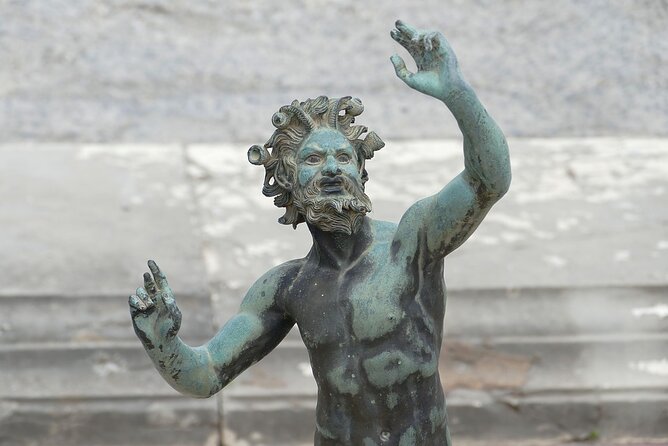
In front of the temple area, you can clearly see a bronze statue of Apollo represented as an archer, and you can also observe a statue of the goddess Diana. This pairing makes the symbolism easier to grasp, and it connects Roman religious life to broader Mediterranean influences.
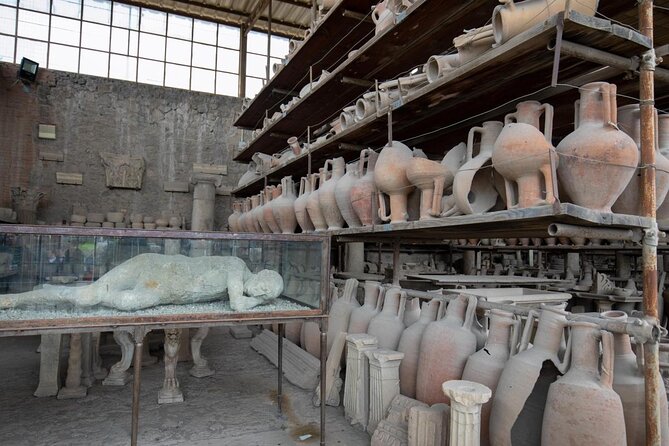
Finally, you reach the granaries area, which in the past served as a market for cereals and legumes. Today, it is an archaeological deposit of materials found during excavations. A key point is that no traces of plaster were found there, which led to the belief that parts of the structure were not finished at the time of the eruption.
One of the most interesting practical history details here is the ponderary table, where tools were stored to ensure correct exchanges and to convert different measurement units used across the empire into units valid in Pompeii. That tells you Pompeii was connected to wider trade networks, not sealed off.
If you like the nuts and bolts of how people lived and bought food, this stop is a standout. It turns “ruins” into a story about daily economy and standardized measurement.
Who this tour suits best, and who might prefer a different pace
This Pompeii walk is a strong choice if you want a guided overview that moves through a mix of places without requiring you to plan each step. You’ll get theaters, streets, wealthy homes, baths, the Forum, major temples, and the working logic of the granaries. In other words, it gives you Roman city life in a compact loop.
It is also a good fit if you want English commentary and a guide who can keep the story moving. Several guides on this route have a reputation for being engaging and clear, with a sense of humor that helps people stay focused through the 2-hour timeframe. Names you might see include Grace, Frederica, Vincenzo, and Igor, each known for strong presentation and good group energy in the time you have.
You might want a different style of tour if you feel the need to linger in one place for a long time. This route is built on short timed stops, so it will feel brisk if you prefer slow wandering and independent exploration.
What to do before you go, to make the 2 hours feel longer
Pompeii can be physically demanding, even when the tour is only around 2 hours. Wear shoes with grip and plan to keep moving. Bring water, and keep your phone charged if you rely on maps.
Since the tour includes tickets and multiple entry points, you do not need to worry about buying admissions. What you should worry about is keeping your attention during the short segments. The best approach is to treat each stop as a theme:
- Theater as entertainment and public gathering
- Street as movement and neighborhood commerce
- House as wealth and taste
- Baths as routine and social structure
- Lupanar as reality and adult commerce
- Forum and Basilica as law, power, and institutions
- Temple and granaries as religion and everyday economy
When you think in themes, the route starts to feel cohesive instead of like a checklist.
Should you book this Pompeii Walking Tour?
Yes, if you want a guided Pompeii visit that stays organized and gives you context for multiple kinds of ruins in about two hours. The value is strongest because entrance tickets are included and you get a coherent route, not just a name-drop of famous sites. It is also a smart pick for first-time visitors who want to leave with a clear mental map of how the city worked.
I would book with a small dose of flexibility. Arrive early for the 10.30 am start, wear comfortable shoes, and remember that some stops are brief by design. If you are okay with that pace, you will get an efficient, meaningful Pompeii experience that feels like a city story rather than scattered monuments.
FAQ
How long is the Pompeii Walking Tour?
The tour lasts about 2 hours.
What is the price per person?
The price is $42.05 per person.
What time does the tour depart and where does it start?
It departs daily at 10.30 am from the InStazione help desk.
What language is the tour offered in?
The tour is offered in English.
Which sights are included, and are tickets included?
You visit multiple sites including Teatro Grande, Casa del Menandro, Stabian Baths, Lupanar, the Forum area with the Temple of Jupiter, the Basilica, and the Temple of Apollo, plus the granaries area. Admission tickets are included.
Is lunch included?
No, lunch is not included.
How large is the group?
The tour has a maximum of 35 travelers.
Pompeii on Foot
- Pompeii 3 Hours Walking Tour Led by an Archaeologist★ 5.0 · 126 reviews
- Explore Pompeii: 2-Hour Guided Walking Tour with Included Ticket★ 4.5 · 77 reviews
- Pompeii: walking tour with 3D glasses and with entrance ticket★ 4.5 · 61 reviews
- Pompeii walking tour★ 5.0 · 29 reviews
- Small Group Guided Walking Tour of Ancient Pompeii Highlights★ 5.0 · 27 reviews
More Tours in Pompeii
- Pompeii Small Group Tour with an Archaeologist★ 5.0 · 6,593 reviews
- Pompeii and Herculaneum Small Group Tour with an Archaeologist★ 5.0 · 1,350 reviews
- Skip the Line Guided Tour of Pompeii led by an Archaeologist★ 5.0 · 703 reviews
- Pompeii Ticket + Tour with Optional Tasting Experience at Pompeii★ 5.0 · 663 reviews
- Pompeii private tour with an Official Guide★ 5.0 · 631 reviews
More Tour Reviews in Pompeii
- Pompeii Small Group Tour with an Archaeologist★ 5.0 · 6,593 reviews
- Discover the Ancient Ruins of Pompeii: Day Trip from Rome★ 3.5 · 2,247 reviews
- Pompeii and Herculaneum Small Group Tour with an Archaeologist★ 5.0 · 1,350 reviews
- Skip the Line Guided Tour of Pompeii led by an Archaeologist★ 5.0 · 703 reviews
- Pompeii Ticket + Tour with Optional Tasting Experience at Pompeii★ 5.0 · 663 reviews
More ways into Historical Tours.
 ★ 4.5Private Guided Multimedia Exhibition on the History of SorrentoFrom $1590 reviews
 ★ 4.5Guided tour of a historic lemon grove in SorrentoFrom $4871 reviews
 ★ 5.0Guided Tours of Pompeii Excavations Historical and Cultural ItinerariesFrom $5756 reviews
 ★ 5.0Authentic Amalfi Lemon Tour & Tasting in the Historical GardenFrom $4952 reviews
 ★ 4.0Visit Costiera Sorrento Coast Between history and legendFrom $6649 reviews
 ★ 4.9Amalfi Organic Lemon Tour & Tasting in the Historical GardenFrom $5946 reviews
 ★ 5.0Guided tour of the history and tradition of the Sorrento lemonFrom $5920 reviews
 ★ 5.0Full-Day Private History Tour in Amalfi Coast with Pick UpFrom $45111 reviews
Other useful routes from here