

REVIEW · TICKETS
Pompeii Skip-the-Line Ticket and Audioguide
Pompeii feels real fast. This Pompeii skip-the-line ticket plus audioguide setup is a practical way to see one of Italy’s best-known UNESCO sites without spending your whole day stuck in queues. You’ll walk through a city frozen in ash from the 79 AD eruption of Mount Vesuvius, and the audio helps you connect what you see with what life was like nearly 2,000 years ago.
I especially like the included multilanguage audioguide (English, French, German, Italian, Spanish). It lets you choose your pace and follow the ruins in order by entering the number tied to each stop for commentary and context. I also like that you get a Pompeii ruins map, because Pompeii is big, and the right orientation saves time and patience.
One drawback to keep in mind: even with a “skip-the-line” product, you may still need to line up to exchange a voucher and then enter via the ticket desk process. If your main goal is pure queue avoidance, plan to arrive with a little extra buffer and be ready to follow the on-site instructions carefully.
Key highlights and practical wins

- Skip-the-line entry ticket for Pompeii Archaeological Park
- Audioguide in 5 languages: English, French, German, Italian, Spanish
- Numbered audio stops, so you can match what you see to the correct commentary
- Pompeii ruins map included, helping you navigate a large archaeological area
- Meeting point at Pompei Scavi Circumvesuviana station, where the Tempio Travel Office is located
- Valid for 1 day, giving you flexibility once you’re there
Getting oriented at Pompei Scavi Circumvesuviana (the right start)
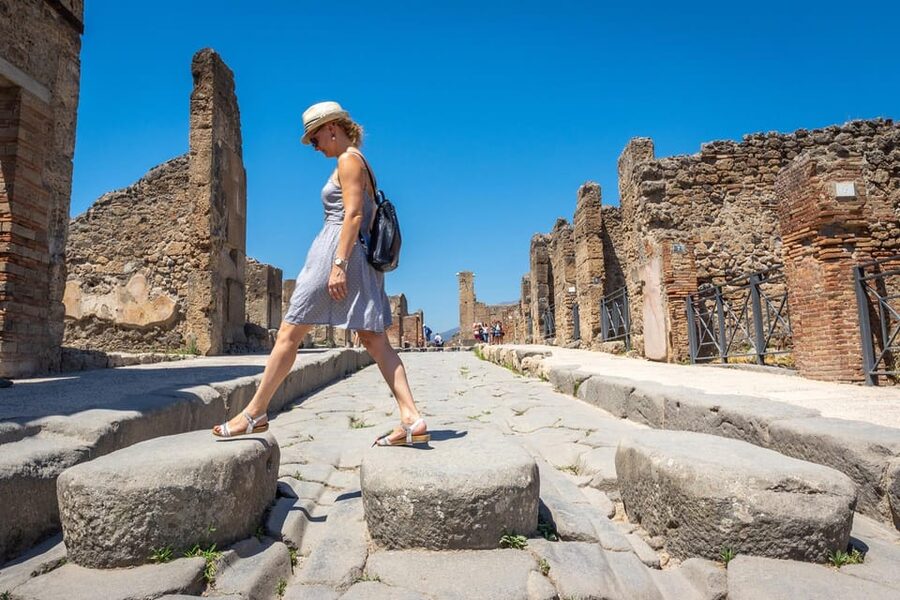
Your experience starts at the Tempio Travel Office at Pompei Scavi Circumvesuviana Train Station. That’s helpful because it anchors everything to a clear, train-station location, which matters in a place like Pompeii where getting turned around is easy.
I suggest you treat the meeting point as your “soft deadline.” If you arrive late, you risk wasting time figuring things out rather than walking the grounds. Bring the ID the activity lists, a passport or ID card, since you’ll need it for the voucher or ticket exchange.
Also, because this is a self-paced park visit with audio, your early minutes really count. The sooner you get into the archaeological area, the more likely you are to enjoy calmer walking and avoid that end-of-day scramble.
Skip-the-line entry at Pompeii, and the one logistics wrinkle
The big promise here is skip-the-line entry to the Pompeii Archaeological Park. In practical terms, that usually means you should spend less time standing before entry. Pompeii can get crowded, and even short delays can drain your energy.
That said, not all “skip-the-line” products feel identical on the ground. One concern that shows up in feedback for this kind of ticket is that the voucher may still require you to stand in a queue for exchange, and then you might stand again at the ticket office. It sounds small, but it’s the difference between feeling like you avoided lines and feeling like you just changed which line you’re in.
My advice: arrive early, keep your voucher confirmation accessible on your phone or printed if you prefer, and plan to follow the exact exchange steps at the station office. If your schedule is tight, consider building in extra time anyway. It’s the simplest way to protect your day.
Your multilanguage audioguide: use it like a guidebook, not background noise

The audioguide is the heart of this experience. It’s multilanguage and designed so you can select stops by entering the number connected to each location. That matters because Pompeii is spread out, and wandering without context can turn into a blurry “walk and hope.”
Pick a language you’re comfortable listening to for longer stretches, not just a language you can survive in. If you want the audio to do its job, choose what you can actually relax into for 1 day.
Here’s how I’d use it:
- Start listening early so you learn what you’re looking at before your eyes get tired.
- Move stop by stop rather than skipping ahead. The audio context is most useful when it matches where you are.
- If you hit a cluster of similar-looking streets or building blocks, let the audio guide your attention to the differences.
The best part is that the audio doesn’t just label things. It provides historical context and details about daily life in a Roman city that was preserved under volcanic ash after Vesuvius erupted in 79 AD. That is the core reason Pompeii hits harder than many other ancient sites.
The Pompeii ruins map: your anti-stress tool
A Pompeii ruins map is included, and I’m glad it is. Pompeii is not the kind of place where you can count on landmarks carrying you the whole way. The map helps you keep your bearings fast, even if you change your route on the fly.
Use the map in two ways:
- Before you start a new audio section, check where that area is relative to your last stop.
- When you pause for photos or a break, look down at the map again so you don’t drift away from your planned path.
This is especially useful if you’re traveling with someone who doesn’t want to wait for you to finish each audio track, or if you want to mix listening with quick wandering.
A practical 1-day Pompeii plan, without overcommitting
This ticket is valid for 1 day, which gives you the breathing room to pace yourself. Pompeii rewards attention, not speed. You can see plenty in a day, but you also want time to actually look.
Because the specific stops on your audio route aren’t listed here, I’ll keep the approach grounded in what the activity is designed to do: you explore Pompeii Archaeological Park with audio commentary and move location to location by entering the corresponding number.
Here’s a practical flow you can copy:
1) First entry zone: orientation and context
When you enter, focus on the basics the audio is likely to give you: what Pompeii was like, how the city layout works, and what the eruption changed. This is the moment to set your mental framework so later details make sense.
If you skip this part, later commentary can feel like facts attached to random ruins. Take the first stretch slowly.
2) Streets and city layout: read the city like a Roman
Once you’re moving through the main stretches, the audio is where the ruins start behaving like a city. You’ll be seeing streets, building fronts, and the physical logic of where people lived and worked.
Pay attention to contrasts: public versus private spaces, and “what you can imagine people doing here” versus “what looks like a ruin until the audio explains it.”
3) Residential areas: daily life, not just big monuments
Pompeii is famous, but the real draw is everyday life preserved in stone and ash. As you reach residential areas, listen for how people used rooms, how spaces functioned, and how household routines show up in the layout.
This is where audio-by-number shines. You’re not guessing which part you’re looking at. The device nudges your eyes toward the right features.
4) Public and civic corners: the city’s social rhythm
As you move through larger communal areas, your audio commentary should shift tone to how citizens interacted. Even if you’re not chasing “must-see” monuments, this is where the Roman city feels more complete.
A tip that saves frustration: if you get tired, shorten your stops rather than rushing everything. One or two focused audio tracks are more satisfying than half-listening to ten.
5) Volcanic tragedy: why ash matters here
The eruption of 79 AD is not just a date in Pompeii. It’s the reason the site is so well preserved. The audio’s explanations around volcanic ash give you a different lens for what you see, including why some details survive when they otherwise wouldn’t.
When you start feeling that the park is just “old buildings,” pause, listen again, and remember why this city looks the way it does today.
6) Final stretch: leave time for the walk out
Plan your day so you’re not sprinting toward the exit. Pompeii takes time, and fatigue creeps in. If you’ve still got audio items you love, consider finishing those rather than trying to hit every last stop.
Price and value: is $41 fair for entry plus audio plus map?

At about $41 per person for a skip-the-line ticket, audioguide, and a map, the value is strongest if you’ll actually use the audio. That part matters. If you’re the type who reads signage only or tunes out audio, you might feel like you paid for something you didn’t fully use.
But if you want context, the included audioguide saves you the hassle of sourcing one separately. And the map helps you navigate a large archaeological park without extra planning.
I also like that the experience is labeled as self-paced through audio, which often works better than rigid group schedules when you’re dealing with a large, spread-out site.
So the value call is simple:
- If you’ll listen and follow the numbered stops, this is good value.
- If you want a fast “see it all” sprint, you may find any ticket product is less useful than you hoped.
Who this Pompeii ticket suits best
This experience is a strong match for:
- You want a practical, self-paced Pompeii visit with built-in context
- You prefer not to rely on local signage alone
- You speak one of the supported audio languages and want commentary on your schedule
It’s not a good fit for:
- Wheelchair users, since it’s listed as not suitable for them
And if you’re sensitive to queues or very tight timing, consider that skip-the-line setups can sometimes still include a voucher exchange line. You can manage that with early arrival.
Should you book this Pompeii skip-the-line ticket with audioguide?

I’d book it if you want Pompeii with structure you can control. The combination of skip-the-line entry, a multilanguage audioguide, and a ruins map is exactly what you need to turn a long archaeological park into something you understand while you walk.
I would think twice or at least pad your schedule if your top priority is zero waiting. The product is sold as skip-the-line, but real-world voucher handling can add a step. If you arrive prepared and early, that risk shrinks a lot.
If you’re aiming for one day in Pompeii where you can actually follow what you’re seeing, this ticket is a smart choice.
FAQ
What’s included with the Pompeii skip-the-line ticket?
You get the Pompeii skip the line entry ticket, a multilanguage audioguide, and a Pompeii ruins map.
Which languages are available on the audioguide?
The audioguide is available in English, French, German, Italian, and Spanish.
Where do I meet for this activity?
You meet at the Tempio Travel Office at Pompei Scavi Circumvesuviana Train Station.
What should I bring with me?
Bring a passport or ID card.
Is this activity suitable for wheelchair users?
No, it is listed as not suitable for wheelchair users.
Can I cancel for a refund?
Yes. Free cancellation is available up to 24 hours in advance for a full refund.
Is there a reserve and pay later option?
Yes. You can reserve now and pay later, keeping your travel plans flexible by paying nothing today.
More Skip the Line in Pompei Campania
- Pompeii: Skip-the-Line Entrance Ticket with Audio Guide★ 4.0 · 2,509 reviews
- Pompeii: Skip-the-line-Ticket and Guided Tour★ 4.6 · 1,152 reviews
- Pompeii: Guided Tour with Skip-the-Line Entry★ 4.9 · 812 reviews
- Pompeii: Skip-the-Line Entry Ticket with Digital Guide App★ 4.1 · 770 reviews
- Pompeii: Tour with Archaeologist Guide & Skip-the-Line Entry★ 4.5 · 478 reviews
Choose the Right Entry
- Pompeii: Entry Ticket and Guided Tour with an Archaeologist★ 4.8 · 19,459 reviews
- Pompeii: Skip-the-Line Entrance Ticket with Audio Guide★ 4.0 · 2,509 reviews
- Pompeii: Skip-the-line-Ticket and Guided Tour★ 4.6 · 1,152 reviews
- Pompeii: Skip-the-Line Entry Ticket with Digital Guide App★ 4.1 · 770 reviews
- Pompeii: Afternoon to Sunset Guided Tour with Ticket★ 4.9 · 484 reviews
More Tour Reviews in Pompei Campania
- Pompeii: Entry Ticket and Guided Tour with an Archaeologist★ 4.8 · 19,459 reviews
- Pompeii: Small Group Tour with an Archaeologist★ 4.8 · 12,264 reviews
- Pompeii: Skip-the-Line Entrance Ticket with Audio Guide★ 4.0 · 2,509 reviews
- Naples: Pompeii and Mt. Vesuvius with Lunch and Wine Tasting★ 4.5 · 2,454 reviews
- Pompeii: Skip-the-line-Ticket and Guided Tour★ 4.6 · 1,152 reviews
More ways into Tickets.
 ★ 4.8Pompeii: Entry Ticket and Guided Tour with an ArchaeologistFrom $3519,459 reviews
 ★ 4.2Pompeii: Entry Ticket with Optional Audio GuideFrom $2612,360 reviews
 ★ 4.0Pompeii: Skip-the-Line Entrance Ticket with Audio GuideFrom $392,509 reviews
 ★ 4.5Pompeii: Archaeological Park Tour with Ticket on requestFrom $312,283 reviews
 ★ 4.6Pompeii: Skip-the-line-Ticket and Guided TourFrom $641,152 reviews
 ★ 4.1Pompeii: Skip-the-Line Entry Ticket with Digital Guide AppFrom $22770 reviews
 ★ 5.0Pompeii Ticket + Tour with Optional Tasting Experience at PompeiiFrom $35663 reviews
 ★ 4.9Pompeii: Exclusive Tour with Archaeologist and Entry TicketsFrom $50634 reviews
Other useful routes from here