

REVIEW · SELF-GUIDED TOURS
Pompeii Audioguide – TravelMate app for your smartphone
Pompeii gets easier when your phone narrates. I like the total autonomy here, because you download TravelMate and start straight away without a paper-ticket hunt. I also like the offline-ready audio option, so you are not stuck refreshing an internet connection as you walk.
The main consideration is getting going smoothly and avoiding playback headaches. Some people found the start process tricky, and the audio may depend on a decent signal if you use the online option rather than offline.
Key things to know before you walk Pompeii
- Start anywhere with no fixed meeting point, so you can time your visit to the crowds.
- 16 audio segments in 48 minutes gives a clear route without turning the day into a long lecture.
- Online or offline listening helps you keep going if your phone has spotty service.
- You can read the text tied to the audio, useful when audio gets crowded or you want to move at your own pace.
- Built-in quiz section lets you turn a few stops into quick check-ins as you go.
Why a smartphone audioguide works in Pompeii

Pompeii is not just one museum room, it is streets, storefronts, courtyards, and rooms that invite you to look around before you even press play. A phone audioguide fits that reality because you control the pace. You can pause for a view, take a few extra minutes at frescoed walls, or walk faster when the route feels obvious.
This TravelMate setup is built for that kind of flexible wandering. There is no need to wait at a meeting point. You download the app called TRAVELMATE on Android or TRAVELMATE TM on iOS, enter an activation code, and begin where you are.
Also, I like the practical detail that headphones are recommended. Pompeii has enough ambient noise that the audio is easier to enjoy with your own earphones, and it lets you focus without disturbing other people nearby.
Price and value for $9 per person
At $9 per person, you are not paying for a person-led guided tour. You are paying for professionally produced audio you can use again and again over a long time window. The app includes 16 audio content tracks for a total of 48 minutes, and access lasts 1095 days from first activation.
That long validity period matters more than you might think. If you are the kind of traveler who wants to re-listen on the train afterward, or you plan to return to Pompeii for a longer walk, this is a low-cost way to keep the context in your pocket.
Just be aware of the tradeoff. One drawback that shows up in the experience is that the content may not feel gripping if you want nonstop surprises or lots of behind-the-scenes fun facts. If you are hoping for a truly animated, story-driven guide, you might want to compare against a traditional audio guide option with a deeper level of interpretation.
The only logistics you truly need: downloading and activation

There is no meeting point, so the whole process happens before you even step inside Pompeii. Your key task is entering the activation code in the email tied to your booking.
Here is how you can find it:
- In your email, click Show activity details or Show your tickets here.
- Tap the big barcode in the orange frame.
- A black-and-white barcode window opens.
- The 10-digit activation code sits just under the barcode.
If you use the GetYourGuide app, you can also tap Show ticket in the App, then access the barcode and read the activation code under it.
Once your code is in, you can start your route immediately and use the audio online or offline. This matters because Pompeii visits can be spur-of-the-moment, and you do not want your day to depend on collecting paper tickets or meeting an organizer.
Your 48-minute route in Pompeii, track by track
The app is designed as a sequence of themed chapters. Even though it is only 48 minutes total, it is not just random facts. It is organized around recognizable areas, so you are less likely to feel lost among streets and entrances.
Below is what you should expect from each named stop. In practice, the 16 tracks are likely to split these areas into smaller audio moments, but these are the exact points of interest listed in the app content.
Pompeii Introduction
You start with a setup chapter that aims to frame what you are seeing. This is useful because Pompeii can be visually overwhelming. With a short introduction running while you get your bearings, you will understand what you are looking for before you hit the first major buildings.
If you are arriving with a day full of questions, the best use of this intro is simple: listen once, then keep your eyes open for the things it mentions as you move.
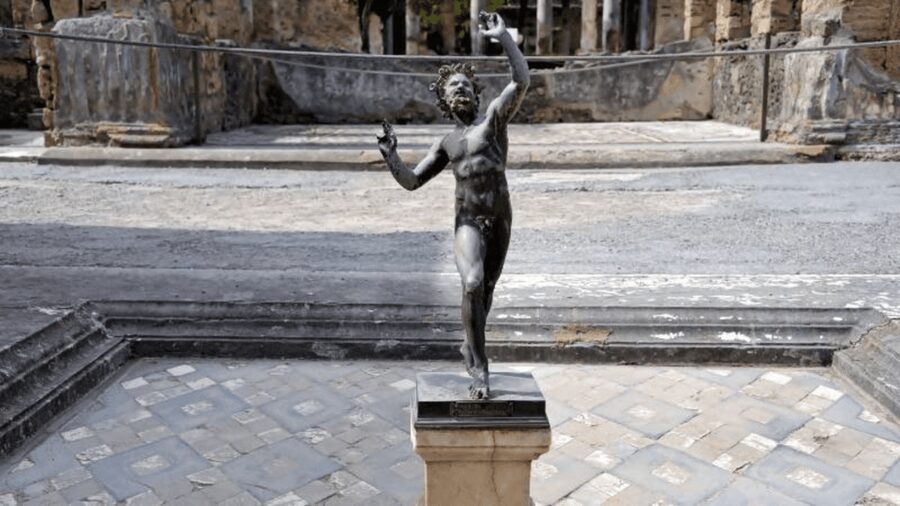
Frescoes
Frescoes are one of Pompeii’s great “look closely” moments. This audio track focuses on wall paintings, the kind that turn an ordinary room or corridor into something worth slowing down for.
My advice: treat this as your cue to get close enough to see the details, but not so close you trip over modern barriers or other visitors. If you have the text option turned on, reading along can help you catch references that audio alone might miss.
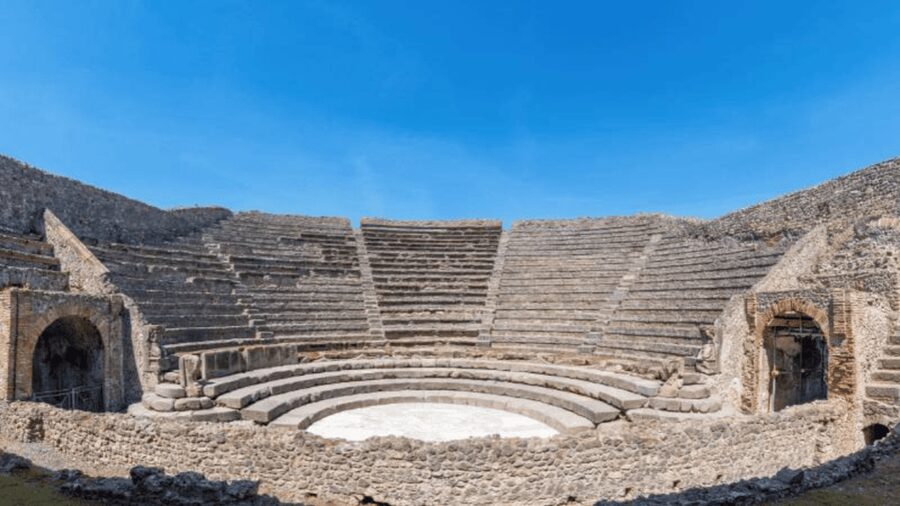
Grand Theatre (Regio VIII)
The Grand Theatre is where Pompeii starts to feel like a planned social stage, not just an archaeological site. This is your chance to connect architecture with community life: a place where performances, crowds, and public gatherings would have been real.
While you listen, pay attention to how the building is laid out and how people would have moved. A theater is all about sightlines and flow, and even a brief audio explanation can help you interpret what you are seeing.
Basilica of the Friars
A basilica is a clue that you are in the zone of public life and civic structure. This track helps you understand the building’s role, and what kind of space it was meant to serve.
If you tend to rush through big buildings, this is a good place to slow down. Even without an ultra-detailed route plan, you can get a lot of meaning by simply understanding why the space existed.
Houses of Marcus Rufus and the Golden Bracelet (Regio VII)
Private houses are where Pompeii stops being generic and becomes personal. This track focuses on specific residences, including the House of Marcus Rufus and the House associated with the Golden Bracelet.
That pairing is smart for visitors, because you are not only looking at “a house,” you are learning that different homes can suggest different status, layout, and everyday routines.
When you listen here, try to notice transitions: where a visitor would enter, where the household activity would likely concentrate, and how rooms relate to each other. Even if you do not catch every term, the structure makes sense once you compare entry to interior space.
Lupanare (Regio VII)
The Lupanare is one of the most talked-about stops in Pompeii, and it is also the sort of place where the tone of the audio matters. Expect a focused explanation tied to the location and its purpose.
My practical tip: if this subject makes you uncomfortable, you can still use this track as a “context only” chapter. You do not have to linger in any one spot. Listen, orient yourself, then move on to areas that feel more aligned with your interests.
Temple of Apollo (Regio VII)
Temples change the mood again. Here you are dealing with religious architecture and public ritual space. This audio track helps you connect the temple to the broader idea of Pompeii as a living city with scheduled beliefs and community identity.
Try to orient yourself first, then listen. Temples can be easier when you understand the layout, and the audio is more satisfying when you are not turning your head constantly.
The Roman Domus
A domus is a Roman house in a more general sense, but the track still gives you the “why” behind what you see. This is a good bridge between the named house chapter earlier and other domestic areas you might spot on your walk.
If you want to understand Pompeii as a city of routines, a domus track is a strong anchor. It helps you interpret rooms not just as artifacts, but as functional space.
Thermae (Regio VII)
Thermae bring you back to everyday city life, but in a different register. Baths were not only about hygiene, they were social spaces too.
This audio track gives you a way to see the layout like a user, not just a spectator. If you can, step back for a moment and imagine where people would have moved through different zones. Even a brief mental map makes the remains feel far more “alive.”
Languages, text support, and comfort basics

The audio is available in multiple languages: Italian, English, Spanish, German, Russian, Chinese, and French. That coverage is a real value add if you have mixed-language traveling companions, because everyone can use the same app without splitting into separate devices or competing for an official audio rental counter.
You can also read the text of the audio files in the app. This is more useful than it sounds. When you are in bright outdoor light, screen brightness can be hard, but having text available lets you catch details you might miss when the sound gets drowned out by the environment.
And yes, earphones are recommended. Even when you do not have sensitive hearing, audio quality and focus improve dramatically with headphones in a place that has foot traffic and wind noise.
What the quiz adds to the Pompeii experience

The app includes a quiz section with short questions about the city. This is not a replacement for a guided tour, but it can help your brain retain what you just saw.
Think of it as a pause button. If you notice you are walking faster than you are processing, the quiz gives you a reason to slow down and check understanding before you head into the next area.
If you enjoy self-testing, you will probably like the quiz. If you dislike game-style content, you can still treat it as optional and stick to the audio route only.
Online vs offline listening, and the signal reality

One clear consideration that comes up is that online listening can be affected by connection. The app can work online or offline, so your best strategy is to plan for both possibilities.
If your phone often struggles with reception outdoors, offline mode is the safer option. If you are relying on online audio, keep an eye on signal strength, especially as you move through wider paths inside the site.
This is one reason I suggest earphones and a calm start. Getting your phone set before you join the flow of crowds makes everything smoother, and it reduces the chance that you lose your place mid-track.
Who should book this Pompeii audioguide

This TravelMate audio guide is a good match if you want:
- Self-paced exploring without paper tickets.
- A short, structured visit using 48 minutes of audio, broken into 16 tracks.
- The ability to listen online or offline, with text support when needed.
- A low-cost way to get professional narration quality tied to key areas like the theater, frescoes, temples, and baths.
It may be a weak fit if you want:
- A highly animated, nonstop story experience where you feel entertained every minute.
- An audio guide that covers everything in ultra-depth with lots of extras and fun fact density.
- A near-instant, frictionless start, since some people found the setup process difficult.
Should you book this Pompeii audioguide?

If your goal is a structured walk with strong convenience, I would book it. The no meeting point approach plus the ability to listen offline, and reuse the audio for nearly three years, makes the $9 price feel fair.
If you know you prefer guides with lots of personality and very “sticky” storytelling, compare this against a more traditional audio guide before you commit. Pompeii can be fascinating with minimal interpretation, but if you need your narration to be gripping at every moment, this might feel a bit too restrained for your taste.
Either way, do one smart thing: pick your priority stops in advance. Frescoes, the Grand Theatre, the Temple of Apollo, and the Thermae are the kind of anchors that make a short audio route feel complete.
FAQ
Do I need to collect paper tickets?
No. There is no meeting point for this activity. You download the TravelMate app and start your experience right away wherever you prefer.
What is the price and duration of access?
The price is $9 per person, and the validity is 1095 days from your first activation.
How long is the Pompeii audio content?
The audioguide includes 16 audio content items for a total of 48 minutes.
Can I listen offline in Pompeii?
Yes. You can listen to the audio guide online or offline.
Can I read the audio content text in the app?
Yes. You may read the text of the audio files in the app.
What languages are included?
The app audio is available in Italian, English, Spanish, German, Russian, Chinese, and French.
Is there a quiz included?
Yes. There is a quiz section with short questions about the city.
Is this activity wheelchair accessible?
Yes, it is listed as wheelchair accessible.
More Self-Guided Tours in Pompei Campania
- Pompeii: Skip-the-Line Entrance Ticket with Audio Guide★ 4.0 · 2,509 reviews
- Pompeii: Skip-the-Line Entry Ticket with Digital Guide App★ 4.1 · 770 reviews
- Pompeii: Skip-the-Line Ticket with Audio Guide and Map★ 4.0 · 117 reviews
- From Naples: Vesuvius & Pompeii with Transfer & Audio Guide★ 4.0 · 58 reviews
- Pompeii & Herculaneum: Skip-the-line & Digital Guide App★ 4.0 · 35 reviews
More Tour Reviews in Pompei Campania
- Pompeii: Entry Ticket and Guided Tour with an Archaeologist★ 4.8 · 19,459 reviews
- Pompeii: Small Group Tour with an Archaeologist★ 4.8 · 12,264 reviews
- Pompeii: Skip-the-Line Entrance Ticket with Audio Guide★ 4.0 · 2,509 reviews
- Naples: Pompeii and Mt. Vesuvius with Lunch and Wine Tasting★ 4.5 · 2,454 reviews
- Pompeii: Skip-the-line-Ticket and Guided Tour★ 4.6 · 1,152 reviews
More ways into Self-Guided Tours.
 ★ 4.2Pompeii: Entry Ticket with Optional Audio GuideFrom $2612,360 reviews
 ★ 4.0Pompeii: Skip-the-Line Entrance Ticket with Audio GuideFrom $392,509 reviews
 ★ 4.1Pompeii: Skip-the-Line Entry Ticket with Digital Guide AppFrom $22770 reviews
 ★ 4.1Ercolano: Herculaneum Entry Ticket with Optional Audio GuideFrom $21581 reviews
 ★ 4.0Ercolano: Herculaneum Skip-the-Line Ticket & Audio GuideFrom $35275 reviews
 ★ 4.0Pompeii: Skip-the-Line Ticket with Audio Guide and MapFrom $44117 reviews
 ★ 3.8Herculaneum Archaeological Park smart Audio TourFrom $470 reviews
 ★ 4.0From Naples: Vesuvius & Pompeii with Transfer & Audio GuideFrom $10858 reviews
Other useful routes from here