
REVIEW · CITY TOURS
Pompeii Ancient City Walking Tour – Italian & English Guide
Pompeii hits different with a guide beside you. This tour pairs a timed route through major ruins with English-led narration and entrance gate facilitation from Sesto Continente Tours, so you spend more time looking and less time figuring out what you are seeing. I especially like how the route spotlights big set pieces, like the Roman amphitheater, and then balances them with memorable interior art stops, like mosaics and fresco scenes. One thing to consider: the Pompeii entrance ticket is not included, and in rare cases there can be communication problems around meeting up.
The value here is all about focus. You get a structured walk with short, repeatable stops across Pompeii Archaeological Park, plus a included visit on day 2 at the Roman Catholic Sanctuary of Pompeii. The group is capped at 25 people, and the overall pacing is designed for seeing highlights without trying to cover the entire city on your own.
Before you book, keep your expectations practical. Many stops are brief, so if you want to linger in one house or one detail, you will need patience or a return visit. And because Pompeii is outdoors, plan around good-weather conditions so you do not get stuck with a cancel or date change.
Quick hits before you go
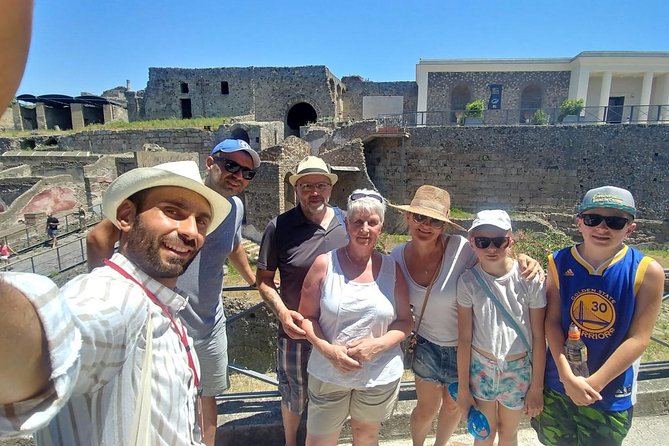
- Entrance gate help: your guide helps with the ticket office entry process at the start.
- Two days, but one main day: day 1 is the big Pompeii ruins walk, day 2 is a shorter sanctuary visit.
- Art and religion in the same route: mosaics, wall paintings, and temples all show up in one itinerary.
- Short stop structure: expect about 10 minutes at most highlights, so you see more but linger less.
- Smallish group size: maximum of 25 travelers keeps it manageable.
- English-led experience with support in Italian: at least one guide named Simone has been flexible with language when needed.
Why Pompeii works best with a guided route
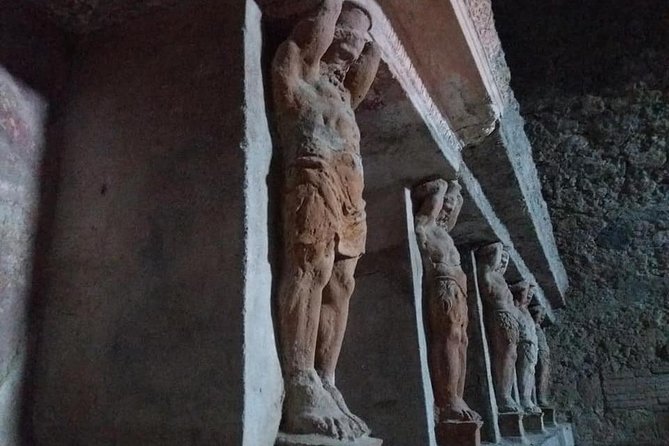
Pompeii is famous for a reason, but it is also easy to get lost in the scale of it. The park is huge, and if you do not have a plan, your day can turn into a long wander where you are not sure what matters most.
This format fixes that. You meet at Piazza Porta Marina in Pompeii, then your guide brings you through the Archaeological Park and strings together the key sights in an order that makes the city feel connected. Even the background context matters here, because Pompeii is not just ruins. It is a living story cut short, and the best way to feel that is to have someone put the pieces in order as you walk.
The other win is pacing. The first stop at the Pompeii Archaeological Park gives you a longer chunk of time to orient yourself, then the rest of the day hits specific highlights where you can actually spot details quickly. That is a smart choice if you are short on time, or if Pompeii is your one big historic outing in the region.
Getting started at Piazza Porta Marina and the ticket office assist
Your day begins at Piazza Porta Marina, 80045 Pompei NA, Italy. The tour ends back at the meeting point, which is helpful in a place where walking paths can feel maze-like.
A small but real quality-of-life perk is the included facilitation at the entrance to the Ticket Office. Pompeii entry is its own process, and waiting in the wrong line or missing the right timing can burn your prime sightseeing hours. With this tour, your guide helps smooth that part.
One important financial note: the Pompeii entrance ticket is not included. The listed entrance fee is €22.00 per person, and some categories like minors under 18 and certain EU seniors and students have free entry, but the standard adult ticket is an extra cost you must plan for.
Day 1 inside Pompeii Archaeological Park: the highlights circuit
Day 1 is the heart of the experience. You start at Pompeii Archaeological Park, where you can expect about two hours to cover major landmarks with your guide. Most of the rest of the stops are short, about 10 minutes each, so think of this day as a guided sampler of the big emotional hits and the best-known buildings.
Pompeii Archaeological Park: Amphitheater, temples, and “oh, that’s what I’m looking at”
This first chunk is where your guide helps you read Pompeii. You pass major anchors like the Amphitheater, the Temple of Apollo, and the Temple of Jupiter. Even if you have seen Pompeii photos before, it helps to stand in the right spots and understand what each building was for.
If you are the type who likes to know why a place exists, this is a big part of the value. You are not just walking between pretty ruins. You are seeing public and religious space in a way that makes the rest of the day click.
Casa del Fauno: a mosaic that brings history to your eye fast
Next up is the Casa del Fauno. This is one of Pompeii’s larger residences, and it is especially memorable for the mosaic reproduction of Alexander the Great’s battle against Darius III.
What I like about this stop is how quickly it works. Even if you only have a short moment, the mosaic gives you an instant visual anchor. Pompeii was not a silent city, not in art terms. People decorated homes, planned stories, and displayed status with images that traveled across cultures.
Temple of Jupiter Capitoline: religion with Mount Vesuvius in the background
The Tempio di Giove Capitolino is a classic “stand here and look around” location. The setting matters, because you get the temple built for the Capitoline Triad: Jupiter, Juno, and Minerva. The Romans treated Jupiter as the head of the divine hierarchy, and the structure’s presence in the city gives you a sense of where public belief sat in everyday life.
This is also one of the stops where the guide context can change your experience. Without explanation, it is easy to see columns and assume the rest. With guidance, you start noticing how religion shaped the way people moved through town.
Temple of Apollo: one of the oldest religious buildings
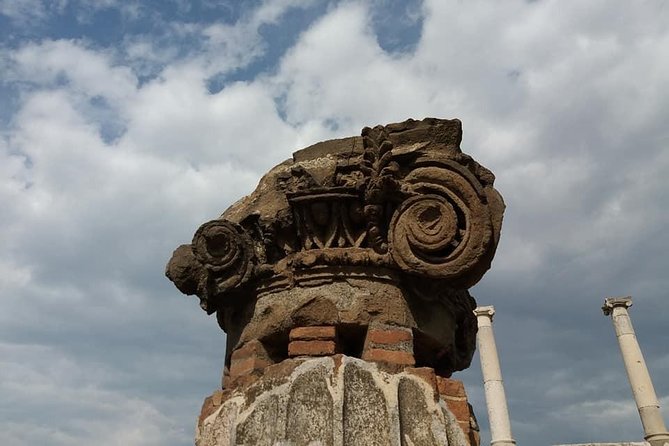
The Temple of Apollo is known as one of Pompeii’s earliest religious buildings. Here, you also get a reproduction of a famous bronze statue of Apollo in a pose that suggests the god is holding a bow and arrow, framed by Corinthian columns.
Even with a quick stop, I find this temple hits because it is compact and specific. You know what you are looking at: an ancient religious space and a key artistic representation of Apollo’s power and role.
Roman Amphitheater: gladiators, class, and a scale shock
Then comes the Roman Amphitheater. It was built around 80 a.C., and it is often cited as one of the oldest amphitheaters of its type. The size alone gives you a gut-level sense of what Pompeii could do for entertainment. The arena could hold up to 20,000 spectators, arranged in three sections based on social class.
This is where I think a guide really earns their pay. If you understand how the seating was organized, you stop seeing it as a generic ruin and start seeing it as a social machine. People did not just watch gladiators. They watched a world where class was visible, built into the architecture.
Casa del Menandro: a house named for a painting
Next is Casa del Menandro, a “name from an artwork” kind of place. It does not take its name from the original owners, the Poppaei family. Instead, it is named for a striking fresco featuring the Greek poet Menander.
The practical value for you is that it teaches you how Pompeii house names often work. A lot of these sites are identified by what survives in the art or layout, not by what was written on a deed. So when you see a home labeled this way, you can quickly understand what clue historians are using.
Casa dei Vettii: freed brothers showing off through frescoes
Then you get to Casa dei Vettii. The Vettii brothers were once enslaved but became free, and they spent money on making their home look like their new status mattered. The result is a residence famous for frescoes and wall paintings.
I like this stop because it gives you a human storyline. You are looking at decoration, yes, but decoration with a purpose: identity, pride, and social messaging.
Villa dei Misteri: a full wall-story in nine scenes
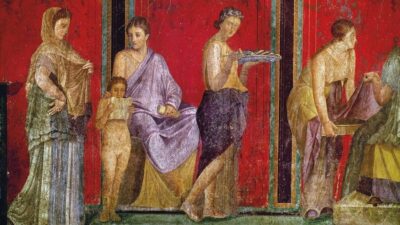
Finally on day 1, you reach the Villa dei Misteri. This is one of the most talked-about art spaces in Pompeii. The walls of the “Initiation Chamber” include nine painted scenes shown in sequence. The images are tied to a rite of passage, marking a bride moving into adult womanhood, and the cult connection is tied to Dionysus, the Greek god associated with wine and fertility.
This is the stop where the emotional tone changes. It is not just pretty interiors. It feels like you are walking alongside a ritual story. Even if you only have about 10 minutes, the sequence format helps you understand why guides often treat this as a must-see.
Day 2 at the Roman Catholic Sanctuary: a calmer included visit
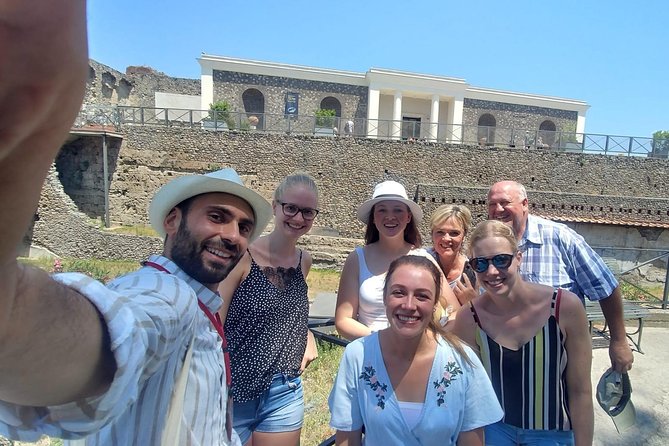
Day 2 is simpler. You get a free-form visit at the Roman Catholic Sanctuary of Pompeii. The time is listed as 1 hour, and the admission ticket is included.
The sanctuary does not replace the Pompeii ruins day. It is more of a different lens on the same town. After spending hours in ancient Roman spaces, this gives you a chance to slow down and see how faith and pilgrimage shape Pompeii today. If you want one less intense day after the long ruins circuit, this structure works.
Because the sanctuary visit is more open-ended, you might find it useful to go with a plan for what you want to see. You can ask your guide for a quick “what matters most here” before you break off, since the ruins day is tightly timed and day 2 gives you more freedom.
Price and logistics: how to judge if $36.12 is a deal
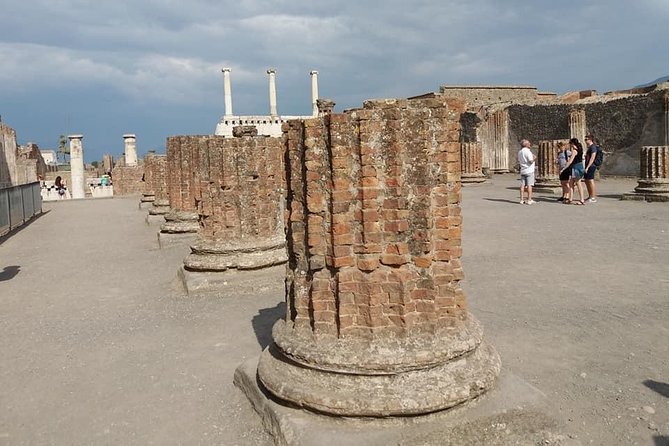
The tour price is $36.12 per person, but the biggest line item you must remember is that Pompeii entry is not included. The entrance fee is €22.00 per person.
So your real cost is the tour fee plus the park ticket. Is it still good value? Usually, yes, if you:
- want a guided route that reduces decision fatigue
- care about understanding what you see, not just ticking off photos
- prefer an organized sequence instead of piecing together a self-guided plan
If you already know Pompeii well and you are comfortable planning your own route, the tour fee might feel unnecessary. But for most first-timers, the structure is the product.
Also note the tour is capped at 25 travelers. That matters because it affects how likely you are to hear explanations and move at a reasonable walking pace without constant crowd bottlenecks.
English guidance, mixed groups, and when language help matters
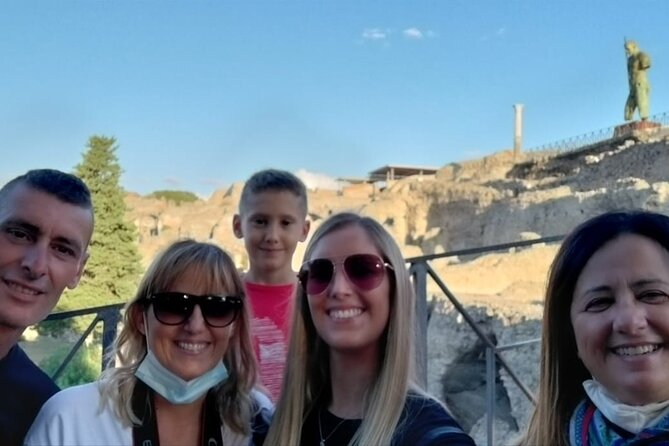
The experience is offered in English. Still, Pompeii is international, and groups can be mixed.
One detail that stood out from an example in the provided information: a guide named Simone stepped in for the English portion when a problem came up, and then offered to repeat in Italian if anyone had trouble understanding. That is exactly the kind of flexibility you want from a guide, because it protects the experience when plans get messy.
So if you are traveling with someone who reads slower or feels less confident in English, you should still be okay. The tour is designed for English-led explanations, but there is precedent for language support when needed.
What I think is the best use of your time in Pompeii
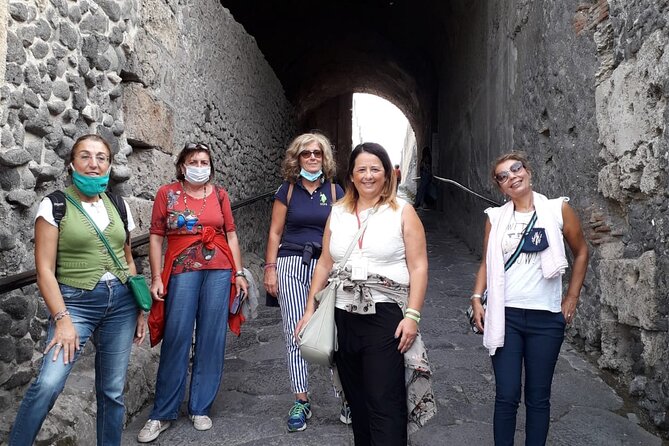
This itinerary is built around major stops that are easy to recognize and easy to photograph, but the best way to enjoy it is to treat each brief stop like a mini mission.
Here is a practical way to do that:
- At temples, take 30 seconds to scan for the building purpose, then read the details the guide points out.
- At houses, focus on the one artwork the stop is known for, mosaic or fresco, and let that be your “why this place matters.”
- At the amphitheater, pay attention to class layout. It changes how you interpret what you are looking at.
The risk with a route like this is simple: you can end the day feeling like you saw a lot but remembered a little. You can beat that by picking one or two “must remember” moments, like the Alexander mosaic at Casa del Fauno or the nine scenes at Villa dei Misteri, and using everything else as supporting context.
Who should book this Pompeii tour, and who might skip it
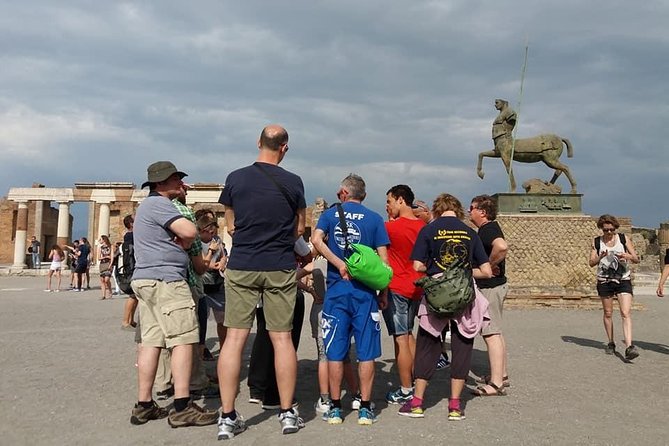
This tour suits you if:
- Pompeii is a first visit and you want a guided path through the key sights
- you like history connected to art, not just stones
- you prefer short, structured visits over trying to plan every turn alone
- you want included help at the ticket office so the day starts smoothly
You might choose differently if:
- you want to spend long hours inside one building, taking your time with details
- you already have a self-guided route and a deep interest in lesser-known corners
- you are the type who gets stressed by fixed stop timing, because many of the major highlights are around 10 minutes each
Should you book Pompeii with Sesto Continente Tours?
If you want an efficient, guide-led Pompeii overview, I think this is a strong option. The guide support at the ticket office helps you start with momentum, and the route balances public architecture with homes full of art, including the amphitheater and Villa dei Misteri.
I do recommend you go in with two practical expectations. First, factor the €22 entrance ticket into your budget. Second, accept that most stops are brief, so you should decide what you want to remember most before the day starts.
If that sounds like your style, book it and enjoy Pompeii with a route that makes the city feel like one story, not a collection of separate ruins.
FAQ
Where does the Pompeii Ancient City Walking Tour meet?
The tour meets in Piazza Porta Marina, 80045 Pompei NA, Italy, and it ends back at the same meeting point.
How much does the tour cost?
The tour price is $36.12 per person.
Is the Pompeii entrance ticket included?
No. The entrance ticket to Pompeii Archaeological Park costs €22.00 per person and is not included in the tour price.
What language is the tour offered in?
The experience is offered in English.
How long is the tour?
The duration is listed as 2 days (approx.).
What are the included activities on the second day?
On day 2 you can visit the Roman Catholic Sanctuary of Pompeii. It is a free visit with 1 hour allocated, and the admission ticket is included.
What is included with the tour at the start?
You get facilitation at the entrance to the Ticket Office.
What is the group size limit?
The tour has a maximum of 25 travelers.
Are pets or service animals allowed?
Service animals are allowed.
Does weather affect the tour?
Yes. The experience requires good weather. If it is canceled due to poor weather, you will be offered a different date or a full refund.
Is free cancellation available?
Yes. You can cancel up to 24 hours in advance for a full refund.
Pompeii on Foot
- Pompeii 3 Hours Walking Tour Led by an Archaeologist★ 5.0 · 126 reviews
- Explore Pompeii: 2-Hour Guided Walking Tour with Included Ticket★ 4.5 · 77 reviews
- Pompeii: walking tour with 3D glasses and with entrance ticket★ 4.5 · 61 reviews
- Pompeii walking tour★ 5.0 · 29 reviews
- Small Group Guided Walking Tour of Ancient Pompeii Highlights★ 5.0 · 27 reviews
More Tours in Pompeii
- Pompeii Small Group Tour with an Archaeologist★ 5.0 · 6,593 reviews
- Pompeii and Herculaneum Small Group Tour with an Archaeologist★ 5.0 · 1,350 reviews
- Skip the Line Guided Tour of Pompeii led by an Archaeologist★ 5.0 · 703 reviews
- Pompeii Ticket + Tour with Optional Tasting Experience at Pompeii★ 5.0 · 663 reviews
- Pompeii private tour with an Official Guide★ 5.0 · 631 reviews
More Tour Reviews in Pompeii
- Pompeii Small Group Tour with an Archaeologist★ 5.0 · 6,593 reviews
- Discover the Ancient Ruins of Pompeii: Day Trip from Rome★ 3.5 · 2,247 reviews
- Pompeii and Herculaneum Small Group Tour with an Archaeologist★ 5.0 · 1,350 reviews
- Skip the Line Guided Tour of Pompeii led by an Archaeologist★ 5.0 · 703 reviews
- Pompeii Ticket + Tour with Optional Tasting Experience at Pompeii★ 5.0 · 663 reviews
More ways into City Tours.
 ★ 4.5Capri in a Day All Inclusive Premium Boat Tour + City VisitFrom $288307 reviews
 ★ 4.8Discover Pompeii: French Walking Tour of the Buried CityFrom $41253 reviews
 ★ 4.5All-Inclusive Capri Boat Tour with City Visit from PositanoFrom $337151 reviews
 ★ 4.8Capri Boat Trip with City Visit & Swim StopsFrom $14652 reviews
 ★ 4.5Capri Premium Private Boat Tour + City VisitFrom $3,59248 reviews
 ★ 5.0Capri Premium Boat Tour and City Visit Free Bar and AperitifFrom $28827 reviews
 ★ 4.2Discover Pompeii: English Walking Tour of the Buried CityFrom $4124 reviews
 ★ 5.0Capri Boat Tour and City Visit from SorrentoFrom $25121 reviews
Other useful routes from here