
REVIEW · HERCULANEUM TOURS
Pompeii and Herculaneum small group tour – skip the line
Two Roman cities in one day feels huge. This small-group tour packs Pompeii and Herculaneum into a tight 5.5-hour loop with guided context and skip-the-line access.
I especially like the stop-by-stop pacing, because it helps you connect the dots between everyday life, public spaces, and rich homes. Another win is the small group size, with guides who keep things organized enough for questions, even when the ruins get busy.
One consideration: it is a long day of walking on uneven ancient ground, and you should plan for a real workout. If you bring a stroller, you will likely end up carrying it, and the Herculaneum station is a short walk up hill after the visit.
Key things to know before you go
- Skip-the-line entry in Pompeii and Herculaneum, so you spend more time inside the sites
- Max 20 travelers, which makes Q and A actually possible
- A guided route through both UNESCO sites, built around real Roman daily life
- One-way Circumvesuviana train ticket from Pompeii to Herculaneum included
- Lots of classic highlights fast, from the Forum areas to major domus and baths
- Bring water and expect uneven walking, even though the tour stays well paced
The Value of a Small-Group Pompeii and Herculaneum Plan
At $119.85 per person for about 5 hours 30 minutes, this tour is not trying to be the cheapest option. What you are paying for is time savings plus someone steering the day, because Pompeii and Herculaneum are both massive, and self-guiding can easily turn into guesswork and line-chasing.
The best part is the format: you get a guided route through two UNESCO sites instead of picking just one. That matters because Pompeii shows the city life and architecture in a very public, street-level way. Herculaneum, which experienced a different type of burial, often feels more intimate and different in what survives. Seeing both with the same guiding approach helps you compare how Romans built, shopped, socialized, bathed, and lived.
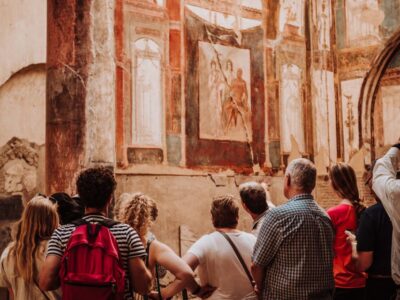
Finally, the small-group size up to 20 really changes the experience. It is easier for a guide to keep you together, faster to regroup when the crowd thickens, and simpler to ask follow-up questions without feeling like you are talking to the group from the back row.
How You Start: Meeting Point and Pompeii Arrival Without Stress
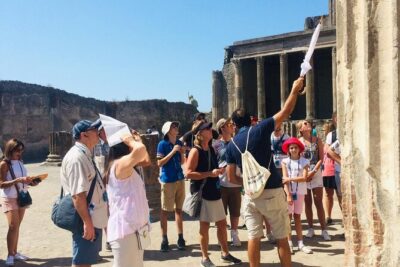
The tour begins at Piazza Esedra, 4, 80045 Pompei NA. From there, you arrive at Pompeii Archaeological Park and meet the guide at the main entrance called Porta Marina Superiore. The guide holds a sign for Askos Tours, which is helpful if you arrive a little early or the entrance area feels chaotic.
The early minutes matter. Pompeii can swallow your time before you even start, especially if you are rerouting due to crowds. With skip-the-line tickets in play, you can start moving through the site rather than spending your morning watching other people advance while you wait.
Pompeii Highlights: Forum Power, Rich Homes, and Roman Street Life
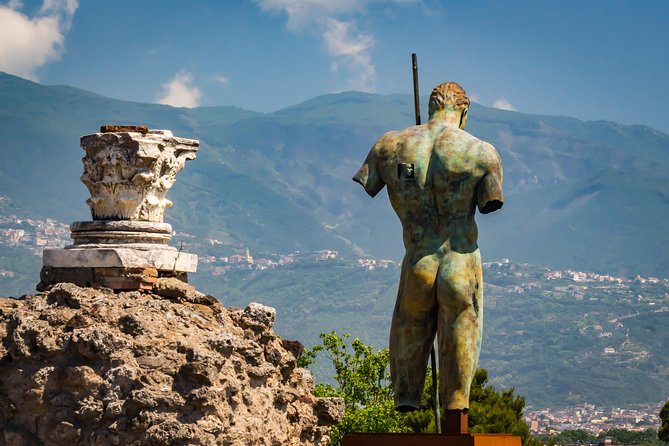
Pompeii is where you learn to read a city. Not just the big buildings, but the everyday layout, from sheltered porticos to the main square and the spaces where people bathed and shopped.
Here is what the Pompeii half does especially well, and what to watch for.
Porta Marina, Basilica Portico, and the City Rhythm
You begin with entry and then head toward the Basilica, described as an open portico where merchants and other activities took place. This is a great starting concept because it sets the tone: Roman commerce and community happened in public spaces, often in semi-covered zones where weather mattered.
The Foro de Pompeya and the Main Square Energy
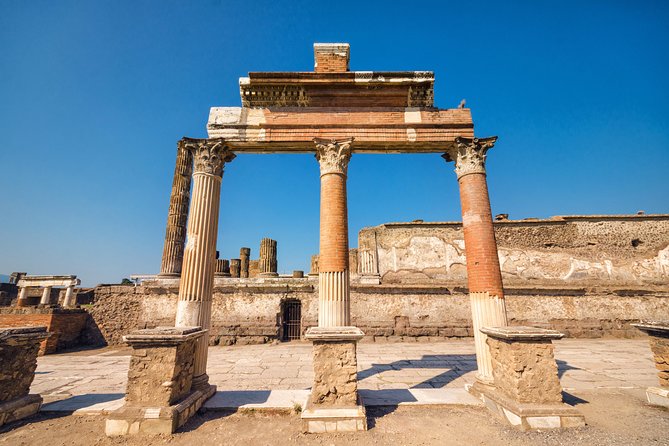
Next is the Foro de Pompeya, the ancient main square. This is the anchor of the city center, and it helps you understand how Romans organized civic life. You also get time around the main street, which is where it finally clicks that Pompeii was designed for movement, crowds, and visibility.
Practical tip: plan on taking photos, but also pause long enough to look at the wall surfaces, doorways, and floor layouts. Even when the bigger murals are damaged, the setting tells you how people used each space.
Casa del Menandro and What Wealth Looked Like
Casa del Menandro is one of the richest and most magnificent houses, with architecture and decoration that goes beyond basic living. This is where the tour balances visuals with context, helping you see how elite households turned private space into a status display.
Granai del Foro and the Darker Side of Survival
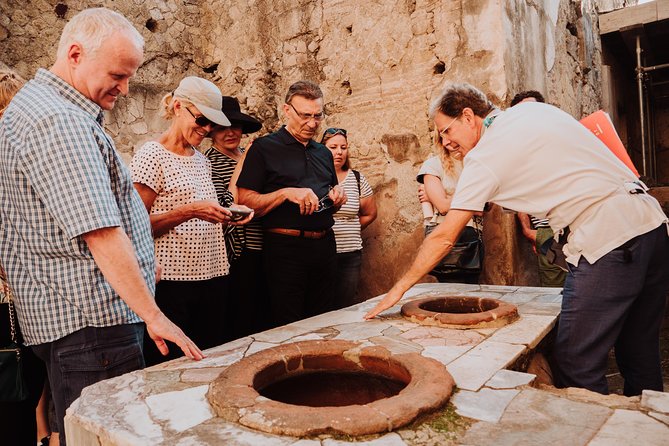
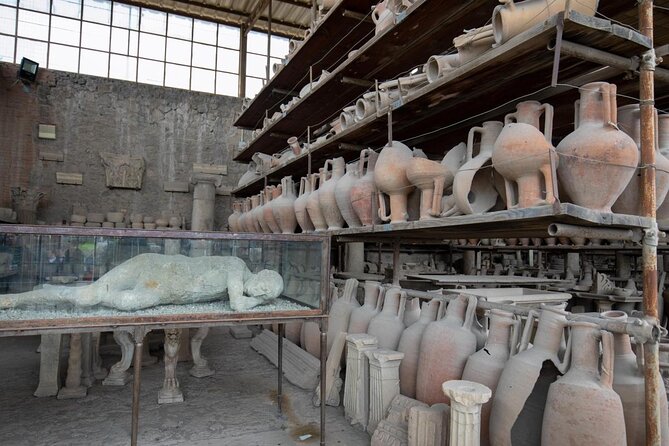
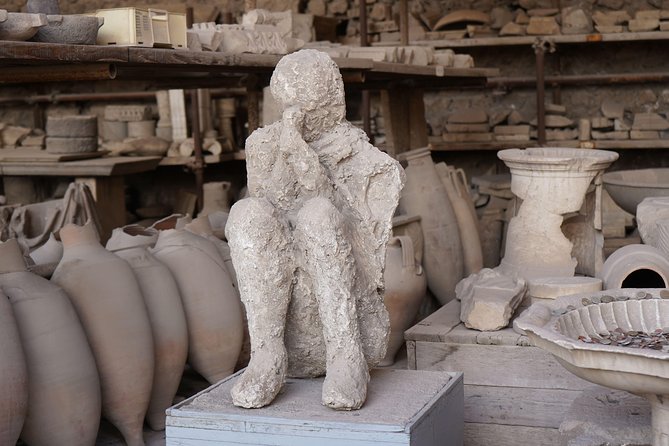
Granai del Foro is a fascinating stop because it combines practical infrastructure with survival evidence. You will see marble tables and fittings around fountains, plus casts of victims of the eruption. There is also mention of a dog and a tree in the cast display area.
This is one of those stops that can feel heavy. The upside is that it is also one of the most memorable. If you want to understand Pompeii as a real tragedy, not just an Instagram stop, this is where the tour makes that shift.
Terme del Foro and Oldest Thermal Complex Vibe
The Terme del Foro takes you into the bath complex area. Baths in Pompeii were not only about hygiene, they were social. Seeing an older thermal layout helps you grasp how serious Romans were about public comfort and routine.
Casa del Fauno and Teatro Grande for the Full Culture Mix
Casa del Fauno is a large, impressive private residence. Then the tour moves to the theater zones, including the smaller Teatro Piccolo and the major Teatro Grande. Teatro Grande gets extra time, and it is the kind of location where you understand why Romans built for gatherings, performance, and spectacle.
A side note from the reality of doing Pompeii in a few hours: you will cover a lot, quickly. That is not a flaw. It is the trade-off for seeing the best-known neighborhoods and then transferring to Herculaneum before the day gets away from you.
Transfer to Herculaneum by Train: The Pace Reset You Actually Need
After Pompeii, you transfer to Herculaneum by train. The ride is about 30 minutes plus a 10-minute walk to the meeting place at the Herculaneum ruins.
This is not just convenient, it is smart pacing. Pompeii can tire you out mentally and physically, and taking the train gives your brain a short break. You also get a quick lunch break if you need it, though meals are not included.
The meeting point in Herculaneum is the Ticket Office of the Herculaneum ruins. Getting there is described as doable by car, or by train in Corso Resina 1, with the Circumvesuviana station about a 10-minute walk away.
One more practical note: you may run into station area changes, including renovation work. When that happens, follow the signs on the ground, because those routes can shift.
Herculaneum Stops: Lived-In Luxury, Baths, and Wooden Partition Mysteries
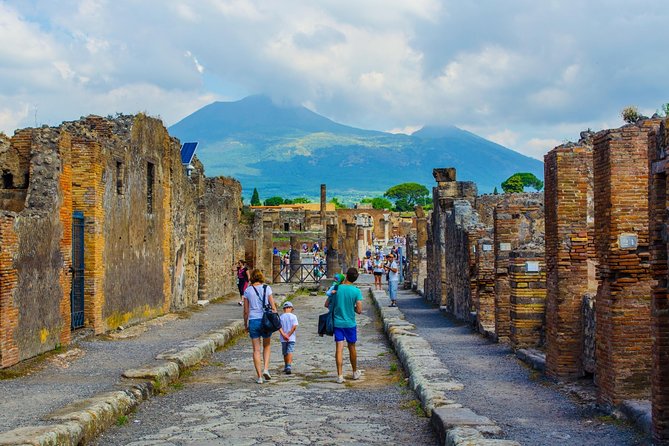
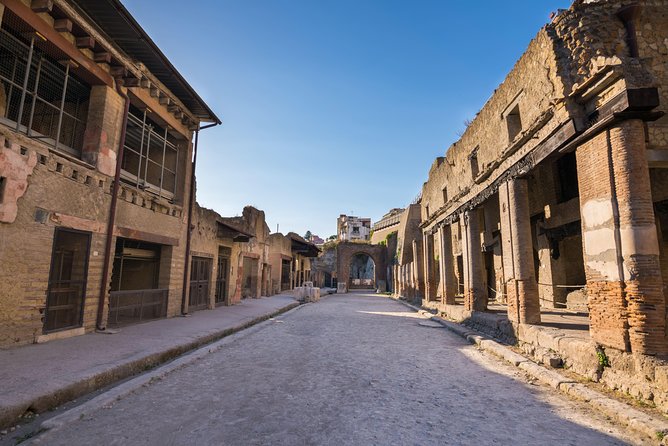
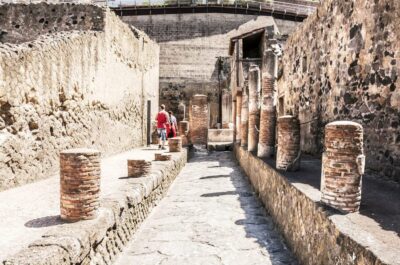
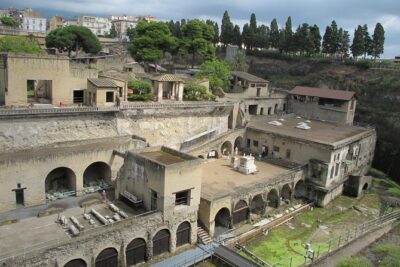
Herculaneum often feels like Pompeii’s quieter cousin. Instead of only grand public drama, you get a strong feel for rooms, doorways, and how households were arranged.
You still move through a long list of houses and complexes, but the guide time is enough to make each place matter.
Casa dei Cervi and Marble Stag Details
Casa dei Cervi gets its name from marble statues of stags or deer found in the peristyle. It is a perfect example of how Herculaneum rewards careful looking. If you spot the details the tour points out, you start connecting decorative themes to the household’s identity.
Casa del Rilievo di Telefo: Art, Patronage, and Private Access
Casa del Rilievo di Telefo is described as unusual in having its own private access to the adjoining Suburban Thermae. It is also linked to a leading benefactor, Marcus Nonius Balbus, based on the context provided.
This is where the tour helps you see that Roman life was not only about public buildings. Even leisure and bathing could be controlled by private access and household connections.
Partem Domus lignea and the Surprise of Preserved Wood
Partem Domus lignea, also referred to as Casa del Tramezzo di Legno, is a standout because it focuses on an elegant wooden partition that remained. This kind of detail is exactly why Herculaneum is so compelling. Pompeii gives you strong street and building context, while Herculaneum can feel more tactile.
House of the Skeleton and Central Thermae Gender Separation
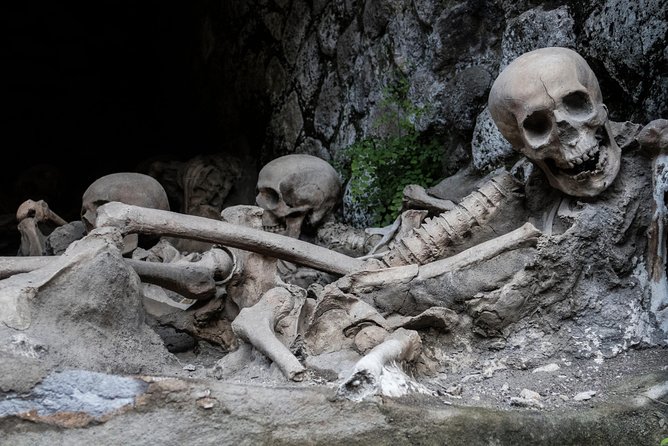
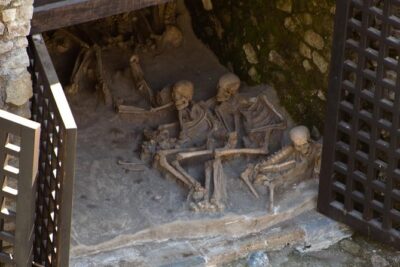
House of the Skeleton is named from human remains found in a second-floor room. Central Thermae then adds another layer, describing how baths were divided for men and women, with separate entrances.
That separation helps you understand that Roman bathing was a structured social routine, not a casual soak.
Casa del Salone Nero and Charred Doorposts
Casa del Salone Nero, the House of the Black Hall, includes a monumental entrance retaining carbonised remains of doorposts and lintel. You get a sense of what heat and time did to the physical world, down to architectural elements people once used daily.
Casa Sannitica, Casa del Bel Cortile, and Grand Portal Views
Casa Sannitica connects to Samnite arrangement, including an atrium with a gallery and Ionic columns, plus frescoes. Casa del Bel Cortile offers a different layout with a courtyard, stairway, and stone balcony instead of an atrium. Finally, House of the Grand Portal rounds out the set with collonnati, frescoes, and charred remains of wooden parts.
Together, these stops make Herculaneum feel like a place where you could almost imagine daily routines, even if the ruins are silent.
What the Best Guides Do for You Here
This tour really rises and falls on the guide, and the reviews attached to it are consistent about that point. I like the way the best guides bring structure and energy, and how they use humor without losing focus.
Names that show up in guide feedback include Amadeau, Sergio, Vince, Paulo, Vincenzo, Diego, Michele, and Alfredo. What you can expect from that type of guiding style is a mix of clarity and attention to small details, like why a bath complex matters, or what a decorative theme in a peristyle house might signal.
Also, the pacing is described as organized and question-friendly. That matters in Pompeii and Herculaneum because it is easy to feel rushed and disconnected. Here, the structure helps you keep up.
Practical Tips to Make the Day Comfortable
This day is short on paper but long in your legs. Plan around it.
- Bring water. Fill your bottle whenever you can where Roman-era water access exists on your route, if available during your timing.
- Use the toilet before you start, because the walking rhythm inside ruins can make finding breaks annoying.
- Wear shoes with good grip. Uneven ground is part of both sites.
- Skip the stroller if you can. The ruins are not stroller-friendly, and you may need to carry it.
- Think about lunch timing. There is a quick lunch break option, but meals are not included.
If you are sensitive to heat, pick light clothing and expect sun exposure, especially in Pompeii’s open areas.
Price and Value: Is This the Right Use of $119.85?
For $119.85 per person, you are getting a lot of built-in convenience.
You pay for:
- Skip-the-line entry in Pompeii and Herculaneum
- A guide for the full duration inside the ruins
- Admission ticket coverage as described for each listed stop
- One-way train tickets from Pompeii to Herculaneum via Circumvesuviana
What you do not get:
- Meals
- Personal expenses
- Transportation to Pompeii at the start and from your final stop in Herculaneum
To me, this price makes sense if you want a planned route and clean logistics. If you love spending extra time wandering, taking your time in one house, or returning to the same plaza multiple times, then a more flexible day might suit you better. But if you want the strongest hits with a guide and less friction, this is good value.
Who Should Book This Tour (and Who Might Not Love It)
Book it if:
- You want both UNESCO sites without turning your day into logistics work
- You like guided context while you walk
- You prefer a small group where questions are welcome
- You want a fast, structured route through big Roman highlights
You might rethink it if:
- You need a low-walking outing, because both sites involve uneven surfaces and lots of movement
- You are traveling with a stroller and cannot manage carrying it
- You are the type who wants long, slow hours in a few rooms rather than a broad overview
Should You Book This Pompeii and Herculaneum Small Group Tour?
Yes, if your goal is to see Pompeii and Herculaneum in one day with skip-the-line comfort and a guide who keeps the route coherent. The combination of Pompeii’s Forum and theater zones with Herculaneum’s houses, baths, and unusual preserved details is a smart way to compare Roman life across two very different surviving cities.
If you are fit, curious, and ready for walking, you will likely love how much you get for your time. If you are trying to minimize walking stress, you may be happier choosing one site and going deeper.
FAQ
How long is the Pompeii and Herculaneum small group tour?
It is approximately 5 hours 30 minutes.
What is the price per person?
The price is $119.85 per person.
Is the tour offered in English?
Yes, it is offered in English.
How big is the group?
The tour has a maximum of 20 travelers.
Where do we meet for the Pompeii part of the tour?
You start at Piazza Esedra, 4, 80045 Pompei NA, Italy, and then meet the guide at the main entrance of Pompeii Archaeological Park called Porta Marina Superiore.
Are skip-the-line tickets included for both sites?
Yes, skip-the-line tickets are included in Pompeii and in Herculaneum.
How do you get from Pompeii to Herculaneum?
You travel by train from Pompeii to Herculaneum, then walk about 10 minutes to the Herculaneum ruins. One-way Circumvesuviana train tickets are included.
What does the tour include?
You get guidance in Pompeii and Herculaneum for the entire duration, skip-the-line tickets in both, and the one-way train ticket from Pompeii to Herculaneum. Admission tickets for the listed stops are included as described.
Are meals included?
No, meals and personal expenses are not included.
What is the end point of the tour?
The tour ends at the Archaeological Park of Herculaneum, Corso Resina, 187, 80056 Ercolano NA, Italy.
Can I cancel and get a refund?
Yes. Free cancellation is available up to 24 hours in advance for a full refund. Cancellation within 24 hours of the start time is not refunded.
More Tours in Pompeii
- Pompeii Small Group Tour with an Archaeologist★ 5.0 · 6,593 reviews
- Pompeii and Herculaneum Small Group Tour with an Archaeologist★ 5.0 · 1,350 reviews
- Skip the Line Guided Tour of Pompeii led by an Archaeologist★ 5.0 · 703 reviews
- Pompeii Ticket + Tour with Optional Tasting Experience at Pompeii★ 5.0 · 663 reviews
- Pompeii private tour with an Official Guide★ 5.0 · 631 reviews
More Tour Reviews in Pompeii
- Pompeii Small Group Tour with an Archaeologist★ 5.0 · 6,593 reviews
- Discover the Ancient Ruins of Pompeii: Day Trip from Rome★ 3.5 · 2,247 reviews
- Pompeii and Herculaneum Small Group Tour with an Archaeologist★ 5.0 · 1,350 reviews
- Skip the Line Guided Tour of Pompeii led by an Archaeologist★ 5.0 · 703 reviews
- Pompeii Ticket + Tour with Optional Tasting Experience at Pompeii★ 5.0 · 663 reviews
More Days in Herculaneum
- Pompeii and Herculaneum Small Group Tour with an Archaeologist★ 5.0 · 1,350 reviews
- Private Day Tour to Vesuvius, Herculaneum & Pompeii with Pick Up★ 5.0 · 279 reviews
- The Ultimate Ruins of Pompeii and Herculaneum Private Day Trip★ 5.0 · 103 reviews
- Naples: Pompeii & Herculaneum Day Trip – Small Group Tour★ 4.5 · 72 reviews
- Pompeii and Herculaneum small group Excursion from Naples★ 5.0 · 70 reviews
More ways into Herculaneum Tours.
 ★ 5.0Pompeii and Herculaneum Small Group Tour with an ArchaeologistFrom $771,350 reviews
 ★ 4.8Pompeii: Small-Group Tour of Pompeii and Herculaneum867 reviews
 ★ 4.1Ercolano: Herculaneum Entry Ticket with Optional Audio GuideFrom $21581 reviews
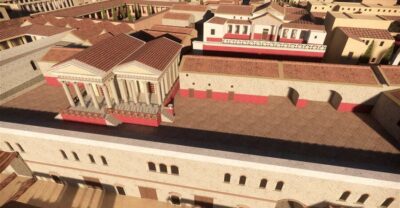 ★ 4.3Herculaneum: 3D Walking Tour with Skip-the-Line TicketFrom $45313 reviews
 ★ 4.5Guided Day Tour of Pompeii and Herculaneum with Light LunchFrom $185311 reviews
 ★ 5.0Private Day Tour to Vesuvius, Herculaneum & Pompeii with Pick UpFrom $120279 reviews
 ★ 4.0Ercolano: Herculaneum Skip-the-Line Ticket & Audio GuideFrom $35275 reviews
 ★ 4.3Herculaneum: Skip The Line Entrance ticket + AudioguideFrom $35266 reviews
Other useful routes from here