
REVIEW · HERCULANEUM TOURS
Pompeii and Herculaneum small group Excursion from Naples
Two Roman cities in one smooth day plan. This small-group excursion from Naples pairs skip-the-line entry with an archaeologist-led walk that helps you make sense of the ruins fast. You also get direct minibus transportation and pickup options, so your day starts working for you, not fighting transit.
What I like most is the tight structure: about 2 hours inside each site, guided from highlight to highlight without wasting time. I also like that the guides bring the places to life with clear explanations and a human rhythm, with humor and real pacing that keeps the group together, as seen in guide styles like Rafael, Gennaro, Michele Lamberti, Vincenzo, and Giulia.
One thing to consider before you book: this is a walking day. You’ll cover a lot of ground in a single stretch, and no meals are included, so you’ll want to plan for water and lunch breaks.
Key things to know before you go
- Small group size (max 20): easier listening, easier movement through busy areas
- Skip-the-line at Pompeii: you trade waiting time for actual museum time
- Archaeologist guide focus: you get help reading what you’re looking at, not just seeing it
- Balanced pacing: short stops, plus real time on the ground in each park
- Two major sites in one day: Pompeii first, then Herculaneum, with an organized flow
Naples pickup and minibus ride, the part that protects your time
The day starts with a practical setup in Naples. You meet at Starhotels Terminus in Piazza Giuseppe Garibaldi, and the tour also lists pickup from Naples Central Station or the train station area, which matters if you’re juggling cruise schedules or trains.
Once you’re on the minibus, the big win is simple: you do not have to navigate the logistics on your own. In the reviews, people specifically mention a comfortable, air conditioned ride, and that sets the tone for a long day on foot. When a tour takes transportation seriously, you arrive at Pompeii with your energy still intact.
Also, you’re not just dropped off. You have a professional driver handling the driving while the archaeologist guide focuses on timing and interpretation. For first-timers, that division of labor is huge. You spend less time asking where to go, and more time learning what you’re seeing.
Finally, a quick note for current health rules: masks are mandatory during the visit, and temperature checks are used for entry. Bring your own mask, and plan for a smooth but security-style start.
Pompeii Express entry and how it changes your first hour
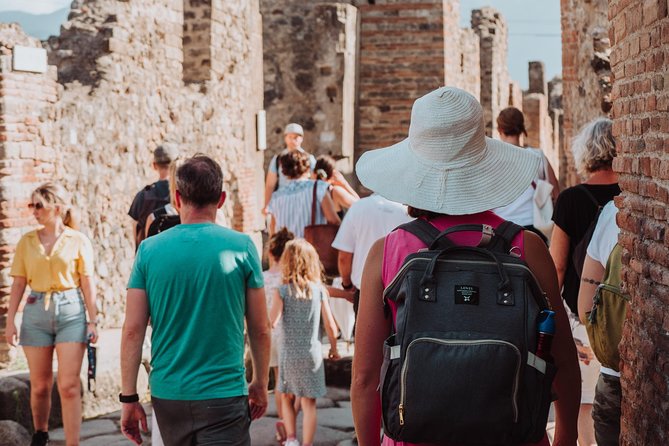
Pompeii can feel like a traffic jam if you arrive without a plan. This tour includes Pompeii Express entry tickets, which is the built-in advantage. It means less time staring at lines and more time walking the site while your guide sets the context.
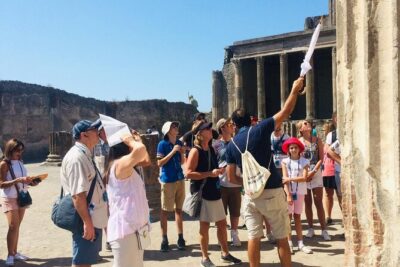
You begin with the Pompeii Archaeological Park visit, with about 2 hours inside. That’s a realistic block for orientation and for seeing multiple highlights without turning it into a sprint. You also get a guide who can explain the layout so you stop guessing and start connecting scenes.
Here’s the practical impact of that guide time: Pompeii isn’t just random walls. It’s a whole city in fragments, and interpretation helps you recognize the difference between public spaces, everyday streets, and notable buildings. When you understand what you’re looking at, your photos stop feeling like snapshots and start feeling like a story.
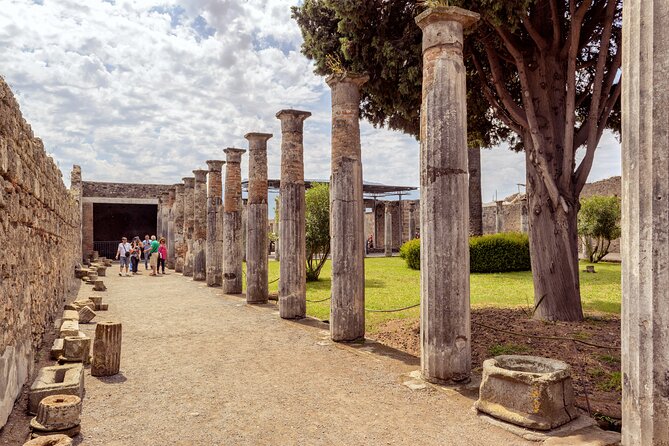
The Pompeii highlights: Forum energy, bathhouse views, and street-level details
After your main Pompeii park time, the tour keeps moving through key stops. Many of these are shorter looks, around 5 to 10 minutes each, which can feel fast until you realize the trade-off. You get a broad hit list in one day, then you still have the park’s longer block where you can absorb more.
At the Basilica, the guide’s job is to help you read the building type and what it meant in the life of the city. Expect this to be a quick but informative anchor point, the kind of stop where the guide gives you a framework for the rest of what you’ll see.
Next comes the Forum area and the Via dell’Abbondanza. These are the most useful stops for understanding the city’s rhythm. Street-level walking and public-area views help you imagine movement, commerce, and how people navigated everyday life.
Then you hit a string of standout interiors or semi-interior house stops, including the House of Menander and the House of Faun. These are valuable for two reasons. First, they help you shift from city life to household life. Second, they give your brain a “scale” reference, because houses look bigger when you realize what rooms are for and how they connect.
The Granaries of the Forum add a different flavor. Instead of focusing on grand architecture, it helps you see Pompeii as a working city. It’s a reminder that cities run on systems, not just monuments.
You’ll also see the Stabian Baths (Terme Stabiane). Bathhouse stops are usually where guides get a chance to make daily routine feel tangible. Even if you’re only viewing certain parts, the explanation can help you understand why these spaces were more than just functional buildings.
The tour then moves to the Lupanar and the two theatres: Odeon (Teatro Piccolo) and Teatro Grande. The theatres are short stops, but they matter because they show how public entertainment and gatherings fit into the city’s plan.
If you’re wondering whether the pace is too intense: reviews suggest an easy rhythm overall. The guide keeps the group together, answers questions without derailing timing, and uses humor to keep the day from feeling like a lecture.
Herculaneum entry time and why the second site often feels calmer
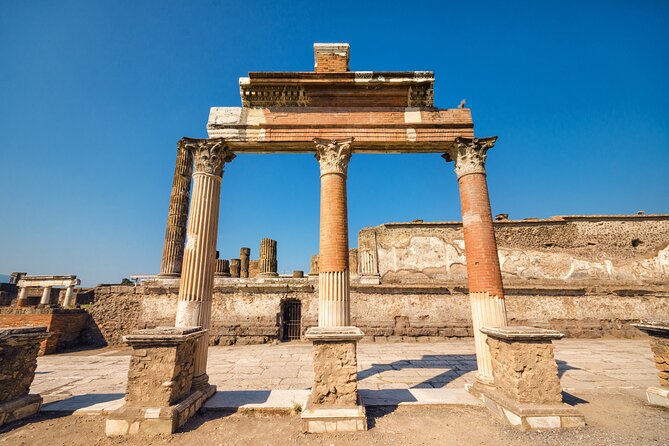
After Pompeii, you head to the Archaeological Park of Herculaneum for another 2 hours with included admission. Many people find the second stop emotionally sharper, because Herculaneum often feels more “human-scale” once you’ve already learned how to read Roman ruins at Pompeii.
The biggest practical value here is sequencing. You see the larger, more sprawling Pompeii first, then Herculaneum. That order helps you compare what’s similar and what’s different, without you needing to do mental math at every turn.
With the guide, you also get a better grasp of the timeline of the eruption story, not just the aftermath. Reviews mention that guides explain events during and after the eruption, and that can make the experience feel less like history class and more like a timeline you can follow.
Herculaneum houses you’ll recognize by name, plus the big public stops
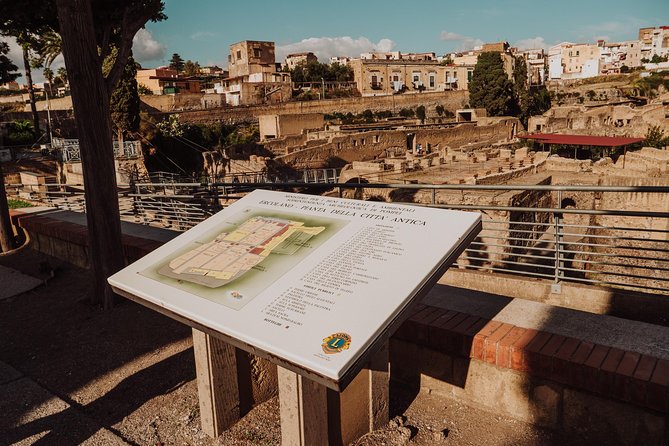
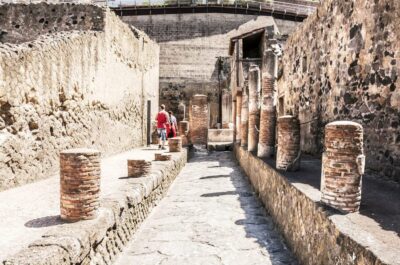
Herculaneum’s itinerary is a tour of houses and public spaces, and the short stop format stays consistent. You’ll see a run of named highlights, usually around 5 to 10 minutes each.
Early on, you’ll hit the House of the Deer and then the Terrace of M. Nonio Balbo. Terraces can be memorable because they show how people used outdoor space, and the guide’s interpretation usually helps you understand how these views connect to the home’s layout.
Next is the College of the Augustales. That kind of stop is helpful because it breaks up the tour of private residences and reminds you that the city had social and civic institutions, not only homes.
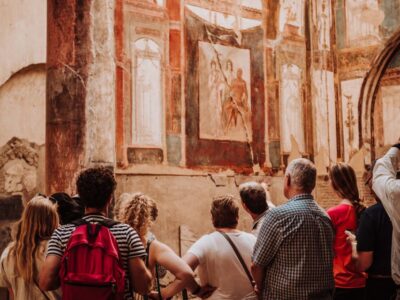
You’ll also see the Casa del Rilievo di Telefo and the Partem Domus lignea (Casa del Tramezzo di Legno), including the House of the Wooden Partition. These are the stops where the guide can point out why certain design details matter, especially when you’re trying to picture the space as it once functioned.
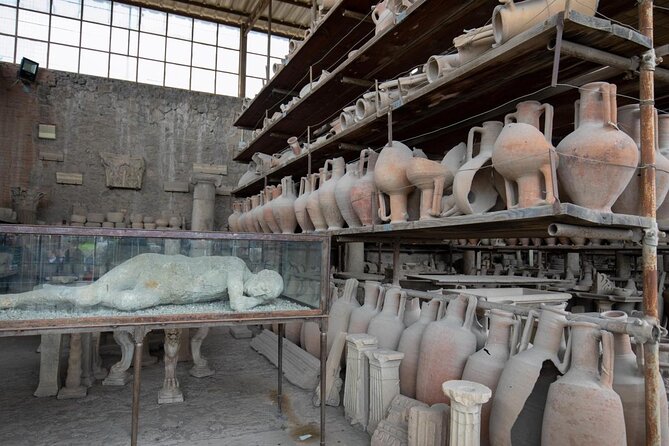
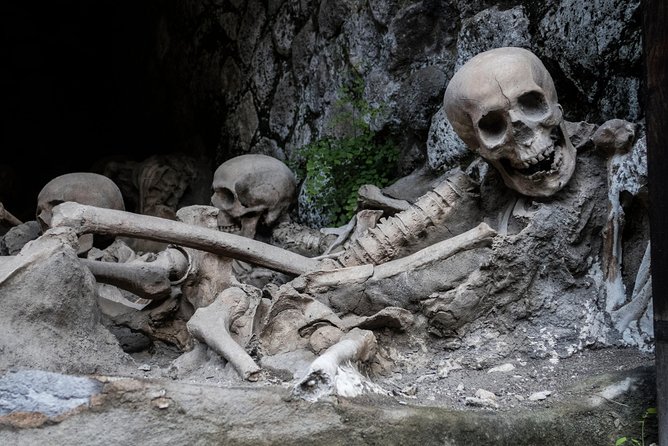
One of the more striking named stops is the House of the Skeleton. It’s short on the schedule, but it tends to stick with people because the title alone forces you to confront the human side of the story.
The Central Thermae bring you back to public routine again, similar in concept to the bathhouse stop at Pompeii. Then you’ll see the House of the Black Salon, which is one of those places that feels like it should take longer. Since the schedule keeps moving, your best bet is to let the guide focus your attention on what’s most important rather than trying to absorb everything at once.
The tour also includes homes like Casa Sannitica, Casa del Bel Cortile, and House of the Grand Portal. Collectively, these house stops help you see how different families lived, how rooms connected, and how architecture signals status and everyday use.
Timing on the ground: what 7 hours really feels like
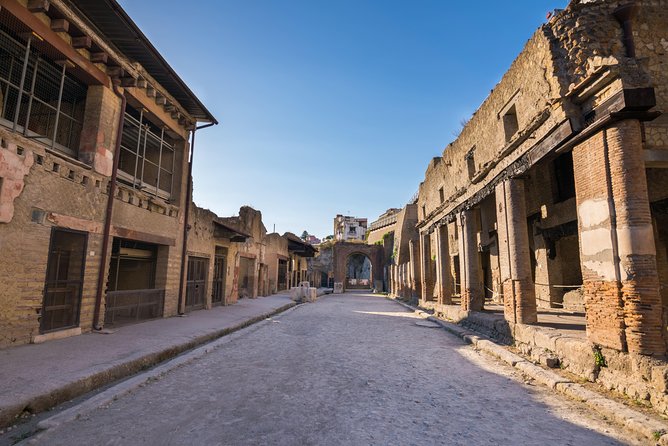
On paper, it’s about 7 hours. On the ground, it’s a full day that starts with a transportation buffer, runs through Pompeii, then continues straight into Herculaneum.
The good news is the schedule isn’t pretending it’s slow. Short named stops are built in. You’re meant to leave with a curated map of highlights, not to linger for hours in one room. If you want the kind of day where you sit for a long time and sketch every detail, this tour might feel structured. But if you want a strong orientation with interpretation, the time allotments do their job.
Based on how guides and pacing are described, the experience is usually kept at a steady tempo. Reviews repeatedly mention that guides keep a good pace and don’t leave you stranded or confused. That matters on these sites because the paths can be dense and it’s easy to lose time if you’re trying to self-navigate.
Also, people mention having time for lunch between Pompeii and Herculaneum. Meals are not included, but the structure seems to create space to grab something, rather than pushing straight through without a break.
And yes, wear shoes you trust. Pompeii and Herculaneum involve walking on uneven surfaces and long distances. If you’re the kind of traveler who packs a blister kit, you’ll feel smug by mid-afternoon.
Guides, humor, and how interpretation keeps ruins from feeling flat
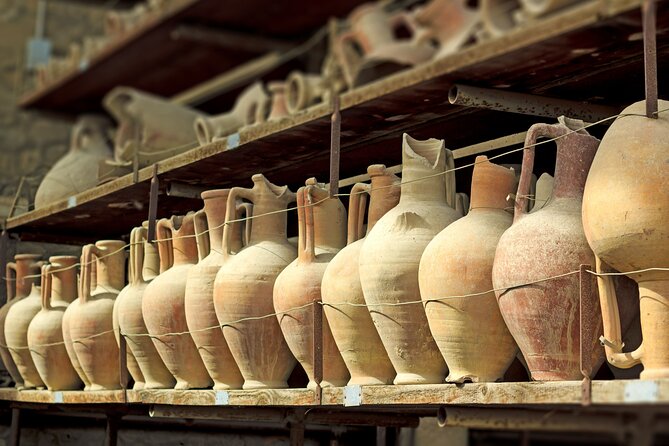
This tour’s biggest differentiator is the archaeologist guide. The guide doesn’t just point. They explain why a building matters, how parts connect, and what to watch for as you move through the city.
In the feedback, guides like Rafael, Gennaro, Michele Lamberti, Vincenzo, Diego, and Giulia show up again and again. Common thread: they’re engaging and often funny, and they answer questions in a way that makes the day easier to follow. When a guide can match your level, from first-time history curiosity to more detailed questions, you get more out of the short stop format.
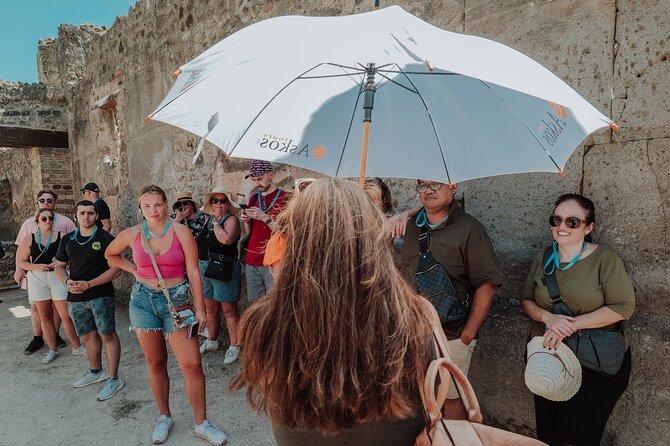
You’ll also notice that good guides manage the group dynamics. They keep you from drifting too far behind, they protect the schedule so you still reach later stops, and they know which parts of a site tend to confuse people. That’s not glamour work, but it’s what makes the experience feel smooth.
Price and value around $173.27 per person
At $173.27 per person, you’re paying for more than the bus ride. You’re buying three things that are hard to DIY well: time savings, interpretation, and included entry.
Here’s how the value adds up from the tour details:
- Pompeii Express entry tickets are included, meaning you’re not scrambling for timed entry or losing time to lines
- Herculaneum admission tickets are included (listed as €16 each)
- You get guidance at both sites from an archaeologist guide, which is where your day becomes meaningful
- You get round-trip transportation by minibus with assistance from a professional driver
What’s not included is just as important: meals and drinks. So your real budget should include lunch and water. If you add lunch on your own anyway, the day still pencils out as a cost-effective way to cover both sites without wasting half a day on logistics.
I think this price is strongest for first-time visitors. If it’s your first time in Pompeii or Herculaneum, paying for a guided structure usually beats trying to build one from scratch.
Should you book this Pompeii and Herculaneum small group tour?
Book it if:
- you want to see both Pompeii and Herculaneum in one day
- you prefer a small group over a giant bus crowd
- you value skip-the-line entry and a plan that protects your time
- you like learning with a guide who can keep the day moving and still make it understandable
Skip it or look closer if:
- you don’t want a walking-heavy itinerary
- you want long, independent time in a single area instead of a highlight circuit
- you’re on a tight food budget and don’t want to plan lunch on your own
If you’re a typical visitor trying to fit the big two into a limited time window, this is the kind of tour that pays off. You get organization, interpretation, and a realistic pace, with guides who have a talent for turning stone and street corners into something you can actually understand.
FAQ
How long is the Pompeii and Herculaneum excursion?
The tour is listed as about 7 hours.
What is the price per person?
The price is $173.27 per person.
Do they offer pickup in Naples?
Yes. Pickup is offered, including round-trip transportation from Naples Central Station or the train station area, and the meeting point is at Starhotels Terminus in Piazza Giuseppe Garibaldi.
Is skip-the-line entry included?
Yes. Pompeii Express entry tickets are included for Pompeii.
How much time do we spend at Pompeii and Herculaneum?
You spend about 2 hours at the Pompeii Archaeological Park, and about 2 hours at the Archaeological Park of Herculaneum.
Are meals included?
No. Meals and drinks are not included.
What is included in the tour guidance?
Guidance at Pompeii and Herculaneum is provided by an archaeologist guide.
How many people are in the group?
The tour lists a maximum of 20 travelers.
Are there any COVID-19 related rules?
The use of masks is mandatory during the visit, and the tour also notes temperature screening on site for entry.
What is the cancellation policy?
Free cancellation is available up to 24 hours in advance for a full refund. If you cancel less than 24 hours before the start time, the amount paid is not refunded.
More Tours in Pompeii
- Pompeii Small Group Tour with an Archaeologist★ 5.0 · 6,593 reviews
- Pompeii and Herculaneum Small Group Tour with an Archaeologist★ 5.0 · 1,350 reviews
- Skip the Line Guided Tour of Pompeii led by an Archaeologist★ 5.0 · 703 reviews
- Pompeii Ticket + Tour with Optional Tasting Experience at Pompeii★ 5.0 · 663 reviews
- Pompeii private tour with an Official Guide★ 5.0 · 631 reviews
More Tour Reviews in Pompeii
- Pompeii Small Group Tour with an Archaeologist★ 5.0 · 6,593 reviews
- Discover the Ancient Ruins of Pompeii: Day Trip from Rome★ 3.5 · 2,247 reviews
- Pompeii and Herculaneum Small Group Tour with an Archaeologist★ 5.0 · 1,350 reviews
- Skip the Line Guided Tour of Pompeii led by an Archaeologist★ 5.0 · 703 reviews
- Pompeii Ticket + Tour with Optional Tasting Experience at Pompeii★ 5.0 · 663 reviews
More Days in Herculaneum
- Pompeii and Herculaneum Small Group Tour with an Archaeologist★ 5.0 · 1,350 reviews
- Private Day Tour to Vesuvius, Herculaneum & Pompeii with Pick Up★ 5.0 · 279 reviews
- The Ultimate Ruins of Pompeii and Herculaneum Private Day Trip★ 5.0 · 103 reviews
- Naples: Pompeii & Herculaneum Day Trip – Small Group Tour★ 4.5 · 72 reviews
- Half-Day Exclusive Private Tour of Pompeii and Herculaneum★ 5.0 · 49 reviews
More ways into Herculaneum Tours.
 ★ 5.0Pompeii and Herculaneum Small Group Tour with an ArchaeologistFrom $771,350 reviews
 ★ 4.8Pompeii: Small-Group Tour of Pompeii and Herculaneum867 reviews
 ★ 4.1Ercolano: Herculaneum Entry Ticket with Optional Audio GuideFrom $21581 reviews
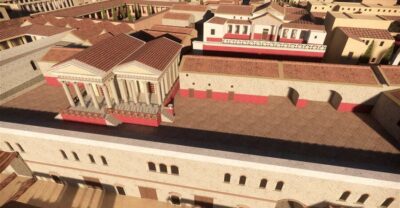 ★ 4.3Herculaneum: 3D Walking Tour with Skip-the-Line TicketFrom $45313 reviews
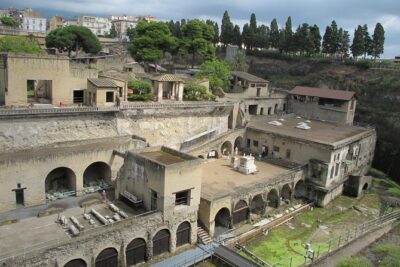 ★ 4.5Guided Day Tour of Pompeii and Herculaneum with Light LunchFrom $185311 reviews
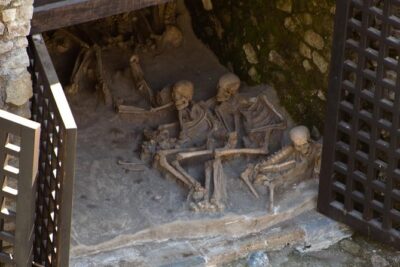 ★ 5.0Private Day Tour to Vesuvius, Herculaneum & Pompeii with Pick UpFrom $120279 reviews
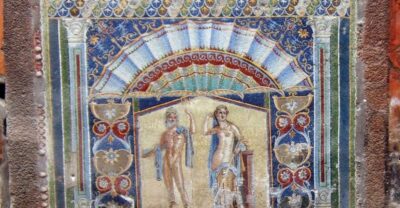 ★ 4.0Ercolano: Herculaneum Skip-the-Line Ticket & Audio GuideFrom $35275 reviews
 ★ 4.3Herculaneum: Skip The Line Entrance ticket + AudioguideFrom $35266 reviews
Other useful routes from here