
REVIEW · HERCULANEUM TOURS
Private Pompeii & Herculaneum Tour from Sorrento
Two Roman cities, one volcanic mystery. In a single day, this private Pompeii and Herculaneum tour takes you from Sorrento into UNESCO-listed ruins that were frozen by the AD 79 eruption of Mount Vesuvius, then guided so you don’t lose the plot. You’ll also get built-in time-saving transport and pre-booked entry so your day starts with momentum instead of standing still.
I love two things about it. First, the pacing hits the big moments at Pompeii and Herculaneum without making you spend your whole day just figuring out where to go. Second, the guide focus is on real daily life, from public baths and markets to homes and street scenes, which turns the ruins into a story you can actually follow.
One possible drawback to plan for: it’s a long, packed day. You cover two major sites, so there is free time, but you should expect your experience to be structured rather than slow and wandering.
Key points worth knowing
- Skip-the-line access in both Pompeii and Herculaneum, so you spend less time stuck at entrances.
- Hotel pickup in Sorrento by private air-conditioned vehicle, which makes the day feel easy from minute one.
- Two-hour guided time at each site, with high-impact stops like the Pompeii Forum and the Herculaneum baths.
- Pompeii and Herculaneum in one shot, a smart comparison since preservation is different at each city.
- English guide who helps you connect landmarks to daily routines, not just dates and facts.
From Sorrento, a fast route to Pompeii and Herculaneum
Sorrento is a great home base, but Pompeii and Herculaneum are inland, and planning your own transportation can turn into a time tax. This tour removes that headache by handling pickup from your hotel or a central Sorrento location and then transferring you by private vehicle between stops.
The big value here is mental. When you start the day already moving, you use your energy on the ruins. Instead of spending the morning hunting tickets or timing buses, you meet your guide near the Pompeii entrance and go straight to the good stuff. It also helps that your visit is organized around guided time blocks, roughly 2 hours at Pompeii and about 2 hours at Herculaneum, which gives you a satisfying overview without the “I’m walking and nothing makes sense” feeling.
Pompeii’s Forum, temples, markets, and street life
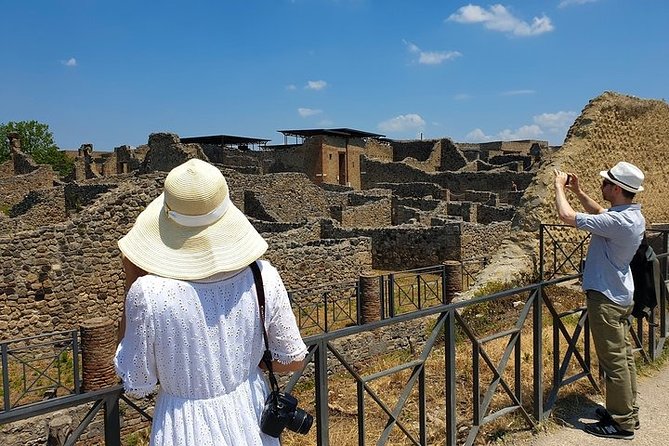
Pompeii is enormous. It’s one of those places where the ruins can feel like a maze if you do it alone. With a private guide, you get the map inside the map: why the Forum mattered, where people shopped, how the city moved from one public space to another, and what daily routines looked like before AD 79 changed everything.
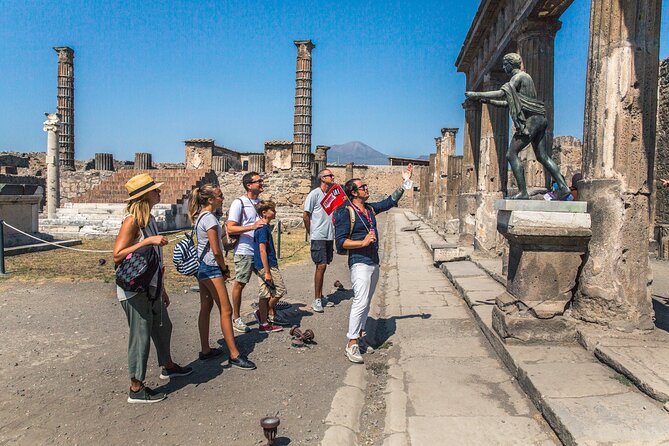
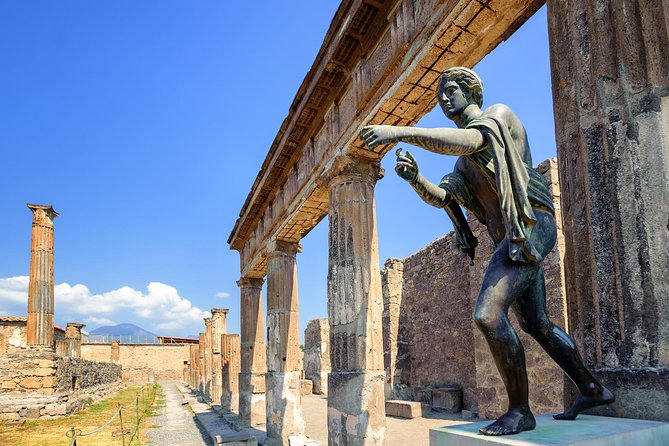
At Pompeii, your guided visit is built around the civic and commercial heart first. You’ll stand in the Civil Forum area, the core of daily life where administration, justice, business, trade, and worship all intersected. Next comes the Tempio di Giove Capitolino (Temple of Jupiter), sitting on the north side of the Forum. When you see Mount Vesuvius rising behind in the scenery, it makes the eruption story feel less like trivia and more like an unavoidable storm cloud hanging over the city.
Then you move into shopping and food culture. The Macellum was the marketplace complex, and it helps you picture the daily rhythm of what people bought, where meetings happened, and even how the space tied into imperial worship. After that, you walk one of the most important streets of Pompeii: Via dell’Abbondanza, the long commercial artery that ran from the Forum toward the Sarno Gate. Walking its basalt stones, you can still imagine the raised stepping stones, shops, workshops, and the kind of graffiti and scrawls that show how people truly used the street.
One practical bonus: these “high frequency” stops keep you grounded. Instead of jumping randomly between ruins, you’re following the city’s logic, public center to commerce, commerce to social spaces. That is exactly what makes a guide feel worth it here.
Terme Stabiane, the city’s social engine
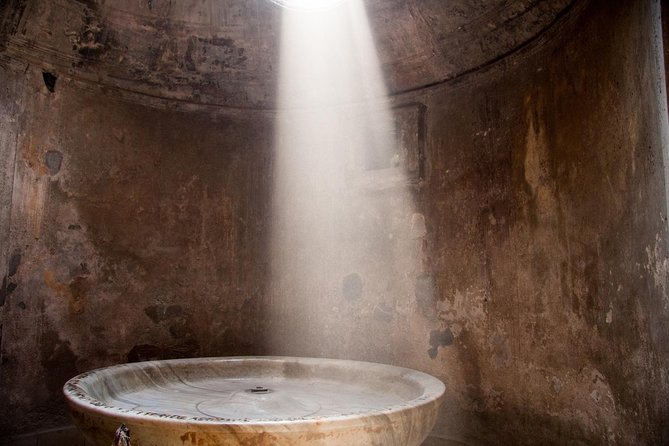
Public baths were not just about cleanliness. In Pompeii, they were a social hub. Your route includes the Stabian Baths (Terme Stabiane), one of the oldest and largest bathing complexes. It’s a standout because you can still picture the engineering with the hypocaust underfloor heating system and understand how people moved between areas.
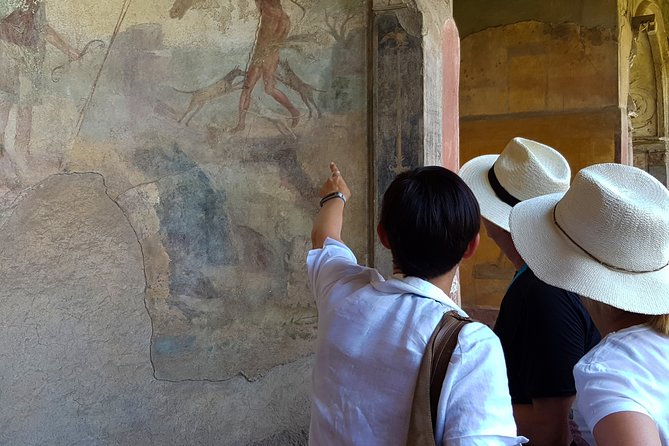
What I like about this stop is how it breaks the stereotype of ruins as silent and cold. In the baths, you can see how Romans designed space for both men and women, and you’ll spot features like an outdoor gym area (palaestra) and a large pool. Even with a brief stop, it gives you a sense of how much time ordinary people spent in places built for everyday life.
A quick look at the Lupanar
You’ll also pass through the Lupanar, Pompeii’s famous brothel building, known for the erotic paintings on its walls. It’s not everyone’s favorite topic, but it is historically relevant. It shows how the city included entertainment, work, and services that modern visitors often forget existed.
If you’d rather keep your visit more neutral, treat it like what it is: a window into social reality. Your guide can help connect it to what was normal in that society, not just sensationalize it.
Houses and entertainment, from the Faun to the Teatro Grande
Next, you’ll get a taste of elite life and public spectacle. The Casa del Fauno is one of Pompeii’s largest and most impressive private residences. It gives you scale and status, and it reminds you that Pompeii wasn’t only streets and shops. It also had major art and wealthy interiors.
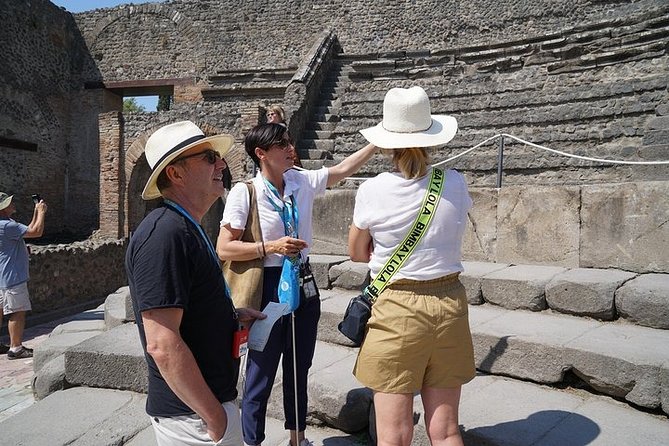
Then it’s on to Teatro Grande, a horseshoe-shaped auditorium built into a hillside for around 5,000 spectators. The theater dates to the 2nd century BC and was Pompeii’s main venue for performances. Seeing its tiered seating and stage area helps you understand how public entertainment worked for both elite and regular citizens.
Finally, you’ll spend time near the Basilica in the Forum area, a large administrative and business building. Even in a short stop, it makes the point that the Forum was not just a monument zone. It was a functional city office district.
The Pompeii stop list is intentional
Not all “Pompeii tours” feel balanced. This one is, because it rotates through the city’s main roles: religion, justice, shopping, street life, baths, entertainment, and homes. When you return to the street with those categories in your head, you understand what you’re looking at, and your photos look better too.
Herculaneum: better preservation, different texture of the ruins
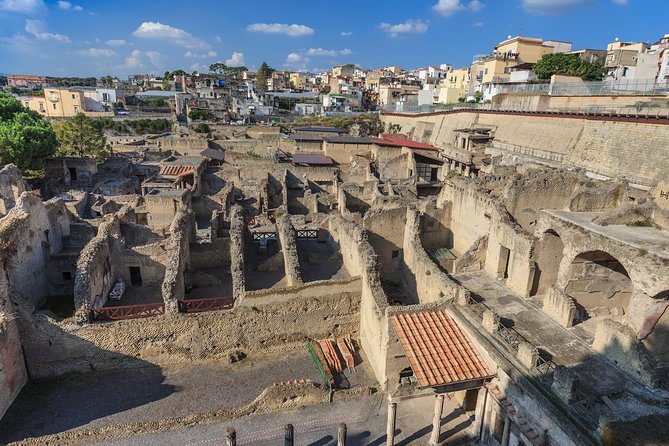
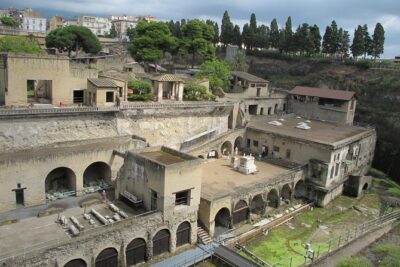
After Pompeii, you get some breathing space. You’ll have free time for lunch on your own before heading to Herculaneum. Then you get back into guided mode for about an hour or so, exploring one of the best reasons to do both cities: Herculaneum is often considered better preserved because it was encased in mud and lava rather than just ash and pumice.
That difference matters. In Pompeii, you’re often looking at structures that are impressive but fragmented. In Herculaneum, the ruins can feel more intact and intimate, and that can change how emotional the whole experience feels.
Casa dei Cervi and elite residential life
Your Herculaneum loop starts with the Casa dei Cervi, a noble-family house that had a seafront address before the disaster. It was built around a central courtyard and included murals and still-life paintings. The courtyard layout helps you picture how a Roman home organized light, privacy, and daily flow.
College of the Augustales and the culture of worship
Next is the College of the Augustales, thought to have been linked to the cult of Emperor Augustus and the Collegium Augustalium (with a possibility it also served as a local headquarters). Even if your eyes only catch fragments at first, this stop is a reminder that the eruption did not freeze only homes and streets. It stopped civic and religious systems too.
House of the Skeleton: a hard stop, handled by context
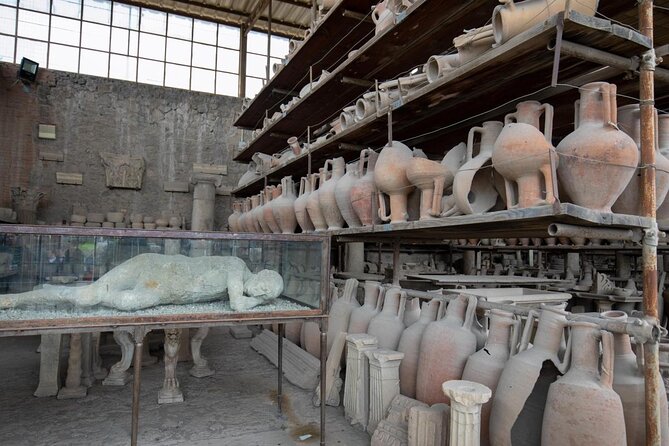
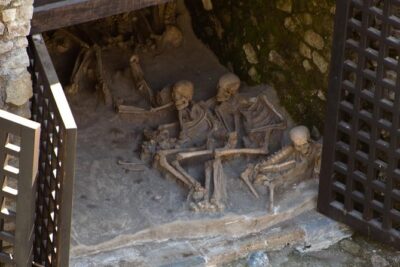
One of the most striking stops is the House of the Skeleton, named after human remains found in a second-floor room in 1831. It’s a sobering visit. The site is associated with people who shut themselves into their homes and died there, likely from suffocation or extreme heat from gases.
If you want the day to stay uplifting, this is the spot where you’ll feel the tragedy most. For me, it also grounds everything else. It helps you connect the city’s daily normalcy to what the eruption really meant, not just the spectacle.
The Central Thermae: men and women, changing rooms, and heat
Then you shift back to daily life with the Central Thermae, Herculaneum’s public baths. Again, baths are not an afterthought. They were social infrastructure.
This stop is clearly organized in your route: you’ll see that the baths were divided into sections reserved for women and men, with rooms for cold, tepid, and hot bathing. It’s a rare opportunity to understand how Roman heat and water systems were planned, rather than just reading about them.
Casa del Tramezzo di Legno: a room divider you can picture
Another standout is Partem Domus lignea, also called Casa del Tramezzo di Legno. This one has a very specific detail: the name comes from a folding wooden door discovered there. Your visit helps you picture how the atrium and tablinium (owner’s study area) were separated.
You’ll also have a view of the benches where clients waited to be received by the host. That small detail makes the space feel lived in, not just excavated.
Salone della Barca di Ercolano: the preserved boat story
To end on something visual, you’ll visit the Salone della Barca di Ercolano, where you can admire a recovered wooden boat. The story is dramatic: after the eruption, people fled toward the beach, but the port and shoreline were destroyed.
The key reason this stop works is the preservation method. The wooden boat was covered with a resinous material, which helped preserve it. It was brought back to life and repositioned in 1982, and that means you can see the physical object rather than only a concept.
Lunch break and how to protect your energy
Between Pompeii and Herculaneum, you get free time for lunch at your own expense. This is important because the day is long, and the ruins are not light walking.
My practical advice: use the lunch break to reset your body. Eat something simple, drink water, and take a few minutes off your feet. If you only grab a quick snack and keep walking on empty, the afternoon ruins feel longer than they should.
Also, since water is not listed as included, you should plan to carry some. One guide feedback specifically wished water had been provided, and on a hot Campania day, that small detail matters.
What the day feels like, from pickup to return
This is designed to be smooth. You meet your vehicle at the hotel area in central Sorrento at the agreed time, travel to Pompeii, meet the guide at the entrance area, then repeat the same structured flow at Herculaneum.
You should expect a return to Sorrento around 4pm to 5pm. That’s late enough for dinner plans, but early enough that you usually won’t feel wiped out for the whole night.
Because Pompeii is vast, the guide’s job is not only explaining. It’s also helping you avoid dead ends and repetitive routes. A good guide essentially turns Pompeii into a sequence, not a scatter of highlights.
And the guide impact in this tour type is real. In the guide feedback, names like Connie, Ugo (Hugo), Nella, and Carmela come up with praise for being engaging and answering questions. When your guide can explain what you’re seeing, the ruins become understandable faster.
Price and value: is $769.43 per person worth it?
Let’s talk money plainly. At $769.43 per person, this is not a budget day. But it does include several things that add up fast if you plan solo: private hotel pickup and transportation, 2 hours guided at Pompeii, 2 hours guided at Herculaneum, and skip-the-line entrance tickets.
That matters because these two sites are famous for their crowds and ticket lines. If you arrive without pre-booking, you can lose a chunk of your day waiting. Here, the “skip the line” benefit is baked in, so your day doesn’t stall.
There is also value in the compression. You’re effectively buying an organized day that compares two cities shaped by the same eruption. Pompeii and Herculaneum are both huge, and doing both efficiently is hard without a plan.
So who gets best value? People who want a guided overview, want help reading the sites, and care about time. If you love slow, independent wandering and you already know Pompeii well, you might feel the cost. If you want structure, context, and less stress, this price can start to make sense.
Should you book this Pompeii and Herculaneum private tour?

Book it if:
- You want two UNESCO-level archaeological sites in one day without logistical headaches.
- You prefer a guide who helps you connect monuments to how people lived, shopped, bathed, and worshiped.
- You value skip-the-line convenience and hate wasting time at entrances.
- You like the idea of comparing Pompeii’s ash preservation with Herculaneum’s mud and lava survival.
Skip it or think twice if:
- You dislike structured pacing and want lots of free roaming.
- You’re highly price sensitive for a day trip.
- You plan to do very slow sightseeing, where 2 hours can feel short for Pompeii alone.
If you do book, come ready for heat and lots of walking. Wear comfortable shoes, bring sunscreen, and keep water on you. Then let the guide do what they’re best at: turning a massive site into a story you can actually understand.
FAQ
How long is the tour?
The tour is about 8 hours total. It includes around 2 hours guided at Pompeii and about 2 hours guided at Herculaneum.
Is pickup from Sorrento included?
Yes. Pickup is offered from your hotel or a central location in Sorrento, and you also get return transportation back to Sorrento.
Are tickets included, and do you skip the lines?
Yes. Admission tickets are included, and you get skip-the-line entrance tickets for both Pompeii and Herculaneum.
Is the tour guided in English?
Yes. The tour is offered in English.
Is there time for lunch?
Yes. After the Pompeii portion, you’ll have free time for lunch, but food and drinks are not included, so you’ll pay on your own.
What time will I be back in Sorrento?
The return transfer is scheduled for around 4pm to 5pm.
Can I cancel and get a full refund?
Yes. You can cancel for a full refund if you cancel at least 24 hours before the experience’s start time.
More Tours in Sorrento
- Sorrento: Exclusive Capri Boat Tour and Optional Blue Grotto★ 4.8 · 3,170 reviews
- Capri Blue Grotto Small-Group Boat Day Tour From Sorrento★ 4.5 · 2,511 reviews
- From Sorrento/Nerano: Amalfi and Positano Boat Tour★ 4.6 · 2,440 reviews
- Sorrento: Skip-the-Line Pompeii Express Tour by Train★ 4.8 · 2,038 reviews
- From Sorrento: Capri Boat Tour with Blue Grotto Visit★ 4.7 · 1,759 reviews
More Tour Reviews in Sorrento
- Sorrento: Exclusive Capri Boat Tour and Optional Blue Grotto★ 4.8 · 3,170 reviews
- Sorrento Farm and Food Experience including Olive Oil, Limoncello, Wine tasting★ 5.0 · 2,524 reviews
- Capri Blue Grotto Small-Group Boat Day Tour From Sorrento★ 4.5 · 2,511 reviews
- From Sorrento/Nerano: Amalfi and Positano Boat Tour★ 4.6 · 2,440 reviews
- Day Trip to Positano, Amalfi & Ravello from Sorrento★ 4.5 · 2,371 reviews
More Days in Herculaneum
- Guided Day Tour of Pompeii and Herculaneum with Light Lunch★ 4.5 · 311 reviews
- Sorrento: Pompeii & Herculaneum Tour with Skip-the-Line★ 4.6 · 125 reviews
- Pompeii, Herculaneum and Winery on Vesuvius with an Archaeologist★ 5.0 · 89 reviews
- Herculaneum: 2-Hour Skip-the-Line Tour from Sorrento★ 4.0 · 46 reviews
- Pompeii & Herculaneum – Skip the line from Sorrento★ 4.5 · 44 reviews
More ways into Herculaneum Tours.
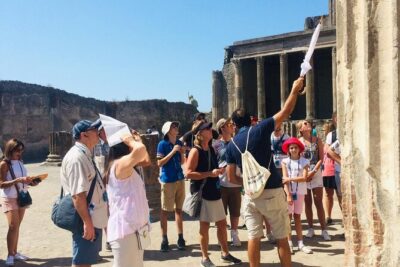 ★ 5.0Pompeii and Herculaneum Small Group Tour with an ArchaeologistFrom $771,350 reviews
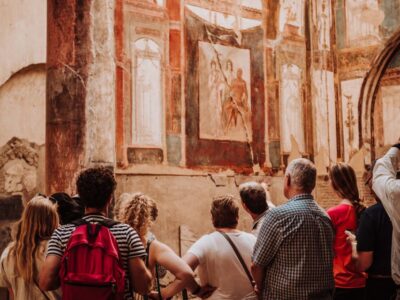 ★ 4.8Pompeii: Small-Group Tour of Pompeii and Herculaneum867 reviews
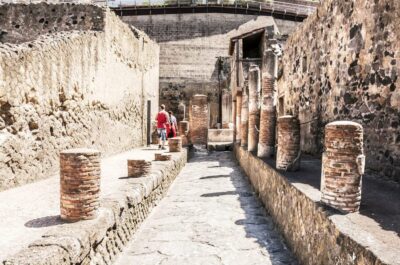 ★ 4.1Ercolano: Herculaneum Entry Ticket with Optional Audio GuideFrom $21581 reviews
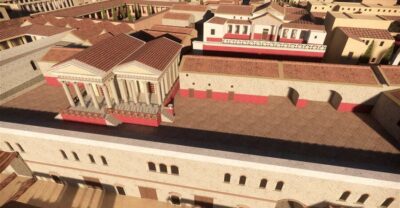 ★ 4.3Herculaneum: 3D Walking Tour with Skip-the-Line TicketFrom $45313 reviews
 ★ 4.5Guided Day Tour of Pompeii and Herculaneum with Light LunchFrom $185311 reviews
 ★ 5.0Private Day Tour to Vesuvius, Herculaneum & Pompeii with Pick UpFrom $120279 reviews
 ★ 4.0Ercolano: Herculaneum Skip-the-Line Ticket & Audio GuideFrom $35275 reviews
 ★ 4.3Herculaneum: Skip The Line Entrance ticket + AudioguideFrom $35266 reviews
Other useful routes from here