
REVIEW · POMPEII TOURS FROM SORRENTO
Pompeii tour with LOCAL GUIDE and SKIP THE LINE entrance
Pompeii feels alarmingly close to today. This skip-the-line Pompeii guided tour brings you in with a local guide, then walks you through the ruins with context that makes the ash-preserved city feel real. It runs in English, and the group stays small, up to 14 people.
I love the practical pacing here, especially how the guide helps you read what you are seeing instead of just following signs. I also really like the stop mix, from Casa del Menandro to the Forum and the Stabian Baths, so you get both daily-life details and big public spaces. One drawback to plan for: with an about 2.5 hour length, you will not see every corner of Pompeii, so this is best when you want the highlights with a guide, not a full, slow exploration.
Key highlights to know before you go
- Skip-the-line priority entry saves time at a very crowded site
- Small group size (max 14) keeps the tour conversational
- Casa del Menandro details include frescoed atrium scenes and stories about hidden silverware
- Forum of Pompeii stop explains how Roman public life and justice worked
- Stabian Baths gives you a look at the oldest bath complex in the city
- Optional time to stay after your guided walk, so you can linger where you care most
Pompeii with skip-the-line priority and local storytelling
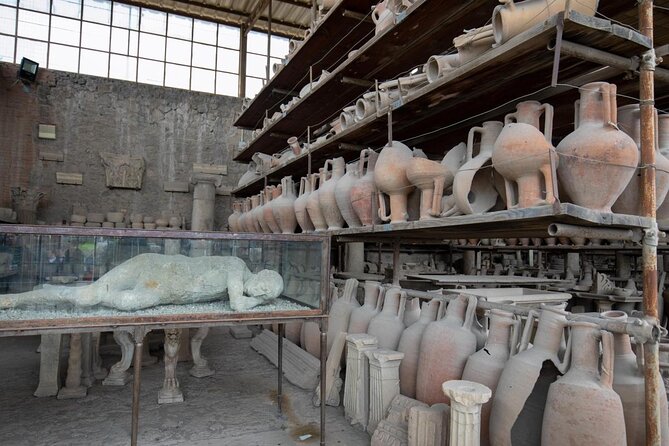
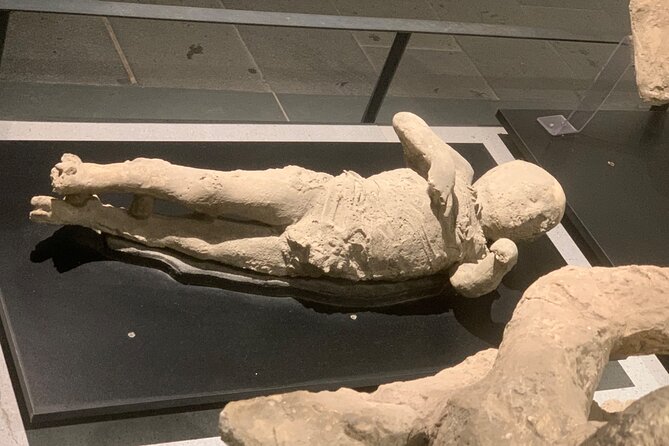
Pompeii is famous because volcanic ash froze a whole city in time. One minute you are standing in open air, the next minute you are walking Roman streets where plastered walls, worn stone steps, and everyday layouts make the past feel specific. What makes a guided version especially useful is that the guide points out what to notice, then ties it to how people lived.
This tour is designed to start smoothly. You meet at Via Villa dei Misteri 3, Pompei, and you end back there. The big headline is priority service, so you are not stuck wrestling with lines right as you arrive.
If you like local guides who can explain without turning it into a lecture, this is a strong fit. The tour is offered in English, and it includes a local guide service plus the entry ticket.
Your time budget: what 2.5 hours lets you see
Pompeii is huge, so the biggest question is simple: how much do you want to cover in one sitting? This experience runs about 2 hours 30 minutes, with a guided walking plan that hits several key areas. That is enough time to get oriented fast and see major highlights, but it is not enough to deeply explore every site on your own after.
I recommend using this tour as your smart first visit. Let the guide show you where the important spaces are, what they were used for, and why they matter. Then, if you want more, you can stay inside the excavations after the guided portion and follow your interests.
One practical note: the tour includes a skip-the-line entrance, but it still involves walking on uneven ground. Wear comfortable shoes and plan for sun, because even a guided highlight route will not feel like an indoor museum.
Stop 1: Archaeological Park of Pompeii, where ash makes the city read like a snapshot
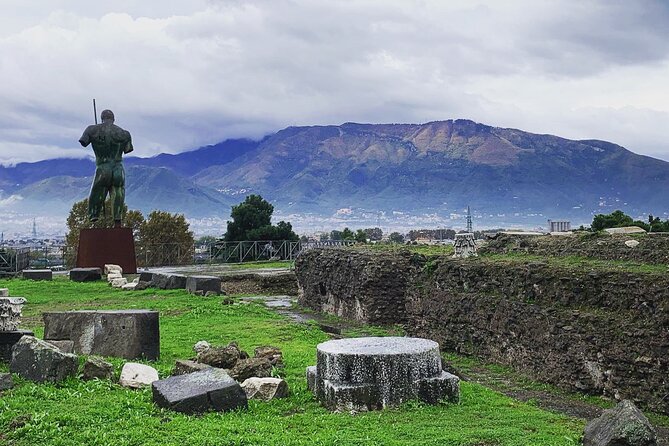
The tour begins at the Archaeological Park of Pompeii, near the entrance area close to the station and car parks. You get a local-guided walk that frames Pompeii as one of the most important historical sites because volcanic ash preserved so much, so clearly. You will hear that excavation work started in the 18th century and that after roughly 250 years, about 75% of the site has been brought to light.
That matters because it shapes how you see the place. When you walk the streets during the tour, the explanation helps you understand why some areas feel like they are mid-construction and why other parts feel more exposed, like an archaeological window into daily life.
You spend about two hours in the main park during the guided portion. This chunk is where you should pay extra attention. The guide’s job here is to help you build a mental map, so later stops do not feel random.
A small consideration
Some people want a slower, longer Pompeii day so they can linger at walls, rooms, and inscriptions. If you are in that camp, you may feel this tour is a bit fast, even if the guide is doing a great job. Think of this as a smart highlights route, not a full-depth survey.
Stop 2: Casa del Menandro and the atrium fresco that tells epic stories

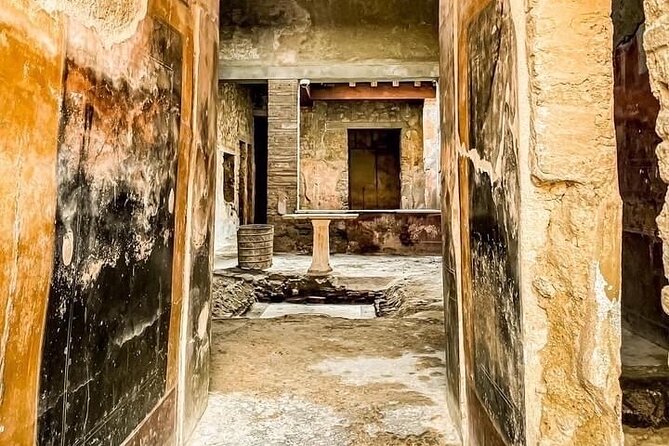
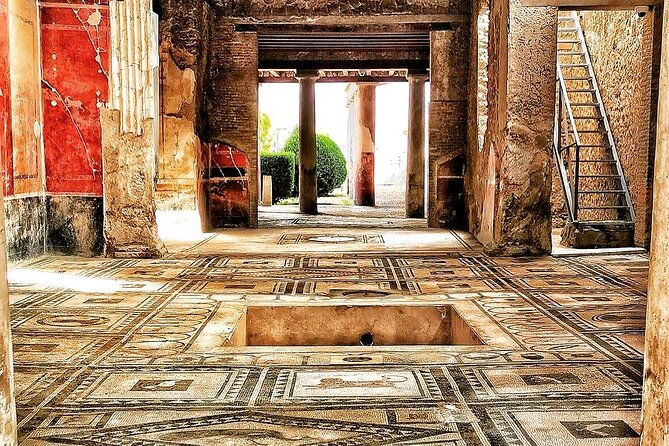
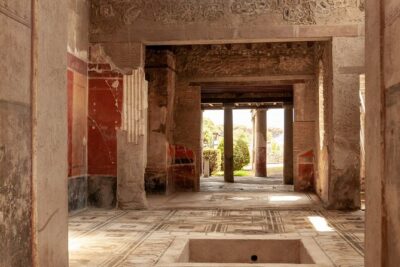
Casa del Menandro is the kind of stop that makes Pompeii feel intimate. This large home belonged to someone with status, and it shows how serious wealth expressed itself in decoration, layout, and even the hidden systems of daily comfort.
You get a look at the atrium, where frescoes depict scenes from the Iliad and the Odyssey. That combination, epic Greek storytelling inside a Roman household, helps you understand how culture and identity traveled across the Roman world. You also learn about the peristyle, described as a “rhodium” type, with a raised northern side.
Then the house name comes from a portrait of Menander, an Athenian playwright, placed in the porch. It is a reminder that Pompeii was not only about Roman power, it was also about the personal choices and artistic tastes of real families.
The practical stuff that makes it more than pretty walls
This stop gets interesting fast because it is not only decorative. There was a small thermal area below, plus an underground room that may have served as a cellar. In that underground space, a chest of 118 pieces of silverware was found, and those pieces are now in the National Archaeological Museum of Naples. The story of hiding valuables before restoration adds a human layer to the archaeology.
Even the pottery detail matters. Wine-serving forms and banquet plates and cups tell you what social life looked like in this household. On the southern side, you also see the rustic quarter, including a reconstructed wagon display.
You spend about 15 minutes here. That is brief, but it is enough to hit the core highlights without turning Casa del Menandro into a half-day project.
Stop 3: Lupanar, the Pompeii brothel stop that explains layout and pricing
The Lupanar stop is unforgettable. It is not meant to shock you, but it does not hide the reality either. You see how the building was set up for mercenary sexual pleasure, and you get a look at the actual room arrangement that would have guided customers through the space.
The tour explains that the prostitutes were mostly Greek and Oriental slaves, working for between two and eight asses, with a cup of wine costing one. Whether you find those details uncomfortable or fascinating, they bring the site out of vague legend and into tangible everyday economics.
Architecturally, the building has two floors. On the upper floor were the owners’ and slaves’ homes. On the lower floor were five rooms, each with a built-in bed, arranged along a corridor that connects the two entrances on the ground floor. Curtains closed the rooms. At the corridor’s end, under the stairwell, you can see a latrine.
What sticks with people is the corridor itself. Small erotic pictures on the central corridor functioned like a visual message about what customers might be seeking. The name comes from the Latin lupa, meaning she-wolf, used as the term for prostitute.
What to consider before you go
This is one of the more adult-focused stops on the route. If you are traveling with kids, you will want to consider how you want to handle sensitive topics in a historic context. The good news is that the stop is short, about 10 minutes, so it is not a long sit.
You also get a second Lupanar-related segment later on the route, listed again for about 10 minutes. Think of it as extra viewing time and reinforcing context, rather than a separate, long add-on.
Stop 4: The Forum of Pompeii and how Romans ran city life
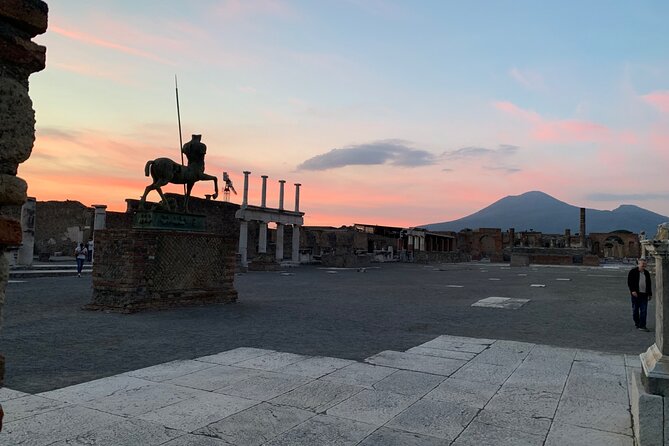
If you want to understand how the city worked, the Forum is the place. This Civil Forum served as the center of daily life in Pompeii, with public buildings for administration and justice, plus space for business management and commerce.
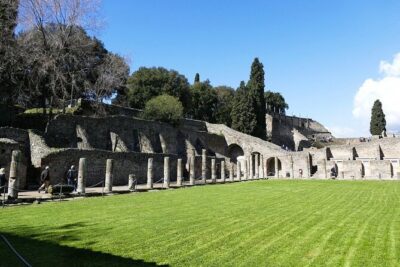
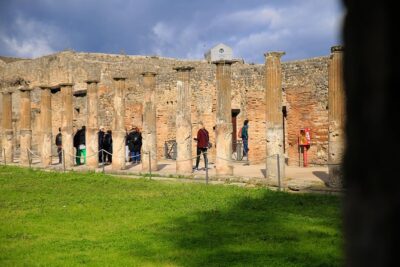
You learn how the Forum originally looked like a more open area of rammed earth. On the western side was the Sanctuary of Apollo, and on the eastern side you could find a row of shops. Later, the square was modified between the 3rd and 2nd centuries BC, regularized, surrounded by arcades, and paved with tuff slabs.
Then comes one of those “oh, that makes sense” connections. The axis of the square became aligned with the facade of the Temple of Jupiter, placed in line with Vesuvius. Later in the imperial age, travertine slabs replaced parts of the paving. Some slabs were moved out of place, and you can see recesses that once held bronze letters from a major inscription.
The Forum stop is about 20 minutes. That is enough time to understand the big structure, then focus on a few key elements with the guide pointing out what would have mattered to an ordinary Roman day.
Stop 5 and 6: Back to the Lupanar area, then into the Stabian Baths
After the Forum, you return to the Lupanar area for about 10 minutes again. This is a useful structure for the tour because it lets you process what you saw, then reframe it. Instead of only treating it as an isolated building, you get to connect it to how Roman society assigned commercial spaces and managed mercenary services.
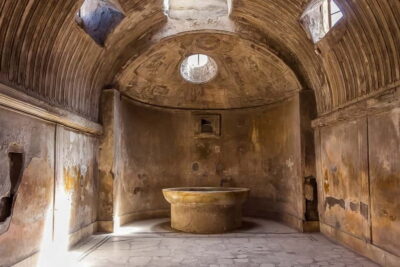
Then you finish with the Stabian Baths, also called Terme Stabiane. This stop is short, about 10 minutes, but it is packed with meaning. The Baths are a Roman-era thermal complex, buried by Vesuvius in 79 and rediscovered during excavations. Of its type, it is the oldest building in the city.
Even in a brief time window, you can appreciate the bath complex because it shows a different side of Pompeii life. This was not only about homes and street corners. It was also about routines, hygiene, and social interaction in public spaces.
Finishing here also gives you a change of pace. After the intense Lupanar and the political energy of the Forum, the Baths feel like a reset to daily human rhythm.
How the skip-the-line entrance changes your day
At Pompeii, time lost at entry is time you cannot get back. This is why priority service is more than a convenience. When you can start earlier and avoid line stress, you walk the park with less rushing and more attention.
This tour also uses a mobile ticket. That helps in practical terms, since you are not juggling printed vouchers at the gate. You still want to double-check the meeting point and show up early enough to find your guide.
One more useful detail: after the guided tour, you have the possibility of remaining inside the excavations. That is your chance to turn a highlight tour into a custom visit.
Meeting point reality at Via Villa dei Misteri 3
The tour meeting point is Via Villa dei Misteri 3, 80045 Pompei NA, Italy. The walk begins near the entrance to the ruins, just a few meters from the station and car parks.
Because this is a busy area, I suggest arriving with a buffer, especially if you are traveling by train. Communication about the meeting point can be confusing for some people, and one person noted they were almost late due to that mix-up, even with a small group. If you want the least stress, plan to be there a little early and confirm you are at the right side of the road.
End time is back at the meeting point, which is a nice way to keep your day organized. You are not left wondering how to regroup once the guided part is done.
Guides, group size, and the learning style you get
The operator lists Gennaro Balzano as the experience provider. In practice, the quality you will feel often comes from the guide’s tone and pacing. In past groups, guides named Antonio, Anna, Sasa, and Gennaro are mentioned for being friendly, funny, and genuinely willing to answer questions.
Group size is capped at 14 travelers, so you are not part of a giant herd. That matters because Pompeii needs context, and the ability to ask even a few things improves the experience.
If you get someone who has a good way of explaining, the site turns from ruins into a timeline. The tour connects rooms to daily routines, public spaces to social rules, and art to what people wanted to signal in their own homes.
One small listening note
Some guides can be heard clearly without trouble, but the tour does not list headphones as included. If you know you rely on audio, consider bringing your own small listening setup, and keep an eye on whether your guide uses a microphone during your walk.
Who should book this Pompeii tour, and who should pick longer?
This tour is a smart match if you want:
- A guided overview that hits major Pompeii areas in a single morning or afternoon block
- Skip-the-line priority so you spend more time inside and less time in queues
- An English explanation with a local guide in a small group
It may not be your best choice if you want to:
- Slowly explore and read every detail at your own pace
- Spend long periods in one house or one forum area
- Treat Pompeii as a full-day deep study
If you are the kind of traveler who can spend an hour in one courtyard reading every wall, you might feel the route is a bit tight. The most common “fix” is choosing a longer Pompeii guided option. But if you want the big hits and a map of what to do next, this plan works well.
Also, this is a solid family-friendly choice in the sense that some guides are described as patient and good with kids. Still, because the Lupanar stop is explicit in topic, think about how your family handles adult themes in history.
Should you book this Pompeii skip-the-line guided tour?
Yes, if you want a high-value Pompeii primer with less time lost at entry. The combination of priority access, a local guide, and a stop mix that covers homes, public life, and baths makes this a practical first visit.
Book it especially if you are planning ahead, because it is commonly reserved about 18 days in advance. And if you know Pompeii will be a once-per-trip moment, use this tour as your foundation, then stay inside afterward to linger on what grabbed you most.
If you already know you want a slow, thorough tour, consider booking longer. Pompeii rewards time. This one rewards focus.
FAQ
How long is the Pompeii tour?
It runs for about 2 hours 30 minutes.
How much does the tour cost per person?
The price is $66.38 per person.
Where do I meet for the tour?
The meeting point is Via Villa dei Misteri, 3, 80045 Pompei NA, Italy.
Does the tour include skip-the-line entry?
Yes. Priority service is included to help you skip the line for entry.
What is included with the tour ticket?
Entrance tickets, an authorized local guide, and the skip-the-line priority service are included.
What language is the tour offered in?
The tour is offered in English.
Will I get a mobile ticket?
Yes. The tour includes a mobile ticket.
How many people are in the group?
The tour has a maximum of 14 travelers.
What stops are covered on the tour?
You visit the Archaeological Park of Pompeii, Casa del Menandro, the Lupanar, the Foro of Pompeii, and the Stabian Baths (Terme Stabiane).
What happens if it is canceled due to weather or too few travelers?
If canceled due to poor weather, you will be offered a different date or a full refund. If canceled because the minimum number of travelers is not met, you will be offered a different date or experience, or a full refund.
More Tours in Pompeii
- Pompeii Small Group Tour with an Archaeologist★ 5.0 · 6,593 reviews
- Pompeii and Herculaneum Small Group Tour with an Archaeologist★ 5.0 · 1,350 reviews
- Skip the Line Guided Tour of Pompeii led by an Archaeologist★ 5.0 · 703 reviews
- Pompeii Ticket + Tour with Optional Tasting Experience at Pompeii★ 5.0 · 663 reviews
- Pompeii private tour with an Official Guide★ 5.0 · 631 reviews
More Tour Reviews in Pompeii
- Pompeii Small Group Tour with an Archaeologist★ 5.0 · 6,593 reviews
- Discover the Ancient Ruins of Pompeii: Day Trip from Rome★ 3.5 · 2,247 reviews
- Pompeii and Herculaneum Small Group Tour with an Archaeologist★ 5.0 · 1,350 reviews
- Skip the Line Guided Tour of Pompeii led by an Archaeologist★ 5.0 · 703 reviews
- Pompeii Ticket + Tour with Optional Tasting Experience at Pompeii★ 5.0 · 663 reviews
Sorrento to Pompeii, More Ways
- Skip the Line Guided Tour of Pompeii led by an Archaeologist★ 5.0 · 703 reviews
- Sharing Tour of Pompeii★ 5.0 · 487 reviews
- Pompeii Tour & Lunch with Wine Tasting Experience★ 5.0 · 383 reviews
- 2 hours Pompeii Tour with Local Historian – Ticket Included★ 5.0 · 335 reviews
- Private Day Tour of Pompeii, Sorrento and Positano with Pick Up★ 5.0 · 110 reviews
More ways into Pompeii Tours from Sorrento.
 ★ 4.8Pompeii: Small-Group Tour of Pompeii and Herculaneum867 reviews
 ★ 4.9Pompeii Ruins Private Tour with Optional Skip-the-Line EntryFrom $254732 reviews
 ★ 4.0Pompeii Ruins Half-Day Tour from Sorrento with GuideFrom $97714 reviews
 ★ 5.0Skip the Line Guided Tour of Pompeii led by an ArchaeologistFrom $95703 reviews
 ★ 4.3Day Tour to Pompeii Ruins and Mount VesuviusFrom $130489 reviews
 ★ 5.0Sharing Tour of PompeiiFrom $193487 reviews
 ★ 5.0Pompeii Tour & Lunch with Wine Tasting ExperienceFrom $120383 reviews
 ★ 5.02 hours Pompeii Tour with Local Historian – Ticket IncludedFrom $48335 reviews
Other useful routes from here