
REVIEW · POMPEII TOURS FROM SORRENTO
Pompeii Tour & Admission included in a Small Group
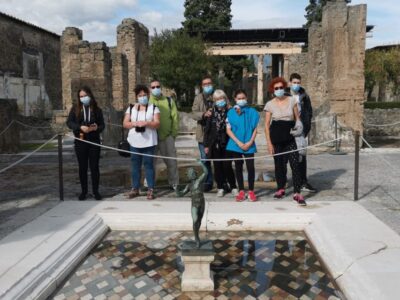
Pompeii makes more sense with a plan. This small-group, English-led tour brings you through the big hits of the ruins in about two hours, and the Pompeii admission is included so you can skip ticket stress. You get an authorized guide, headset support if it gets crowded, and a straightforward way to connect the eruption of 79 AD to what you see on the ground.
The main thing to know is the walking. Pompeii has uneven stone, curbs, and stepping stones, so comfortable shoes matter more than you think.
Key things to know before you go
- Admission included: you enter the Archaeological Park with your ticket already covered.
- Small group size: capped at up to 15 people, which helps the pace stay human.
- Headsets when it’s busy: you’ll have audio help to catch details without straining.
- A “highlights plus story” route: Porta Marina to the Forum, then homes, markets, baths, and theaters.
- Some indoor or guarded areas can be limited: houses and other spots may depend on seasonal openings and time of day.
From Porta Marina to the Streets: how this 2-hour route works
This tour starts at the Villa of the Mysteries (Via Villa dei Misteri, 2, 80045 Pompei). That matters because Pompeii feels endless on your own, and this route gives you a clear direction from the main entrance area at Porta Marina toward the public heart of the city.
Expect a lot of “see it, understand it, move on.” Stops are short, about 10 minutes each, but the guide ties them together so you leave with a mental map. If you’ve been wondering what Pompeii is actually like day to day, this is built to answer that fast.
The group stays small, so your guide can keep things flowing instead of herding a big crowd. On crowded days, headsets help a lot. And yes, you’ll still walk, because Pompeii is Pompeii.
Entering Pompeii at Porta Marina and why it hits hard
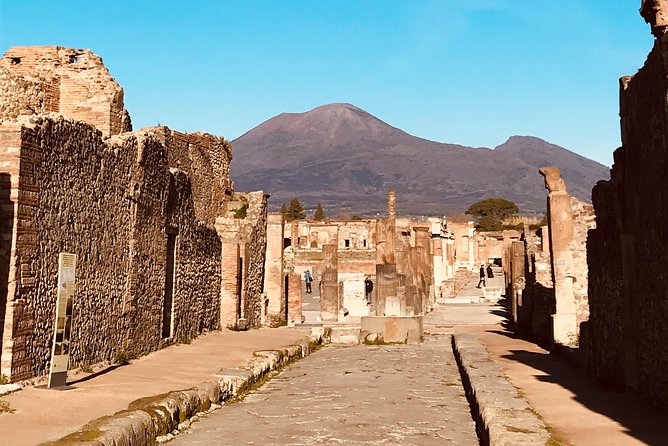
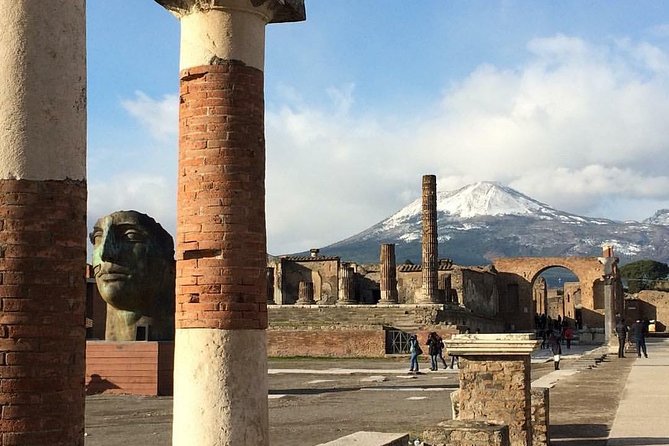
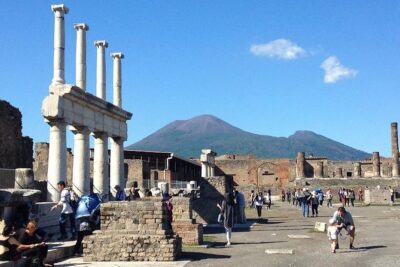
Stop 1 is your big foundation stop, at the Archaeological Park of Pompeii with entry included. The tour begins near Porta Marina, with Mount Vesuvius rising in the background. That visual is powerful because it grounds the story in the actual geography of the eruption.
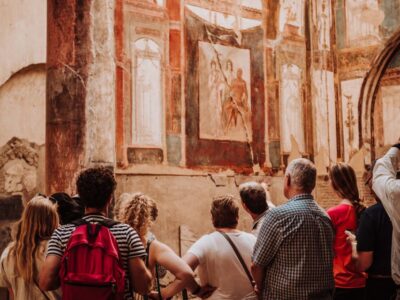
You’ll learn about what happened in 79 AD and also how Pompeii’s rediscovery and excavations shaped what we know today. Then you step into the Roman city experience, walking along streets that were once full of life, noise, smells, commerce, and routine.
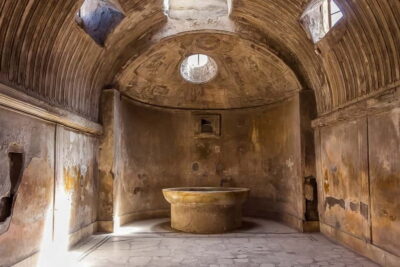
This first stretch is where the tour stacks the classic landmarks. You’ll pass through key civic and religious zones such as the Roman Forum, the Basilica, market areas, and major temples. You’ll also hit Roman Baths that are described as recently reopened, which is a nice bonus if you’re visiting when others might feel closed or underwhelming.
A major plus here is the focus on daily life, not just monuments. The guide points out shopfront life like thermopolia (ancient street diners) and bakeries, plus the kinds of spaces that show how ordinary people used the city.
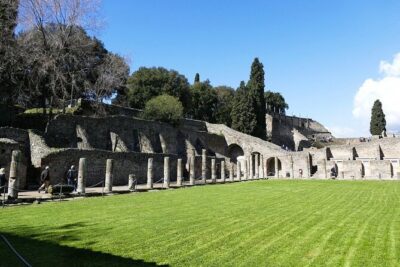
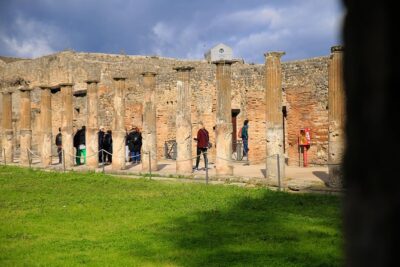
Near the end of this core zone, you’ll also see highlights tied to entertainment and protection, including the Large and Small Theatres and the Gladiators’ Barracks. In a short time, that gives you a fuller picture of Pompeii as a working city, not just a “frozen set.”
Possible drawback to plan for: the tour is built around highlights. If you want a slow, excavation-focused lecture on how archaeologists work, you may wish you had more time on your own after the guided portion.
Venus, Apollo, Jupiter, and the Forum temples in quick doses
After the big entry block, the route shifts into a series of smaller, very targeted temple and Forum stops. These are each about 10 minutes, with admission free at these sites during the tour.
Stop 2 is the Tempio di Venere (Temple of Venus). This is connected to the idea of Venus as a patron goddess of Pompeii. In practice, this stop helps you see how religion was woven into the city’s civic space, not hidden away in remote corners.
Stop 3 brings you to the Basilica. Here, you’re not just looking at architecture. The guide explains how the Basilica functioned as a hub for managing business and administration of justice. It’s one of those places where the building form and the social role make sense together.
Stop 4 is the Sanctuary of Apollo. It’s described as among Pompeii’s oldest places of worship, and it sits along a strategic street path linking the entrance zone toward the public heart of the city. This is an important “connect the dots” stop.
Stop 5 is the Forum, the Main Square. This is where Pompeii’s daily life centered. Even in a short visit, you’ll get the sense of the Forum as a stage: politics, trade, gatherings, and religious reference points all at once.
Stop 6 is the Temple of Jupiter (Tempio di Giove Capitolino). What makes this one memorable is the view back toward Vesuvius. The guide uses that visual to sharpen what you’re seeing in context.
These temple stops are quick, but they’re not random. They create a story arc, moving from civic spaces to religious anchors to the city center. For first-timers, that’s exactly the right sequence.
Market and daily life at the Macellum, baths, and thermopolia
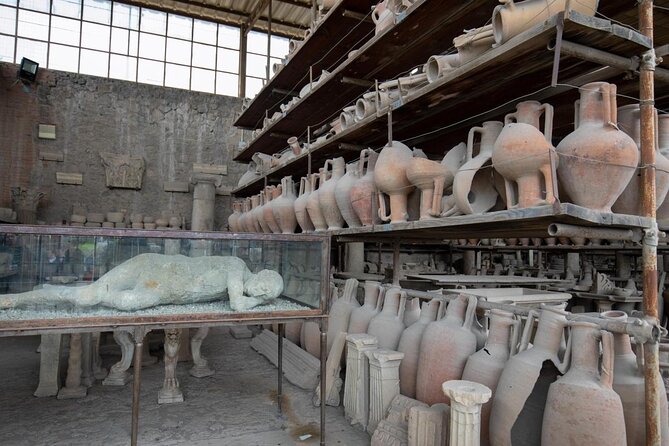
Stop 7 is the Macellum, a monumental food market building. This is the “life, food, and shopping” stop. You’re also shown plaster casts of bodies, tied to the archaeological method used to reveal how people may have looked at the moment of the eruption. If you want a moment that feels both sobering and educational, this is it.
Stop 8 is the Forum Baths (Terme del Foro). This is one of the best-preserved elements of the city on this route, and it’s explained with a real-life detail: male and female parts had separate entrances. That small detail makes the space feel practical, like you’re imagining how people navigated their day.
Stop 9 is the Thermopolium of Vetuzio Placido. Think of it as an ancient diner. This is where the tour leans into how people refreshed themselves, ate on the go, and used common streets as part of everyday routines.
Small caution: these are popular areas, so keep your expectations aligned with the time. Ten minutes goes fast. If you spot a detail you want to linger on, your best move is to memorize where it is, then come back when your guided block moves on.
Rich homes, the House of the Faun, and the Via dell’Abbondanza main street
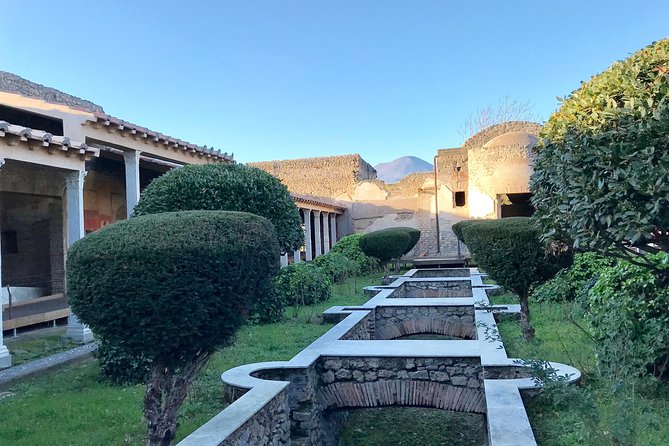
Stops 10 and 11 are where the city shifts from public to more private, and that change helps you understand Pompeii’s social mix.
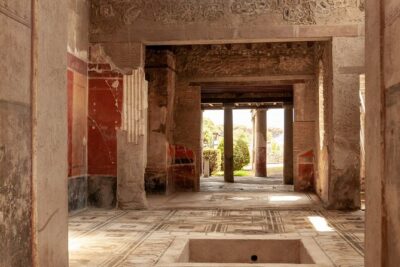
Stop 10 is a two-part experience around major homes. You’ll see the House of the Faun, described as one of the largest, with a welcome inscription on the sidewalks in Latin that includes HAVE. You’ll also see the House of the Vettii, known as one of the richest and most famous houses in Pompeii, and linked to the god Priapus, described here as a protector of prosperity.
One practical thing I’d plan for: these homes are subject to seasonal openings and closings. So if something looks different on your visit day, that’s often not the guide’s doing.
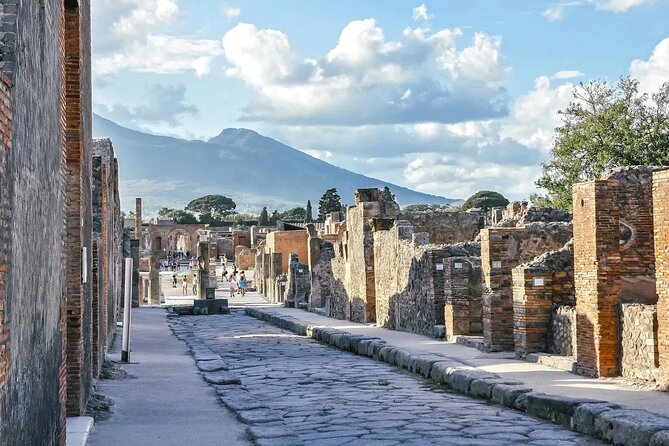
Stop 11 is Via dell’Abbondanza, the ancient main street, also called the Decumanus Maximus. Walking this section gives you a “this is the spine of the city” feeling. It’s the kind of street you can picture people using to go from shops to homes to public spaces.
If you’re the type who likes architecture but also wants to understand how movement worked in an ancient city, these two stops are a great pairing.
Teatro Grande: where Greco-Roman performances played in stone
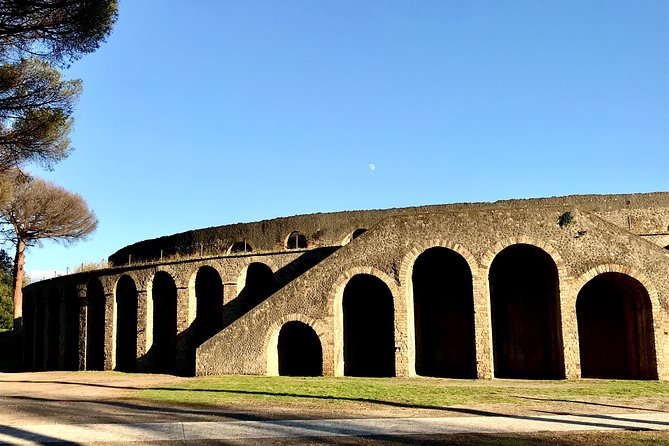
Stop 12 is the Teatro Grande. It’s tied to comedies and tragedies in the Greco-Roman tradition. Even with a short stop, the point is to show that entertainment was a real piece of civic life, not a luxury.
This is also a good finale because theaters visually connect you to the idea of community. People didn’t just live near each other, they shared common experiences.
When the tour ends, you return to the meeting point area. That’s useful if you’re trying to connect with other plans and want to avoid getting “stuck” far from your next transport option.
What I like about the guide setup, and why it matters
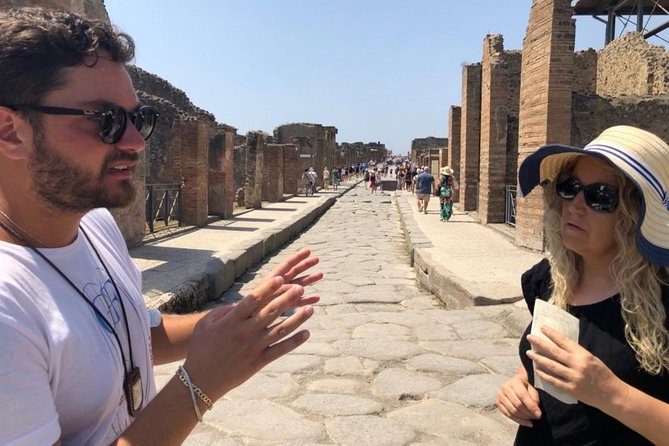
The guide is the secret sauce here. The tour is built for understanding, and the guide does the heavy lifting in plain language, with a steady pace that keeps the story understandable without dragging.
The quality shows in the names people have praised. Guides such as Livio, Antonio, Riccardo, Ornella, Annalisa, and Angelo come up with strong feedback for clarity and passion. In particular, I love when a guide can explain Roman architecture and everyday city life side by side, and that exact mix is repeatedly singled out.
Headsets are included if the site is crowded, and they matter. Pompeii can be noisy, and stone echoes are real. Audio support helps you hear the guide without constantly turning your head.
Another small practical win: you get a Pompeii paper map. It’s the kind of thing that costs you almost nothing, but it helps you keep your bearings once the guided loop ends.
Price and value: what $66.01 buys you in real terms
At $66.01 per person for about 2 hours, the value is mainly in what’s included, not just the duration.
You’re paying for:
- admission to the Pompeii Archaeological Park
- an authorized guide
- headset support if needed
- a paper map
That means you’re not trying to solve entry logistics mid-trip. You also get a guided plan that saves time figuring out what to see first. On a site like Pompeii, wasted time is expensive, even when the ticket is paid already.
If you’re visiting with limited time, this tour is a strong “get oriented, see the key places, leave with context” option. You can then add more exploration later at your own speed if you want.
Practical tips that will make your Pompeii day smoother
A great Pompeii tour still has physical limits. Here’s how to set yourself up for a better walk.
Wear shoes with grip. The terrain is uneven, and there are curbs and stepping stones. One review noted that it can be challenging, and that lines up with what you should assume.
Plan for a little time pressure. Some guarded sites can close at certain times, and at least one guide-led experience ran into closures when the group needed to wrap earlier for transport. If you’re visiting late in the day, build in flexibility.
Bring your own water. Bottled water is not included, so pack some if you can.
Watch for seasonal openings. The homes stop mentions seasonal openings and closings, so don’t be surprised if one area looks limited depending on the calendar.
And one more tiny thing: try to arrive a few minutes early at the start point, the Villa of the Mysteries. Small groups move fast, and being on time helps you start smoothly.
Who this tour is best for
This is a great fit if:
- you’re seeing Pompeii for the first time
- you want the top stops connected into a clear story
- you like a guide who explains both architecture and everyday life
- you want a compact route that takes about two hours
It may not be ideal if:
- you want a slow, excavation-focused tour with lots of technical detail
- you prefer long quiet wandering with minimal structure
Should you book this Pompeii Tour & Admission (small group)?
I’d book it if you want Pompeii to feel understandable and organized without turning your day into a full-time research project. The combination of included admission, an expert-led route through Forum life, markets, baths, homes, and theaters, plus practical tools like headsets and a paper map makes the cost feel justified.
If you’re on a tight schedule, this tour is the best kind of “high value first pass.” You’ll leave knowing what you saw, why it mattered, and what to look for if you return later on your own.
If you have the time and you really want to focus only on excavation methods and deeper technical detail, consider using this as your orientation, then add extra self-guided time afterward.
FAQ
Is Pompeii admission included in this tour?
Yes. Your admission ticket to the Archaeological Park of Pompeii is included in the price.
How long is the Pompeii tour?
It runs for about 2 hours (approximately).
What languages is the tour offered in?
The tour is offered in English.
What’s the group size limit?
The maximum group size is 15 travelers.
Do I need to buy tickets in advance?
The tour includes a mobile ticket, and admission to the Pompeii site is included in the price.
Is bottled water provided?
No, bottled water is not included.
Where does the tour start and where does it end?
It starts at the Villa of the Mysteries (Via Villa dei Misteri, 2, 80045 Pompei NA, Italy). It ends back at the meeting point.
What should I bring for a comfortable visit?
Comfortable walking shoes are a must because the terrain is uneven. Bottled water is not included, so plan to bring it if you need it.
Can I get a full refund if I cancel?
Free cancellation is available up to 24 hours in advance for a full refund. If you cancel less than 24 hours before the start time, the amount paid is not refunded.
More Tours in Pompeii
- Pompeii Small Group Tour with an Archaeologist★ 5.0 · 6,593 reviews
- Pompeii and Herculaneum Small Group Tour with an Archaeologist★ 5.0 · 1,350 reviews
- Skip the Line Guided Tour of Pompeii led by an Archaeologist★ 5.0 · 703 reviews
- Pompeii Ticket + Tour with Optional Tasting Experience at Pompeii★ 5.0 · 663 reviews
- Pompeii private tour with an Official Guide★ 5.0 · 631 reviews
More Tour Reviews in Pompeii
- Pompeii Small Group Tour with an Archaeologist★ 5.0 · 6,593 reviews
- Discover the Ancient Ruins of Pompeii: Day Trip from Rome★ 3.5 · 2,247 reviews
- Pompeii and Herculaneum Small Group Tour with an Archaeologist★ 5.0 · 1,350 reviews
- Skip the Line Guided Tour of Pompeii led by an Archaeologist★ 5.0 · 703 reviews
- Pompeii Ticket + Tour with Optional Tasting Experience at Pompeii★ 5.0 · 663 reviews
Sorrento to Pompeii, More Ways
- Skip the Line Guided Tour of Pompeii led by an Archaeologist★ 5.0 · 703 reviews
- Sharing Tour of Pompeii★ 5.0 · 487 reviews
- Pompeii Tour & Lunch with Wine Tasting Experience★ 5.0 · 383 reviews
- 2 hours Pompeii Tour with Local Historian – Ticket Included★ 5.0 · 335 reviews
- Private Day Tour of Pompeii, Sorrento and Positano with Pick Up★ 5.0 · 110 reviews
More ways into Pompeii Tours from Sorrento.
 ★ 4.8Pompeii: Small-Group Tour of Pompeii and Herculaneum867 reviews
 ★ 4.9Pompeii Ruins Private Tour with Optional Skip-the-Line EntryFrom $254732 reviews
 ★ 4.0Pompeii Ruins Half-Day Tour from Sorrento with GuideFrom $97714 reviews
 ★ 5.0Skip the Line Guided Tour of Pompeii led by an ArchaeologistFrom $95703 reviews
 ★ 4.3Day Tour to Pompeii Ruins and Mount VesuviusFrom $130489 reviews
 ★ 5.0Sharing Tour of PompeiiFrom $193487 reviews
 ★ 5.0Pompeii Tour & Lunch with Wine Tasting ExperienceFrom $120383 reviews
 ★ 5.02 hours Pompeii Tour with Local Historian – Ticket IncludedFrom $48335 reviews
Other useful routes from here