
REVIEW · WALKING TOURS
Pompeii Guided Walking Tour with Ticket
Pompeii feels real with the right guide. This 2 hours 30 minutes walk through the Pompeii Archaeological Park is built around skip-the-line tickets and a small group of 15 people or fewer, so you spend less time stuck at the gate and more time noticing details. I also like the focus on the big storytelling stops, from the Forum to the brothel, and how guides such as Paulo and Pierpaolo tend to answer questions with humor and real clarity. The main trade-off to consider is the walking pace, so bring comfortable shoes and expect a solid stroll through uneven ground.
You get a tight route with clear highlights, not a wandering day. The itinerary hits the places people remember for a reason, including plaster death casts, the main square, the main theatre, ancient market areas, public baths, and the old fast-food and bakery vibes along the way.
If you prefer a slow, do-it-at-your-own-speed museum day, this may feel a bit structured. But if you want your visit to connect the dots quickly, this tour is designed for that.
Key things I’d prioritize on this tour
- Skip-the-line Pompeii entry: fewer delays, more time in the ruins.
- Small group size (max 15): better conversation and easier navigation.
- Forum to baths to theater flow: you see daily life in a logical route.
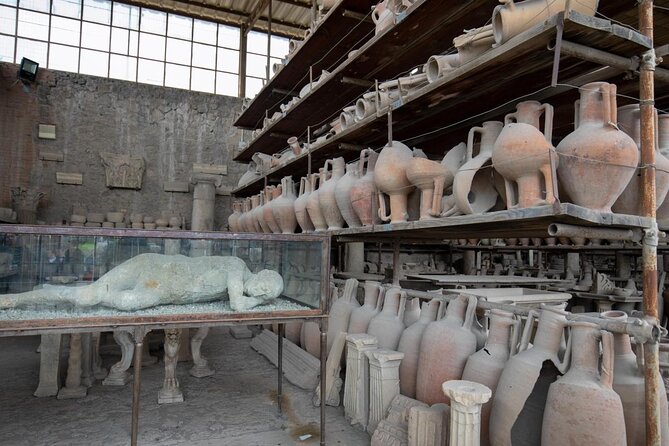
- Granary del Foro artifacts and casts: market space becomes a history lesson.
- Stabian Baths: one of the oldest Roman bath sets you’ll spot at Pompeii.
- Lupanar (ancient brothel): a frank stop that adds context to the city’s everyday reality.
Why a Pompeii walking tour beats a self-guided day
Pompeii is the kind of place that looks cool at first glance, then really clicks when someone explains what you are seeing. The ruins are still dramatic on their own, but a guide helps you connect streets to neighborhoods, buildings to routines, and symbols to social life.
What I like about this tour format is that it does the heavy lifting for you. You get a professional licensed guide and you move from highlight to highlight without guessing. That matters at Pompeii because the site is huge, and you can lose a lot of time deciding what to prioritize.
A small group also changes the experience. With up to 15 people, it is easier to stop, ask questions, and not feel like you are sprinting just to keep up. Guides in this style are often great at turning Pompeii from a photo-op into a place where you understand how people actually lived.
$112.35 value: what you are really paying for
At $112.35 per person, you are paying for three things that add up fast at Pompeii: a licensed guide, skip-the-line entrance tickets, and time-efficient routing through key sights.
Self-guided tickets are only part of the cost picture. The big value here is that the guide helps you interpret what those tickets buy. Without that, you might walk past the most interesting details and only realize later you missed the point.
Is it pricey? Compared to a basic entrance ticket, yes. Compared to paying for a knowledgeable guide plus entry, it starts to look more reasonable, especially because the group is capped at 15. If your schedule is tight and you want to hit the major Pompeii highlights in one go, this is the kind of tour that can save you from paying twice in time, energy, or confusion.
Meet at Ristorante Bar Sgambati, then get moving
The tour starts at 10:30 am at Ristorante Bar Sgambati, Via Villa dei Misteri, 1, 80045 Pompei NA, Italy. It ends back at the same meeting point, so you do not have to plan a second exit.
Why this matters: Pompeii can be logistically annoying if you are trying to coordinate timing on your own. Here, you are dropped into a plan that already knows where the best stops are.
The walk runs about 2 hours 30 minutes, and the tour notes a moderate physical fitness level. Translation: you should be comfortable walking for a couple hours with site stairs and uneven surfaces. You will thank yourself for good traction shoes. Also bring bottled water, since you are outside most of the time.
Stop 1 at Pompeii Archaeological Park: houses, baths, theater, and death casts
This is where the tour really sets the tone. At Pompeii Archaeological Park, you are guided through an overview of what makes the ruins so important, with a sequence that typically includes houses, baths, a theatre area, and the brothel stop later in the route.
One of the most striking parts of a Pompeii visit is the human scale. The tour includes plaster death casts, the preserved forms that represent victims and the way the eruption froze life in place. Even if you have seen photos, standing near the casts changes the whole mood. A guide helps you understand what you are looking at and why these figures became such a powerful part of Pompeii’s story.
You also get the kind of context that turns ruins into a daily-life map. The city was built around public spaces and neighborhood routines. So, when you pass rooms, courtyards, and bath areas, you get a sense of how people moved through their day, not just what the buildings look like now.
One more reason to love a guided structure: Pompeii rewards attention to small details. Guides often point out what to notice, like how public and private spaces contrast, or why certain areas were built for crowds and ceremonies. It is easier to catch these clues when someone is already watching for them.
Foro de Pompeya: the town square where power and commerce met
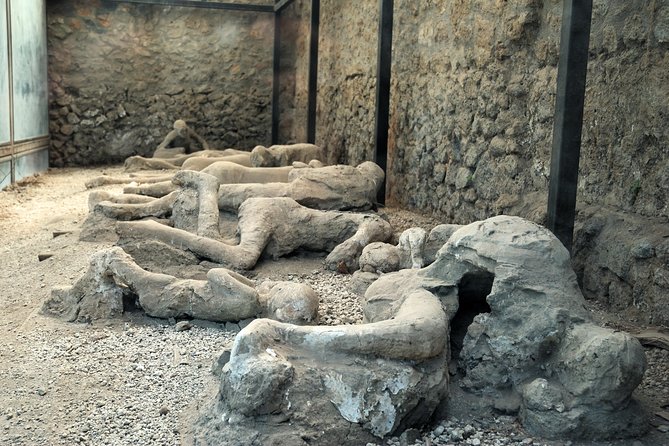
The Foro de Pompeya is the social center of the Roman town model. This stop is described as the main square and the commercial, political, and religious hub.
At ground level, the Forum can look like a collection of stones until someone explains the roles. Your guide is there to help you see how people used the space. This is where civic life happened, where ideas and announcements traveled, and where everyday business mixed with official life.
You do not need a doctorate to appreciate it. The simple win is this: you will understand what a Forum was meant to do, so when you see the architecture around you, you know what it was for.
Time at the Forum is short, about 15 minutes, so come in ready to take quick notes in your head. Focus on the “why here” feeling, not only on the “what remains” look.
Teatro Grande: Greek-Roman plays in a Roman city
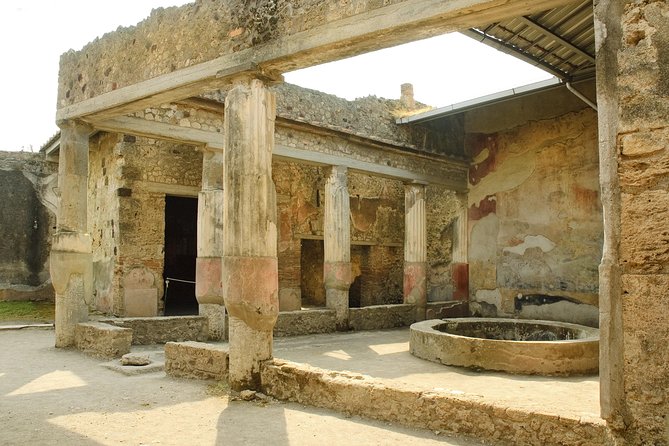
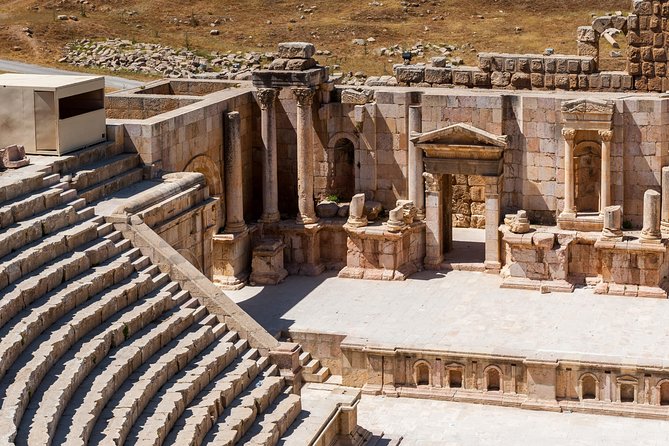
Next up is the Teatro Grande, Pompeii’s main theatre. This is the place for plays from the Greek-Roman tradition.
A theatre stop can be hit-or-miss if you are not sure what you are looking at. With a guide, you get the context: performance was a major public event, and theatres were built to turn a city into a stage.
Even in a short 10 minute stop, you can usually pick out the basic layout once you understand the function. You start to connect seating areas with sightlines and crowds, and suddenly the building becomes more than a shell.
If you love Roman public life, this stop is a strong payoff. If you usually skip theatres, it is still worth it here because it links back to how Pompeii served as a community, not just a set of houses.
Granai del Foro: the market space with 9,000+ artifacts
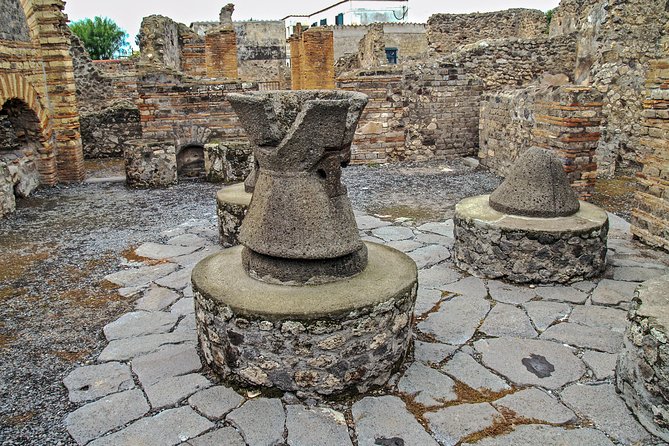
The Granai del Foro is one of the most memorable stops, partly because it is not only visually interesting, it is also packed with details. The Forum granary was used for fruit and vegetable markets, and today it houses more than 9,000 artifacts.
This is where Pompeii becomes very practical. You are not just looking at politics or entertainment. You are looking at food logistics and everyday trading.
The tour also highlights that among the materials you can encounter here are pots and pans for cooking, jugs and bottles, and other items linked to daily use. You may also see evidence like marble tables and bath fountains that once adorned entrances of houses.
The tour adds emotional weight too. This area includes casts of victims of the eruption, plus casts of a dog and a tree. That combination is powerful because it shows the full range of what the eruption caught, including living creatures you would never expect a market stop to bring into focus.
This stop runs about 15 minutes, which is not long, but it is enough to understand the shift: granary becomes a museum of ordinary life.
Stabian Baths (Terme Stabiane): some of the oldest Roman baths
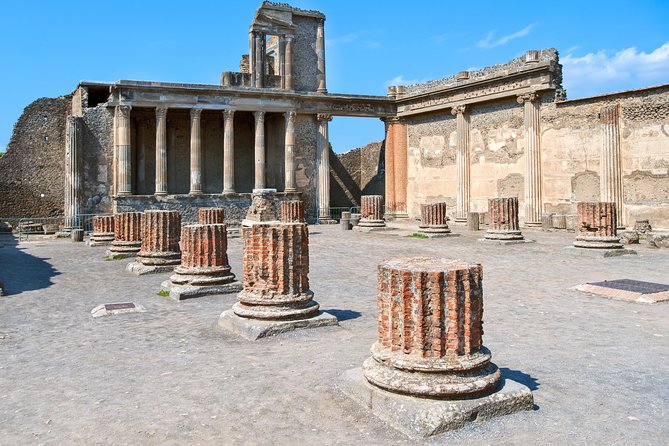
Roman baths were social hubs, not just places to wash. The tour stops at the Stabian Baths (Terme Stabiane), noted as among the oldest Roman baths we know of in the Roman world.
Even a short visit, around 10 minutes, can be worthwhile if you understand the “why.” In Roman culture, baths were tied to conversation, relaxation, and routine. With a guide, you are better able to imagine the spaces being used: areas for different stages of bathing, movement through the complex, and how people interacted while doing their daily care.
This is also one of those stops where interpretation makes the ruins clearer. You might otherwise see walls and rooms. With guidance, you see sequence and purpose.
Macellum and the main road: shops, markets, and fast-food energy
The tour includes the Macellum, described as the shops on the main road. It is another daily-life stop that helps you understand Pompeii as a working city.
The broader tour description also points to ancient fast-food restaurants and a bakery. That fits the Macellum idea perfectly: you are watching commerce unfold in stone form. When you connect these dots, Pompeii starts to look less like a tragedy site and more like a normal place that happened to be frozen in time.
This portion is about 10 minutes, so your goal is not to read everything, it is to get a feel for street-level business. Ask your guide simple questions like where people would eat, what would sell there, and how daily movement worked through the main thoroughfare.
If you like food history, market life, or just the human scale of a street, this is a good part of the route to stay focused. Even quick stops can be memorable when someone helps you look with the right lens.
Lupanar brothel: erotic wall art and a no-filter city view
The Lupanar is the ancient brothel, visited if time permits. This stop is typically about 15 minutes, and it is exactly the kind of place that makes Pompeii feel honest.
The tour notes that erotic paintings on the walls that once advertised services are still visible. That detail can be uncomfortable for some people, but it is also important. Pompeii was not a sanitized version of Rome. It included sex work, street life, humor, desire, and all the messy parts of human society.
With a guide, this stop is less about shock and more about context. You can understand how businesses signaled what they offered, what kind of clientele the space might have served, and why this would have been part of a working city street.
If you are sensitive to explicit imagery, you might want to prepare for this before you go. On the other hand, if you want a fuller picture of Pompeii’s real life, it is one of the stops that makes the city feel complete.
What to bring and how to get the most from your 2.5 hours
This tour is built around a steady walking rhythm. You will get more out of it if you plan like it is a guided walk with stops, not a museum marathon.
Here is what helps on the ground:
- Comfortable walking shoes matter more than you think, because Pompeii ground surfaces can be uneven.
- Bottled water is recommended, and you will appreciate it more than a snack you forget in your bag.
- Bring a simple camera plan. If your phone battery is low, consider a power bank so you can keep photographing without stress.
Also, use the short stop times wisely. For each location, pick one question before you arrive. Something like what this place was used for, or who would have walked through it. Guides on this route often take time to answer questions, and with a small group, you are more likely to get real answers.
Should you book this Pompeii guided tour?
Book it if you want a structured, time-efficient Pompeii visit with skip-the-line tickets, a licensed guide, and a route that covers the big storytelling stops without leaving you overwhelmed. The small group size is a strong advantage, especially if you like asking questions and hearing the “how did it work” explanations.
I would skip it if you already know Pompeii well and you want to roam slowly at your own pace, or if you are not up for a moderate walk on uneven ground. In that case, you might prefer a self-guided plan.
If you fit the middle ground, this is a smart way to see Pompeii’s most important highlights in a single half-morning style outing.
FAQ
What time does the Pompeii guided walking tour start?
The tour starts at 10:30 am.
How long is the Pompeii tour?
It lasts about 2 hours 30 minutes.
Where is the meeting point for the tour?
Meet at Ristorante Bar Sgambati, Via Villa dei Misteri, 1, 80045 Pompei NA, Italy.
Are entrance tickets included?
Yes. Skip-the-line Pompeii entrance tickets are included.
How big is the group?
The tour has a maximum of 15 travelers.
Is food included in the tour price?
No. Food and drinks are not included.
What happens if I cancel?
This experience is non-refundable and cannot be changed for any reason.
Choose the Right Entry
- Round-Trip Ferry Ticket from Salerno to Amalfi and Positano★ 3.7 · 173 reviews
- Pompeii & Mount Vesuvius Tour with Guided Visit, Tickets & Lunch★ 4.5 · 155 reviews
- From Sorrento: Round-Trip Ferry Ticket to Capri and Positano★ 4.0 · 74 reviews
- Sorrento to Capri and back: Minicruise Daily Return Ticket★ 4.5 · 31 reviews
- Guided Tour of Pompeii and Herculaneum with Lunch and Ticket★ 5.0 · 30 reviews
More Tours in Sorrento
- Sorrento: Exclusive Capri Boat Tour and Optional Blue Grotto★ 4.8 · 3,170 reviews
- Capri Blue Grotto Small-Group Boat Day Tour From Sorrento★ 4.5 · 2,511 reviews
- From Sorrento/Nerano: Amalfi and Positano Boat Tour★ 4.6 · 2,440 reviews
- Sorrento: Skip-the-Line Pompeii Express Tour by Train★ 4.8 · 2,038 reviews
- From Sorrento: Capri Boat Tour with Blue Grotto Visit★ 4.7 · 1,759 reviews
More Tour Reviews in Sorrento
- Sorrento: Exclusive Capri Boat Tour and Optional Blue Grotto★ 4.8 · 3,170 reviews
- Sorrento Farm and Food Experience including Olive Oil, Limoncello, Wine tasting★ 5.0 · 2,524 reviews
- Capri Blue Grotto Small-Group Boat Day Tour From Sorrento★ 4.5 · 2,511 reviews
- From Sorrento/Nerano: Amalfi and Positano Boat Tour★ 4.6 · 2,440 reviews
- Day Trip to Positano, Amalfi & Ravello from Sorrento★ 4.5 · 2,371 reviews
More ways into Walking Tours.
 ★ 4.5Walking Food Tour in Sorrento w/ Limoncello Factory Lemon GroveFrom $125821 reviews
 ★ 5.0Guided Walking Tour & Limoncello TastingFrom $41472 reviews
 ★ 4.3Herculaneum: 3D Walking Tour with Skip-the-Line TicketFrom $45313 reviews
 ★ 5.0Capri Walking Tour with local guideFrom $104300 reviews
 ★ 4.8Discover Pompeii: French Walking Tour of the Buried CityFrom $41253 reviews
 ★ 4.5From Salerno: Pompeii Guided Walking TourFrom $94235 reviews
 ★ 5.0Night time Walking Tour & Limoncello TastingFrom $28155 reviews
 ★ 4.6Guided Walking Tour & Street Food ExperienceFrom $55152 reviews
Other useful routes from here