
REVIEW · POMPEII TOURS FROM SORRENTO
Guided Tour of Pompeii and Herculaneum with Lunch and Ticket
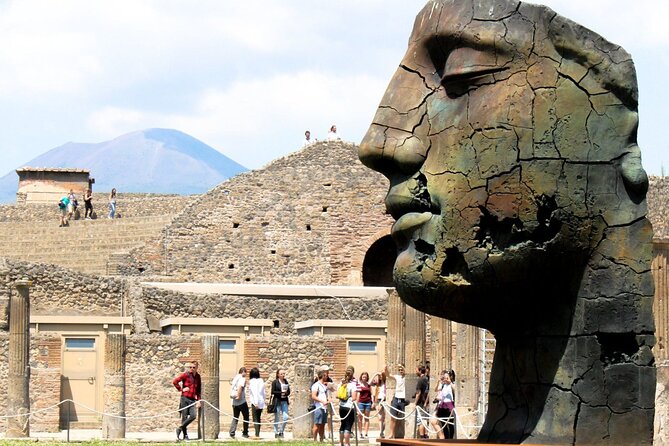
Pompeii and Herculaneum in one day is powerful. This guided tour from Sorrento pairs included tickets with a set route, so you spend more time walking the streets and houses and less time figuring out logistics. I love the way the plan stitches Pompeii’s Forum to Herculaneum’s preserved villas, with a real explanation at each stop. I also like the lunch break at Sorrentino Vini on the slopes of Vesuvius, plus wine tasting. My only caution is that Pompeii can be crowded, so your pace may feel brisk on busy days.
You’ll be in a group of up to 100, with an English-speaking guide, and you use a mobile ticket. The day runs about 9 hours, and local traffic or crowds can shift timing, but the overall flow stays the same: Pompeii first, then Herculaneum.
Come prepared for walking and heat. Bring comfortable shoes, sunglasses, and sunscreen in summer, and expect lots of open-air sun. The tour also needs good weather, so plan for the possibility of a date change if conditions are rough.
Key Things To Know Before You Go
- Tickets are built in for Pompeii and Herculaneum stops, so you avoid hunting for admissions on the day.
- Two major sites back-to-back, which is the best move if you only have one day in Campania.
- Wine plus lunch at Sorrentino Vini, with a scheduled break that keeps you from getting exhausted too early.
- Pompeii includes big-name sights like the Forum, Stabian Baths, and the Lupanar.
- Herculaneum adds the wow factor of well-preserved streets, mosaics, and house interiors.
- Group sizes can be large (up to 100), so you’ll want to stay close to your guide.
One Long Day From Sorrento: how the 9-hour rhythm works
This tour is designed for one thing: getting you to the two biggest Vesuvius-era archaeological sites in a single day. With an approximate 9-hour schedule, it’s not “slow travel.” It’s more like a structured sprint with real stops where a guide explains what you’re seeing.
You start in Sorrento and spend time on the road, then shift into walking mode fast. Pompeii takes the morning block, and Herculaneum closes out the day. That order matters: Pompeii is huge and spread out, while Herculaneum feels more compact and intimate, even though you’re still moving.
A big plus is how the tour keeps the day organized. In guides who know the sites well, you tend to waste less time “figuring it out” and more time making sense of what you see. One standout pattern from the experience you’re buying is that the guides give context, not just directions.
Pompeii’s Forum to the City Market: the core “daily life” route
Pompeii can overwhelm you on your own. A guided route helps you understand how the city worked, not just what’s left of it. The itinerary begins at the Archaeological Park of Pompeii and gives you time to settle in before you start bouncing between set highlights.
Archaeological Park of Pompeii, then the Forum (2 hours at Stop 1)
You’ll get about two hours at Pompeii with your admission ticket included. This is the moment to orient yourself. Look for the street layout and think in “neighborhoods,” because Pompeii is less a single ruin and more a whole city you’re walking through.
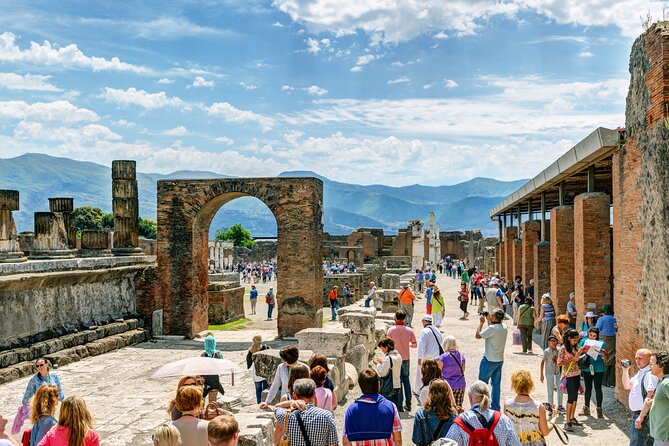
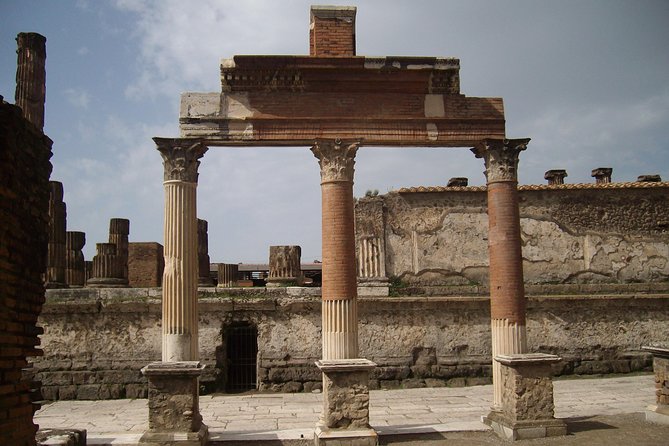
Then you move to the Forum, the civil and commercial heart of Pompeii’s daily life. Here you’re surrounded by the main public-facing spaces, including areas tied to administration, justice, worship, and business. If you’ve ever wondered what the Romans did outside of wars and emperors, the Forum helps answer that in a practical way.
Temple of Jupiter on the Forum square
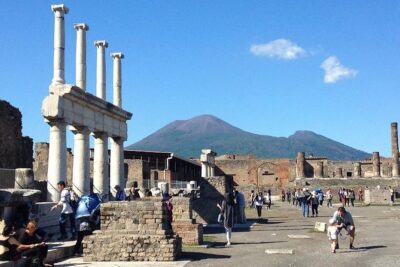
The Temple of Jupiter Capitolino dominates the northern side of the Forum, and Vesuvius rises behind it. That sightline is part of the lesson. After the colony period, the temple was renovated and became a kind of Capitolium, modeled on Rome, with cult statues of Jupiter, Juno, and Minerva placed on a high base.
This is one stop where timing matters. If the group moves quickly, you’ll still catch the key idea: the Forum wasn’t only for paperwork and courts. It was religious power made visible.
Macellum, Pompeii’s market
Next comes the Macellum, Pompeii’s market complex. You’ll see how the tuff porticoes and elevated worship space mix commerce with religion. The Macellum is also a lesson in city design: it was located north-east of the Forum so it wouldn’t cause too much crowding right in the main square.
If you like everyday Roman life, the market imagery is where you feel it. Decorative scenes on the porticoes connect you to the idea of routine buying and selling, not just grand temples.
Via dell’Abbondanza and the Stabian Baths: Roman routines you can picture
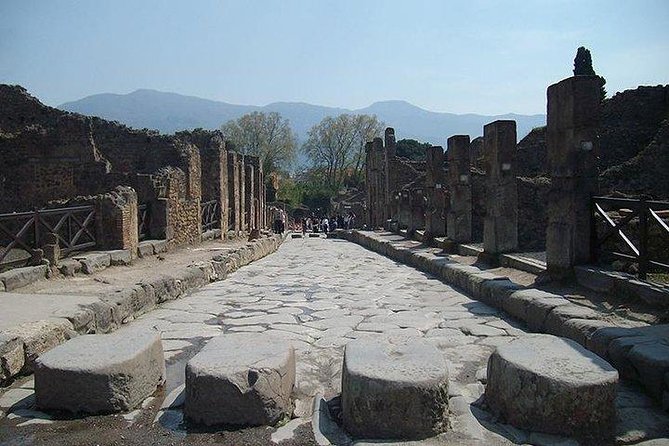
From the Forum area, the route follows Via dell’Abbondanza, one of the main Pompeii streets that connected the Forum to the amphitheatre. It’s the kind of street you can imagine filled with noise, vendors, and foot traffic, even though today it’s quiet in parts.
Then you hit one of the most memorable stops: the Stabian Baths, or Terme Stabiane. These baths weren’t built once. They evolved through different construction phases, with earlier work dating back to the 4th century BC, and the visible complex mostly reflecting the 2nd century renovation.
What makes the Stabian Baths special
The itinerary walks you through how the baths functioned: courtyard, pool, and the sequence through changing rooms into frigidarium, tepidarium, and calidarium. Heating was handled by wall piping and systems circulating hot air from furnaces and braziers.
This is one of the best “human scale” stops in Pompeii because baths were more than washing. They were social space, where people talked politics, battles, trials, and even women. That turns the ruins into something easier to picture.
If you’re someone who hates feeling rushed, pay attention to your group’s pace here. Baths can be the most detailed stop of Pompeii because there’s a lot to interpret, even without walking into every corner.
Lupanar and Teatro Grande: the darker and theatrical sides of Pompeii
Pompeii isn’t only sunlit temples. You also see sides of Roman life that are uncomfortable or surprising.
Lupanar, Pompeii’s brothel
The Lupanar is famous for its erotic paintings and its built-in bed rooms. The building has two floors, with the owner and servants above and the customer rooms below. It’s described as functioning as a brothel, often tied to Greek and Oriental slaves in the historical picture the tour presents.
You don’t need to be shocked by it, but you should go in prepared to see how direct Roman art could be. The details here are what make Pompeii feel like a lived-in place, not a textbook.
Teatro Grande, the city’s stage
Then you move to the Teatro Grande, built around the middle of the 2nd century BC and restored in the Roman style. This is where you get to imagine performances of comedies and tragedies rooted in Greek-Roman tradition.
One cool detail is that the theatre was the first large public building completely freed from eruption deposits. In other words, it helps show how different parts of the city ended up under ash to different degrees.
Sorrentino Winery lunch and wine tasting: the break that makes the rest work
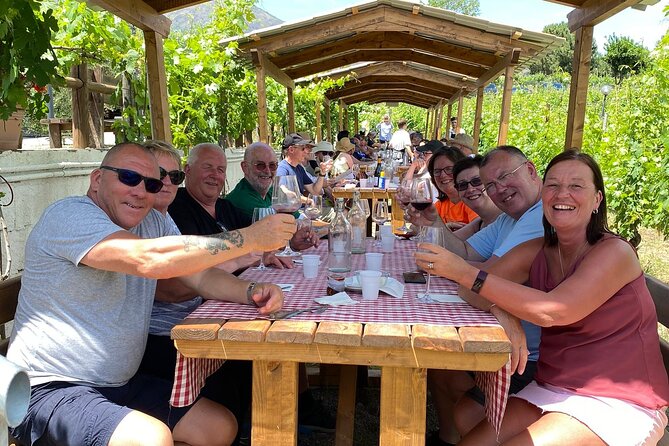
The best guided days understand pacing. This itinerary builds in a lunch stop at Sorrentino Winery (Sorrentino Vini), with an included tasting.
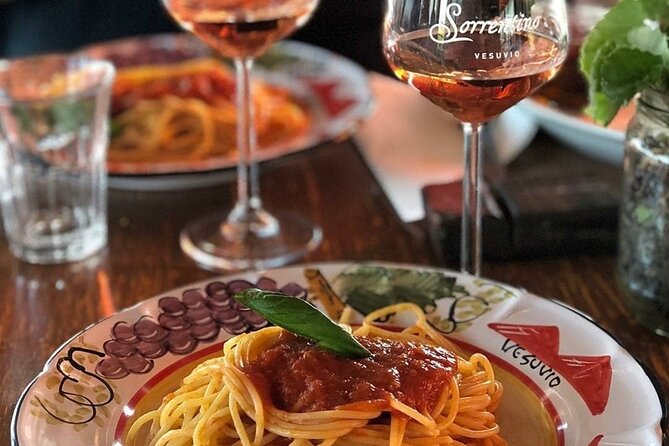
You’ll have a starter of bruschetta, cured meats, cheeses, and seasonal vegetables. Then comes pasta with piennolo cherry tomatoes, a local specialty. Dessert is listed as a traditional homemade dessert.
The wine tasting includes three pours: Prosecco, red, and white. That matters because it keeps the break feeling like part of the experience instead of just a fuel stop.
If you’ve done day trips that rush from ruin to ruin without proper recovery time, you’ll appreciate this built-in pause. Pompeii and Herculaneum together are a lot of walking, and the midday break helps you enjoy the last stretch instead of powering through it.
Herculaneum’s Parco Archeologico: why it feels so intact
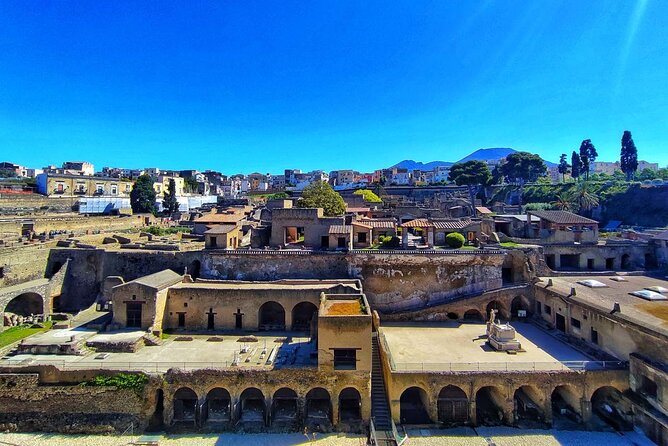
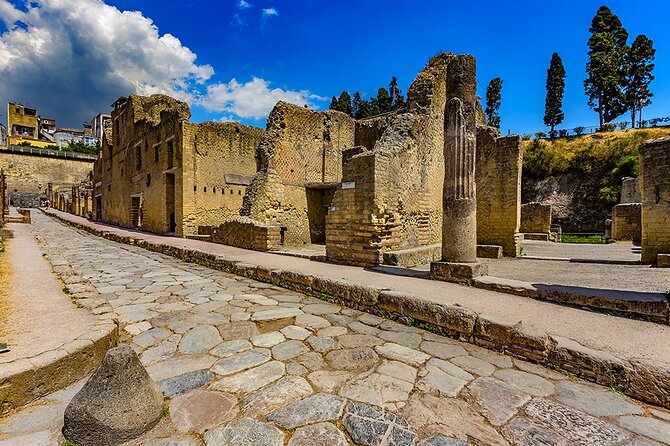
After Pompeii, you head to Herculaneum, another Vesuvius burial site. Herculaneum was a smaller city, but the key difference is how well it’s preserved. The ash and pumice covered it so effectively that streets, houses, and villas are still visible in a way that feels almost uncanny.
You get about two hours at Herculaneum with admission included. This is long enough to do more than pose for photos. It’s also short enough that you won’t lose the group to “wandering.”
House of the Deer: a mansion name with a story
One highlight is the House of the Deer, linked to Q. Granius Verus, described here as a slave freed shortly before Herculaneum’s destruction. The house includes a sea view terrace and garden statues of deer attacked by dogs, which is how the place got its modern name.
It’s a good stop to remind yourself that these weren’t just ruins. People ate, hosted, gardened, and looked at the water from terraces.
Casa di Nettuno e Anfitrite: mosaics that make you slow down
Then you see Casa di Nettuno e Anfitrite, where glass-paste mosaics show floral and hunting scenes. The central mosaic features Neptune and Amphitrite. Even if you’re not a mosaic person, the way the tour frames these as expensive and time-consuming art for the era helps you understand the level of wealth behind the decoration.
Casa dello Scheletro, Sacello degli Augustali, and the house-spa idea
Herculaneum is where you start noticing how space changes meaning from one building to the next.
Casa dello Scheletro: the skeleton room that gave it a name
Casa dello Scheletro gets its name from the discovery of human remains in 1831. The building is thought to be made from the aggregation of three smaller buildings.
You don’t come here for comfort. You come here for the truth of the place, and the way the ruins keep the story tangible. It’s also a reminder that the eruption wasn’t a distant event. It was immediate.
Sacello degli Augustali: art, myth, and a preserved frescoed structure
Near the forum area, you’ll visit the Sacello degli Augustali. The building preserves splendid frescoes showing Hercules entering Olympus with Jupiter, Juno, Minerva, and Hercules against Achelous.
It’s one of those stops where guided interpretation helps. The more you understand the figures and the myth references, the more the fresco becomes a message about status, belief, and identity.
House of the Hotel: a large home and a spa district
The House of the Hotel is described as Herculaneum’s largest discovered house so far, with about 2,250 square meters. It sits on the hill edge in a panoramic position and is noted for having a spa district, which is why it was first considered like a hotel.
Even if you think “hotel” sounds modern, this is useful context. The Romans built leisure space into elite homes too.
House of the Black Salon: the tablets and the personal angle
Casa del Salone Nero, or the House of the Black Salon, is named for a party hall painted black with geometric patterns. You also learn about waxed tablets found there belonging to L. Venidius Ennychus, with information connected to eligibility for Augustale, a slave purchase, and the birth of a daughter.
That last part is what makes this stop hit differently. It’s not just decoration and architecture. It’s evidence of who held power and how families recorded key events.
If your guide ties the scene to what daily life might have looked like, this can be one of the stops you remember most when you leave the site.
Tickets, group size, and how the day stays organized
This tour includes admission tickets at each listed stop, and it uses a mobile ticket. That reduces the number of moments you’re standing around with paperwork.
Group size can reach up to 100, which affects your experience. You might move in dense clusters at busy points, especially in Pompeii. If your guide uses clear group management, you’ll feel it. If you’re the type who gets anxious when you’re separated from the main group, do a quick check-in early, like confirming where to meet when you pause for photos.
Guide quality is one of the strongest parts of this experience. When the day runs well, a guide can connect the big monuments to everyday routines, so Pompeii stops feel like a system and not random piles of stone. In successful runs, guides were praised for staying upbeat, keeping the group on track, and adjusting pacing to the heat, like finding shade while explaining details.
One more practical note: because Pompeii is huge and crowded, don’t rely on the “first second” of arrival to understand everything. Give yourself time to reset your eyes. Then let the guide’s route do the heavy lifting.
What to wear, bring, and expect in Pompeii heat
This is a long, mostly outdoor day. Plan like you’re doing a hike, not a museum visit.
Wear comfortable walking shoes with grip. Bring sunscreen and sunglasses, and consider a hat if you’re sensitive to sun. You’ll be under direct light for parts of Pompeii and Herculaneum, and the walking adds up quickly.
Also, keep your water and small essentials easy to reach. Even with a lunch stop built into the day, you’ll feel better if you’re prepared before you get hungry.
Finally, accept that timing can shift. Local traffic and crowd levels can change the order or speed slightly. If you’re traveling with a tight schedule, this tour still tends to be a strong choice because you get both major sites, but you should plan with flexibility.
Is $192.22 good value for Pompeii and Herculaneum?
At $192.22 per person, you’re paying for a full day that bundles a lot of the expensive and time-consuming parts together.
Here’s the value logic. You’re paying for guided time that helps you see meaning in the ruins, plus admission tickets included across multiple Pompeii and Herculaneum stops. You also get lunch at Sorrentino Winery and a three-wine tasting (Prosecco, red, and white). That food component matters, because it’s not a generic sandwich break. It’s a structured meal with local items like pasta with piennolo cherry tomatoes.
Where the price can feel less “fair” is if you personally dislike crowds or hate feeling rushed. Pompeii is the main variable. Even with a guided plan, you may face slower entry moments or dense areas simply because the site is one of the most visited in the world.
Still, if you want a one-day solution that gets you both sites and also gives you a guided story, this price is defensible. You’re buying time saved and context provided.
Should you book this Pompeii and Herculaneum tour?
Book it if you want the best one-day plan for Pompeii plus Herculaneum from Sorrento. It’s especially right for you if you like your sightseeing structured: a set route, included tickets, and a lunch stop so the day doesn’t fall apart halfway through.
Skip it or rethink your expectations if you’re highly sensitive to crowding or if you need a slow pace. Pompeii can be intense, and the itinerary moves from major points to major points, which can feel fast if you want to linger.
My simple decision rule: if your priority is seeing both sites and you’re okay with a guided, time-managed day, this tour fits. If your priority is taking your time at one site and reading every stone for an entire afternoon, you’d likely be happier choosing a shorter, more relaxed plan focused on just one.
FAQ
Where is this tour based?
The experience is located in Sorrento, Italy, and it is near public transportation.
How long does the tour last?
The duration is approximately 9 hours, and timing may vary due to local traffic conditions or other circumstances.
What language is the tour offered in?
The tour is offered in English.
Are admission tickets included for Pompeii and Herculaneum?
Yes. The tour includes an admission ticket for the listed stops in Pompeii and an admission ticket for the listed stops in Herculaneum.
Is lunch included, and what is served?
Yes. Lunch includes bruschetta, cured meats, cheeses, and seasonal vegetables as a starter, plus wine tasting (Prosecco, red, and white). The main is pasta with Piennolo cherry tomatoes, and dessert is traditional homemade dessert.
Does the winery stop include wine tasting?
Yes. The included tasting features three wines: Prosecco, red, and white.
How big is the group?
The tour has a maximum of 100 travelers.
Do I need a printed ticket?
No. The tour uses a mobile ticket.
What should I wear or bring?
Wear comfortable shoes, and in summer bring sunglasses and sunscreen.
What happens if the weather is bad or I need to cancel?
This experience requires good weather. If it’s canceled due to poor weather, you’ll be offered a different date or a full refund. Free cancellation is available up to 24 hours in advance for a full refund.
More Tour Reviews in Sorrento
- Sorrento: Exclusive Capri Boat Tour and Optional Blue Grotto★ 4.8 · 3,170 reviews
- Sorrento Farm and Food Experience including Olive Oil, Limoncello, Wine tasting★ 5.0 · 2,524 reviews
- Capri Blue Grotto Small-Group Boat Day Tour From Sorrento★ 4.5 · 2,511 reviews
- From Sorrento/Nerano: Amalfi and Positano Boat Tour★ 4.6 · 2,440 reviews
- Day Trip to Positano, Amalfi & Ravello from Sorrento★ 4.5 · 2,371 reviews
More Days in Herculaneum
- Guided Day Tour of Pompeii and Herculaneum with Light Lunch★ 4.5 · 311 reviews
- Sorrento: Pompeii & Herculaneum Tour with Skip-the-Line★ 4.6 · 125 reviews
- Pompeii, Herculaneum and Winery on Vesuvius with an Archaeologist★ 5.0 · 89 reviews
- Herculaneum: 2-Hour Skip-the-Line Tour from Sorrento★ 4.0 · 46 reviews
- Pompeii & Herculaneum – Skip the line from Sorrento★ 4.5 · 44 reviews
Sorrento to Pompeii, More Ways
- Pompeii Ruins Half-Day Tour from Sorrento with Guide★ 4.0 · 714 reviews
- From Sorrento: Day Tour to Pompeii Ruins and Mount Vesuvius★ 4.3 · 489 reviews
- Guided Day Tour of Pompeii and Herculaneum with Light Lunch★ 4.5 · 311 reviews
- From Sorrento: Pompeii Ruins All-inclusive Guided Tour★ 4.4 · 218 reviews
- Mt Vesuvius and Pompeii Tour by Bus from Sorrento★ 4.5 · 170 reviews
More ways into Pompeii Tours from Sorrento.
 ★ 4.8Pompeii: Small-Group Tour of Pompeii and Herculaneum867 reviews
 ★ 4.9Pompeii Ruins Private Tour with Optional Skip-the-Line EntryFrom $254732 reviews
 ★ 4.0Pompeii Ruins Half-Day Tour from Sorrento with GuideFrom $97714 reviews
 ★ 5.0Skip the Line Guided Tour of Pompeii led by an ArchaeologistFrom $95703 reviews
 ★ 4.3Day Tour to Pompeii Ruins and Mount VesuviusFrom $130489 reviews
 ★ 5.0Sharing Tour of PompeiiFrom $193487 reviews
 ★ 5.0Pompeii Tour & Lunch with Wine Tasting ExperienceFrom $120383 reviews
 ★ 5.02 hours Pompeii Tour with Local Historian – Ticket IncludedFrom $48335 reviews
Other useful routes from here