
REVIEW · POMPEII TOURS FROM SORRENTO
Discover Pompeii on this Guided Walking Tour of the Buried City
Pompeii is quiet proof of how fast life changes. This guided walking tour is a smart, time-saving way to see Pompeii’s UNESCO ruins with a professional guide, included admission, and headsets so you do not miss the details. I like the way the tour connects the city’s layout and Roman daily life to the eruption story, and I also like the small-group setup that keeps the pace workable. One thing to consider: language quality depends on your tour language, and French or German needs a minimum number of participants.
You meet at Piazza Esedra, 2, and you are back there after about 2 hours, which makes planning other parts of your day easier. I also appreciate that you do not just get a highlights walk, you get context, including how Pompeii sat on a plateau shaped by Vesuvius lava and how different peoples helped form the city long before Rome made it famous. The main drawback is simple: if you book in German or French, keep an eye on language confirmation close to departure, because tours may switch to English if the minimum is not met.
Key Points at a Glance
- Skip-the-line time saver with a mobile ticket and admission included
- Headsets for clear listening during your 2-hour walk through the ruins
- Language options with practical limits (French and German require a minimum group size)
- Roman life explained on-site, not just background reading
- Small group size (max 15) for a more controlled, guided pace
- Pompeii history tied to Vesuvius so the eruption makes sense
Entering Pompeii Without Wasting Half Your Morning
This tour is built for the way Pompeii days usually go. You want to see the place, but you also do not want your vacation swallowed by queues. Here, you get a mobile ticket and admission included, plus the big promise of bypassing the long ticket line when you arrive. In practice, that means more time walking the real streets, less time standing and checking your watch.
Your meeting point is very specific: Piazza Esedra, 2, 80045 Pompei NA. You start there, and you finish back at the same meeting point. That is a small detail, but it matters because it helps you plan lunch or train schedules without needing a second pickup location.
One practical note I like: you bring a valid ID or passport for entry verification, and booking requires full passenger names. That keeps things smooth at check-in, but it also means you should prep early, especially if you are traveling as a couple or family and filling out several tickets.
What a 2-Hour Guided Walk Feels Like (and What It Does Not)
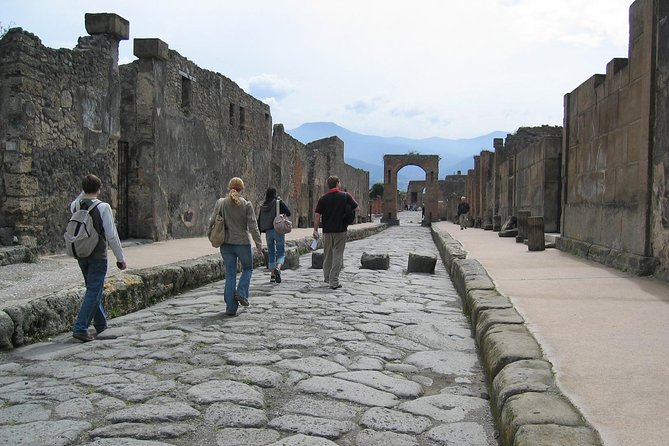
Pompeii is large, and a 2-hour guided tour cannot cover every square meter. What it can do well is give you the spine of the city: what you are looking at, why it mattered, and how the whole place fits together. This tour focuses on guided walking through the Pompeii Archaeological Park, with the guide explaining Pompeii’s origins and then bringing you forward into the Roman period and everyday life.
You also get headsets, which I consider a major quality-of-life upgrade here. Ruins can be windy, people can bunch up, and groups can get noisy. With headsets, you have a better chance of hearing the guide’s explanation instead of nodding along while missing key points.
So what should you expect? A structured walk with time to see significant remains, plus a story that connects Pompeii to Vesuvius. What you should not expect is a slow, museum-style crawl. The value is that you gain context fast, so when you later wander on your own, you are not just looking at walls, you are recognizing spaces and patterns.
Stop in Pompeii Archaeological Park: Built on Lava, Shaped by Port and River
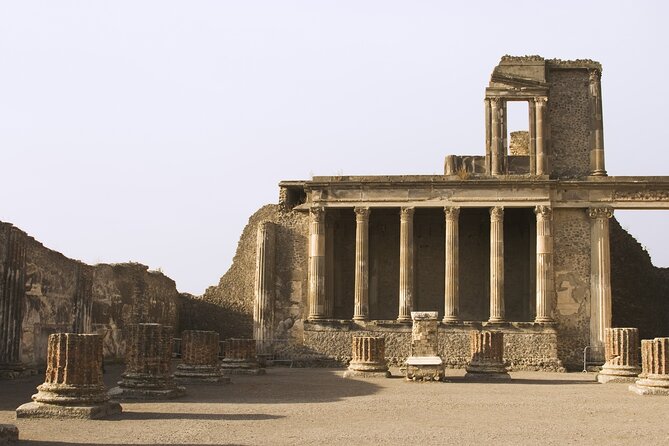
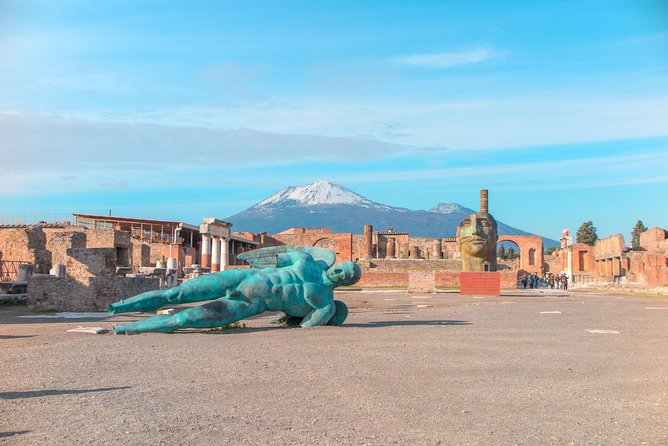
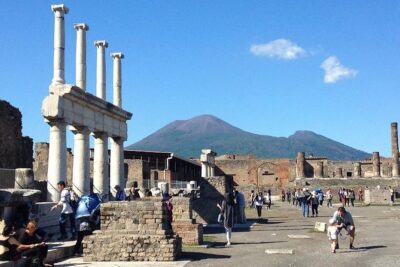
This is where the heart of the experience happens, because Pompeii is more than a pile of ruins. The tour starts with the big setting: Pompeii sits on a plateau formed by Vesuvius lava flows. The city dominated the valley around the Sarno River, and the delta hosted a busy port. In other words, this was a place with movement and trade, not a quiet backwater.
Then your guide connects the city to its early roots, and that part can be surprisingly helpful. The origins are uncertain, but the oldest traces go back to the 7th and 6th centuries BC, when early tuff walls called pappamonte enclosed an area of about 63.5 hectares. After that, a mixed population of Etruscans, Greeks, and other Italic peoples helped shape the city’s development. That matters because it explains why Pompeii does not feel like one single “Roman only” story when you look at the remains.
A possible drawback to keep in mind: Pompeii can overwhelm you visually. In a short timeframe, you might want to take a few photos, but also remind yourself to listen. If you spend the whole time filming, you will miss the guide’s connections, which is where the tour’s real value is.
How Your Guide Explains Roman Daily Life
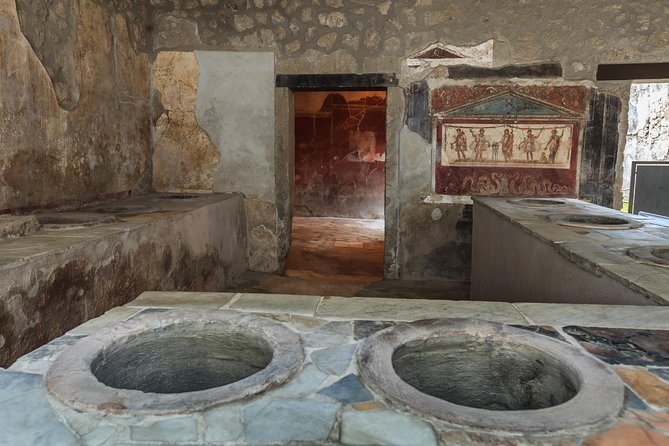
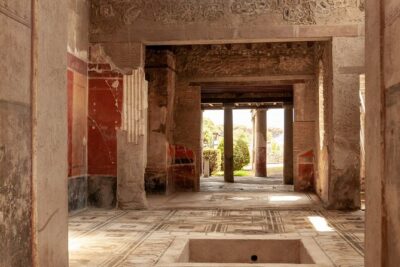
The best guided experiences do two things. They show you what is in front of you, then they translate that into human life. This tour is designed around exactly that: you follow the guide through remains of the UNESCO-listed city and get an insider look at the Romans’ daily lives before the catastrophe.
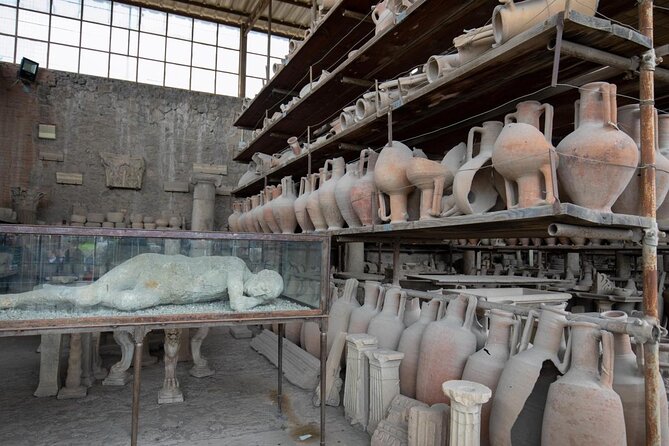
That daily-life focus is what makes a guided walk more than a sightseeing checklist. Pompeii is famous because it was preserved, but it is also powerful because you can imagine ordinary routines in a world frozen in time. When a guide points out functions of spaces, everyday objects, and how people lived, the ruins start to feel less like a set and more like a snapshot of real behavior.
You might find that the eruption story lands harder after this context. That is intentional. Your guide is not only telling you what happened, they are framing why the city’s location and structures made the disaster so final.
Vesuvius Context: Why the Eruption Story Makes Sense
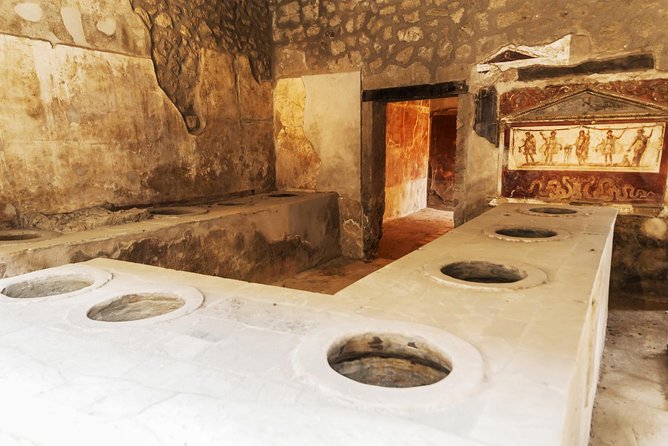
Even if you never physically travel up Mount Vesuvius on this specific tour, the name still matters because it is the reason you are here. The guide provides the geographic and volcanic background so you understand the scale of the event.
Mount Vesuvius is described as a somma-stratovolcano on the Gulf of Naples, about 9 km east of Naples. It is part of the Campanian volcanic arc. Vesuvius has a large cone partially encircled by the steep rim of a summit caldera, formed by the collapse of an earlier, much taller structure. In plain terms, it is a system with deep structure, not a simple single cone.
You can use that explanation to interpret what you are seeing in Pompeii. Lava flows and ash preservation do not happen by magic. They connect back to how Vesuvius works and how the surrounding landscape was formed. So the eruption story is not just drama, it is cause-and-effect that your guide turns into something you can picture.
Language Options, Headsets, and the One Thing to Double-Check
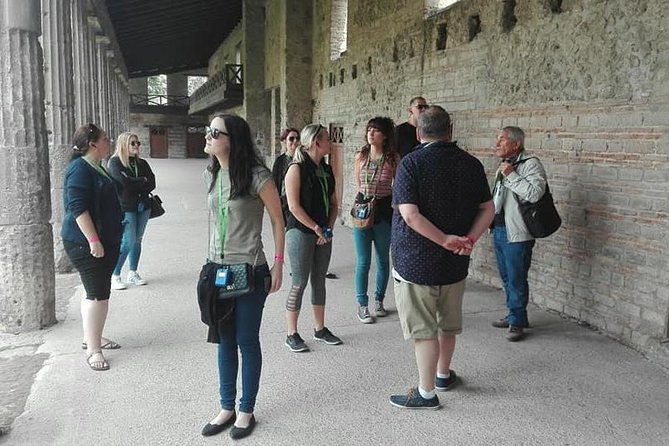
This is where you should be a little strategic. The tour offers guides in English, Spanish, German, and French. Headsets are included, which helps regardless of language. You also get audio guides in other languages, with seasonal availability.
Here is what the tour data says about audio guides:
- From November to March: audio guides in Italian, Portuguese, Chinese, Russian, and Japanese
- From April to October: audio guides in Italian, German (Mondays to Fridays), French, Portuguese, Chinese, Russian, and Japanese
And there is an important rule for French and German: a minimum of 10 participants is required to confirm those language options. If that minimum is not met, the tour runs in English. The note even tells you to contact the reservations team to confirm the language option within 24 hours before departure.
That point is not just fine print. It can make or break your experience if you booked for a specific language because you want deeper explanations or questions to be easier. I suggest doing a quick language check the day before, then plan as if English is the fallback.
Also note: confirmation is received at booking, but language availability can change based on that minimum. If your group has kids or you need clear explanations, it is worth verifying early.
Small Group (Max 15): Why That Matters in Pompeii
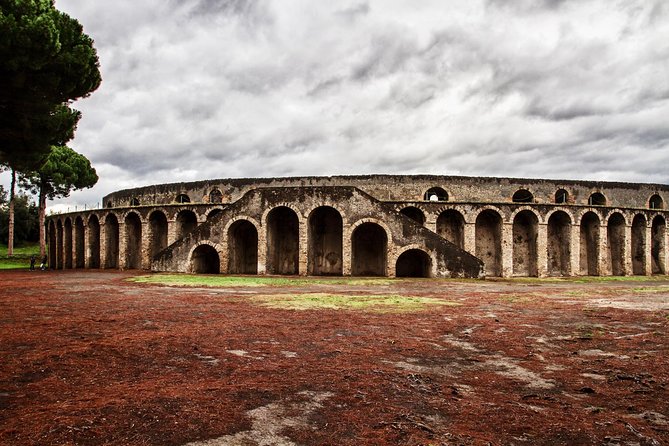
With a maximum of 15 travelers, you should expect a more controlled experience than you would with huge crowds. That is a real advantage at Pompeii, where paths can be narrow and stops can be close together.
A smaller group also typically helps in the key moments: when the guide is explaining how a space functioned, or when you need a moment to look closely. You are not competing with a wave of people for sight lines, and you are more likely to hear the guide without leaning or turning your body constantly.
This is a good fit if you want structure but still like to look around afterward. Think of the guide as your way to get the city’s logic in 2 hours, then you can wander with better understanding.
Price and Value: Is $63 a Good Deal?

At $63 for about 2 hours, with admission included and headsets provided, this is not a bargain in the “cheap ticket” sense. But it can be good value if you compare what you would normally spend to assemble the same experience yourself.
What you are paying for:
- Guided interpretation in your language (or the confirmed language for your date)
- Included admission, so you do not add another line-item ticket purchase
- Headsets, which make listening realistic in a busy site
- A time advantage by bypassing the long ticket line
If you are the type of traveler who shows up at major sites with a few questions and wants a human to answer them, this format tends to pay off. If you prefer reading on your own at your own speed, you might feel boxed in by the 2-hour frame. But for most first-time Pompeii visitors, a guided start is the fastest way to avoid that stuck feeling of seeing everything and understanding almost nothing.
Best For Who? Who Will Enjoy This Most
I think this tour fits best if you:
- Want a first look at Pompeii with context, not just photos
- Care about hearing the guide clearly, since headsets are included
- Want your visit organized around a 2-hour time window
- Prefer getting the eruption story explained in relation to the city’s setting
It may be less ideal if you already know Pompeii deeply and you want total freedom to roam at your own pace. Also, if language is your top priority, take the French or German minimum rule seriously and confirm your language within 24 hours of departure.
A Real-World Caution From Reviews: Language Expectations
The reviews show one clear theme: when people book a specific language, they expect to understand the guide well and ask questions comfortably. There are complaints about German language sessions being hard to follow or shifting toward mainly English. The company’s response in those cases was an apology and a promise to improve.
I take that as your practical takeaway: if you book German or French, verify the language close to departure using the reservation team. And if you are traveling with children or teens, remember that the reason you booked your language option is usually about clarity, not just convenience.
Practical Tips for Your Pompeii Walking Tour
You will get the most out of this experience if you plan around Pompeii’s realities.
- Arrive ready to walk for about 2 hours. This is a walking tour through ruins, so keep your footwear comfortable.
- Use the headsets. Do not rely on your phone audio. Your guide is the main source here.
- Bring your ID or passport for entry verification. This is specifically requested.
- If you care about language, re-check the language status within 24 hours for French or German, since there is a minimum participant rule.
One more small tip: take photos, but keep one hand free. The moment you start balancing your phone on a wall, you usually miss the sentence that explains what that wall actually was.
Should You Book This Pompeii Guided Walking Tour?
Book it if you want a time-efficient, guided way to understand Pompeii’s setting, origins, and Roman daily life, with admission and headsets included. The $63 price makes sense when you factor in the skip-the-line advantage and the value of having someone explain what you are seeing.
I would not book it blindly if you are counting on French or German. Check the language option within the 24-hour window, because the tour can switch to English if the minimum of 10 participants is not met. If you are comfortable with English as a backup, then you can enjoy the tour even if plans shift.
If you want a first successful Pompeii visit that sets you up to explore thoughtfully afterward, this is a strong match.
FAQ
What time does this tour last?
The tour lasts approximately 2 hours.
Is the admission ticket included?
Yes. Admission ticket is included as part of the tour.
Where does the tour start and end?
It starts at Piazza Esedra, 2, 80045 Pompei NA, Italy, and ends back at the same meeting point.
What languages are available for the guided tour?
The guided tour is offered in English, Spanish, German, and French, depending on the confirmed language for your date.
Are headsets provided?
Yes. Headsets are included.
Are audio guides included, and in which languages?
Audio guides are included. The available languages depend on the season: from November to March they include Italian, Portuguese, Chinese, Russian, and Japanese; from April to October they include Italian, German (Mondays to Fridays), French, Portuguese, Chinese, Russian, and Japanese.
What if I booked French or German?
A minimum of 10 participants is required for French and German to confirm. If the minimum is not met, the tour will be conducted in English. It’s also recommended to contact reservations to confirm the language option within 24 hours before departure.
What should I bring for entry verification?
Bring a valid ID or passport for entry verification.
Is cancellation free?
You can cancel for a full refund if you cancel up to 24 hours in advance of the experience start time.
More Tours in Pompeii
- Pompeii Small Group Tour with an Archaeologist★ 5.0 · 6,593 reviews
- Pompeii and Herculaneum Small Group Tour with an Archaeologist★ 5.0 · 1,350 reviews
- Skip the Line Guided Tour of Pompeii led by an Archaeologist★ 5.0 · 703 reviews
- Pompeii Ticket + Tour with Optional Tasting Experience at Pompeii★ 5.0 · 663 reviews
- Pompeii private tour with an Official Guide★ 5.0 · 631 reviews
More Tour Reviews in Pompeii
- Pompeii Small Group Tour with an Archaeologist★ 5.0 · 6,593 reviews
- Discover the Ancient Ruins of Pompeii: Day Trip from Rome★ 3.5 · 2,247 reviews
- Pompeii and Herculaneum Small Group Tour with an Archaeologist★ 5.0 · 1,350 reviews
- Skip the Line Guided Tour of Pompeii led by an Archaeologist★ 5.0 · 703 reviews
- Pompeii Ticket + Tour with Optional Tasting Experience at Pompeii★ 5.0 · 663 reviews
Sorrento to Pompeii, More Ways
- Skip the Line Guided Tour of Pompeii led by an Archaeologist★ 5.0 · 703 reviews
- Sharing Tour of Pompeii★ 5.0 · 487 reviews
- Pompeii Tour & Lunch with Wine Tasting Experience★ 5.0 · 383 reviews
- 2 hours Pompeii Tour with Local Historian – Ticket Included★ 5.0 · 335 reviews
- Private Day Tour of Pompeii, Sorrento and Positano with Pick Up★ 5.0 · 110 reviews
More ways into Pompeii Tours from Sorrento.
 ★ 4.8Pompeii: Small-Group Tour of Pompeii and Herculaneum867 reviews
 ★ 4.9Pompeii Ruins Private Tour with Optional Skip-the-Line EntryFrom $254732 reviews
 ★ 4.0Pompeii Ruins Half-Day Tour from Sorrento with GuideFrom $97714 reviews
 ★ 5.0Skip the Line Guided Tour of Pompeii led by an ArchaeologistFrom $95703 reviews
 ★ 4.3Day Tour to Pompeii Ruins and Mount VesuviusFrom $130489 reviews
 ★ 5.0Sharing Tour of PompeiiFrom $193487 reviews
 ★ 5.0Pompeii Tour & Lunch with Wine Tasting ExperienceFrom $120383 reviews
 ★ 5.02 hours Pompeii Tour with Local Historian – Ticket IncludedFrom $48335 reviews
Other useful routes from here