
REVIEW · POMPEII TOURS FROM SORRENTO
Private Pompeii Tour with Guide & Transfer included from Sorrento
Skip the line, then enjoy Pompeii right.
This private Pompeii outing from Sorrento is interesting because it pairs round-trip hotel transfer with priority entry, so you lose less time to logistics and more time to the ruins. I love the idea of having an official guide on the ground, not just wandering and guessing, and I also like that you can ask questions and adjust the pace in a private group. The main consideration is simple: it’s still a lot of walking on stone in summer heat, so you’ll want comfy shoes and a sun plan.
If you care about getting oriented fast, this works well. You’ll spend time on the Forum and everyday spaces like baths and markets, then shift to major houses and theaters where you can spot how Pompeii looked as a functioning city, not a photo set. The downside? The heat can make the same route feel longer, so early timing matters.
Key points to know before you go
- Priority access helps you bypass the ticket-window line and start exploring sooner
- Official guide live commentary keeps the site readable instead of overwhelming
- Private round-trip transfer from the Sorrento area saves you stress and time
- Pompeii daily-life stops include baths, markets, and the main street, not just big monuments
- A private pace means you can ask questions instead of marching behind headphones
- Tickets for key stops are included, so you’re not constantly checking what’s covered
Price and Logistics: Why This Private Format Costs What It Does
At $504.67 per person for a 4 to 5 hour experience, you’re paying for convenience plus expert guidance. In plain terms, you’re not just buying entry into Pompeii. You’re buying a local guide, a private transfer from Sorrento, and priority entry so your day starts with momentum.
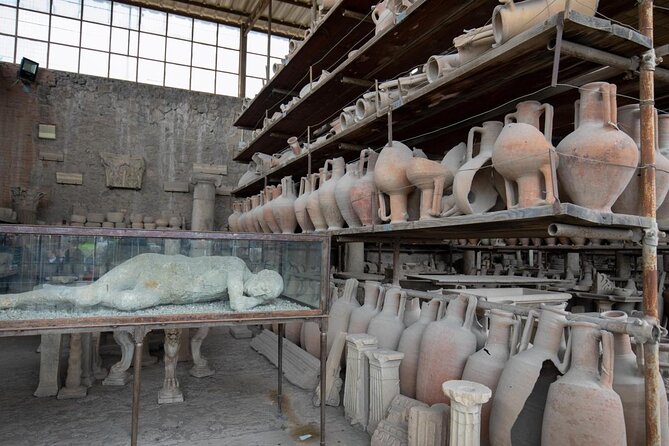
That matters on a site as huge as Pompeii. Without help, it’s easy to walk a lot and still miss the “why it’s here” stories. With a guide, you get meaning fast, like how the city was preserved by the 79 AD eruption of Mount Vesuvius and how that preservation helps conservation teams understand and protect the site today.
One practical note: pickup in the Sorrento area isn’t always possible from every single hotel door. Traffic restrictions and pedestrian-only zones can block access, so you’ll need to confirm the exact pickup location with the provider at least 24 hours before departure.
Getting From Sorrento to Pompeii Without the Headache
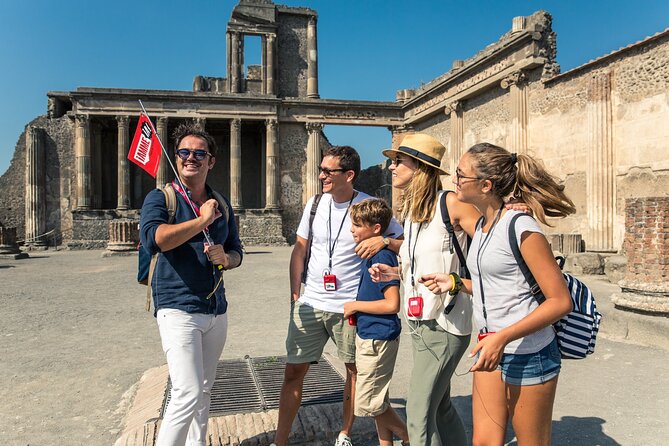
The tour includes private transportation with an English-speaking driver, round trip from your hotel in the Sorrento area. That’s a big deal if you don’t want to figure out trains, buses, or the timing puzzle that comes with a day trip.
The transfer is built to get you to Pompeii when it’s most workable for walking. One of the best pieces of advice from the experience is to go early, especially in July, because the site can get very hot. If you’re flexible, early starts make the ruins feel more comfortable and less exhausting.
Also, the tour is described as private, meaning it’s only your group. That tends to matter when someone in your party needs a bathroom break, wants a slower pace, or simply has more questions than the average “follow the group” traveler.
Priority Entry: The Small Time Saver That Changes Your Day
Pompeii has a reputation for long lines, and this tour uses fast-track entry to bypass the ticket-window line. That’s one of the highest praised parts of the experience, because it’s not a vague perk. It’s time you feel immediately once you’re inside.
When you save time at the entrance, you gain something else too: mental energy. You arrive ready to look instead of arriving already annoyed. And because the tour includes guided stops, you’re not spending your limited energy figuring out where to go next.
You’ll also have a mobile ticket, which is handy in general, especially if you’re traveling light and don’t want to manage paper tickets in a hot sun.
The Official Guide Factor: How the Site Becomes Understandable
A private Pompeii tour is never just about seeing ruins. It’s about seeing patterns. The key is the live commentary from an official local guide, who helps you connect landmarks into a map you can actually use while you walk.
This guide-led format also gives you permission to slow down. You can ask follow-up questions without feeling like you’re holding up strangers. In the experience, people mention guides who are friendly and highly engaged, with the added bonus of pointing out spots that feel less packed than the most obvious routes.
That’s where Pompeii turns from “impressive piles of stone” into a real place. You start to notice how the city organized itself: civic life around the Forum, commerce along key streets, and private wealth expressed in large houses and decorated spaces.
Archaeological Park of Pompeii: Your Big Orientation Block
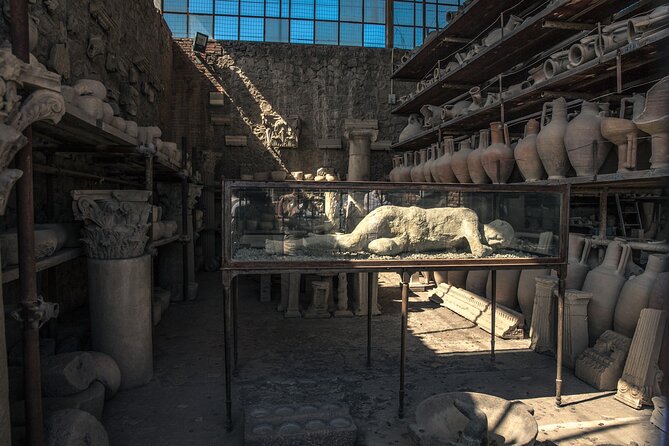
The heart of the day is a 2-hour guided walking tour at the Archaeological Park of Pompeii, with the admission ticket included. This is where you get your bearings and your baseline understanding of what you’re seeing.
You’ll learn the big story first, the one that explains why Pompeii looks the way it does: after Mount Vesuvius erupted in 79 AD, the city was covered by lapilli and lava, which preserved infrastructure and everyday objects. That preservation is exactly why the site is so valuable, and it also explains why conservation is ongoing and careful.
This first block is also a smart use of time. If you get the “how to read the city” part early, later stops like baths, theaters, and houses make more sense. You’ll understand what you’re looking at before you hit the smaller details.
The Forum and Civic Power: Pompeii’s Daily Center
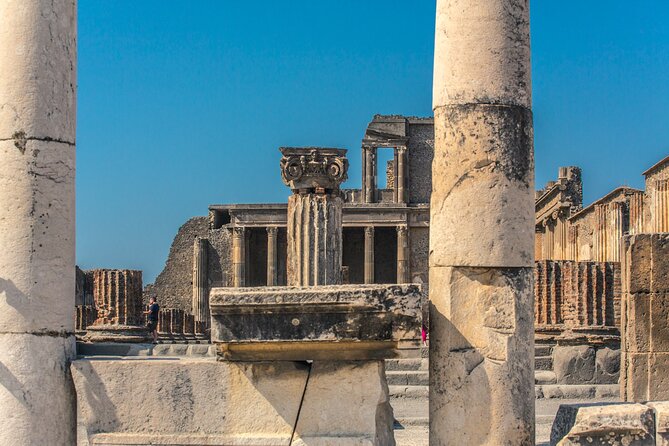
A short guided look at the Forum is one of the most effective ways to understand Roman urban life. The Civil Forum is described as the core of daily city business, including administration and justice, markets, and places of worship.
In practical terms, this is where Pompeii stops feeling like a museum and starts feeling like a place people used every day. The Forum is also the setting for major religious and political architecture, so you get a layered view of power.
A couple of highlights here:
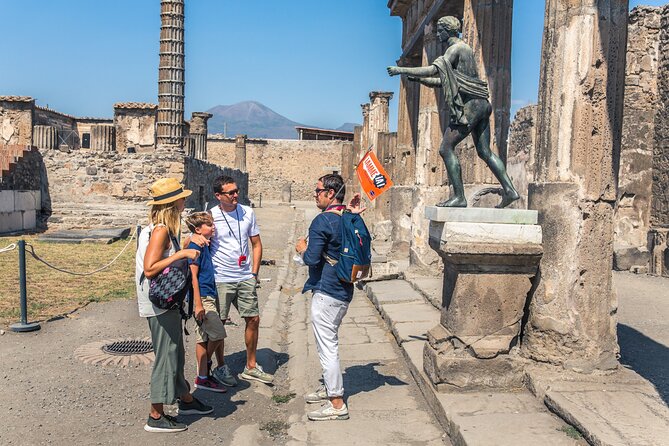
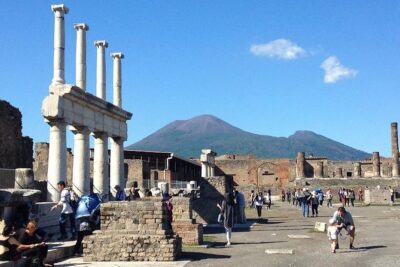
- Temple of Jupiter (Tempio di Giove Capitolino): you get the visual impact of a major temple, plus context about how it was renovated when the colony was founded around 80 BC. You’ll also understand why it’s positioned to dominate the Forum area, with Mount Vesuvius rising in the backdrop.
- Basilica: this large civic building, used for business and justice, helps explain how Romans handled contracts, disputes, and public administration.
Time is short at individual points, but because you’re guided, even a brief stop can turn into a useful mental snapshot: what this building was for and what it signals about the city.
Markets, Shops, and the Main Street Energy
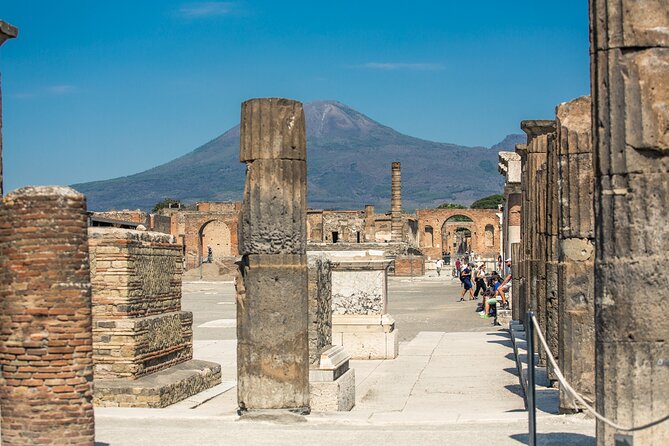
Pompeii isn’t only temples and theaters. It’s also commerce and routine, and this tour places you in those everyday channels.
You’ll spend time at the Macellum, a market area. It’s described as a tuff quadriporticus with a hall for worship positioned on an elevated spot. The details matter here because they show how commerce and ritual mixed, including references to imperial cult signals and a counter-like space that likely relates to selling food, such as fish.
Then you’ll walk the Via dell’Abbondanza, Pompeii’s ancient main street, the decumanus maximus. The big idea is that this wasn’t quiet. It ran east to west from the Forum toward Porta Sarno and would have been crowded with shops, workshops (officinae), and spots for eating and drinking.
This part is great for photos, yes, but it’s more than that. You’ll start to visualize how noise and foot traffic shaped daily life. And because the route is tied to key city points, you can understand movement through the town instead of treating each stop like a separate postcard.
Stabian Baths: How Romans Lived, Dressed, and Socialized
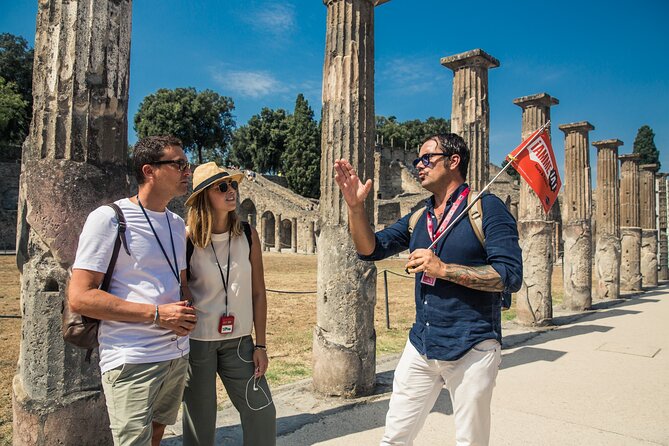
The Stabian Baths (Terme Stabiane) are one of those stops that feels oddly human, even with thousands of years between you and the people who used them. The baths date to years right after the founding of the colony of veterans, around 80 BC, and the men’s and women’s quarters had separate entrances.
You’ll learn how the spaces functioned, including how the men’s section includes an apodyterium used as a dressing room and also connected to different temperatures, like tepid and cold baths, plus hot baths.
A realistic note: baths were heavily damaged during the earthquake of 62 AD. So as you look, you’ll understand that the site is a record of everyday life plus disruption. That makes Pompeii feel less like a perfectly preserved fantasy and more like a city that was changing up until the eruption.
Via delle Ville and Casa del Fauno: From City Life Toward Wealth
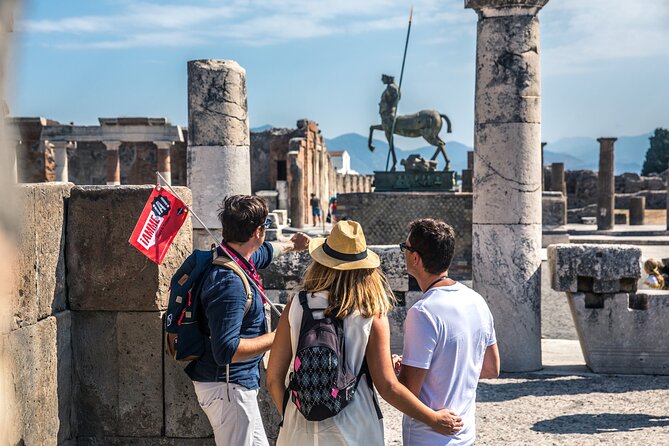
After the civic and commercial focus, the tour shifts toward residential and scenic areas.
You’ll go to Via delle Ville, often associated with the path toward the Villa of the Mysteries. It’s described as a scenic road outside the city walls, connected to a necropolis lined with impressive tombs. The point of this segment is atmosphere: it helps you sense the transition from dense urban life to the outskirts, where estates and tombs sit along routes people traveled.
Then comes Casa del Fauno (House of the Faun), one of Pompeii’s largest and most impressive private residences. Built in the 2nd century BC, it’s a strong example of how wealth and status showed in Roman republican-era homes, with major art and a level of luxury that stands out even compared with what you might see in Rome.
This is a stop that pays off if you like to look past the obvious. The guide’s job is to point out what signals luxury and how the house is organized. Even a shorter visit can change how you understand Pompeii because you start seeing class and domestic life, not just public spaces.
Teatro Grande and the Basilica: Public Performance and Administration
The Teatro Grande is Pompeii’s large theater, built into a hillside slope. The Romans used the natural depression of the terrain to create a grand auditorium with divided sectors. You’ll also learn that tragedies of the Greco-Roman tradition were performed on the stage.
This stop helps you connect civic life to culture. In Pompeii, public buildings weren’t only functional. They were where communities gathered, where events happened, and where identity was reinforced.
You’ll also spend time at the Basilica, described as the most sumptuous building of the Forum, with about 1,500 square meters of space. That size tells you how seriously Pompeii took administration and commerce. It’s one of those buildings that makes the city feel planned and purposeful, not random.
What’s Included, What’s Not, and How to Plan Your Comfort
Here’s the practical setup:
- Included: priority access, an English-speaking driver, an official local guide with live commentary, and admission tickets for the key guided stops listed in the experience structure.
- Not included: food and beverages.
So you should plan a basic day kit. The tour suggests sunscreen and comfortable shoes, and that’s exactly right. Pompeii is a place where the ground and the sun both get real. Bring water if you can, and consider a hat and sunglasses. Even if your route is guided, you’re the one doing the walking.
Because the day is 4 to 5 hours, you don’t want to overpack your schedule. Treat this as the main event. If you try to tack on extra stops that require extra transit, you’ll feel rushed.
Who This Tour Fits Best (and Who Might Want a Different Style)
This private Pompeii tour is a strong fit if you:
- Want hotel pickup and drop-off from the Sorrento area
- Prefer an official guide to keep you oriented
- Like structured stops that cover public life, markets, baths, and standout houses
- Travel as a couple or small group who benefits from having the pace shaped to your questions
It might be less ideal if you:
- Have limited tolerance for heat and long walking segments (the guidance includes a summer heat note)
- Want a totally unstructured day where you roam alone for hours without time checks
Because it’s private, it suits different personalities within the same group. One person wants architecture, another wants street life context, and you can usually manage both with a good guide.
Should You Book This Private Pompeii Tour From Sorrento?
I’d book it if your priority is a smooth day with minimal friction: transfer handled, fast-track entry, and an official guide doing the heavy lifting of interpretation. At this price, you’re paying for time savings and for not getting lost in a massive site.
If you’re someone who enjoys detail and wants the Forum, baths, main street, and a major house all in one coherent storyline, this format is a solid match. Just plan for the basics: sun protection, comfortable walking shoes, and a simple food plan since meals are not included.
Provider: IAMME IA! – Gray Line Amalfi Coast
If you want Pompeii to feel like a living city you can read, not a blur of ruins, this is one of the cleaner ways to do it from Sorrento.
FAQ
How long is the private Pompeii tour from Sorrento?
The experience runs about 4 to 5 hours.
Is pickup included?
Yes. You get pickup from your hotel in the Sorrento area, plus return transport to your hotel.
Will I be able to skip the ticket line?
Yes. The tour includes priority access to Pompeii Archaeological Site, described as fast-track entry to bypass the ticket line.
What language is the guide in?
The tour is offered with an English-speaking driver, and it includes an expert private local guide with live commentary in English.
Are admission tickets included?
Yes. The admission ticket is included for the guided site entries listed in the tour format, including Pompeii Archaeological Park and multiple stops such as the Forum sites and other major areas.
What is not included in the tour price?
Food and beverages are not included.
Is this a private tour?
Yes. It is private, meaning only your group participates.
Will I receive a mobile ticket?
Yes. The experience offers a mobile ticket.
Are all hotels guaranteed to be reachable for pickup?
Not necessarily. The provider notes that some hotels in the Sorrento area may not be reachable due to traffic restrictions and pedestrian areas, and you must confirm the exact pickup location at least 24 hours prior.
What is the cancellation policy?
You can cancel for a full refund up to 24 hours before the experience start time, and cancellation is free.
Who is the tour suitable for?
It states that most travelers can participate, and it recommends comfortable shoes and sunscreen due to summer heat.
More Tour Reviews in Sorrento
- Sorrento: Exclusive Capri Boat Tour and Optional Blue Grotto★ 4.8 · 3,170 reviews
- Sorrento Farm and Food Experience including Olive Oil, Limoncello, Wine tasting★ 5.0 · 2,524 reviews
- Capri Blue Grotto Small-Group Boat Day Tour From Sorrento★ 4.5 · 2,511 reviews
- From Sorrento/Nerano: Amalfi and Positano Boat Tour★ 4.6 · 2,440 reviews
- Day Trip to Positano, Amalfi & Ravello from Sorrento★ 4.5 · 2,371 reviews
Your Own Driver for the Day
- From Sorrento: Positano and Amalfi Boat Trip with Transfer★ 4.9 · 1,598 reviews
- Capri Guided Boat Experience with Island Exploration and Transfer★ 5.0 · 302 reviews
- Private Tour of the Amalfi Coast from Sorrento with Driver★ 5.0 · 269 reviews
- Private Transfer from Sorrento to Naples★ 5.0 · 268 reviews
- Amalfi & Positano Boat Experience with Free Time & Transfer★ 5.0 · 267 reviews
Sorrento to Pompeii, More Ways
- Pompeii Ruins Half-Day Tour from Sorrento with Guide★ 4.0 · 714 reviews
- From Sorrento: Day Tour to Pompeii Ruins and Mount Vesuvius★ 4.3 · 489 reviews
- Guided Day Tour of Pompeii and Herculaneum with Light Lunch★ 4.5 · 311 reviews
- From Sorrento: Pompeii Ruins All-inclusive Guided Tour★ 4.4 · 218 reviews
- Mt Vesuvius and Pompeii Tour by Bus from Sorrento★ 4.5 · 170 reviews
More ways into Pompeii Tours from Sorrento.
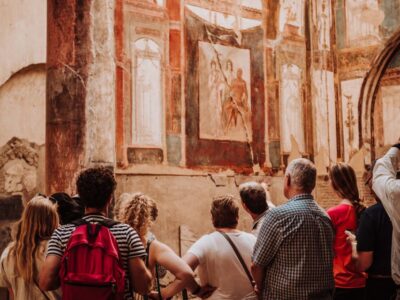 ★ 4.8Pompeii: Small-Group Tour of Pompeii and Herculaneum867 reviews
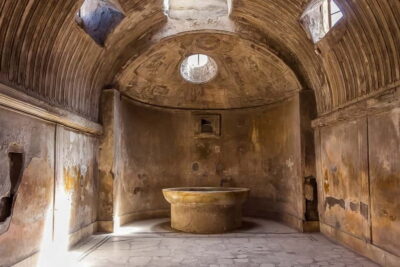 ★ 4.9Pompeii Ruins Private Tour with Optional Skip-the-Line EntryFrom $254732 reviews
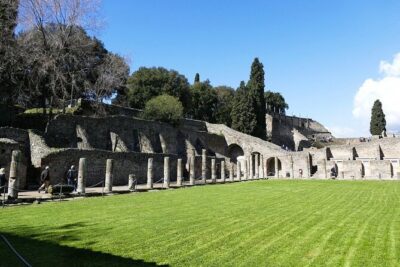 ★ 4.0Pompeii Ruins Half-Day Tour from Sorrento with GuideFrom $97714 reviews
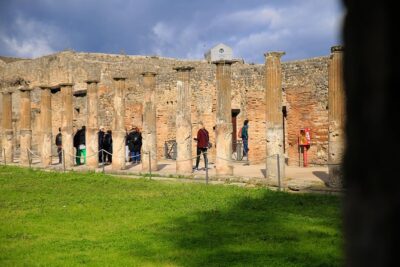 ★ 5.0Skip the Line Guided Tour of Pompeii led by an ArchaeologistFrom $95703 reviews
 ★ 4.3Day Tour to Pompeii Ruins and Mount VesuviusFrom $130489 reviews
 ★ 5.0Sharing Tour of PompeiiFrom $193487 reviews
 ★ 5.0Pompeii Tour & Lunch with Wine Tasting ExperienceFrom $120383 reviews
 ★ 5.02 hours Pompeii Tour with Local Historian – Ticket IncludedFrom $48335 reviews
Other useful routes from here