
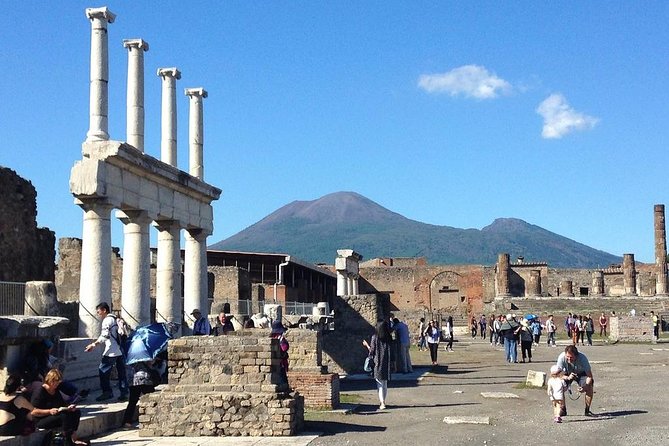
REVIEW · POMPEII TOURS FROM SORRENTO
Sharing Tour of Pompeii
Three Pompeii stops, tightly guided.
I love how this 2 hours 30 minutes tour gets you into the ruins with a private tour guide and an English explanation, so you are not wandering Pompeii with only a map and good intentions.
I also like the focus. You visit the Roman temple buried by Vesuvius in 79, the Casa dei Vettii, and the lupanari (the ancient brothel area) in one outing, and each stop is explained in plain terms tied to burial and excavation. The group stays small, sold for up to 8 in your party.
One consideration: the Pompeii entrance ticket is not included. You will still need to pay Euro 20.00 per person for admission, and the tour can be adjusted if minimum numbers are not met.
Key Things I’d Prioritize On This Pompeii Tour
- A small group with a guide: you get answers without the scramble.
- Three high-signal stops: a temple, a major domus, and the lupanari in one logical run.
- Clear Roman context: the guide connects each site to the eruption of 79 and later excavations.
- English mobile ticket: less hassle day-of, and you confirm at booking.
- Practical value for small parties: you pay per group, not per person for the guided portion.
Getting to Pompeii: Villa Dei Misteri Meeting Point and Pickup
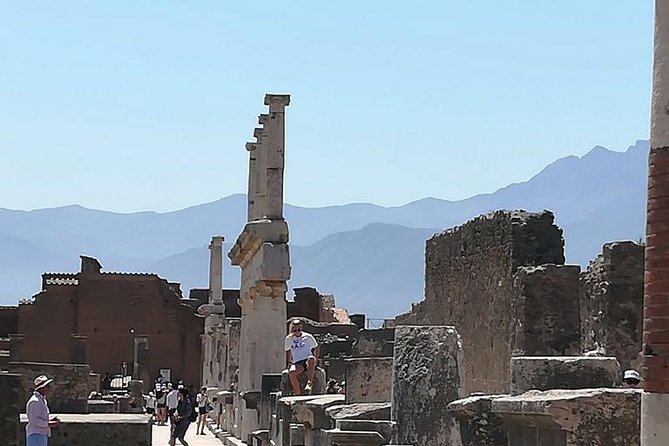
You start at Pompei Scavi Villa Dei Misteri (80045 Pompei, Metropolitan City of Naples, Italy). If you have pickup included, the operator will handle that, but the default meeting point is clearly set. You will find the guide with the Sharing Tour of Pompei sign waiting for you.
This part matters more than it sounds. Pompeii is not a tidy place for last-minute coordination. A fixed meeting spot near Villa Dei Misteri helps you arrive calm, not stressed. It also means you can line this up with your day around Naples, Sorrento, or wherever you are staying.
One small plus: service animals are allowed, and the meeting point is near public transportation. So if you are doing this as part of a longer itinerary, you are not locked into a car schedule.
Time on the Ground: How a 2.5-Hour Route Really Works
The tour runs about 2 hours 30 minutes. That is a very workable window for Pompeii because you get real conversation time with a guide, but you still leave energy for the rest of your day.
With a guided format, you are not just looking at walls. You are getting a story in the order you see it. At Pompeii, that order helps. The eruption of Vesuvius in 79 is the big timeline thread, and the tour organizes the ruins around that moment, plus the later archaeological excavations that brought structures back into view.
I also like the pace implied by the “sharing tour” model plus the note that only your group participates. That setup usually means you are not stuck waiting for strangers to catch up at every turn.
Practical tip: wear shoes you can walk in for the full length of Pompeii. Even when a tour is short, the ground and stone surfaces take effort, and you will want your feet to feel good by the end.
Stop 1: The Roman Temple Buried by Vesuvius in 79
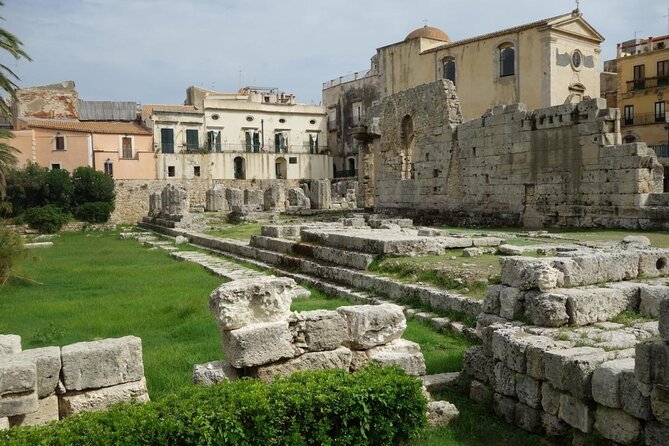
The first stop is a Roman temple that was buried by the eruption of Vesuvius in 79. After the archaeological excavations of ancient Pompeii, it was recovered, letting you see the structure again in the context of a real city, not just a collection of ruins.
What I like about starting here is focus. A temple sets the tone. It is a reminder that Pompeii was a living Roman city with religious space, not just houses and street corners. Once you understand what you are looking at, the rest of the tour becomes easier to read.
What to watch for at this stop:
- Look for the basic form and how the space was designed as a place of worship.
- Listen for how the guide explains burial and later recovery, because it changes how you interpret damage and what survived.
- Notice how Roman architecture reads even when it is partially exposed. The shapes still communicate function.
A drawback of temple-focused beginnings is that some people expect only “big wow” wall art. If you are purely chasing the most dramatic, highly decorated interiors, you might find the temple more restrained at first glance. The tradeoff is that it gives you a clean framework for everything after.
Stop 2: Casa dei Vettii, a First-Century Roman Domus
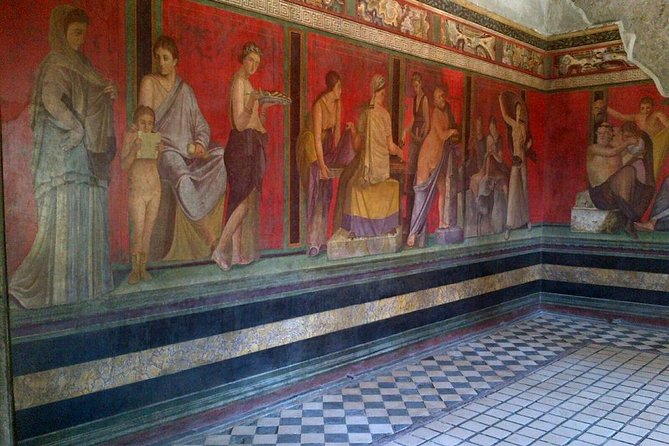
Next up is the Casa dei Vettii, described as a Roman domus buried during the eruption of Vesuvius in 79 and later found through excavations. It is highlighted as one of the greatest examples of Roman art of the first century, named after the name of the owners.
This is the stop that tends to pull you forward with curiosity. A domus is a home, so you get the more personal side of Pompeii. And the guide connects what you see to Roman art of the first century, which is the key point for getting value out of your time here. Without context, you can stand in front of ruins and think, Okay, that was nice. With context, you start asking better questions: what does the decoration suggest, how did the rooms function, and how does it reflect wealth and taste in that era.
Why Casa dei Vettii works so well on a short tour:
- It is specifically called out as top-tier Roman art from the first century.
- The name tied to the owners gives you a hook that makes the space feel less anonymous.
- The story of burial and recovery links the building’s survival to the broader Pompeii timeline.
Possible drawback: domus sites can be busy or visually dense. If you rush, you miss the meaning. This is exactly where a guide pays off. You do not need to become an art historian. You just need someone pointing out what matters so your brain can keep up.
If you want to maximize this stop, slow down for the features your guide calls out most. The time you spend noticing details is usually what turns a “saw a house” moment into an actual memory.
Stop 3: Lupanari Ruins and What They Reveal About Roman Life
The last stop is the lupanari. The name comes from Latin lupa, meaning prostitute. During the Roman period, these were the places dedicated to mercenary sexual pleasure, basically appointment houses or brothels. Some are still visible in the ruins of ancient Pompeii.
This stop is not for everyone’s comfort level, and that is worth saying plainly. If you prefer your sightseeing to avoid adult-theme topics, you might feel awkward here. But if you want Pompeii to feel real, the lupanari is part of that reality.
What I appreciate is that the guide explains it as a historical institution, not scandal for shock value. You get a window into how economic and social life worked in the city. It also helps you understand Pompeii as a complete society, including the uncomfortable parts.
Things to watch for:
- The Latin origin of the name, so you understand the word behind the site.
- The description of how it functioned as an appointment house.
- The fact that some structures remain visible, so you can connect the explanation to physical layout.
A practical note: if you are visiting with kids or you have personal sensitivities, you should consider whether this stop fits your group. The tour includes it, so it is not optional once you are on the route.
Price and Value: What $193.49 Per Group Really Buys
This tour is priced at $193.49 per group, up to 8 people. It lasts about 2 hours 30 minutes and includes a private tour guide.
The big value question is always the entrance ticket. Here, it is not included. Pompeii entrance tickets are Euro 20.00 per person, and the tour notes that it never includes admission in the base price. The operator also states that they buy Pompeii entrance tickets daily to their customers, which is helpful because it reduces your time spent figuring out the ticket process on arrival. Still, you pay the admission fee separately.
How I think about the math:
- Your guided portion costs less per person when you fill the group closer to 8.
- Even at a full group, you still have the Euro 20 per person admission added on top.
- At smaller group sizes, the guided cost per person goes up fast, since the price is per group.
So this tour is usually best when you have a small crowd of friends or family who want to move together with one guide. If you are a solo traveler, this might still be worthwhile for the structure, but the per-person math will likely feel heavier once you add admission.
A final value signal: the rating is high, with 4.9 and a 98% recommendation rate. That points to the guide and route planning being strong for most people, even if the ticket fee remains a separate line item.
Mobile Ticket, English, and the Small Details That Matter
A few details make day-of smoother:
- Offered in English.
- You receive a mobile ticket.
- You get confirmation at booking time.
- Pickup is offered.
- Service animals are allowed.
These are not glamorous, but they reduce friction. In Pompeii, friction becomes time wasted. Mobile tickets help you avoid paper chaos. English helps you actually understand what you are seeing, not just collect photos.
Also, the end of the tour returns you back to the meeting point. That matters if you have a train connection, a scheduled lunch, or a planned ride back toward Naples.
If you want the best experience, do not treat this like a race. Pompeii punishes hurry. The guide can only do so much. Give yourself a little time to absorb each stop, especially Casa dei Vettii, which is where you will benefit most from the context.
Who This Pompeii Tour Fits Best
I think this tour is a good match if you want:
- A short, structured Pompeii visit, not a full-day marathon.
- Expert guidance in English, focused on three key stops.
- A mix of architecture, interior-domestic life, and the lupanari, so you get more of Pompeii’s full social picture.
- A group format that makes sense for up to 8 people.
It may be less ideal if:
- You only want the most famous postcard sites and do not care about how different parts of Roman life fit together.
- Adult-theme content is a hard no for your group, since the lupanari stop is part of the route.
Should You Book This Pompeii Sharing Tour?
Yes, if you want a focused Pompeii outing with a guide who ties what you see to the eruption of 79 and later excavations, and you are okay paying the Euro 20 entrance ticket separately. The route hits three core stops that cover temple life, domestic art, and the lupanari, so you leave with a clearer sense of how Pompeii functioned.
Book with confidence if your top goal is structure and explanation in English for a half-day chunk of time. The strong rating and recommendation rate suggest most people feel the guide portion delivers.
Think twice if you dislike last-minute changes. The tour notes it requires a minimum number of travelers, and if that threshold is not met, it can be canceled, rescheduled, or refunded. If your schedule is tight, build in flexibility.
One more practical point: since this is often booked around 50 days in advance on average, earlier booking is smart. It helps you lock in the time window you want.
FAQ
FAQ
How much does the Pompeii sharing tour cost?
The price is $193.49 per group, up to 8 people.
How long is the tour?
It runs about 2 hours 30 minutes.
Is the Pompeii entrance ticket included in the price?
No. The Pompeii entrance ticket is not included. The tour states an entrance ticket price of Euro 20.00 per person.
What is included in the tour price?
The tour includes a private tour guide.
What is not included?
Not included items are the Pompeii entrance tickets (Euro 20.00 per person) and other personal items like soda/pop tip.
Where is the meeting point?
You meet at Pompei Scavi Villa Dei Misteri, 80045 Pompei, Metropolitan City of Naples, Italy. You will find the guide with the Sharing Tour of Pompei sign.
Is there pickup available?
Pickup is offered. You will still have the meeting point as listed, and the guide will be there with the sign.
What language is the tour in?
The tour is offered in English.
Is this tour private or shared?
Although it is called a sharing tour, the activity description says only your group will participate.
What is the cancellation policy?
Free cancellation is available up to 24 hours in advance for a full refund. The experience may also be canceled if a minimum number of travelers is not met, with an offer for a different date or a full refund.
More Tours in Pompeii
- Pompeii Small Group Tour with an Archaeologist★ 5.0 · 6,593 reviews
- Pompeii and Herculaneum Small Group Tour with an Archaeologist★ 5.0 · 1,350 reviews
- Skip the Line Guided Tour of Pompeii led by an Archaeologist★ 5.0 · 703 reviews
- Pompeii Ticket + Tour with Optional Tasting Experience at Pompeii★ 5.0 · 663 reviews
- Pompeii private tour with an Official Guide★ 5.0 · 631 reviews
More Tour Reviews in Pompeii
- Pompeii Small Group Tour with an Archaeologist★ 5.0 · 6,593 reviews
- Discover the Ancient Ruins of Pompeii: Day Trip from Rome★ 3.5 · 2,247 reviews
- Pompeii and Herculaneum Small Group Tour with an Archaeologist★ 5.0 · 1,350 reviews
- Skip the Line Guided Tour of Pompeii led by an Archaeologist★ 5.0 · 703 reviews
- Pompeii Ticket + Tour with Optional Tasting Experience at Pompeii★ 5.0 · 663 reviews
Sorrento to Pompeii, More Ways
- Skip the Line Guided Tour of Pompeii led by an Archaeologist★ 5.0 · 703 reviews
- Pompeii Tour & Lunch with Wine Tasting Experience★ 5.0 · 383 reviews
- 2 hours Pompeii Tour with Local Historian – Ticket Included★ 5.0 · 335 reviews
- Private Day Tour of Pompeii, Sorrento and Positano with Pick Up★ 5.0 · 110 reviews
- Semi – Private Tour of Pompeii with an Archaeologist★ 5.0 · 99 reviews
More ways into Pompeii Tours from Sorrento.
 ★ 4.8Pompeii: Small-Group Tour of Pompeii and Herculaneum867 reviews
 ★ 4.9Pompeii Ruins Private Tour with Optional Skip-the-Line EntryFrom $254732 reviews
 ★ 4.0Pompeii Ruins Half-Day Tour from Sorrento with GuideFrom $97714 reviews
 ★ 5.0Skip the Line Guided Tour of Pompeii led by an ArchaeologistFrom $95703 reviews
 ★ 4.3Day Tour to Pompeii Ruins and Mount VesuviusFrom $130489 reviews
 ★ 5.0Pompeii Tour & Lunch with Wine Tasting ExperienceFrom $120383 reviews
 ★ 5.02 hours Pompeii Tour with Local Historian – Ticket IncludedFrom $48335 reviews
 ★ 4.5Guided Day Tour of Pompeii and Herculaneum with Light LunchFrom $185311 reviews
Other useful routes from here