
REVIEW · 2-HOUR EXPERIENCES
Pompeii 2h Small-Group Tour with Expert Archaeologist
Pompeii can feel like a blur. This 2-hour small-group walk gives you guided highlights so you can hit the key sights fast, and the pacing stays manageable even with a lot to see. I also like that you get an archaeologist-style interpretation at stops that many people simply rush past.
The only real catch is the usual Pompeii tradeoff: in a short visit, you’ll see the headline areas, not every street corner. Also, heat and crowd flow can change the feel of the tour, so plan for breaks and take it at a steady walking pace.
Key things to know before you go
- A fast, guided Pompeii orientation that helps you understand what you’re looking at, not just where to stand
- Stop-by-stop focus on major sights like the Teatro Grande, baths, the Lupanar, and the Foro
- Tickets are built into the stops, with Pompeii entrance rules noted for special cases
- Small-group style with a max of 30, which can still feel busy at peak moments
- Some guides are especially good with kids, but humor and engagement levels can vary by guide and group
Pompeii in two hours, what you’re really paying for
This tour is priced at $32.67 per person, and the value comes from how tightly it packs guided time into a site that is huge and easy to get lost in. Two hours at Pompeii can either turn into “lots of walking, not much understanding,” or it can become a smart sampler that gives you context for everything you’ll notice on your own afterward.
What you’re buying is a focused route through high-impact zones: theaters, baths, elite homes, and the city’s central square. The guided format matters because Pompeii is not laid out like a tidy museum. It’s a real city footprint, with neighborhoods you can’t fully “read” unless someone points out what the buildings were for.
One more value point: many of the big-ticket sights on this route include admission for that stop, so you’re not juggling separate logistics mid-walk. In short, you’re paying for time saved, context gained, and a route that’s been stress-tested.
Where to meet at Piazza Esedra (and why it’s convenient)
You meet at Ristorante Suisse, Piazza Esedra, 10/13, 80045 Pompei NA, Italy, and the tour ends back at the same meeting point. That round-trip format is helpful in Pompeii because you don’t end up stuck trying to navigate your way out while the crowd crush shifts around you.
The meeting point is also noted as being near public transportation. A review even mentioned the train station is about a five-minute walk away, which is a big deal if you’re connecting from Naples or if you’re trying not to waste your morning on transit stress.
Tip I’d follow: arrive a touch early. In Pompeii, “right on time” can still mean you’re doing a last-second sprint while the group forms.
The route: stop by stop highlights that make sense together
This tour moves through Pompeii in a logical sweep: orientation, public life, entertainment, wealthy homes, everyday routines, then back to the civic center. Each stop is short, so you’ll get an overview, not a slow museum pace.
Here’s what each segment is for, and what to watch for when you’re standing there.
Stop 1: Archaeological Park of Pompeii, the big picture fast (about 10 minutes)
You start in the Archaeological Park of Pompeii. The guide sets the stage on how this Roman city was preserved after the eruption of Mount Vesuvius in 79 AD. In a short format, this opening matters because it gives your brain something to organize everything into.
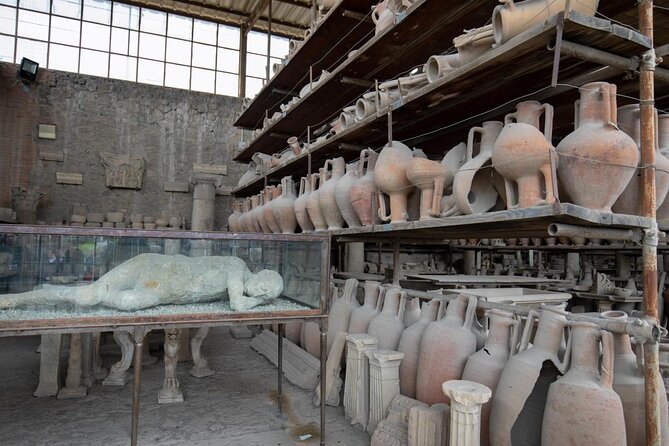
You also get exposure to famous frescoes in the areas your guide highlights. In Pompeii, frescoes are one of the quickest ways to feel the human side of the place, but only if someone explains what you’re seeing and where your attention should land.
Stop 2: Odeon and Teatro Piccolo (about 10 minutes)
Next comes the Odeon, also called Teatro Piccolo. This is where you start to see Pompeii as a city of performance and public gatherings, not just “ruins with columns.”
Even in 10 minutes, the key is learning how theaters fit into daily life: who attended, what they did there, and why the design mattered. If you’re the type who loves architecture, this stop gives you an early win without demanding too much time.
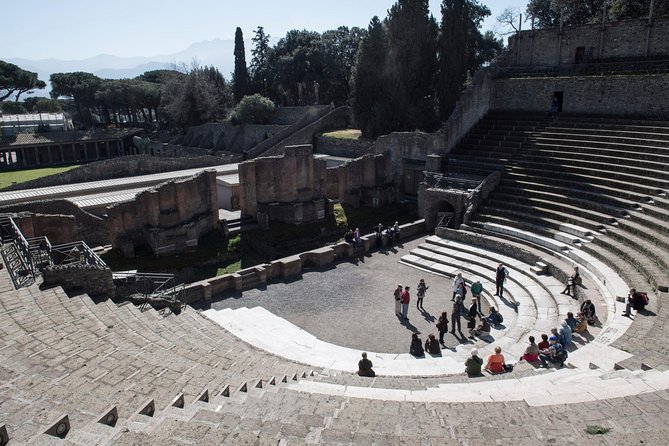
Stop 3: Teatro Grande, the main theater moment (about 15 minutes)
The Teatro Grande is the big one: the most important theater in Pompeii. This is one of those stops where a guided explanation can turn “I see steps” into “I understand the city’s social machine.”
Watch for how the space feels built for viewing crowds, and listen for the guide’s framing of how entertainment was woven into civic identity. It’s a short stop, but it’s one of the most memorable pieces of the route.
Stop 4: House of Menander, elite living in a nutshell (about 15 minutes)
Then you move from public spaces to private wealth at the House of Menander. This house is described as one of the richest and most magnificent homes in Pompeii, with standout architecture, decoration, and contents.
In a two-hour tour, this stop is your reality check that Pompeii wasn’t only about public life. Private homes were loaded with status signals, and the layout often tells you how people moved, hosted, and displayed taste.
Drawback to consider here: if you want deep time in a single villa, 15 minutes may feel rushed. Still, it’s a great “taste” that helps you know what to look for if you return later.
Stop 5: Stabian Baths (Terme Stabiane), the city’s oldest thermal complex (about 15 minutes)
The route then heads to the Stabian Baths (Terme Stabiane), noted as the oldest thermal complex in the city. These baths take up a vast area between key Pompeii street landmarks, which is exactly why a guide helps.
Bathrooms and baths sounds basic until you see the scale and recognize them as social and routine hubs. This stop helps you connect Pompeii to real human habits: bathing, meeting, and lingering as part of everyday life.
Stop 6: Lupanar, the infamous brothel stop (about 10 minutes)
Next is the Lupanar, described as the most famous brothel in Pompeii. This is one of those stops that people either love because it’s so raw and specific, or they’d rather skip if they’re expecting something gentler.
The guide’s job here is not just telling you it was a brothel, but helping you understand what the building’s design communicated in that era. I’d treat this as a short history stop, not a graphic “shock tour.” Pompeii can be intense on its own.
Stop 7: Via dell’Abbondanza, walking the city’s main spine (time not specified)
Then you hit Via dell’Abbondanza, a major street used to understand how Pompeii functioned as a connected urban grid. Even if you’re not getting a long stop here, it helps you recalibrate your sense of scale.
This is where the city starts to “click.” When you walk a main street as part of a planned route, the distances and neighborhoods feel more readable than when you wander randomly.
Stop 8: House of the Faun, a large residence made concrete (about 10 minutes)
The House of the Faun is next, and it’s described as one of the largest and most impressive private residences in Pompeii. A house this big can be visually overwhelming, so a guide’s job is selecting the handful of features that tell the story.
In 10 minutes, you’re not inspecting every corner. You’re learning what makes it exceptional: the layout, the scale, and the impression it gave to anyone who entered.
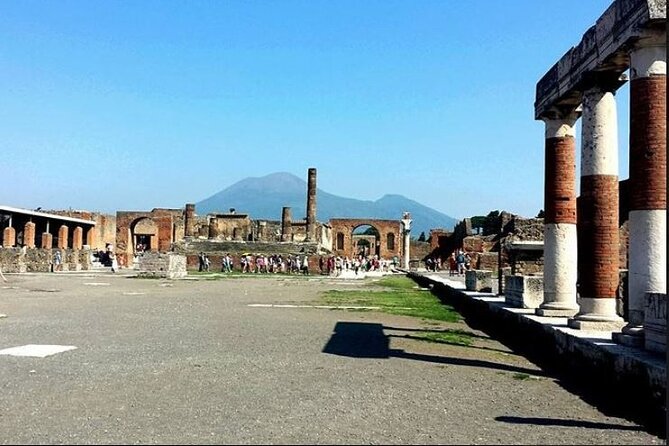
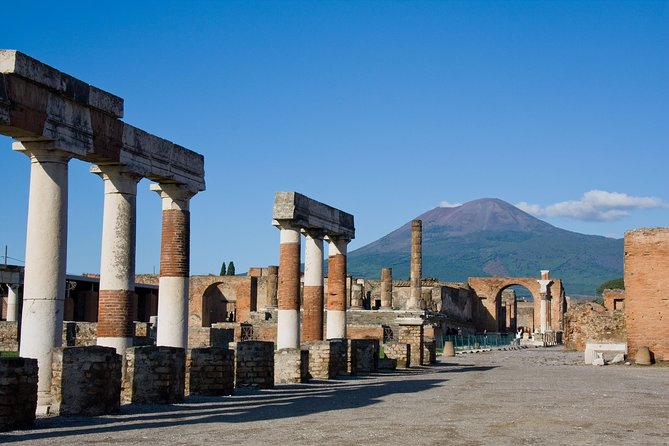
Stop 9: Foro de Pompeya, the main square (about 15 minutes)
Now you return to civic life with the Foro de Pompeya, the ancient main square. This stop is the payoff for everything you’ve been learning about public buildings and community routines.
If you want one place where the city feels most like a place people lived in, it’s often the squares. In Pompeii, forums and civic centers help you connect the dots between theaters, markets, and everyday movement.
Stop 10: Basilica, merchants and sheltering portico life (about 15 minutes)
Finally, the Basilica is an open portico that provided shelter for merchants and other activities. It’s a practical stop, and that’s why it works. You’re learning how people traded, gathered, and moved through covered public space.
This last segment helps you end with a sense of how commerce and daily routine shaped the city. It also gives you an easier mental exit, because you can picture where people went next in a normal day.
Small group energy, and how guides can change your experience
This tour caps at a maximum of 30 travelers, and it also has a minimum of 6. That mix is why the “small-group” label is real but not always the same size you might imagine in your head.
From the experiences tied to this tour, certain guides shine for story delivery and pacing. Names you might encounter include Luca, Roberta, Manuela, Patrizia, Clare, Mafilda, Enzo, Keeva, and Barbara. Many guests praised how these guides kept the tone lively, explained details clearly, and managed the flow so people did not feel trampled.
That said, there’s at least one contrasting experience where a guide did not feel like an archaeologist and the tour felt more like basic facts. That doesn’t mean every guide is the same, but it does mean the guide quality is a key variable for your enjoyment.
Families with kids: when it works best, when to adjust expectations
The tour is marketed as family-friendly, and multiple guide-name examples included kids doing well. Guides like Roberta, Manuela, and Patrizia were praised specifically for being patient and keeping younger visitors engaged.
Still, there’s one important caution from the provided experiences: in at least one case, a guide used humor that landed badly when children were involved. That’s not something you can fully predict, but you can plan smarter.
My practical advice: if you’re traveling with kids, come prepared for a history tour that still needs adult-style explanations sometimes. If your kids need constant hands-on engagement, consider making your own plan for breaks and snack time, and be ready to gently steer the day back on track if they lose interest.
Pompeii heat, crowd flow, and comfort tips that make the day easier
Pompeii is a lot of exposed walking. One review put it plainly: it gets very hot, so plan for the physical reality. Another praised the way a guide adapted by stopping in shaded spots to speak, which is the kind of small adjustment that makes or breaks a two-hour visit.
Here’s what I’d do to keep it enjoyable:
- Dress for sun and uneven stone. Comfortable walking shoes matter more than you think.
- Bring water and take advantage of any shaded stops your guide suggests.
- Move steadily. A moderate pace is part of the expectation, especially since the tour notes moderate physical fitness.
Also, if you’re sensitive to sound or have hearing issues, pay attention to group-size equipment. One experience mentioned audio headsets in a larger-than-expected group, and another person had trouble hearing through the headset. If you need clear audio, it’s worth being proactive about that on-site.
Tickets and the entry rules that can save you money
The itinerary notes admission ticket included for the listed stops. So in most cases, you’re not paying extra entrance fees while you’re with the guide on those segments.
There’s also helpful entry info for special cases:
- Pompeii entrance is free on the first Sunday of each month
- Pompeii entrance is free for people under 18, as long as they show valid ID or passport on the day
If you’re traveling with a teen or you’re visiting on the first Sunday, this tour can become even better value because you can align the free entry rules with the guided stops.
Should you book this Pompeii small-group tour?
Book it if you want a smart two-hour Pompeii orientation and you’d rather spend your time learning what you’re seeing than mapping the site yourself. This tour is a strong match if you’re juggling a tight day, traveling with kids who can handle short attention bursts, or you just want the top “can’t miss” places in a single route.
Consider skipping or pairing it with self-guided time if you:
- Want hours inside one home or one building type without moving on
- Are worried about guide-style humor being a factor with children
- Prefer total freedom over a set route
If you do book, aim to be early at the Piazza Esedra meeting point, dress for heat, and treat it as a highlights tour with context. Two hours is short, but with the right guide, it’s long enough to make Pompeii feel real instead of random.
FAQ
How long is the Pompeii tour?
It’s about 2 hours.
Is the tour offered in English?
Yes, it’s offered in English.
What is included with the tour ticket?
The itinerary notes admission tickets included for the listed stops.
Where does the tour start and end?
It starts at Ristorante Suisse, Piazza Esedra, 10/13, 80045 Pompei NA, Italy, and ends back at the meeting point.
How big is the group?
There is a maximum of 30 travelers. There is also a minimum number of 6 people per tour.
Is the tour family-friendly?
Yes, it’s described as family-friendly, so kids can stay engaged during the visit.
What physical level is needed?
The tour requires a moderate physical fitness level.
Are there special rules for free Pompeii entry?
Yes. Pompeii entrance is free on the first Sunday of each month, and it is free for people under 18 if they show valid ID or a passport.
How does cancellation work?
Free cancellation is available up to 24 hours in advance for a full refund. If you cancel less than 24 hours before the start, the amount paid is not refunded.
Do I receive a ticket on my phone?
Yes, you get a mobile ticket.
More 2-Hour Experiences in Pompeii
- 2 hours Pompeii Tour with Local Historian – Ticket Included★ 5.0 · 335 reviews
- Pompeii: 2 Hour Private Tour with an Archeologist Guide★ 5.0 · 214 reviews
- Pompeii 2-hour Private Tour with an Archaeologist-Ticket included★ 5.0 · 181 reviews
- 2 Hours Private Tour in Pompeii with Archaeologist★ 5.0 · 123 reviews
- Explore Pompeii: 2-Hour Guided Walking Tour with Included Ticket★ 4.5 · 77 reviews
More Tours in Pompeii
- Pompeii Small Group Tour with an Archaeologist★ 5.0 · 6,593 reviews
- Pompeii and Herculaneum Small Group Tour with an Archaeologist★ 5.0 · 1,350 reviews
- Skip the Line Guided Tour of Pompeii led by an Archaeologist★ 5.0 · 703 reviews
- Pompeii Ticket + Tour with Optional Tasting Experience at Pompeii★ 5.0 · 663 reviews
- Pompeii private tour with an Official Guide★ 5.0 · 631 reviews
More Tour Reviews in Pompeii
- Pompeii Small Group Tour with an Archaeologist★ 5.0 · 6,593 reviews
- Discover the Ancient Ruins of Pompeii: Day Trip from Rome★ 3.5 · 2,247 reviews
- Pompeii and Herculaneum Small Group Tour with an Archaeologist★ 5.0 · 1,350 reviews
- Skip the Line Guided Tour of Pompeii led by an Archaeologist★ 5.0 · 703 reviews
- Pompeii Ticket + Tour with Optional Tasting Experience at Pompeii★ 5.0 · 663 reviews
More ways into 2-Hour Experiences.
 ★ 5.02 hours Pompeii Tour with Local Historian – Ticket IncludedFrom $48335 reviews
 ★ 4.8Capri: 2-Hour Boat Tour with Happy HourFrom $105286 reviews
 ★ 5.0Pompeii: 2 Hour Private Tour with an Archeologist GuideFrom $193214 reviews
 ★ 5.0Pompeii 2-hour Private Tour with an Archaeologist-Ticket includedFrom $214181 reviews
 ★ 4.9Pompeii: 2-Hour Guided Tour with an ArchaeologistFrom $175151 reviews
 ★ 4.9Herculaneum 2-Hour Private Guided TourFrom $283139 reviews
 ★ 5.02 Hours Private Tour in Pompeii with ArchaeologistFrom $267123 reviews
 ★ 4.9Pompeii 2-Hour Private TourFrom $181121 reviews
Other useful routes from here