
REVIEW · POSITANO TOURS
Private Skip-the-Line Pompeii & Mt. Vesuvius Tour from Positano
Pompeii, then a volcano crater. This full-day private outing from Positano pairs skip-the-line access to Pompeii with a hike to Vesuvius’s rim, plus a guide who turns ruins into real daily life.
What I like most is the hands-on pacing: you see the big Pompeii sites in a logical route, from the Forum to the Stabian Baths. You also get real time on Vesuvius for panorama views, not just a quick photo stop.
The one drawback to plan for is the physical side: even with the route chosen for highlights, it is still a long walking day on uneven ground, and the Vesuvius climb can be challenging in heat.
Key things you’ll notice on this tour
- Door-to-door pickup from Positano (or a nearby meeting point if your hotel is tricky for vehicles)
- Priority access designed to help you avoid the worst ticket-line headaches
- Guided Pompeii route that hits the Forum, baths, theater, and major houses
- Crater-edge access on Vesuvius, including time at the rim for real views
- A full-day schedule that mixes structured guiding with time to grab food and look around
Door-to-door Positano pickup that keeps your day sane
Positano is dramatic, steep, and not built for easy bus access. The biggest practical win here is that your day starts with pickup from your accommodation when a vehicle can reach it. If not, you meet at the closest convenient point. Either way, you avoid the puzzle of matching transit times and transfers while you are tired from travel and carrying a day bag.
The tour also runs with an English-speaking driver plus a licensed private guide for Pompeii. That combination matters in two ways. First, you get smooth transfers in and out of the Bay of Naples area. Second, the guide handles the interpretation so you are not stuck guessing what you are looking at.
Expect a long but straightforward rhythm: travel to Pompeii, guided time through key ruins, then a move to Vesuvius for the crater rim and views, and finally a return to Positano by private vehicle. It is built for people who want one excellent day instead of half a dozen complicated “maybe” plans.
Pompeii’s highlights, from Forum politics to everyday streets
Pompeii is huge. Even with a guided route, you are not seeing everything, and that is not a flaw. It is a reality check. You are there for a concentrated walk through the city’s most meaningful sections, so you can understand how Pompeii functioned as a Roman city, not just as scattered walls.
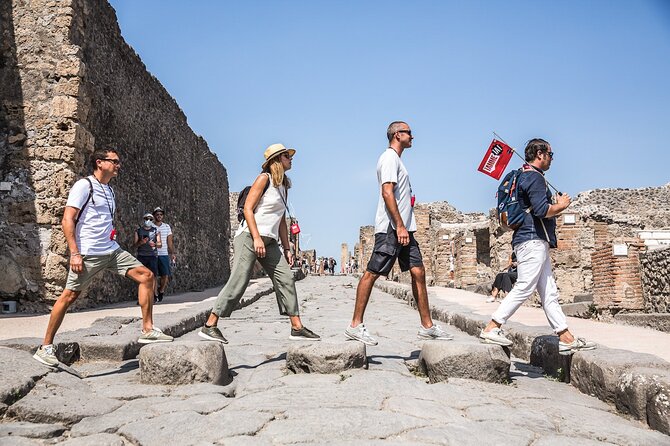
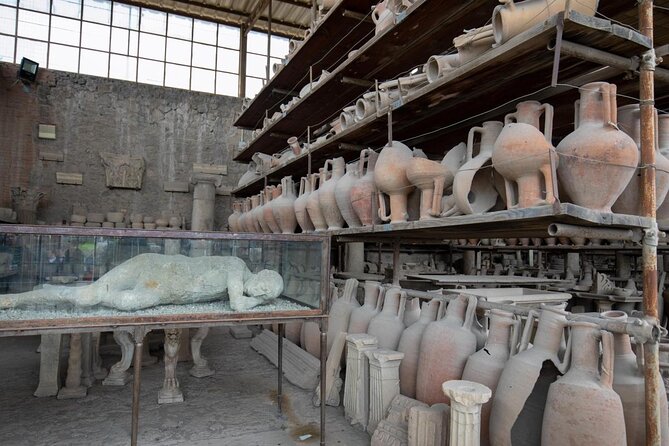
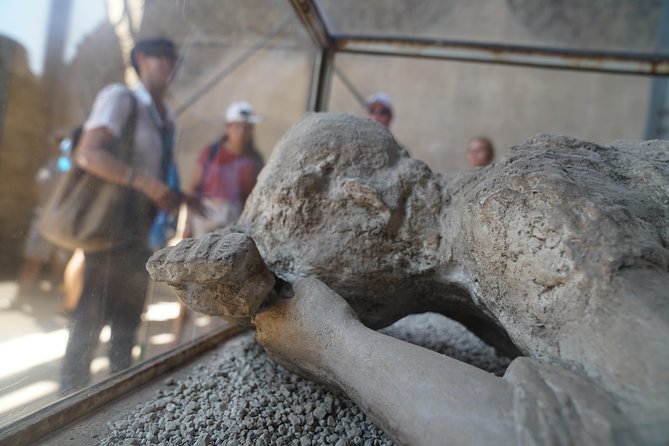
Once you arrive, priority access helps you get into the site efficiently. Then the guiding begins with the Archaeological Park of Pompeii, where you learn why this city is so well preserved. In 79 A.D., Mount Vesuvius erupted and buried Pompeii under meters of ash and pumice. Today, you walk streets and buildings that survived because the disaster acted like a time capsule.
The day’s pacing gives you a guided “spine” through the highlights:
- You start with the main site orientation.
- You hit the Forum quickly, then move outward to buildings that show politics, religion, commerce, and entertainment.
- You end Pompeii with a short leap toward the sites that explain private life and public spectacles, then you shift gears to Vesuvius.
Foro de Pompeya, the city’s workroom and decision center
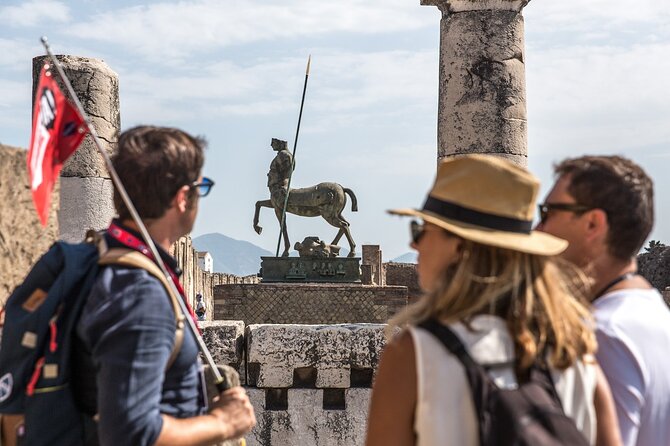
In the Forum, you see how Pompeii’s power and economy mixed. The Forum sat in the center and served as a thriving market and trade area, but it also connected directly to politics. In plain terms, people did business here and also handled civic decisions here.
You get a short stop, about 10 minutes, but it is timed to connect the dots. After you learn what the Forum meant, the later stops make more sense, because you can place each building within daily routines.
Tempio di Giove Capitolino, religion with big sightlines
Next comes the Tempio di Giove Capitolino, the Capitolium. The key idea is location and visibility: statues of Jupiter, Juno, and Minerva were set high so passersby in the Forum could see them. That detail is a reminder that religion in Rome was public, not private.
This stop is brief, about 10 minutes, but it is useful if you want to understand why architecture and power were linked. Even the way statues are placed tells you something about who the city was trying to impress.
The Macellum and Via dell’Abbondanza, where food and noise met
Two stops help you understand the “everyday Pompeii” feeling.
The Macellum was the provision market tied to the Forum. It was built in phases, and it suffered damage in the earthquake of 62 A.D. That earthquake matters because it shows the city did not freeze in time the moment disaster struck in 79 A.D. It was already unstable, already stressed.
Then you walk through Via dell’Abbondanza, Pompeii’s main street, also called a decumanus maximus. It ran east to west from the Forum toward the Porta Sarno. This street was crowded and noisy in ancient times, with shops, workshops (officinae), cafés, snack-bars, and places to eat. If you have ever wondered what a Roman street “felt” like, this is the stop that brings sound and motion back into the ruins, even though you are standing still in 2026.
Stabian Baths, the social plumbing of Roman life
Terme Stabiane, also called the Stabian Baths, sits behind the Temple of Jupiter. These baths date to the years after the founding of the colony of veterans by General Sulla in 80 B.C., which means the city’s earlier Roman roots show up here.
What I like is the clear layout. Women’s and men’s areas had separate entrances. The men’s section includes spaces like the apodyterium for undressing, plus areas for medium temperature baths, cold baths, and hot baths. The stop is short, but you come away with a functional understanding of how bathing was part of daily routine and social life.
The ruins are heavily damaged from the 62 A.D. earthquake, so you can see how repeated shocks shaped what survived into the final eruption.
Lupanar, private life with uncomfortable wall art
The Lupanar of Pompeii, the famous brothel, is often one of the most talked-about stops. It is specifically interesting for the erotic paintings on its walls.
This is not everyone’s favorite subject, but it is historically important. It reminds you Pompeii had a whole spectrum of occupations and behaviors, including those that modern people prefer to ignore. If you want Pompeii to feel complete, this stop adds the part that is not glamorous.
Casa del Fauno, wealth, power, and floor art
Casa del Fauno is one of Pompeii’s largest and most luxurious residences. It occupies an entire city block, and it is known for its bronze statue of a dancing faun, which gives the house its name.
The highlight here is the Alexander Mosaic, a famous floor mosaic depicting the battle between Alexander the Great and Darius III. It also connects to family and status, since the house belonged to Quintus Poppaeus Sabinus of the Poppei family, relatives of Empress Poppea Sabina, Nero’s second wife. Even if you do not care about noble family connections, the takeaway is clear: Pompeii’s elites spent money on art and architecture, and they made it part of their status display.
Teatro Grande and Basilica, public entertainment and civic business
The Teatro Grande shows the Romans using landscape features. Built on a slope, it uses the natural depression of the hill to create a theater with sectors and impressive seating. You learn that tragedies were performed from Greco-Roman traditions.
Then the Basilica brings you back to the Forum’s center of business and justice. This building was the administrative space for transactions and legal matters, so it anchors what “politics” and “commerce” really meant in everyday terms.
A quick note on timing: 2 hours in Pompeii is a sprint, not a stroll
You get around two hours at Pompeii overall before the day shifts toward Vesuvius. That is enough for highlights, but not enough for full exploration. If you want to slow down at particular rooms or read every side note, you might feel rushed. For most first-timers, though, the guide’s route is the point, because it helps you see what matters without getting lost in the scale.
Also, Pompeii can be hot with limited shade. Bring sun protection and water. If you have knee issues, consider good walking shoes and plan to take short breaks when you can.
Mount Vesuvius, named after Vulcan, hiked for real views
After Pompeii, you head to Vesuvius National Park. The timing here is built around giving you both the crater rim and a broader viewpoint experience.
You first reach the crater’s edge at about 1,280 meters. This part is short but intense. The path surface is uneven, so your footing matters. The reward is a panoramic view over the Gulf of Naples, the coastline, and the volcanic terrain that ties the whole Pompeii story together.
Then there is a drop-off around 1,000 meters for additional time to explore and take in the volcano surroundings for about an hour. That split schedule makes sense: crater-edge time for the “wow” moment, then more wandering for the big picture.
A few useful context points you’ll hear from the guide:
- Vesuvius is a somma-stratovolcano with Monte Somma attached.
- The eruption in 79 A.D. destroyed Pompeii and Herculaneum.
- The volcano was named after Vulcan, the Roman god associated with flame and metal forging.
- Scientists monitor activity 24/7, and the general consensus shared during tours is that a future eruption is overdue and could be major.
One very practical tip: bring a jacket or warmer layer for the upper elevation. Even if the morning in Positano is warm, the crater rim can feel chilly. You do not want to be shivering while you are trying to take in the view.
Also, the climb is uneven and can feel steep, depending on your fitness. Comfortable shoes are not optional. If you are unsure, take your time on the ascent and treat it like a careful hike rather than a race to the top.
Food breaks, what to plan for when lunch is not included
Lunch is not included. That means you need to plan for a meal either during your free time between Pompeii and Vesuvius or at the stop areas near Vesuvius.
This tour structure is flexible enough that you can choose what works for your budget and hunger level. In practice, you should expect a period where you can eat something before heading up the volcano.
My advice is simple: keep lunch light if you are hiking soon after. On a hot day, heavy food and alcohol can make the climb harder. And even if you are feeling fine, dehydration sneaks up fast. Water and pacing matter on the uneven parts of the trail.
Drivers and guides make or break the day
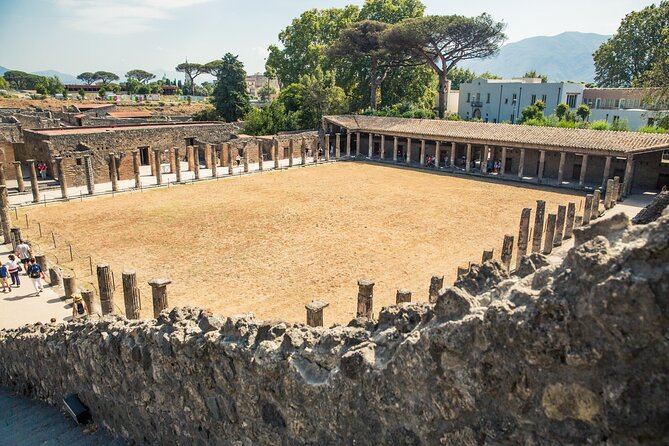
This experience is sold on two big promises: guidance at Pompeii and access that reduces the worst waiting. The human factor is what turns it from a checklist into a memory.
I’ve seen the day work especially well when the Pompeii guide is energetic and hands you a story. Names that have shown up with strong praise include Monica, Carmine, Roberta, Carmela, Daniela, Annalisa, Rose, Hugo, and Gennaro. Common themes in how those guides work: they connect buildings to Roman life, they answer questions, and they plan the route so you do not spend all your time in one tiny corner.
Drivers also matter, especially with Positano traffic and the steep road approach. Luigi, Fabio, Salvatore, Carlo, and others have been praised for getting people safely to the sites on time and keeping the ride comfortable. That matters because you want your energy for walking, not for stress.
If you care a lot about certain Pompeii areas, speak up early. A good guide can often adjust the pacing within the constraints of a full-day schedule.
Price, value, and who this tour is really for
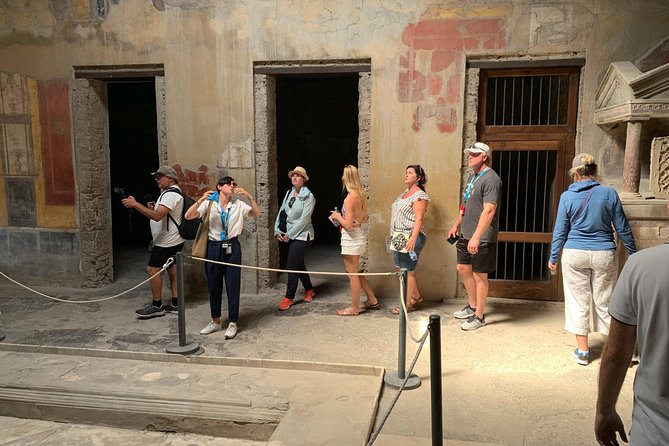
At $750.91 per person, this is not a budget day trip. You are paying for private round-trip transportation, a licensed private Pompeii guide, priority access, and admission to both Pompeii and Vesuvius (plus the Vesuvius entrance ticket). In other words, the price is not just “getting there.” It is paying for saved time, reduced hassle, and expert interpretation.
So the value question becomes: will you use all of that? If you only want to see Pompeii with minimal walking and minimal talking, you might not get your money’s worth. If you want a guided highlights route and a crater-edge hike without ticket-line stress, the pricing starts to feel fair.
This tour fits best if you are:
- First-time visitors who want the Pompeii essentials done properly
- People who dislike coordinating transfers and would rather let someone handle the driving
- History-minded travelers who enjoy architecture, street life, and how Roman civic spaces worked
- Active travelers comfortable with a few hours of walking plus an uneven hike on Vesuvius
It may not be ideal if you:
- Want to wander Pompeii slowly for half a day or more without a set route
- Have limited mobility or difficulty with uneven ground
- Expect the volcano climb to be easy, because it is a real hike to the crater rim
Should you book this Pompeii and Vesuvius tour from Positano?
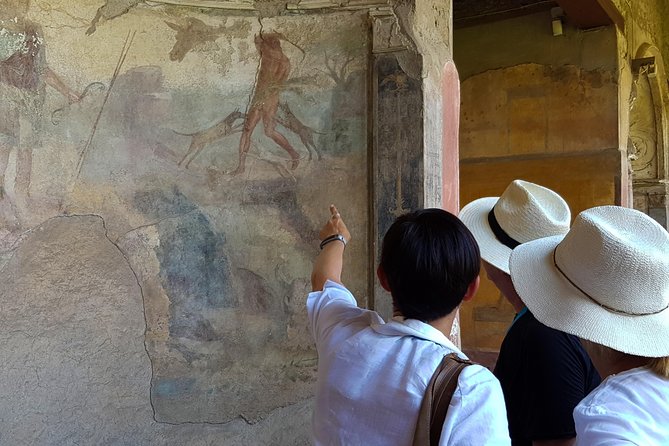
If your priority is seeing Pompeii and Vesuvius in one smooth, guided day, I think this is an excellent choice. The biggest strengths are the private pickup approach, the priority access that helps reduce time lost to lines, and the fact that Pompeii is guided with stops that explain how the city worked, not just what it looked like.
Book it if you can handle walking on uneven surfaces and you want a structured highlights route with time on the crater rim. Bring good shoes, water, sun protection, and a warmer layer for Vesuvius.
Skip it, or look for an alternative, if you want a slower, deeper self-paced Pompeii visit where you choose every stop for yourself. Pompeii deserves it, but this tour is built for focus, not endless wandering.
FAQ
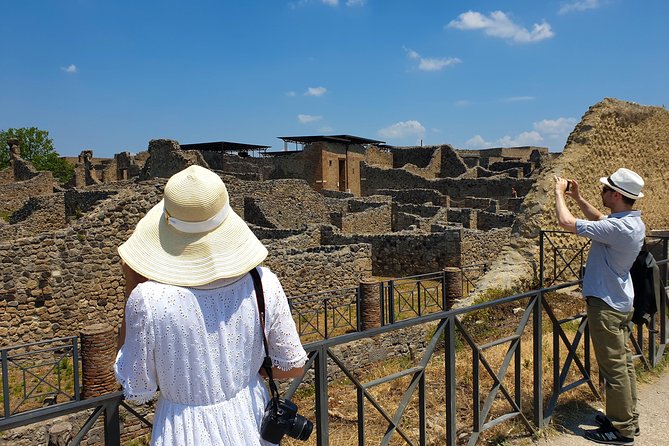
How long is the Pompeii and Mount Vesuvius tour?
The tour runs about 8 hours.
Is pickup from my hotel included?
Pickup is offered door-to-door if your accommodation is reachable by vehicle. If it is not reachable, you will meet at the closest meeting point.
Does the tour include tickets for Pompeii and Vesuvius?
Yes. Priority access is included for Pompeii and Mount Vesuvius National Park, and the Mount Vesuvius entrance ticket is included.
Is lunch included?
No. Lunch is not included.
Is this a private tour?
Yes. It is a private tour, meaning only your group will participate.
What happens if Mount Vesuvius is closed due to bad weather?
If Vesuvius is closed due to bad weather, there is a refund of the entrance fees for the volcano.
What should I bring for the Vesuvius hike?
Wear comfortable shoes for an uneven path and consider bringing a jacket, since it can be chilly at higher elevation.
Up the Volcano from Sorrento
- Amalfi Coast: Pompei & Vesuvius small group with Skip the line tickets★ 4.5 · 71 reviews
- Enjoy Pompeii & Mt. Vesuvius: Semi-Private Tour from Positano★ 5.0 · 65 reviews
- Pompeii & Vesuvius with Lunch & Wine Tasting from Positano★ 4.5 · 58 reviews
- Pompeii & Vesuvius with Lunch & Wine Tasting from Amalfi Coast★ 5.0 · 36 reviews
- One day excursion to Pompeii and Vesuvius from Positano★ 5.0 · 9 reviews
More Paths into Positano
- Private Amalfi Coast Boat Trip from Positano, Praiano or Amalfi★ 5.0 · 431 reviews
- Small Group Day Trip to Capri from Positano or Praiano★ 4.5 · 354 reviews
- From Positano: Sorrento Coast & Capri Full-Day Trip by Boat★ 4.7 · 340 reviews
- Very Small Group Capri Boat Excursion with Transfer from Positano★ 4.5 · 334 reviews
- From Positano, Praiano, or Amalfi: Capri Full-Day Boat Tour★ 4.5 · 318 reviews
More ways into Positano Tours.
 ★ 4.6From Naples: Sorrento, Positano and Amalfi Full-Day TourFrom $10710,988 reviews
 ★ 5.0From Naples: Sorrento, Positano & Amalfi Coast – Small Group TourFrom $768,643 reviews
 ★ 4.8From Naples: Premium Tour of Sorrento, Positano, AmalfiFrom $853,606 reviews
 ★ 4.6From Sorrento/Nerano: Amalfi and Positano Boat TourFrom $702,440 reviews
 ★ 4.5Day Trip to Positano, Amalfi & Ravello from SorrentoFrom $1312,371 reviews
 ★ 4.7From Naples/Salerno: Group Tour to Positano, Amalfi, RavelloFrom $1012,033 reviews
 ★ 4.9Positano and Amalfi Boat Trip with TransferFrom $1741,598 reviews
 ★ 4.0Positano and Amalfi Day CruiseFrom $621,500 reviews
Other useful routes from here