
REVIEW · AMALFI COAST TOURS
Pompeii & Amalfi Coast Private Tour: Archaeologist-led, Flexible
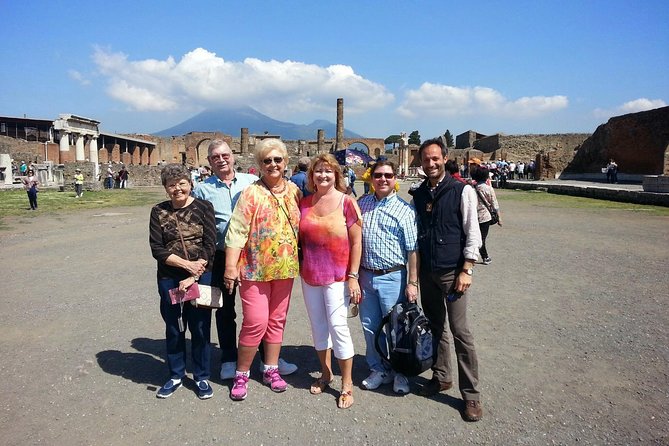
Pompeii feels personal when Fabrizio guides you. This private day pairs archaeologist-led explanations with a pace you can actually control, so the ruins stop feeling like a checklist. I especially liked the way Fabrizio connects the Forum and villas to daily Roman life, and I also loved how the Amalfi half can be tuned to your group. The main drawback is simply time and walking, Pompeii is big and you should plan for a fair amount of steps.
What makes this tour work is the mix of comfort and freedom. You get pickup from Naples or Sorrento (and sometimes Positano or Pompeii), then you travel by private car with bottled water and WiFi on board. Then you spend the day with a guide in Pompeii, followed by scenic coastline drives and town stops that keep changing based on what you want most.
Key things that make this tour a smart pick
- Fabrizio’s archaeological perspective turns Pompeii from pretty ruins into real everyday stories.
- Flexible Amalfi Coast routing means you are not stuck doing only the biggest-name stops.
- Private transport with hotel-area pickup saves stress, especially if you are coming from Naples.
- Great for families and mixed ages, since pacing is adjusted on the fly.
- Lunch support for dietary needs was specifically mentioned, including gluten free options when possible.
- Skip-the-line Pompeii entry can be included if you choose the ticket option at booking.
How the private day runs from Sorrento, Naples, or the port
This is a private tour, so it is just your group, not a mixed crowd. The day runs about 8 to 9 hours, which is long enough to see Pompeii properly and still enjoy Amalfi Coast scenery, but short enough that you should keep expectations realistic about how much you can walk.
Pickup is a big part of the value here. You can meet Fabrizio in Naples, Sorrento, Positano, or Pompeii, including at the port, airport, or railways in Naples. If you want to start in Amalfi or Ravello, it is possible but costs extra, so I’d plan that only if you are already staying down there.
Behind the wheel, you are covered with private transportation and a backup driver is sometimes involved for larger groups. The reviews make it clear that the team focuses on staying on schedule without rushing you through Pompeii’s key areas.
Pompeii’s big hits: Porta Marina, the Basilica, and the Forum
Pompeii is stunningly preserved, and that is the foundation for everything else you will do. The eruption buried the city under soft volcanic debris, which helped keep street levels, building interiors, and architectural details in place. Fabrizio leans on that advantage, so you get explanations that feel grounded in what you can literally see.
The tour usually starts with the cinematic entrance through Porta Marina, a gateway that funnels you straight into Pompeii’s central drama. It is a great way to begin, because you get context first, then you step into the city’s core like you are arriving in real time.
Next comes the Basilica, Pompeii’s legal and commercial heart. You walk through the massive interior and the guide points out how civic power worked, including the raised podium where magistrates handled disputes. You also see the physical scale of the 28 columns that once supported the roof, and it makes the whole building feel less like a ruin and more like infrastructure.
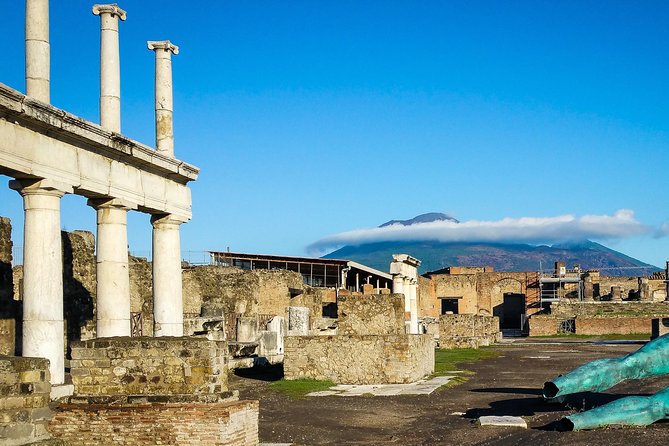
Then you hit the Forum, Pompeii’s pedestrian hub. This is where the city’s religious, political, and commercial life collided. The paving stones under your feet matter here, because the Forum is the place where you sense how Romans gathered for speeches and markets, with Mount Vesuvius framed in the background.
One practical note: Pompeii admission is not automatically included. If you choose the ticket-included option at booking, you may get skip-the-line entry for Pompeii. If you do not, Pompeii tickets cost €19 per person (kids free), and you will handle that yourself.
Pompeii’s daily life tour: Baths, markets, the House of the Vettii, and more
The best Pompeii tours do not just stop at the famous “big monuments.” This one keeps pulling you toward daily life, and that is why it gets such strong praise.
A highlight is the Forum Baths, which let you follow the bathing routine like a circuit. You can see the changing area, cold and warm rooms, and the hot room powered by a hypocaust system that pushed hot air through hollow walls. It is one of those places where you understand Roman comfort by watching how the architecture controlled heat and movement.
The Macellum is another smart stop because it shows how food and commerce worked. You get the sense of an official covered market, with shop spaces around a central structure. Fabrizio also points out weight-checking stone tables used by officials, which is a small detail that makes the whole economy feel real, not academic.
Then there is the famous Casa dei Vettii, often treated as Pompeii’s showpiece for wall painting. The guide helps you read the frescoes in context, including the restored appearance and what the home’s owners’ story tells you about social mobility. The peristyle garden, with fountain statuary and the layout, also does a lot of work for your imagination.
You also get street-level “food culture,” including the Thermopolium. It is basically an ancient counter for quick meals, and the preservation makes it memorable. You can peer into the dolia storage jars, and the frescoes on the counter walls help you understand how visuals acted like a menu.
If you are lucky and the timing works, you may also walk through newer-feeling areas like the Insula dei Casti Amanti, where elevated walkways let you look down into active excavations. That angle matters, because it reminds you that Pompeii is not frozen history, it is still being uncovered.
Teatro Grande and the Antiquarium: how museum time makes the ruins hit harder
Even with a guide, Pompeii can feel like a series of locations unless someone stitches the story together. This tour uses the Antiquarium di Pompei to do that work, and it is a very good move with this itinerary.
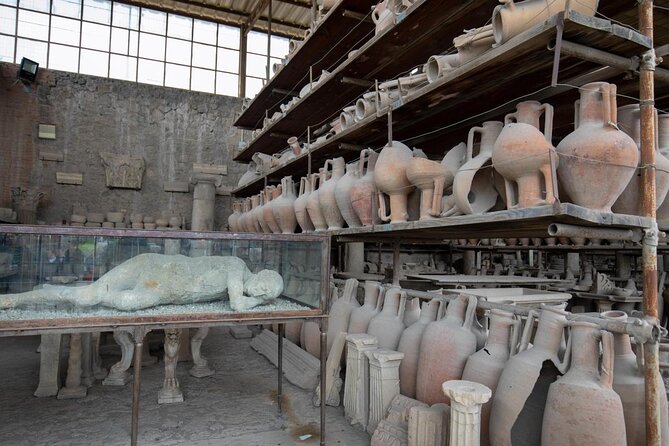
The Antiquarium is modern and air-conditioned, which is a real comfort advantage when the summer heat is brutal. It houses the most fragile treasures and, most importantly, the plaster casts of victims and animals. Seeing those casts after you have walked the streets makes the tragedy feel more human and less abstract.
Then you may end at Teatro Grande, an early stone theater that shows Roman social structure. You can see the horseshoe shape and how seating tiers relate to status. The acoustics are famous, and even if you do not test them, the building’s design helps you feel how performance and hierarchy were tied together.
If you like architecture, you’ll also appreciate how the theater’s setting with hills and Vesuvius in the distance changes your perception. It is not just a ruin, it is a stage set, and that helps Pompeii land emotionally.
SS 145 to Sorrento: the scenic reset before Amalfi town time

Once Pompeii is done, you shift gears fast. The drive along SS 145 Sorrentina is one of the best “breather” parts of the day because it is about viewpoints, not museum pace.
This coastal route threads along cliffs with sweeping curves, tunnels, and bridges, and you get framed views of the Bay of Naples, Vesuvius across the water, and hill towns like Vico Equense and Meta. The lemon groves and watchtowers keep it from feeling like you are just passing time in a car.
Sorrento usually comes next for a stop that feels like a proper restart. You get time to walk in the centro storico, with landmarks like Piazza Tasso and the calmer viewpoint areas around Villa Comunale. You can also head toward Marina Grande for seafood if that is your mood.
In real life, this Sorrento pause helps you stay sane. It breaks the day into two halves, ruins first, then coastline towns, and it gives you a place to snack, stretch, and reset your energy.
The Amalfi Coast road, Positano, and Amalfi’s old power center
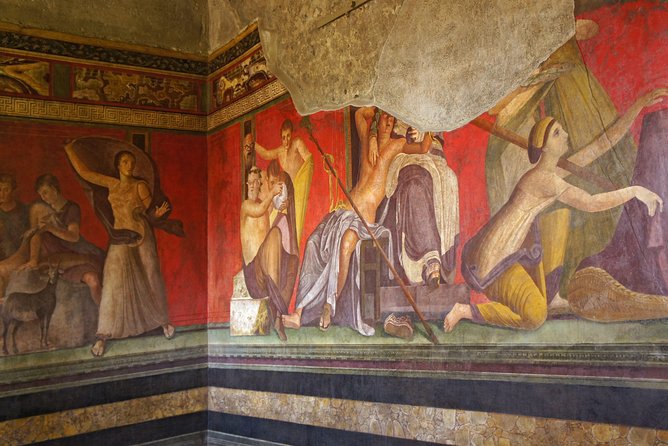
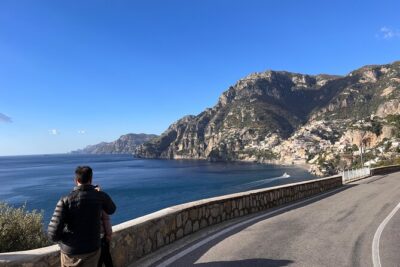
From Sorrento, you typically take the legendary SS 163 Amalfi Drive, the winding road carved into rock with cliff-hugging curves. It is thrilling by design, and the goal is to get the views without turning the whole day into motion sickness. Plan to sit where you can see the sea best, and keep your camera ready for quick pull-offs.
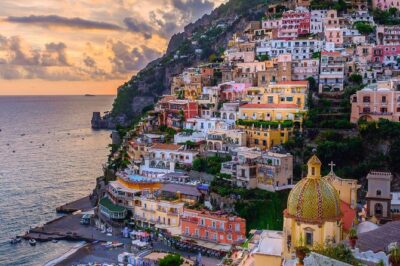
Then it is town time, usually with Positano first. Positano’s vertical layout is the whole point. You wander narrow lanes with shops and gardens, and you get the iconic Church of Santa Maria Assunta domed silhouette as a visual anchor. This is also where you can soak in that “arrive somewhere special” feeling, even if you only have a short walk.
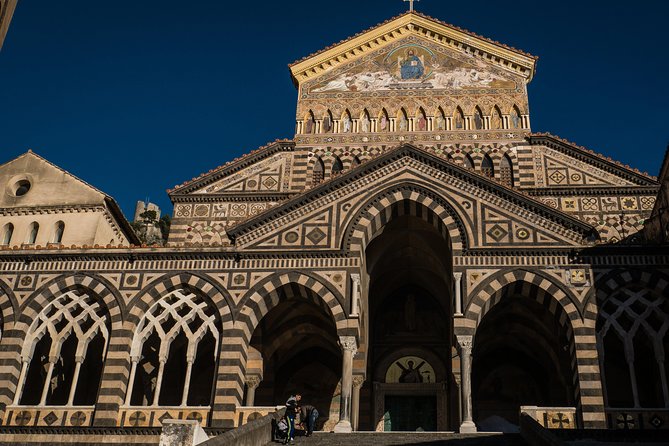
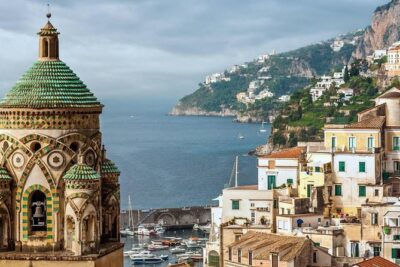
Next is Amalfi, which is more than postcard scenery. The cathedral square anchors the town, and the Duomo di Sant’Andrea is the big visual payoff with its striped facade, the staircase up to the church, and its layered interior influences. If you want history that is tied to power, seafaring, and changing styles over centuries, Amalfi delivers.
A quick practical tip: towns on the Amalfi Coast can move at a slower pace than you expect because of stairs and tight streets. This is where having a guide who can adjust the order and walking time is actually valuable.
Ravello and Villa Cimbrone gardens: the quieter heights
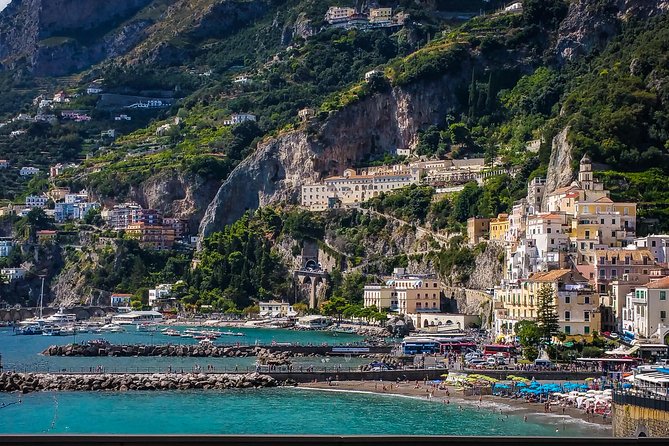
If the day includes Ravello, you get a different vibe from Positano and Amalfi. Ravello sits higher above the water, and the effect is immediate once you are there. It feels more relaxed, with medieval streets and a calmer sense of space.
The crown-jewel stop is typically Villa Cimbrone Gardens. The headliner is the Terrace of Infinity, the famous viewpoint lined with marble busts. Even if you’ve seen photos, it hits differently when you’re physically there, looking down across the coast.
Ravello is also a smart choice if your group wants one “wow” stop that is not a crowded promenade. In a day that includes Pompeii and multiple coastal towns, that quieter altitude can feel like a reward.
The flexible extra stops: Minori, Maiori, Erchie, and Vietri sul Mare
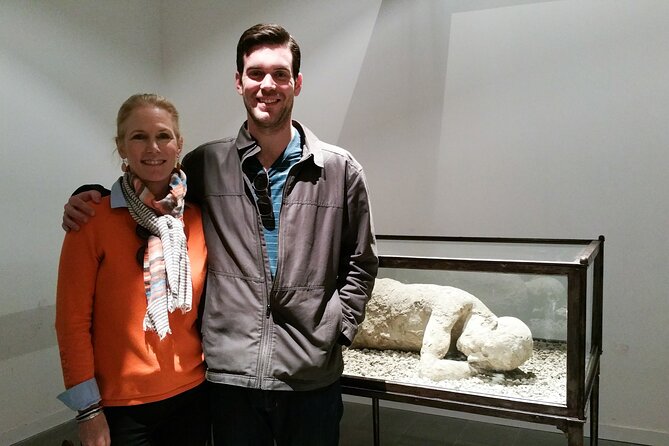
One reason people love this tour is that the itinerary can be customized. Depending on timing and your preferences, the schedule can extend beyond the headline towns.
You might add Minori, known for a calmer feel and food-focused culture, with the Sal De Riso pastry shop often mentioned in that context. Maiori can also fit, especially if your group wants a longer sandy stretch and a palm-lined promenade that is easier to move through than the steep towns.
For something more low-key, there is Erchie, described as a tucked-away fishing hamlet with clear water and a beach that feels sheltered from heavy winds. It is the kind of stop you’d choose when you want less crowds and more swimming or simple downtime.
Then there is Vietri sul Mare, the ceramics and craft gateway. It adds a different kind of souvenir hunt, with bright pottery colors and the major domed church covered in majolica tiles.
These extra stops are not guaranteed every day in the details you were given, but the flexible promise means you can steer the coastline portion toward your group’s style, food, photos, or quiet time.
Pacing, heat, and how to make the day feel smooth
With a day this packed, pacing is the make-or-break. The good news is that Fabrizio clearly adjusts in real time, including for families with young kids and multi-generational groups.
One useful scheduling tip that came up: consider doing Pompeii in the afternoon if heat is a concern. There was a specific suggestion that the breeze tends to pick up later, and following that advice can make walking feel more manageable.
For you, that means pack for Pompeii like it is a long outdoor walk, even if you are not spending all day outdoors. Comfortable shoes matter, and bring sun protection. The Antiquarium helps you cool down, so timing that museum segment wisely can keep you from hitting a wall.
Also, because this is Pompeii first, your stamina will matter most there. The tour is not recommended for people with walking issues, and with Pompeii’s size, you should be honest about your group’s comfort level.
Price and value: what $540.66 gets you, and what costs extra
The price is $540.66 per person. That number is high compared to group tours, but value is not only about the guide. Here you are paying for a private guide experience in Pompeii, private transport with pickup and drop-off, and on-board basics like bottled water and WiFi.
You are also paying for flexibility, which is hard to quantify until you need it. In practice, that flexibility showed up as customized stops, help choosing lunch, and dietary support, including gluten free pasta in one case.
What you should budget for separately is Pompeii admission if you did not select the ticket-included option, plus lunch. Lunch is not included, and Fabrizio helps you choose from the options that work for your group, including special dietary needs when feasible.
If you are traveling with kids, two grandparents, or a group where everyone’s interests differ, a private format like this can feel like the only way to keep everyone happy without losing your whole day to mismatched pacing.
Who this private day is best for
I’d put this tour at the top of your list if you want Pompeii with real context, not just moving from photo spot to photo spot. The archaeologist-led approach works well if you like architecture, daily-life details, and historical connections between ruins and how people lived.
It also suits groups that need practical adjustments. The guide’s style is described as engaging, patient, and careful about keeping everyone on track while still letting you choose the rhythm.
If your group has limited mobility or you know Pompeii walking is a problem, this is not your best fit. The tour specifically says it is not recommended for people with walking issues, and you should listen to that.
Should you book this Pompeii and Amalfi Coast private tour?
Book it if you want one guide to handle both sides of the day, ruins with depth in Pompeii, then stress-free coastline driving and town choices on the Amalfi Coast. It is the kind of trip where flexibility is not a marketing word, it is how the day actually stays enjoyable.
Hold off if you want a totally hands-off, low-walking day with minimal decisions. Pompeii alone takes energy, and you will still be out and moving through multiple towns. If you know you prefer a simpler route, ask for a tighter Amalfi plan and keep Pompeii highlights as the priority.
If you do book, choose your Pompeii ticket option based on whether you want skip-the-line entry. Then tell Fabrizio what you care about most, history details, food stops, photos, or quieter viewpoints, and use that private format to make the day yours.
FAQ
What is included in the tour price?
The tour includes a private walking tour in Pompeii with an official guide, private transportation pick-up and drop-off, bottled water, and WiFi on board. Pompeii admission fees are only included if you select the tickets-included option at booking.
How long is the Pompeii and Amalfi Coast private tour?
The duration is about 8 to 9 hours.
Where can you get picked up?
Pickup is available in Naples or Sorrento or Positano or Pompeii. The port, airport, or railways in Naples are also not a problem. Pickup in Amalfi or Ravello may be possible for an additional charge.
Is Pompeii admission covered?
Pompeii admission fees are not included unless you choose the tickets-included option. If not selected, Pompeii admission is €19 per person, and kids are free.
Is lunch included?
Lunch is not included. The guide can help with lunch choices based on your requests.
Is the tour suitable for people with walking issues?
The tour asks for moderate physical fitness, and visiting Pompeii is not recommended for travelers who have walking issues.
More Tours in Sorrento
- Sorrento: Exclusive Capri Boat Tour and Optional Blue Grotto★ 4.8 · 3,170 reviews
- Capri Blue Grotto Small-Group Boat Day Tour From Sorrento★ 4.5 · 2,511 reviews
- From Sorrento/Nerano: Amalfi and Positano Boat Tour★ 4.6 · 2,440 reviews
- Sorrento: Skip-the-Line Pompeii Express Tour by Train★ 4.8 · 2,038 reviews
- From Sorrento: Capri Boat Tour with Blue Grotto Visit★ 4.7 · 1,759 reviews
More Tour Reviews in Sorrento
- Sorrento: Exclusive Capri Boat Tour and Optional Blue Grotto★ 4.8 · 3,170 reviews
- Sorrento Farm and Food Experience including Olive Oil, Limoncello, Wine tasting★ 5.0 · 2,524 reviews
- Capri Blue Grotto Small-Group Boat Day Tour From Sorrento★ 4.5 · 2,511 reviews
- From Sorrento/Nerano: Amalfi and Positano Boat Tour★ 4.6 · 2,440 reviews
- Day Trip to Positano, Amalfi & Ravello from Sorrento★ 4.5 · 2,371 reviews
Along the Amalfi Road
- Full-Day Amalfi Coast Experience from Sorrento, Naples or Salerno★ 5.0 · 1,275 reviews
- Amalfi Coast Day Tour from Sorrento with Light Lunch and Wine★ 4.5 · 1,148 reviews
- Private Amalfi Coast Day Tour from Sorrento or Naples★ 5.0 · 1,059 reviews
- Full Day Private Amalfi Coast Tour from Sorrento or Naples★ 5.0 · 803 reviews
- From Sorrento: Positano & Amalfi Coast Small-Group Boat Day Tour★ 5.0 · 599 reviews
More ways into Amalfi Coast Tours.
 ★ 5.0From Naples: Sorrento, Positano & Amalfi Coast – Small Group TourFrom $768,643 reviews
 ★ 4.7From Naples or Sorrento: Amalfi Coast Full-Day TripFrom $1072,043 reviews
 ★ 5.0Full-day Sorrento, Amalfi Coast, Pompeii from Naples or SalernoFrom $1081,561 reviews
 ★ 5.0Full-Day Amalfi Coast Experience from Sorrento, Naples or SalernoFrom $1021,275 reviews
 ★ 4.5Amalfi Coast Day Tour from Sorrento with Light Lunch and WineFrom $1391,148 reviews
 ★ 5.0Private Amalfi Coast Day Tour from Sorrento or NaplesFrom $3531,059 reviews
 ★ 4.9Amalfi Coast: Boat and Snorkeling Tour with Fruit & DrinksFrom $100985 reviews
 ★ 5.0Hands-On Cooking Class & Farmhouse Tour on the Amalfi CoastFrom $156956 reviews