
REVIEW · PRIVATE
Private Tour: Explore Paestum with an Expert Archaeologist
Paestum makes more sense with a guide. This private, 2-hour tour takes you through temples and layered ruins at Parco Archeologico di Paestum e Velia, then shifts to the National Archaeological Museum to connect what you saw outside with the objects inside. I love the focused way the story is built around key sites like the Heroon and the Roman Forum, instead of bouncing around aimlessly.
My second favorite part is the museum time. You get clear explanations of the stone frieze from the temple of Hera, plus offerings for gods, and even Roman armor and weapons. One thing to plan for: the entrance fee is not included (you pay separately), so budget a bit extra before you arrive.
Key highlights before you go
- Expert archaeologist, private pace: just your group, with enough time to understand what you are looking at
- Heroon, Roman Forum, and residential area: the tour ties together Greek myth and Roman life across the site
- Museum connections: the national museum explains artifacts that echo the temples and finds you see outside
- Stone frieze and offerings: you learn what specific decorative and ritual objects mean
- Shade-friendly guidance: the guide style is attentive, including pacing for comfort
- Know the entry cost: Paestum park entry is €15 per person, and it is separate from the tour price
Paestum in two hours, with an archaeologist at your side
Paestum can feel like a field of ruins until someone gives you the map your eyes need. This tour is designed to do that quickly, in a smart sequence: first the archaeological area, then the museum. In practice, that order helps you put names and purpose to what might otherwise look like scattered stone.
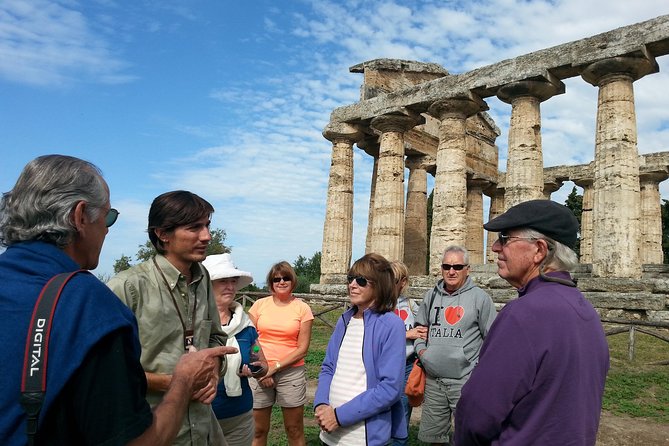
The experience is private, so you are not squeezed into a big group rhythm. That matters because archaeology rewards attention, not speed. You can ask questions, and the guide can tailor explanations to what your group is most curious about.
And yes, English is covered. The guide approach in the reviews was clear, engaging, and easy to follow, including using diction that lands well when you are standing among wind and stone.
Meeting at the Paestum Archaeological Park, then getting right to it
You start at the Archaeological Park of Paestum, Via Magna Graecia, 919, 84047 Capaccio Paestum SA, Italy. The activity ends back at the same meeting point, so you are not dealing with an awkward drop-off or a second transit step.
The tour uses a mobile ticket, which is handy if you do not want to juggle paper while you are navigating sites and ticket lines. Also, the meeting point is near public transportation, which is useful if you are coming from Salerno or another nearby stop.
The duration is about 2 hours, split into 1 hour 30 minutes at the archaeological area and 30 minutes in the museum. That pacing is realistic. It gives you enough time to see the big pieces without turning the visit into a marathon.
Stop 1: Parco Archeologico di Paestum e Velia temples, Heroon, and Roman layers
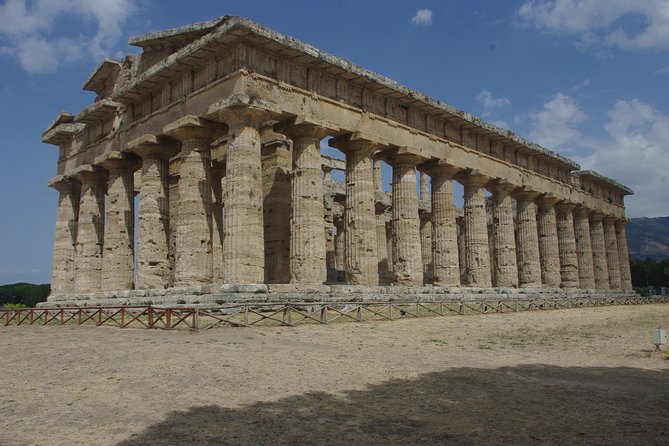
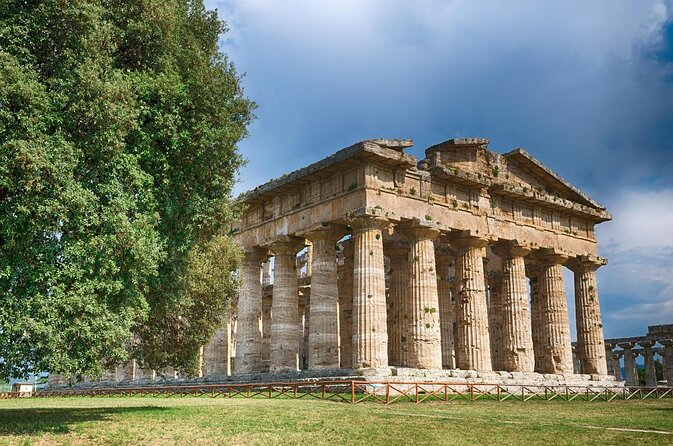
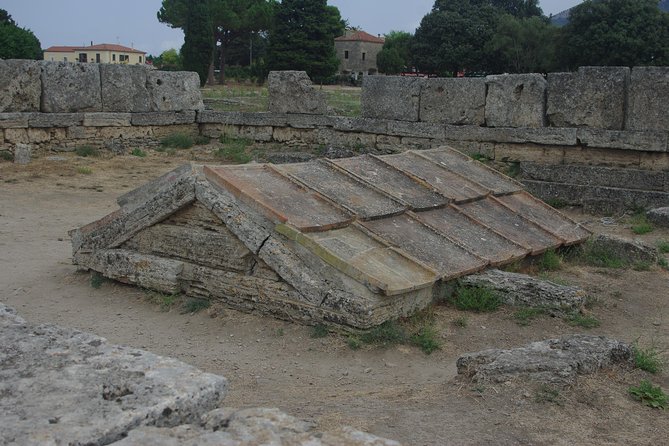
This first stop is where the tour does its main work, because it orients you in space and time. During the visit of the archaeological area, the guide shows the ruins of the temples, plus the Heroon, the Roman Forum, and a Roman residential area.
Temples, seen with purpose
Walking through ruins is one thing. Understanding what you are looking at is another. You will get explanations tied directly to the temple ruins, which helps you connect architecture to how people used these places.
Even if you know nothing about ancient cities, the guide language is meant to make the shapes meaningful. You learn what each area represents, not just that it is old stone.
The Heroon, the tomb of the mythical founder
The Heroon is the star for people who like stories with a backbone. The tour explains it as the tomb of the mythical founder, the Hero of the Greek city. That detail matters, because it turns a specific structure into a clue about identity and belief.
This is the kind of stop where a good archaeologist makes you slow down. You start noticing what is positioned where, and why a tomb is not just a burial site, but a statement.
Roman Forum and the residential area
Then the tour moves into the Roman layer of the site, including the Roman Forum and a Roman residential area. This shift is valuable because it is not one culture presented in isolation. You see how the narrative changes when Roman public space and everyday living come into view.
If you like comparisons, this section is especially satisfying. You are not guessing at what is civic and what is domestic, because the guide points to what those spaces represent.
A practical comfort note
This stop lasts 1 hour 30 minutes. The reviews highlight that the guide made sure explanations happened in the shade when possible. If you are traveling in warmer months, that detail is more than a nice touch. It helps you stay focused instead of constantly fighting the sun.
One drawback to keep in mind: the tour needs good weather. If conditions are poor, you may be offered a different date or a full refund. Ruins are great in the right light, but you cannot power through rain with enthusiasm alone.
Stop 2: Paestum’s National Archaeological Museum, from Hera to tomb paintings
After the outdoor sequence, you move to the Museo Archeologico Nazionale Di Paestum for 30 minutes. This is a shorter stop, but it is packed with high value because it explains objects tied to the temples and rituals you saw outside.
The stone frieze of the temple of Hera
One of the key things you will hear about is the stone frieze that decorated the temple of Hera. A frieze is easy to overlook if you are just looking at structures from afar. In the museum, the guide can zoom in with explanation, so the decorative element becomes more than an aesthetic detail.
This is a great way to learn how temple design and religious meaning connect, using an artifact that is specific, not vague.
Offerings for gods
You also learn about artifacts produced as offerings for gods. That kind of detail changes how you interpret finds. Instead of thinking, someone left something here, you get a clearer sense of why objects ended up in these sacred contexts.
If you like the human side of archaeology, these explanations are often what stick. People did not just build places. They brought items with purpose.
Roman armor and weapons of Roman warriors
Another standout topic is Roman armor and weapons of Roman warriors. This is not just about violence or cool artifacts. It gives you another handle on Roman life, now expressed through material culture.
Seeing armor and weapons while also hearing about the Roman Forum and residential area creates a more complete picture of how Roman presence showed up across the site.
Painting tombs
The museum visit also covers painting tombs. This is particularly useful after you have been shown the Heroon outdoors. Tombs are where belief and identity get most personal, and the guide connects the dots without requiring you to be an expert.
Even with only 30 minutes, this museum stop is structured to hit the meaningful objects that support the outdoor story.
Why this guide approach really matters at Paestum
The difference here is not simply that you get facts. You get structure. Archaeological sites can be hard because you are standing in the middle of layers, and your brain wants to treat them as one scene. A strong archaeologist helps you sort the layers and understand what each area is telling you.
In the reviews, Lucia is singled out for making that work click. She is described as knowledgeable, polite, engaging, and clear in English, with strong diction. The shade-aware pacing is also mentioned, which is a practical touch that keeps the visit pleasant instead of exhausting.
That tone matters. You are not being dragged through a checklist. You are guided through a narrative with real explanations tied to specific areas and objects.
Price and value for a private group up to 8
The price is $313.07 per group, up to 8 people. For a private archaeological experience, that is the real value equation: you are paying for expert interpretation and a tour format that fits your group size, not just a seat.
One important note: the €15 entrance fee per person for the Paestum Archaeological Park is not included. The museum entrance is also not listed as included in the tour price. So, when you budget, count on separate entry costs for each person you bring.
If you split the cost across a full group of 8, the per-person tour portion becomes much easier to justify. If you are coming as a smaller party, the tour can still be worth it, especially if you care about understanding what you see. For Paestum, the guide is often the difference between a quick look and a visit that sticks.
Also, this tour is often booked about 26 days in advance on average. That timing suggests limited availability, so booking earlier is a smart move if your schedule is fixed.
Who should book this Paestum tour
This is a great fit if you:
- Want a private experience focused on archaeology, not general sightseeing
- Like clear explanations tied to specific places and objects
- Prefer a manageable 2-hour visit with a museum connection
- Are traveling with friends or family and want one expert guiding everyone
It may be less ideal if you:
- Want a fully self-guided walk with no structured explanations
- Are traveling without flexibility, because the experience depends on good weather
The good news is that most travelers can participate, and service animals are allowed. The tour also sits near public transportation, which can help you plan without stress.
Should you book? My practical take
Book it if your goal is understanding Paestum, fast and clearly. The combination of Parco Archeologico di Paestum e Velia plus the National Museum is the key. You see the ruins first, then you learn the objects that give those ruins meaning.
If you are on the fence, here is the decision shortcut I would use: if you are the type who enjoys hearing what a place actually is, not just that it exists, this tour will pay off. If you are just chasing photos and prefer to wander, you might do fine without a guide.
Either way, plan for the €15 per person entry fee for the archaeological park, and remember the tour needs decent weather. Get those two things right, and you will be set for a strong, structured visit.
FAQ
What is included in the private tour?
The tour includes an expert local archaeologist. You also receive a mobile ticket for the experience. Entrance fees are not included.
How long is the tour?
The tour is about 2 hours (approximately). It includes about 1 hour 30 minutes at the archaeological area and 30 minutes at the National Archaeological Museum.
Is the entrance fee included?
No. The Paestum Archaeological Park entrance fee is €15.00 per person and is not included in the tour price. The museum entrance is also listed as not included.
Is the tour private and in English?
Yes, it is private. Only your group participates. The tour is offered in English.
Where do we meet for the tour?
You meet at the Archaeological Park of Paestum, Via Magna Graecia, 919, 84047 Capaccio Paestum SA, Italy. The tour ends back at the same meeting point.
What happens if the weather is poor?
This experience requires good weather. If it is canceled due to poor weather, you will be offered a different date or a full refund.
Just Your Group
- Private Boat Excursion to the Amalfi Coast★ 5.0 · 142 reviews
- Private boat tour of the Amalfi coast or Capri★ 5.0 · 106 reviews
- Private 40hp Boat Tour of the Amalfi Coast and Positano★ 4.5 · 81 reviews
- Private Lesson on the Ceramic Tradition in Vietri sul Mare★ 5.0 · 66 reviews
- Paestum: Private Tour of Greek Temples and Archaeological Museum★ 5.0 · 60 reviews
More Tours in Salerno
- Amalfi Coast Boat tour Small Group★ 5.0 · 501 reviews
- From Salerno: Small Group Amalfi Coast boat tour with stops in Positano & Amalfi★ 5.0 · 291 reviews
- From Salerno: Pompeii Guided Walking Tour★ 4.5 · 235 reviews
- Paestum Small Group Tour with an Archaeologist★ 5.0 · 189 reviews
- Boat tour of the Amalfi Coast with Aperitif★ 5.0 · 170 reviews
More Tour Reviews in Salerno
- Salerno: Amalfi Coast Cruise with Lunch, Aperitif & Swimming★ 4.5 · 879 reviews
- Small-Group Amalfi Coast Day Cruise from Positano★ 5.0 · 678 reviews
- Amalfi Coast Boat tour Small Group★ 5.0 · 501 reviews
- From Salerno: Day Trip to Amalfi Coast by Boat with Drinks★ 4.9 · 374 reviews
- From Salerno: Small Group Amalfi Coast boat tour with stops in Positano & Amalfi★ 5.0 · 291 reviews
More ways into Private.
 ★ 5.0Capri & Blue Grotto Semi Private Boat Day Trip from SorrentoFrom $2162,053 reviews
 ★ 5.0Private Amalfi Coast Day Tour from Sorrento or NaplesFrom $3531,059 reviews
 ★ 5.0Full Day Private Amalfi Coast Tour from Sorrento or NaplesFrom $328803 reviews
 ★ 4.9Pompeii Ruins Private Tour with Optional Skip-the-Line EntryFrom $254732 reviews
 ★ 5.0Private Capri Boat Tour – Top SellerFrom $1,922678 reviews
 ★ 5.0Pompeii private tour with an Official GuideFrom $107631 reviews
 ★ 5.0Private / Small Group at “Quanto Basta” School in Sorrento centerFrom $181574 reviews
 ★ 5.0Pompeii Private Tour with an Archaeologist and Skip The Line – 3 hoursFrom $302564 reviews