
REVIEW · AMALFI COAST TOURS
Private Pompeii & Ravello Day Trip via Amalfi Coast (Tickets)
Pompeii feels different when you have your own guide. This private day trip strings together Roman ruins, Amalfi Coast viewpoints, and the calm heights of Ravello, with hotel pickup and a driver who keeps things moving. I especially like the option to see Pompeii at your pace or upgrade for a licensed guide, and I love that the drive includes live commentary, so you’re not stuck staring out the window while the coastline flies by.
One thing to plan for: it’s a long day with lots of road time, and coastal traffic can steal minutes from town stops, especially if you’re going on busier days.
Key things that make this day trip work
- Hotel pickup plus an all-day driver means you don’t waste time figuring out trains, buses, or parking.
- Flexible Pompeii approach lets you go self-guided or add a Blue Badge guide for context and better flow.
- Real neighborhood stops at Pompeii (Forum, bathhouses, markets, houses) turn the site into a walkable city, not just photos.
- Amalfi Coast scenic driving with viewpoints gives you the “how on earth do they build here?” effect without stress.
- Ravello time for wandering keeps the day balanced, not just ruins and roadside stops.
- Villa gardens are included as short stops so you get the signature views without losing the whole morning.
Private pickup and why the full-time driver is the real value
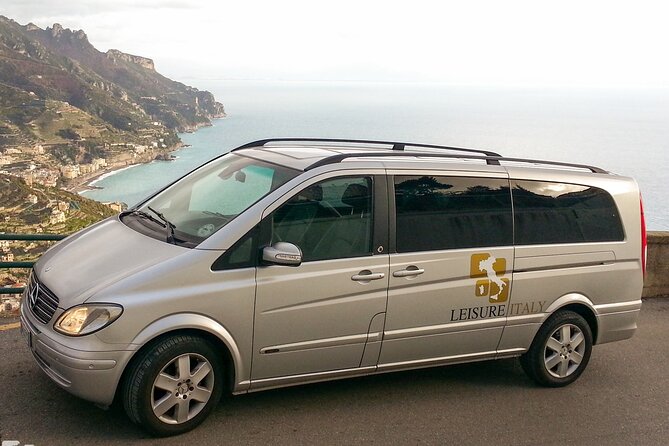
At this price point, you’re not paying just for tickets. You’re paying for a stress-free day. The big win is private transportation with an English-speaking driver plus hotel pickup from places like Naples, Sorrento, Pompeii, and even cruise ports or the airport.
That matters because Pompeii and the Amalfi Coast are not “tap in and go” spots. Roads are narrow, traffic can be unpredictable, and the coastline requires constant attention. An all-day driver also means you can keep your plan flexible. In real life, that flexibility is what keeps the day from turning into a rushed checklist.
Another underrated perk is live commentary on board. It turns the long drive into part of the experience. You learn why the coast towns look the way they do, how the region’s history ties into what you see at Pompeii, and what to look for when you stop for photos.
If you’re traveling with kids or anyone who doesn’t want to constantly manage logistics, this setup is a big deal. If you want a more relaxed experience where the guide handles timing, meeting points, and route choices, you’re in the right category.
Pompeii at Porta Marina: how the day starts with the right feeling
Your Pompeii visit begins at Porta Marina, one of the city’s ancient gates. Entering at a gate gives you instant perspective. You’re not starting in the middle of ruins with no context. You’re walking into the arrival point that merchants and visitors would have recognized, almost 2,000 years ago.
From there, Pompeii becomes a set of neighborhoods with purpose. The experience is designed so you can understand the city’s layout: civic space, religious space, daily life, and elite homes. Even if you go self-guided, the sequence is strong, and if you add a licensed Pompeii guide, the stories can make the stones feel like they still have routines.
Plan on walking. Pompeii is large, and the route covers major highlights. The good news is that many of the “must sees” sit along a sensible flow, so you spend less energy bouncing around.
The Pompeii stops that make it feel like a living city
Here’s how the key parts of Pompeii land when you’re not racing.
Temple of Apollo near the Forum
The Temple of Apollo is a standout because it reaches back further than most visitors expect. It dates to the 6th century BC and shows the Greek influence that came before Roman rule. You still get the portico rhythm, altar area, and podium that signal importance.
If you’re the type who likes a “why this matters” moment, this is it. The setting also offers a natural relationship between religion and landscape, with views toward Mount Vesuvius from the area around the temple.
The Forum: civic life with volcano in the background
The Forum is Pompeii’s civic core. Today it’s mostly open air and stone outlines, but it’s still the easiest place to imagine public life. You picture negotiations, markets, and movement between temples and civic buildings.
It’s also a quick win for your “wow” factor because you get framed views of Vesuvius from the Forum area. That visual connection is hard to replicate in a museum photo.
Macellum, the food market that explains daily life
The Macellum is one of the most human stops. It was Pompeii’s main food market, and its structure helps you understand how commerce worked. You can see the porticoes, market stalls, storage hints, and a sense of organized selling.
This is where Pompeii stops feeling like a tragedy and starts feeling like a real city with real needs. Food distribution, social chatter, and trade all tie into the bigger picture.
Forum Baths: the daily ritual behind the ruins
The Forum Baths are excellent for anyone who likes the “what did normal people do” question. The rooms and hot plunge sequence are still readable, and the vaulted ceilings and decorations survived better than many spots.
Roman bathing is one of those practices that feels surprisingly modern. You can almost picture the rhythm of changing rooms and warm spaces, the social element, and the engineering that made it work.
Elite homes: House of the Faun and House of the Vettii
Pompeii delivers a strong contrast between everyday life and wealth.
The House of the Faun feels like a palace. It spans a whole block, with courtyards and refined details. You’ll also run into the famous mosaic legacy, including the “Alexander Mosaic” mentioned in the route. It’s a reminder that Pompeii’s elite used art and space as status signals.
The House of the Vettii is a favorite because it’s packed with frescoes. Color survives here in a way that’s easy to understand even if you’re not an art expert. The layout also helps you imagine banquets, business discussions, and daily family life.
Via dell’Abbondanza: the commercial street you can walk
Walking Via dell’Abbondanza is one of the most effective ways to understand Pompeii’s density and daily flow. This street links major areas, and the route highlights stepping stones, water features, and the pedestrian design.
You also get small clues of life that feel like instant snapshots, like faded commercial signs and election posters. It’s a reminder that this wasn’t a museum city. It was a working one.
Teatro Grande and the Antiquarium for scale and context
The Teatro Grande helps you see scale. An open-air theater carved into the slope gives you that “thousands once sat here” feeling, and the acoustics are still meaningful even today.
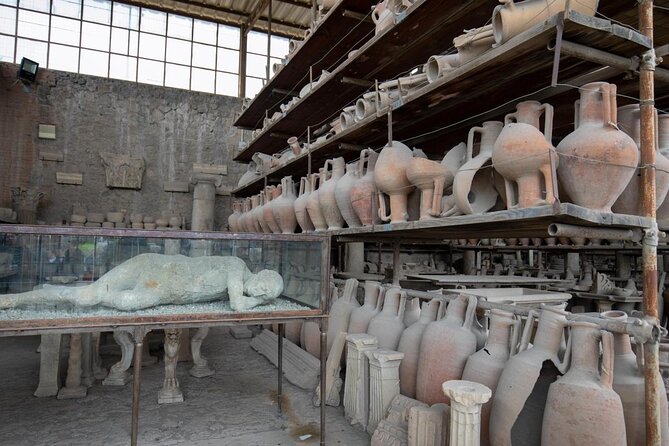
Finish with the Antiquarium if you want to connect the dots. It’s designed to frame what you’ve already seen, with objects, fragments, and plaster casts that tell the story of the city before the eruption and its aftermath through rediscovery.
Pompeii guided or self-paced: how to choose
This tour is built to support both styles.
If you go self-guided, you’ll get the Pompeii time slot and admission ticket included in the Pompeii visit block. You’ll also still benefit from the structured route and the fact that you’re starting at Porta Marina.
If you want more than landmarks, upgrade to the Pompeii option with a Blue Badge guide. The key value is interpretation. A guide can connect why the Forum matters, why the baths show Roman engineering, and what fresco scenes mean beyond decoration. It also helps you navigate efficiently.
In past days, guides like Fabrizio and Viviana have been singled out for making the site feel alive and for adapting to families and time limits. If you care about stories and context, that’s the sweet spot.
Either way, wear shoes that can handle uneven stone and long walking.
The Amalfi Coast drive: scenic stops without the hassle
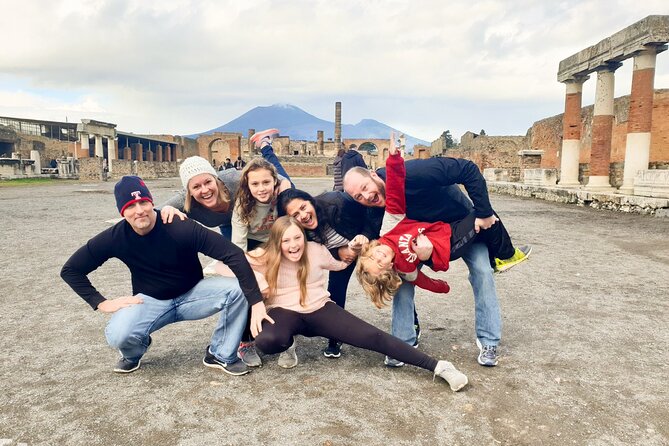
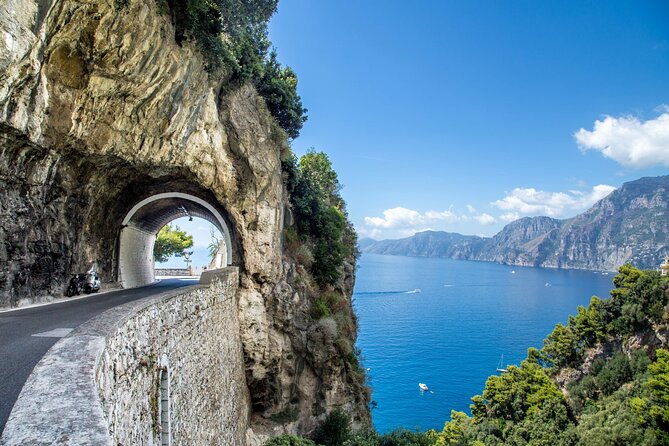
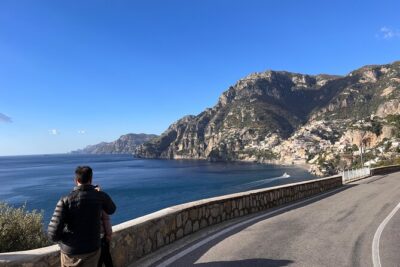
After Pompeii, the day shifts to the coastline. The drive uses the kind of road travelers talk about because it bends through tunnels, terraces, and cliffside towns.
You can expect photo stops and viewpoint moments. This is one of the reasons the full-time driver matters. You get to enjoy the scenery and keep your attention on where to step, not on when you’ll find parking.
If your group enjoys taking pictures, this part can become the most relaxing chunk of the day. You’re not walking in heat for hours, and the coastline changes constantly, so there’s always something new to notice.
Ravello: why the height feels calmer than the sea towns
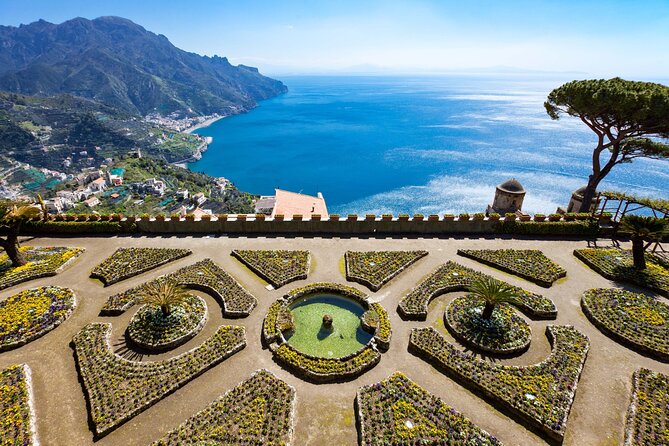
Ravello is the “slow down” section of the day. It sits above the coast on a terrace, so it feels quieter and more refined than the seaside towns down below.
You’ll get about one hour of free time to explore at your own pace. That hour is enough to wander lanes, step into a café, and do the Ravello classic route without feeling trapped by a strict schedule.
The highlight stop is Piazza Duomo, anchored by the 11th-century cathedral. Even if you don’t go inside, it’s a great orientation point. From here, it’s easy to drift through artisan shops and photogenic corners.
If you like an experience that blends small-town charm with big views, Ravello delivers.
Villa Rufolo and Villa Cimbrone: the gardens part of the story
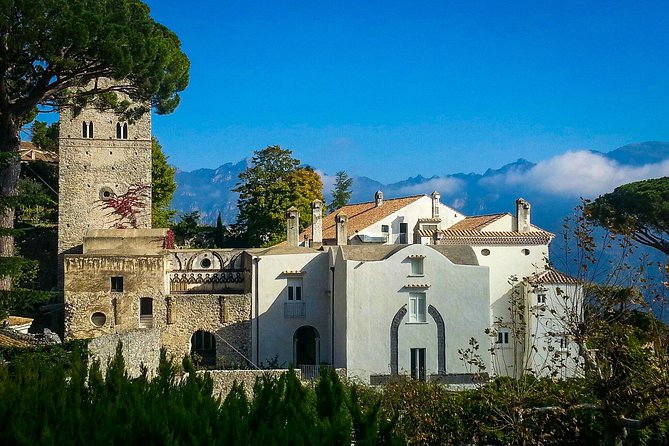
Ravello’s signature experiences include Villa Rufolo and Villa Cimbrone Gardens.
Villa Rufolo (short visit, big payoff)
You’ll have about 15 minutes at Villa Rufolo. The point here is not an all-day garden stroll. It’s a taste of the layered history and the terrace views that made this place famous with Grand Tour artists.
Villa Cimbrone Gardens and the Terrace of Infinity
You’ll have about 30 minutes at Villa Cimbrone Gardens. This is where you get the dramatic panorama and the famous Terrace of Infinity viewpoint. The time window is short, so move with purpose, stop where the view frames best, then enjoy the gardens at a calmer pace.
Both villa stops are “photo and atmosphere” focused. If your group loves long gardens, you might want to add extra time later. If you’re trying to fit a lot into a single day, this timing is smart.
Minori, Maiori, Cetara, and Vietri sul Mare: quick but meaningful coastal variety
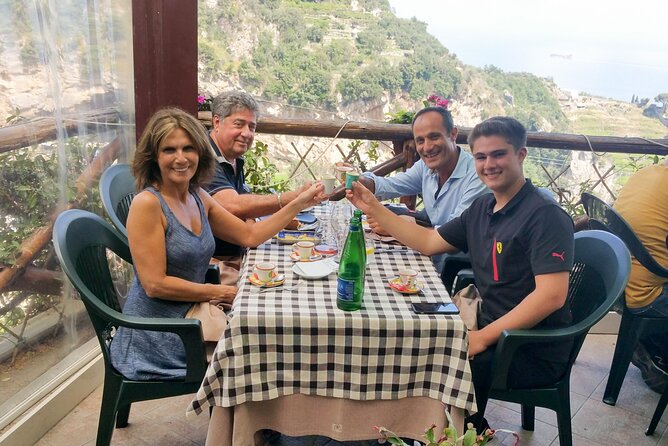
The route adds small towns so the day doesn’t feel like only Ravello and roadside pull-offs.
You’ll pass through or stop in:
- Minori, known as the City of Taste, with a relaxed seaside feel and lemon-and-pasta focus.
- Maiori, with a longer beach area and a breezier vibe than some of the cliff towns.
- Cetara, a fishing village with an authentic working harbor feel.
- Vietri sul Mare, the ceramic gateway, visible even from the road thanks to its bright tilework and domed church.
These stops are short. That’s the tradeoff for squeezing Pompeii and the coast into one day. But even brief moments can change how you remember the region. You see that this coast isn’t one look. It’s many small identities.
Timing, heat, and comfort: what to plan for in real life
This is where you can protect your day.
First, accept that it’s a long day. You’ll spend significant time in the car between Pompeii and Ravello and back down the coast. That’s normal for this route, and it’s why the private driver is part of the value.
Second, think about heat. Pompeii is largely sun, and summer can feel intense. The operator recommends comfortable shoes for Pompeii and sun gear in summertime, and I agree. Bring water if permitted on your day, and wear a hat.
Third, understand that traffic can cut town time. One guide experience highlighted that weekend driving can be slow. If you want more walking time in places like Ravello, choose an earlier schedule when possible and keep expectations realistic.
Finally, use the flexibility. Some groups switch the order to reduce crowds, like doing Amalfi first, then Pompeii later in the day. If you like mornings and prefer afternoons for ruins, ask about a swap. Your driver can often shape the plan around your priorities.
Price and value: what you’re really paying for at $508.61 per person
At $508.61 per person, this is not a budget outing. The value only works if you truly want a private, full-day setup.
What you get for your money:
- Hotel pickup and private transportation
- English-speaking driver
- Live commentary
- Pompeii experience with structured highlights
- Optional upgrade for a Blue Badge Pompeii guide
- A careful pacing plan that tries to avoid you wasting time in transit
If you’re the type who would otherwise hire a car, pay for taxis between stops, and then still struggle with where to start at Pompeii, the private package can be cheaper than you think once you add it up.
If you want to sit on a coach bus with strangers, you can do the trip for less. But the whole point here is control of timing, the ability to tailor the day, and having someone manage the hard parts of logistics.
Should you book this Pompeii and Ravello private day trip?
Book it if you want:
- One private day that covers Pompeii plus the Amalfi Coast feel
- A calmer experience than a large group format
- The option to upgrade Pompeii with a licensed guide
- A balanced mix of big sights (Pompeii and the Forum) and peaceful views (Ravello and the villa gardens)
Skip it or adjust expectations if:
- You hate long drives and prefer a single area
- You’re hoping for lots of free time in many towns
- Your group wants a full beach day instead of a scenic, stops-based route
My practical bottom line: if you’re visiting Naples, Sorrento, or a cruise port and you only have time for one “serious day” inland and along the coast, this is a strong way to spend it. The driver time is the cost, but it’s also what saves your energy so the history and views actually land.
FAQ
How long is the private Pompeii and Ravello day trip?
It runs about 8 to 9 hours.
Where can pickup happen for this tour?
Pickup is offered from Naples, Sorrento, Pompeii, and also from places like train stations, airports, and cruise terminals or ports. You choose your pickup place when booking.
Do I need a guide for Pompeii?
You can visit Pompeii at your own pace, or you can select the option for a private Pompeii guide with a Blue Badge guide. If you choose the Pompeii guide option, you also get Pompeii Express skip-the-line tickets.
Are the Pompeii tickets included?
Pompeii admission is included for the Pompeii visit block. The exact ticket handling can vary based on whether you select the Pompeii guide option, so it’s worth checking the add-ons you select.
Is lunch included?
Lunch is not included.
Is this tour private for my group?
Yes. It’s a private tour, and only your group participates.
More Tour Reviews in Pompeii
- Pompeii Small Group Tour with an Archaeologist★ 5.0 · 6,593 reviews
- Discover the Ancient Ruins of Pompeii: Day Trip from Rome★ 3.5 · 2,247 reviews
- Pompeii and Herculaneum Small Group Tour with an Archaeologist★ 5.0 · 1,350 reviews
- Skip the Line Guided Tour of Pompeii led by an Archaeologist★ 5.0 · 703 reviews
- Pompeii Ticket + Tour with Optional Tasting Experience at Pompeii★ 5.0 · 663 reviews
Higher on the Coast in Ravello
- Full Day Private Tour – Positano Amalfi Ravello or Sorrento★ 5.0 · 41 reviews
- Half Day Tour to Pompeii from Ravello★ 5.0 · 23 reviews
- Transfers from Naples to Sorrento Positano Amalfi Ravello Maiori★ 5.0 · 21 reviews
- Ravello 2-Hour Private Guided Walking Tour★ 5.0 · 18 reviews
- Private Walking tour from Ravello to Amalfi following Escher works★ 5.0 · 5 reviews
Along the Amalfi Road
- Scooter rental on the Amalfi Coast★ 5.0 · 90 reviews
- Official Ape Dolce Vita Tour – Amalfi Coast★ 5.0 · 52 reviews
- Full Day Private Tour of Pompeii and the Amalfi Coast★ 5.0 · 45 reviews
- Private Pompeii & Amalfi Coast Tour: Sorrento & Positano -Tickets★ 5.0 · 33 reviews
- Exclusive Private Tour: Explore Pompeii and the Amalfi Coast★ 5.0 · 29 reviews
More ways into Amalfi Coast Tours.
 ★ 5.0From Naples: Sorrento, Positano & Amalfi Coast – Small Group TourFrom $768,643 reviews
 ★ 4.7From Naples or Sorrento: Amalfi Coast Full-Day TripFrom $1072,043 reviews
 ★ 5.0Full-day Sorrento, Amalfi Coast, Pompeii from Naples or SalernoFrom $1081,561 reviews
 ★ 5.0Full-Day Amalfi Coast Experience from Sorrento, Naples or SalernoFrom $1021,275 reviews
 ★ 4.5Amalfi Coast Day Tour from Sorrento with Light Lunch and WineFrom $1391,148 reviews
 ★ 5.0Private Amalfi Coast Day Tour from Sorrento or NaplesFrom $3531,059 reviews
 ★ 4.9Amalfi Coast: Boat and Snorkeling Tour with Fruit & DrinksFrom $100985 reviews
 ★ 5.0Hands-On Cooking Class & Farmhouse Tour on the Amalfi CoastFrom $156956 reviews
Other useful routes from here