
REVIEW · WALKING TOURS
SALERNO WALKING TOUR
Salerno has layers, and this walk stitches them together. You start at the striking Stazione Marittima by Zaha Hadid, then move into the medieval lanes where Salerno’s past still feels close. The route naturally funnels you toward the Duomo di Salerno, so you end your visit at one of the city’s most important Romanesque stops.
Two things I really like: first, the focus stays on real meaning, not just dates, so the myths, legends, and stories about the Salerno Medical School land fast. Second, you get practical city-reading skills, including a few time-saving tips and a stop at local craft stores that makes the walk feel more like belonging than sightseeing.
One heads-up: the tour is walking heavy and you should be ready for stairs. If sound carries poorly in your group, you may want to position yourself where you can hear clearly.
Key things you’ll notice on this Salerno walk
- Start at Stazione Marittima di Salerno, a modern design landmark that sets the tone
- Piazza della Libertà gives you a city-wide overview, from waterfront to Arechi Castle
- Medieval lanes tied to the Salerno Medical School, with myths and legends along the way
- San Pietro a Corte and Arechi II’s palace setting, a Lombard thread in the story
- Via dei Mercanti leads you to the Duomo, finishing at Romanesque grandeur
- A craft stop breaks up the route, so you see daily local life, not just monuments
Entering Salerno at Stazione Marittima di Salerno, Zaha Hadid’s modern landmark
The tour begins at the Maritime Station entrance, at the Travel Point, which is a smart choice because it gives you an immediate contrast. Salerno’s story isn’t just old stones. It’s also the fact that this port city keeps reinventing itself, even now.
What I like about starting at Stazione Marittima di Salerno is that it “teaches” you how to look at the city. Zaha Hadid’s architecture is bold and angular, and it helps you notice how Salerno has always been a meeting point for people, goods, and ideas. From there, the walking route naturally transitions from sleek, contemporary lines into the tighter rhythms of the historic center.
You’re also in the right mood for the rest of the day. Even if you’re only in town briefly, this opening moment gets you oriented quickly. You’ll be thinking in layers, not in a list of stops.
Piazza della Libertà: the quick panoramic lesson you’ll actually use later
Next you cross Piazza della Libertà, and this is where the walk earns its keep. Instead of wandering blindly through streets, you get a clear overview of what you are seeing. The guide frames the view from the waterfront up toward Arechi Castle and onward to the elegant twentieth-century buildings facing the sea.
This matters more than it sounds. When you later look back at the waterfront or spot the castle from different angles, you’ll already know the “map” in your head. That means you understand what you’re looking at without stopping every ten minutes to re-orient.
If you like photography, this is one of your easiest chances to capture the big picture. If you’re more interested in wandering, it still helps you decide which side streets are worth your time later.
Medieval alleyways and the Salerno Medical School stories
The tour then moves into the medieval city center, where the narrow alleys start doing their job. This is the part where Salerno stops being a place on a postcard and becomes a place with texture. You’re meant to feel how the city connects commerce, learning, and daily life in tight spaces.
A key theme here is the Salerno Medical School, which shaped the city’s reputation for centuries. Even if you know nothing about medieval medicine, the guided approach makes it understandable. You don’t just hear the name. You learn why the setting mattered and how knowledge traveled.
What also helps is the guide’s use of myths and legends. That kind of storytelling can feel fluffy in the wrong hands, but here it functions like a memory tool. It gives the streets a personality, so the route sticks with you after you leave.
You may also notice something practical: guided walking through medieval lanes is less tiring than self-guided wandering. The guide keeps the route moving with purpose, and you’re not constantly second-guessing which turns make sense.
San Pietro a Corte and Arechi II: where Lombard power takes shape
From the medieval lanes, you continue toward San Pietro a Corte, described as the palace of Arechi II, a Lombard prince. Even if you cannot see every detail of the original power structure, the guide gives you the context to read what’s around you.
This stop is valuable because it widens the story beyond one era. Salerno is often discussed for one famous chapter, but the walking route keeps reminding you it was a long-running crossroads. Lombard influence adds a different flavor to what you’re seeing, and it helps you understand why the city’s architectural layers look the way they do.
It’s also one of those places where a good guide can fix the most common problem with sightseeing: seeing something without knowing what it is. Here, you’re not just “passing by a building.” You’re learning why it mattered.
If you’re the kind of person who likes to connect buildings to people, this is a strong moment.
Via dei Mercanti to the Duomo: a route that feels like an old trade line
As you head along Via dei Mercanti, the walk starts to feel like a working artery. The name fits what you’re learning about Salerno as an important commercial hub. Even when you’re in modern streets today, the city still hints at how commerce shaped its layout.
There’s also a human-scale element here. The tour includes a stop at local craft stores, which changes the pace and adds a little contrast to pure monument time. This is the difference between a walk that teaches you buildings and a walk that teaches you people. You get a chance to see local crafts in context, rather than only in souvenir form.
This portion of the walk is also where timing and energy matter. You’re building toward a finale that includes significant interior elements. So it’s worth conserving your energy earlier, then you’ll enjoy the end more.
Duomo di Salerno: Romanesque stops that are worth lingering over
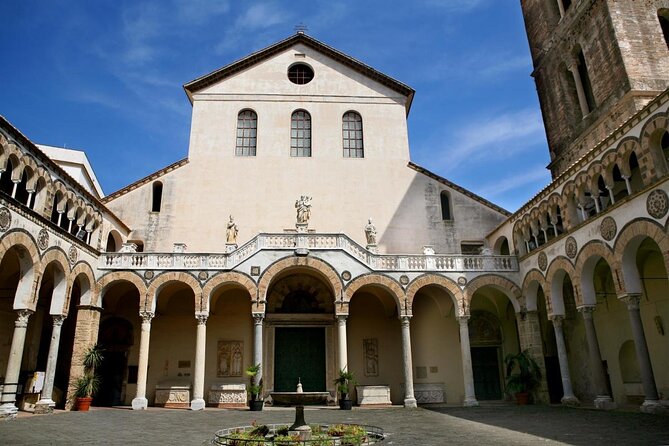
The walk finishes at the Duomo di Salerno, formally tied to Santa Maria degli Angeli, San Matteo, and San Gregorio VII. This is a very important Romanesque monument, and the tour gives you a guided path through the features that matter most.
Here’s what you can expect to focus on:
- The atrium, which sets the tone before you go deeper
- The precious ambos, which are a standout detail many visitors miss without help
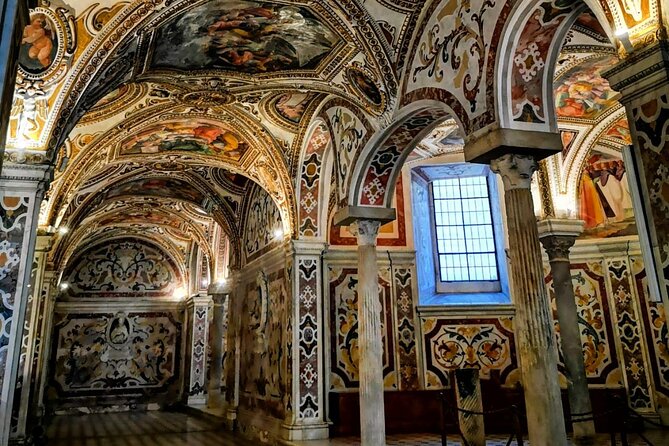
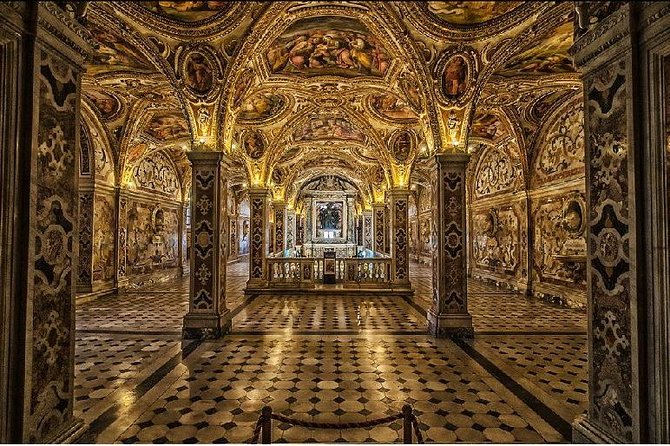
- The crypt dedicated to the Evangelist Apostle St. Matthew, which is the spiritual climax of the visit
The payoff is that you experience the cathedral as a sequence, not as a single big picture. When you understand what you’re looking at, you linger longer naturally. And when you linger longer, you get more out of it, even in a 1.5-hour walking tour.
It’s also a strong finishing point because you end inside a place that clearly connects Salerno’s identity to faith and learning. That connection links right back to the stories you heard earlier about the city’s famed intellectual role.
Price and value: what $53 buys in 1.5 hours
At $53 per person for about 1.5 hours, this is priced as an experience, not a casual stroll. You’re paying for a guided route through the historic center, plus in-depth interpretation and stories that help you understand what you’re seeing.
You do not get entrance fees included, so if you plan to add paid sites on your own, you’ll want to budget separately. But for the value equation, the bigger question is whether guidance helps you get more from the city than you could on your own.
In my view, the answer is yes here, because the walk doesn’t rely on “just look at the building.” It’s built around interpretation: myths, legends, the Salerno Medical School connection, and how power and trade shaped the city. Those are exactly the kinds of details that turn a generic walk into something memorable.
The other value factor is time. If you only have a short window in Salerno, this route gives you a structured way to cover highlights without spending half the tour deciding where to go next.
Walking realities: stairs, pace, and how to hear the guide
This is a walking tour, and it includes areas where you can expect steps. One review note I’d take seriously is that the experience involves stair climbing, so comfortable shoes are non-negotiable.
It’s also worth thinking about listening conditions. In a few small-group situations, it can be hard to hear if you are standing off to the side. If you’re in a group like that, come in with the mindset that you’ll want to move closer to the guide during explanations.
On timing, the duration is set at 105 minutes, so you won’t be dragging your feet for hours. The upside is that the tour stays focused. The downside is that you need to be ready to keep moving at a steady pace.
Language options: English and Italian guiding the same story
The guide offers live commentary in English and Italian. Since you’re learning via storytelling and place interpretation, language matters. Luckily, multiple guide praise points mention strong English, plus extra tips about life and what to do with extra time in Salerno.
One small practical note: some content may be shown in its original language. If you are sensitive to that, you’ll likely still follow the main ideas because the tour is live-guided, but you might see a few moments where you need the guide to translate.
Who should book this Salerno walking tour
This tour is a good fit if you:
- Want a guided introduction to Salerno’s historic center
- Like stories that tie monuments to bigger themes like medicine, trade, and local legend
- Prefer a structured 1.5-hour route when you have limited time
- Appreciate a final cathedral visit that goes beyond a quick exterior photo
It may be less ideal if you:
- Struggle with stairs or long walking stretches
- Need audio support to catch every word, especially in noisier spots
There is also an explicit note that it is not suitable for people over 95 years, so if that matters for your group, check with the operator before booking.
And if you’re the type who likes to ask questions, you may enjoy the way smaller groups can make conversation easier. One experience mentioned a group size as small as four, which can be great for back-and-forth.
Should you book this Salerno walking tour?
I’d book it if you want the fastest path to meaningful Salerno, with a guide who connects the dots from the waterfront and modern station area to medieval lanes and finally the Duomo. For $53, you’re paying for interpretation, not just movement, and that’s what makes this kind of walk worthwhile.
Skip it or consider an alternative if stairs and tight listening spaces are big issues for you, or if you prefer to roam at your own speed with no structured route.
If you’re in Salerno for a short visit, this tour is one of the more efficient ways to get oriented and leave with a real sense of how the city worked, not just what it looks like.
Salerno on Foot
- From Salerno: Pompeii Guided Walking Tour★ 4.5 · 235 reviews
- Walking Tour “Ancient & modern Salerno”★ 5.0 · 68 reviews
- From Salerno: Pompeii Guided Walking Tour with Ticket★ 4.5 · 30 reviews
- Salerno Walking Tour★ 5.0 · 29 reviews
- Discover Salerno: Walking Tour with an Expert Local Guide★ 5.0 · 27 reviews
More Tours in Salerno
- Amalfi Coast Boat tour Small Group★ 5.0 · 501 reviews
- From Salerno: Small Group Amalfi Coast boat tour with stops in Positano & Amalfi★ 5.0 · 291 reviews
- From Salerno: Pompeii Guided Walking Tour★ 4.5 · 235 reviews
- Paestum Small Group Tour with an Archaeologist★ 5.0 · 189 reviews
- Boat tour of the Amalfi Coast with Aperitif★ 5.0 · 170 reviews
More Tour Reviews in Salerno
- Salerno: Amalfi Coast Cruise with Lunch, Aperitif & Swimming★ 4.5 · 879 reviews
- Small-Group Amalfi Coast Day Cruise from Positano★ 5.0 · 678 reviews
- Amalfi Coast Boat tour Small Group★ 5.0 · 501 reviews
- From Salerno: Day Trip to Amalfi Coast by Boat with Drinks★ 4.9 · 374 reviews
- From Salerno: Small Group Amalfi Coast boat tour with stops in Positano & Amalfi★ 5.0 · 291 reviews
More ways into Walking Tours.
 ★ 4.5Walking Food Tour in Sorrento w/ Limoncello Factory Lemon GroveFrom $125821 reviews
 ★ 5.0Guided Walking Tour & Limoncello TastingFrom $41472 reviews
 ★ 4.3Herculaneum: 3D Walking Tour with Skip-the-Line TicketFrom $45313 reviews
 ★ 5.0Capri Walking Tour with local guideFrom $104300 reviews
 ★ 4.8Discover Pompeii: French Walking Tour of the Buried CityFrom $41253 reviews
 ★ 4.5From Salerno: Pompeii Guided Walking TourFrom $94235 reviews
 ★ 5.0Night time Walking Tour & Limoncello TastingFrom $28155 reviews
 ★ 4.6Guided Walking Tour & Street Food ExperienceFrom $55152 reviews
Other useful routes from here